Questions

3 Mark Question

Take a timed test

6 questions · self-marked practice — reveal the answer and mark yourself.

Question 13 Marks
Length of the two parallel sides of a trapezium are 8.5 cm and 11.5 cm respectively and its height is 4.2 cm, find its area.
Answer
Length of the two parallel sides of a trapezium are $8.5 cm$ and $11.5 cm$ and its height is $4.2 cm$.
Area of a trapezium
$=\frac{1}{2} x$ sum of lengths of parallel sides $\times$ height
$=\frac{1}{2} \times(8.5+11.5) \times 4.2$
$=\frac{1}{2} \times 20 \times 4.2$
$=10 \times 4.2$
$=42 sq \cdot cm$
$\therefore$ The area of the trapezium is 42 sq. cm.
View full question & answer
Question 23 Marks
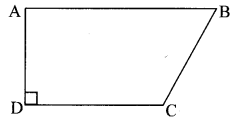
In the given figure, ☐ABCD is a trapezium, side AB || side DC, l(AB) = 13 cm, l(DC) = 9 cm, l(AD) = 8 cm, find the area ☐ABCD.
Image
Answer
$\square A B C D$ is a trapezium, side $A B \|$ side $D C$, $I(A B)=13 cm , I(D C)=9 cm , l(A D)=8 cm$
Area of a trapezium $=\frac{1}{2} x$ sum of lengths of parallel sides $x$ height
$
\begin{aligned}
& \therefore A(\square A B C D)=\frac{1}{2} \times[I(A B)+I(D C)] \times I(A D) \\
& =\frac{1}{2} \times(13+9) \times 8 \\
& =\frac{1}{2} \times 22 \times 8 \\
& =11 \times 8 \\
& =88 \text { sq.cm }
\end{aligned}
$
$\therefore$ The area of $\square ABCD$ is $88 sq . cm$.
[Note: The question is modified.]
View full question & answer
Question 33 Marks
Area of a parallelogram is 83.2 sq.cm. If its height is 6.4 cm, find the length of its base.
Answer
Given, area of a parallelogram $=83.2$ sq.cm, height $=6.4 cm$
Area of a parallelogram $=$ base $\times$ height
$
\begin{aligned}
& \therefore 83.2=\text { base } \times 6.4 \\
& \therefore \text { base }=\frac{83.2}{6.4}=13 cm
\end{aligned}
$
$\therefore$ The length of the base of the parallelogram is $13 cm$.
View full question & answer
Question 43 Marks
If area of a parallelogram is 29.6 sq. cm and its base is 8 cm, find its height.
Answer
Given, area of a parallelogram $=29.6$ sq.cm, base $=8 cm$
Area of a parallelogram $=$ base $\times$ height
$\therefore 29.6=8 \times$ height
$\therefore$ height $=\frac{29.6}{8}=3.7 cm$
$\therefore$ Height of the parallelogram is $3.7 cm$.
View full question & answer
Question 53 Marks
If base of a parallelogram is 18 cm and its height is 11 cm, find its area.
Answer
Given, base = 18 cm, height = 11 cm
Area of a parallelogram = base × height
= 18 × 11
= 198 sq.cm
∴ Area of the parallelogram is 198 sq.cm.
View full question & answer
Question 63 Marks
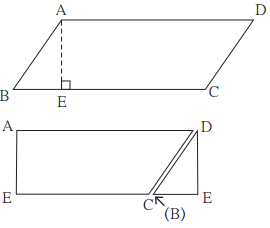
Draw a big enough parallelogram ABCD on a paper as shown in the figure.
Draw perpendicular AE on side BC.
Cut the right angled ∆AEB. Join it with the remaining part of ₹ABCD as shown in the figure.
The new figure formed is a rectangle.
The rectangle is formed from the parallelogram.
So, areas of both the figures are equal.
Base of parallelogram is one side (length) of the rectangle and its height is the other side (breadth) of the rectangle.
∴ Area of a parallelogram = base × height
Image
Answer
Draw a big enough parallelogram ABCD on a paper as shown in the figure.
Draw perpendicular AE on side BC.
Cut the right angled ∆AEB. Join it with the remaining part of ₹ABCD as shown in the figure.
The new figure formed is a rectangle.
The rectangle is formed from the parallelogram.
So, areas of both the figures are equal.
Base of parallelogram is one side (length) of the rectangle and its height is the other side (breadth) of the rectangle.
∴ Area of a parallelogram = Area of a rectangle = length × breadth = base × height
View full question & answer