Questions

5 Mark Question

Take a timed test

8 questions · self-marked practice — reveal the answer and mark yourself.

Question 15 Marks
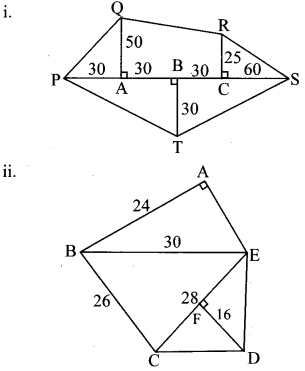
Find the areas of given plots. (All measures are in meters.)
Image
Answer
i. Here, $\triangle Q A P, \triangle R C S$ are right angled triangles and $\square Q A C R$ is a trapezium.
In $\triangle QAP , l ( AP )=30 m , l ( QA )=50 m$
$A (\triangle QAP )$
$=\frac{1}{2} \times$ product of sides forming the right angle
$=\frac{1}{2} \times I(A P) \times I(Q A)$
$=\frac{1}{2} \times 30 \times 50$
$=750 sq \cdot m$
In $\square QACR , l ( QA )=50 m , l ( RC )=25 m$,
$I(A C)=I(A B)+I(B C)$
$=30+30=60 m$
$A (\square QACR )$
$=\frac{1}{2} \times$ sum of lengths of parallel sides $x$ height
$=\frac{1}{2} \times[ I ( QA )+ I ( RC )] \times I ( AC )$
$=\frac{1}{2} \times(50+25) \times 60$
$=\frac{1}{2} \times 75 \times 60$
$=2250$ sq.m
In $\triangle RCS , I ( CS )=60 m , I ( RC )=25 m A (\triangle RCS )$
$=\frac{1}{2} \times$ product of sides forming the right angle
$=\frac{1}{2} \times I ( CS ) \times I ( RC )$
$=\frac{1}{2} \times 60 \times 25$
$=750$ sq. $m$
\begin{aligned}
& \text { In } \triangle PTS , I ( TB )=30 m \text {, } \\
& I(P S)=I(P A)+I(A B)+I(B C)+I(C S) \\
& =30+30+30+60 \\
& =150 m \\
& A (\triangle PTS )=\frac{1}{2} \times { base } \times { height } \\
& =\frac{1}{2} \times I ( PS ) \times I ( TB ) \\
& =\frac{1}{2} \times 150 \times 30 \\
& =2250 sq . m \\
& \therefore \text { Area of plot } QPTSR = A (\triangle QAP )+ A (\square QACR )+ A (\triangle RCS )+ \\
& A (\triangle PTS ) \\
& =750+2250+750+2250 \\
& =6000 sq \cdot m \\
& \therefore \text { The area of the given plot is } 6000 \text { sq.m. } \\
\end{aligned}

\begin{aligned}
& \text { ii. In } \triangle A B E, m \angle B A E=90^{\circ}, I ( AB )=24 m , I ( BE )=30 m \\
& \therefore[ I ( BE )]^2=[ I ( AB )]^2+[ I ( AE )]^2 \\
& \ldots[\text { Pythagoras theorem }] \\
& \therefore(30)^2=(24)^2+[ I ( AE )]^2 \\
& \therefore 900=576+[ I ( AE )]^2 \\
& \therefore[ I ( AE )]^2=900-576 \\
& \therefore[ I ( AE )]^2=324 \\
& \therefore I ( AE )=\sqrt{ } 324=18 m \\
& \ldots[\text { Taking square root of both sides }] \\
& A(\triangle A B E) \\
& =\frac{1}{2} \times \text { product of sides forming the right angle } \\
& =\frac{1}{2} \times I ( AE ) \times I ( AB ) \\
& =\frac{1}{2} \times 18 \times 24 \\
& =216 \text { sq. } m \\
& \text { In } \triangle B C E, a=30 m , b=28 m , C =26 m
\end{aligned}
\begin{aligned}
& \text { Semiperimeter of } \triangle BCE = s =\frac{1}{2}(a+b+c) \\
& =\frac{30+28+26}{2} \\
& =\frac{84}{2} \\
& =42 m \\
& A(\Delta B C E)=\sqrt{s(s-a)(s-b)(s-c)} \\
& =\sqrt{42(42-30)(42-28)(42-26)} \\
& =\sqrt{42 \times 12 \times 14 \times 16} \\
& =\sqrt{2 \times 3 \times 7 \times 2 \times 2 \times 3 \times 2 \times 7 \times 4 \times 4} \\
& =\sqrt{2^2 \times 2^2 \times 3^2 \times 4^2 \times 7^2} \\
& =2 \times 2 \times 3 \times 4 \times 7 \\
& =336 sq . m \\
&
\end{aligned}
In $\triangle EDC , l( CE )=28 m , l( DF )=16 m$
$
\begin{aligned}
A (\triangle EDC ) & =\frac{1}{2} \times \text { base } \times \text { height } \\
& =\frac{1}{2} \times l( CE ) \times l( DF ) \\
& =\frac{1}{2} \times 28 \times 16 \\
& =224 \text { sq. } m
\end{aligned}
$
$\therefore$ Area of plot $A B C D E$
$= A (\triangle ABE )+ A (\triangle BCE )+ A (\triangle EDC )$
$=216+336+224$
$=776$ sq. $m$
$\therefore$ The area of the given plot is 776 sq.m.
[Note: In the given figure, we have taken $I(D F)=16 m$ ]
View full question & answer
Question 25 Marks
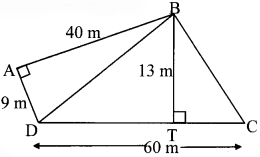
Some measures are given in the figure, find the area of ☐ABCD.
Image
Answer
\begin{aligned}
& A(\square A B C D)=A(\triangle B A D)+A(\triangle B D C) \\
& \text { In } \triangle B A D, m \angle B A D=90^{\circ}, I(A B)=40 m , l ( AD )=9 m \\
& A (\triangle BAD )=\frac{1}{2} \times \text { product of sides forming the right angle } \\
& =\frac{1}{2} \times I ( AB ) \times I ( AD ) \\
& =\frac{1}{2} \times 40 \times 9 \\
& =180 \text { sq. } m \\
& \text { In } \triangle B D C, I ( BT )=13 m , I ( CD )=60 m \\
& A (\triangle BDC )=\frac{1}{2} \times \text { base } \times \text { height } \\
& =\frac{1}{2} \times I (C D) \times I(B T) \\
& =\frac{1}{2} \times 60 \times 13 \\
& =390 \text { sq. } m \\
& A(\square A B C D)=A(\triangle B A D)+A(\triangle B D C) \\
& =180+390 \\
& =570 \text { sq. } m \\
& \therefore \text { The area of } \square A B C D \text { is } 570 \text { sq.m. }
\end{aligned}
View full question & answer
Question 35 Marks
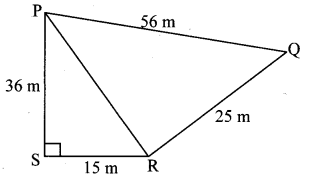
Look at the measures shown in the given figure and find the area of ☐PQRS.
Image
Answer
\begin{aligned}
& A (\square PQRS )= A (\triangle PSR )+ A (\triangle PQR ) \\
& \text { In } \triangle PSR , I ( PS )=36 m , I ( SR )=15 m \\
& A (\triangle PSR ) \\
& =\frac{1}{2} \times \text { product of sides forming the right angle } \\
& =\frac{1}{2} \times I ( SR ) \times I ( PS ) \\
& =\frac{1}{2} \times 15 \times 36 \\
& =270 \text { sq.m } \\
& \text { In } \triangle PSR , m \angle PSR =90^{\circ} \\
& {[ I ( PR )]^2=[ I ( PS )]^2+[ I ( SR )]^2} \\
& \ldots[P y \text { thagoras theorem }] \\
& =(36)^2+(15)^2 \\
& =1296+225 \\
& \therefore I ( PR )^2=1521 \\
& \therefore A ( PR )=39 m \\
& \ldots[\text { Taking square root of both sides }] \\
& \text { In } \triangle P Q R, a=56 m , b =25 m , c =39 m
\end{aligned}

\begin{aligned}
& \text { Semiperimeter of } \triangle PQR = s =\frac{1}{2}( a + b + c ) \\
& =\frac{56+25+39}{2} \\
& =\frac{120}{2} \\
& =60 \\
& \therefore \quad A (\triangle PQR )=\sqrt{ s ( s - a )( s - b )( s - c )} \\
& =\sqrt{60(60-56)(60-25)(60-39)} \\
& =\sqrt{60 \times 4 \times 35 \times 21} \\
& =\sqrt{3 \times 4 \times 5 \times 4 \times 5 \times 7 \times 3 \times 7} \\
& =\sqrt{3^2 \times 4^2 \times 5^2 \times 7^2} \\
& =3 \times 4 \times 5 \times 7 \\
& =420 \text { sq. } m \\
& A (\square PQRS )= A (\triangle PSR )+ A (\triangle PQR ) \\
& =270+420 \\
& =690 sq \cdot m \\
& \therefore \text { The area of } \square \text { PQRS is } 690 \text { sq.m } \\
&
\end{aligned}

View full question & answer
Question 45 Marks
Sides of a triangle are 45 cm, 39 cm and 42 cm, find its area.
Answer
Sides of a triangle are $45 cm , 39 cm$ and $42 cm$.
Here, $a=45 cm , b=39 cm , c=42 cm$
Semi perimeter of triangle $= s =\frac{1}{2}(a+b+c)$
$
\begin{aligned}
& =\frac{1}{2}(45+39+42) \\
& =\frac{126}{2} \\
& =63
\end{aligned}
$
Area of a triangle
$
\begin{aligned}
& =\sqrt{s( s - a )( s - b )( s - c )} \\
& =\sqrt{63(63-45)(63-39)(63-42)} \\
& =\sqrt{63 \times 18 \times 24 \times 21} \\
& =\sqrt{7 \times 9 \times 2 \times 9 \times 2 \times 2 \times 2 \times 3 \times 3 \times 7} \\
& =\sqrt{7^2 \times 9^2 \times 2^2 \times 2^2 \times 3^2} \\
& =7 \times 9 \times 2 \times 2 \times 3 \\
& =756 sq . cm
\end{aligned}
$
$\therefore$ The area of the triangle is 756 sq.cm.
View full question & answer
Question 55 Marks
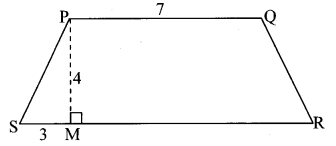
☐PQRS is an isosceles trapezium. l(PQ) = 7 cm, seg PM ⊥ seg SR, l(SM) = 3 cm. Distance between two parallel sides is 4 cm, find the area of ☐PQRS.
Image
Answer
☐PQRS is an isosceles trapezium.
l(PQ) = 7 cm, seg PM ⊥ seg SR,
l(SM) = 3 cm, l(PM) = 4cm
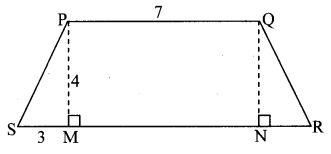
Draw seg QN ⊥ seg SR.
In ☐PMNQ,
seg PQ || seg MN
∠PMN = ∠QNM = 90°
∴ ☐PMNQ is a rectangle.
Image
Opposite sides of a rectangle are congruent.
∴ l(PM) = l(QN) = 4 cm and
l(PQ) = l(MN) = 7 cm
In ∆PMS, m∠PMS = 90°
∴ [l(PS)]² = [l(PM)]² + [l(SM)]² … [Pythagoras theorem]
∴ [l(PS)]² = (4)² + (3)²
∴ [l(PS)]² = 16 + 9 = 25
∴ l(PS) = √25 = 5 cm
…[Taking square root of both sides]
☐PQRS is an isosceles trapezium.
∴ l(PS) = l(QR) = 5 cm
In ∆QNR, m ∠QNR = 90°
∴ [l(QR)]² = [l(QN)]² + [l(NR)]²
… [Pythagoras theorem]
∴ (5)² = (4)² + [l(NR)]²
∴ 25 = 16 + [l(NR)]²
∴ [l(NR)]² = 25 – 16 = 9
∴ l(NR) = √9 = 3 cm
…[Taking square root of both sides]
l(SR) = l(SM) + l(MN) + l(NR)
= 3 + 7 + 3
= 13 cm
Area of a trapezium
$=\frac{1}{2} \times$ sum of lengths of parallel sides x height
$\therefore A (\square PQRS )=\frac{1}{2} \times[ I ( PQ )+ I ( SR )] \times I ( PM )$
$=\frac{1}{2} \times(7+13) \times 4$
$=\frac{1}{2} \times 20 \times 4$
$=40 sq . cm$
$\therefore$ The area of $\square$ PQRS is 40 sq. cm.
View full question & answer
Question 65 Marks
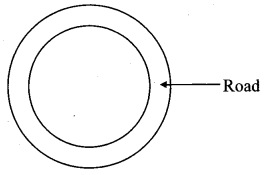
Diameter of the circular garden is 42 m. There is a 3.5 m wide road around the garden. Find the area of the road.
Image
Answer

Image
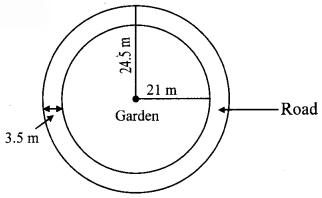
Diameter of the circular garden is $42 m$.... [Given]
$\therefore$ Radius of the circular garden $(r)=\frac{42}{2}=21 m$
Width of the road $=3.5 m$...[Given $]$
Radius of the outer circle $(R)$
$=$ radius $(r)+$ width of the road
$=21+3.5$
$=24.5 m$
Area of the road $=$ area of outer circle - area of circular garden
$=\pi R^2-\pi r^2$
$=\pi\left(R^2-r^2\right)$
$=\frac{22}{7}\left[(24.5)^2-(21)^2\right]$
$=\frac{22}{7}(24.5+21)(24.5-21)$
$\ldots . .\left[\because a^2-b^2=(a+b)(a-b)\right]$
$=\frac{22}{7} \times 45.5 \times 3.5$
$=22 \times 45.5 \times 0.5$
$=500.50 sq . m$
$\therefore$ The area of the road is 500.50 sq. $m$.
View full question & answer
Question 75 Marks
If length of a diagonal of a rhombus is 30 cm and its area is 240 sq.cm, find its perimeter.
Answer
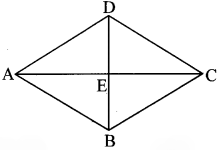
Let ₹ABCD be the rhombus.
Diagonals AC and BD intersect at point E.
l(AC) = 30 cm …(i)
and A(₹ABCD) = 240 sq. cm .. .(ii)
Image
Area of the rhombus $=\frac{1}{2} \times$ product of lengths of diagonal
$
\begin{aligned}
& \therefore 240=\frac{1}{2} \times I ( AC ) \times I ( BD ) \ldots[\text { From (ii)] } \\
& \therefore 240=\frac{1}{2} \times 30 \times I ( BD ) \ldots[\text { From (i)] } \\
& \therefore I ( BD )=\frac{240 \times 2}{30} \\
& \therefore I ( BD )=8 \times 2=16 cm \ldots \text {...(iii) }
\end{aligned}
$
Diagonals of a rhombus bisect each other.
$
\begin{aligned}
& \therefore I ( AE )=\frac{1}{2} I(A C) \\
& =\frac{1}{2} \times 30 \ldots[\text { From (i) }] \\
& =15 cm \ldots \text { (iv) } \\
& \text { and } I ( DE )=\frac{1}{2} l(B D) \\
& =\frac{1}{2} \times 16 \\
& =8 cm \\
& \text { In } \triangle ADE , \\
& m \angle AED =90^{\circ}
\end{aligned}
$
...[Diagonals of a rhombus are perpendicular to each other]
$
\therefore[I(A D)]^2=[ I ( AE )]^2+[ I ( DE )]^2
$
...[Pythagoras theorem]
$\therefore l ( AD )^2=(15)^2+(8)^2 \ldots[$ From (iv) and (v)]
$=225+64$
$\therefore l ( AD )^2=289$
$\therefore I ( AD )=\sqrt{ } 289$
…[Taking square root of both sides]
∴l(AD) = 17 cm
Perimeter of rhombus = 4 × side
= 4 × l(AD)
= 4 × 17
= 68 cm
∴The perimeter of the rhombus is 68 cm.
View full question & answer
Question 85 Marks
If perimeter of a rhombus is 100 cm and length of one diagonal is 48 cm, what is the area of the quadrilateral ?
Answer
Let ₹ABCD be the rhombus. Diagonals AC and BD intersect at point E.
Image
$
\begin{aligned}
& I(A C)=48 cm \ldots(\text { (i) } \\
& I ( AE )=\frac{1}{2} l(A C) \ldots \text {..[Diagonals of a rhombus bisect each other] } \\
& =\frac{1}{2} \times 48 \ldots[\text { From (i)] } \\
& =24 cm \text {...(ii) } \\
& \text { Perimeter of rhombus }=100 cm \text {...[Given] } \\
& \text { Perimeter of rhombus }=4 \times \text { side } \\
& \therefore 100=4 \times l ( AD ) \\
& \therefore I ( AD )=\frac{100}{4}=25 cm \text { (..(iii) } \\
& \text { In } \triangle ADE \\
& m \angle AED =90^{\circ} \ldots \text { [Diagonals of a rhombus are perpendicular to each other] } \\
& \therefore[( AD )]^2=[( AE )]^2+[( DEE )]^2 \ldots[\text { Pythagoras theorem }] \\
& \therefore(25)^2=(24)^2+ I ( DE )^2 \ldots \text { [From (ii) and (iii)] } \\
& \therefore 625=576+ l ( DE )^2 \\
& \therefore l ( DE )^2=625-576 \\
& \therefore l ( DE )^2=49 \\
& \therefore l ( DE )=\sqrt{49} \\
& \text {... [Taking square root of both sides] } \\
& I ( DE )=7 cm \text {...(iv) } \\
& I ( DE )=\frac{1}{2} l(B D) \text {....[Diagonals of a rhombus bisect each other] } \\
& \therefore 7=\frac{1}{2} l(B D) \ldots[\text { From (iv)] } \\
& \therefore l ( BD )=7 \times 2 \\
& =14 cm \text {...(v) } \\
&
\end{aligned}
$
Area of a rhombus
$=\frac{1}{2} \times$ product of lengths of diagonals
$=\frac{1}{2} \times 1( AC ) \times 1( BD )$
$=\frac{1}{2} \times 48 \times 14 \ldots$ [From (i) and (v)]
$=48 \times 7$
$=336 sq . cm$
$\therefore$ The area of the quad rilateral is 336 sq.cm.
Area of a rhombus
$=\frac{1}{2} \times$ product of lengths of diagonals
$=\frac{1}{2} \times I ( AC ) \times I ( BD )$
$=\frac{1}{2} \times 48 \times 14 \ldots$ [From (i) and $( v )$ ]
$=48 \times 7$
$=336 sq . cm$
$\therefore$ The area of the quadrilateral is 336 sq.cm.
View full question & answer