Questions

5 Mark Question

Take a timed test

4 questions · self-marked practice — reveal the answer and mark yourself.

Question 15 Marks
Following figures relate to the weekly wages (in Rs) of 15 workers in a factory: 300, 250, 200, 250, 200, 150, 350, 200, 250, 200, 150, 300, 150, 200, 250.Prepare a frequency table:
  1. What is the range in wages (in Rs)?
  2. How many workers are getting Rs 350?
  3. How many workers are getting the minimum wages?
Answer
The frequency table for the number of accidents per day for a period of 30 days is given below:
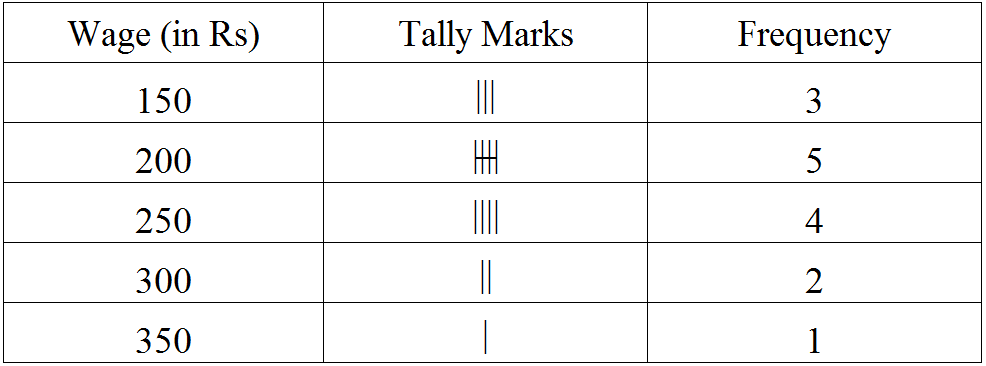
  1. The range of wages (in Rs) is 350-150 i.e. 200.
  2. From the frequency table, we can see that the number of workers earning Rs 350 is 1.
  3. Here, the minimum wage is 150. Hence, the number of workers earning the minimum wage is 3.
View full question & answer
Question 25 Marks
The final marks in mathematics of 30 students are as follows:
53, 61, 48, 60, 78, 68, 55, 100, 67, 90, 75, 88, 77, 37, 84, 58, 60, 48, 62, 56, 44, 58, 52, 64, 98, 59, 70, 39, 50, 60.
Now answer the following:
  1. Arrange these marks in the ascending order, 30 to 39 one group, 40 to 49 second group etc.
  2. What is the highest score?
  3. What is the lowest score?
  4. What is the range?
  5. If 40 is the pass mark how many have failed?
  6. How many have scored 75 or more?
  7. Which observations between 50 and 60 have not actually appeared?
  8. How many have scored less than 50?
Answer
The given raw data can be arranged in an ascending order. The class intervals are 30-39, 40-49, _____ 100-109. Then, take the raw data and place it in the appropriate class intervals.
  1. The marks can be arranged in an ascending order as shown below:
30 to 39 → 37, 39

40 to 49 → 44, 48, 48

50 to 59 → 50, 52, 53, 55, 56, 58, 58, 59

60 to 69 → 60, 60, 60, 61, 62, 64, 67, 68

70 to 79 → 70, 75, 77, 78

80 to 89 → 84, 88

90 to 99 → 90, 98

100 to 109 → 100
  1. The highest score is 100.
  2. The lowest score is 37.
  3. The range is 100-37, i.e. 63.
  4. If 40 is the passing mark, then the number of students who failed is 2 (i.e. 37, 39).
  5. The number of students scoring 75 and above is 8 (i.e. 75, 77, 78, 84, 88, 90, 98, 100).
  6. The marks 51, 54, and 57 do not actually appear between 50 and 60.
  7. The number of students scoring less than 50 is 5 (i.e. 37, 39, 44, 48, 48).
View full question & answer
Question 35 Marks
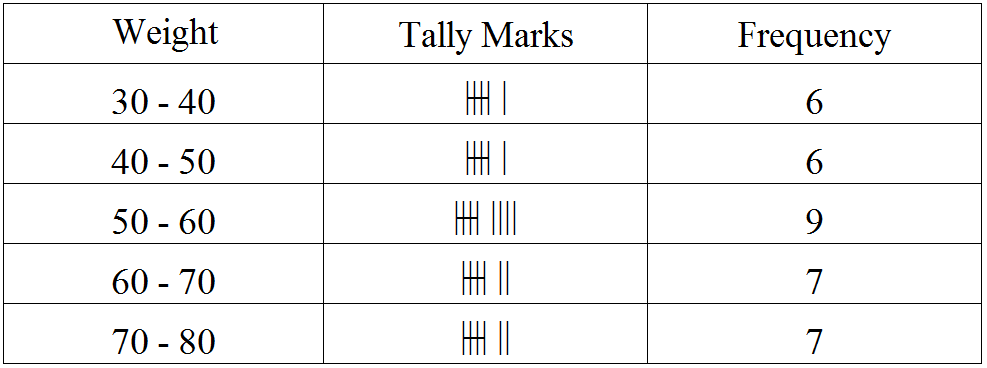
Construct a frequency table for the following weights (in gm) of 35 mangoes using the equal class intervals, one of them is 40-50 (45 not included):
30, 40, 45, 32, 43, 50, 55, 62, 70, 70, 61, 62, 53, 52, 50, 42, 35, 37, 53, 55, 65, 70, 73, 74, 45, 46, 58, 59, 60, 62, 74, 34, 35, 70, 68.
  1. What is the class mark of the class interval 40-45?
  2. What is the range of the above weights?
  3. How many classes are there?
Answer
​​​The frequency table for the given weights (in gm) of 35 mangoes is given below:
  1. Class mark for the class interval 40-45:
Class mark $=\frac{40+45}{2}=\frac{85}{2}=42.5$
  1. Range of the above weights:
Range = Highest value - Lowest value

= 74 - 30

= 44
  1. There are 5 classes (30-40, 40-50, 50-60, 60-70, 70-80).
View full question & answer
Question 45 Marks
The weights of new born babies (in kg) in a hospital on a particular day are as follows:
2.3, 2.2, 2.1, 2.7, 2.6, 3.0, 2.5, 2.9, 2.8, 3.1, 2.5, 2.8, 2.7, 2.9, 2.4.
  1. Rearrange the weights in descending order.
  2. Determine the highest weight.
  3. Determine the lowest weight.
  4. Determine the range.
  5. How many babies were born on that day?
  6. How many babies weigh below 2.5 kg?
  7. How many babies weigh more than 2.8 kg?
  8. How many babies weigh 2.8 kg?
Answer
The frequency distribution of the weights of new born babies in a hospital on a particular day is represented in the following table:
  1. The weights of the newly born babies in descending order are as follows:
Weight
Tally marks
Frequency
3.1
I
1
3.0
I
1
2.9
II
2
2.8
II
2
2.7
II
2
2.6
I
1
2.5
II
2
2.4
I
1
2.3
I
1
2.2
I
1
2.1
I 1
  1. The highest weight is 3.1 kg.
  2. The lowest weight is 2.1 kg.
  3. The range is 3.1-2.1, i.e. 1 kg.
  4. The number of babies born on that day is 15.
  5. The number of babies whose weights are below 2.5 kg is 4 (i.e. 2.4, 2.3, 2.2, 2.1).
  6. The number of babies whose weights are more than 2.8 kg is 4 (i.e. 3.1, 3.0, 2.9, 2.9).
  7. The number of babies whose weight is 2.8 kg is 2.
View full question & answer