Questions

4 Mark Question

Take a timed test

3 questions · self-marked practice — reveal the answer and mark yourself.

Question 14 Marks
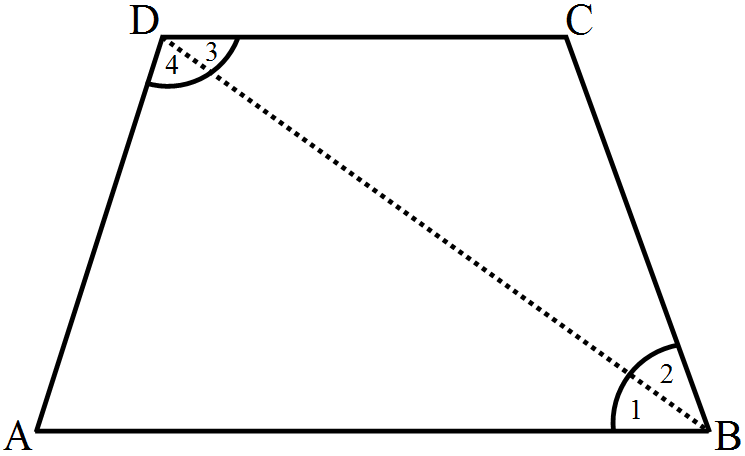
Prove that the sum of the angles of a quadrilateral is 360°.
Answer
Given: ABCD is a quadrilateral,
To prove: $\angle\text{A}+\angle\text{B}+\angle\text{C}+\angle\text{D}=360^\circ$ Construction: Join BD Proof: $\triangle\text{ABD},$ $\angle\text{A}+\angle1+\angle4+\angle3=180^\circ$ Adding we get, $\angle\text{A}+\angle1+\angle4+\angle\text{2}+\angle\text{C}+\angle3$ $=180^\circ+180^\circ$ $\Rightarrow\angle\text{A}+\angle1+\angle2+\angle\text{C}+\angle3+\angle4=360^\circ$ $\Rightarrow\angle\text{A}+\angle\text{B}+\angle\text{C}+\angle\text{D}=360^\circ$ Hence proved.
View full question & answer
Question 24 Marks
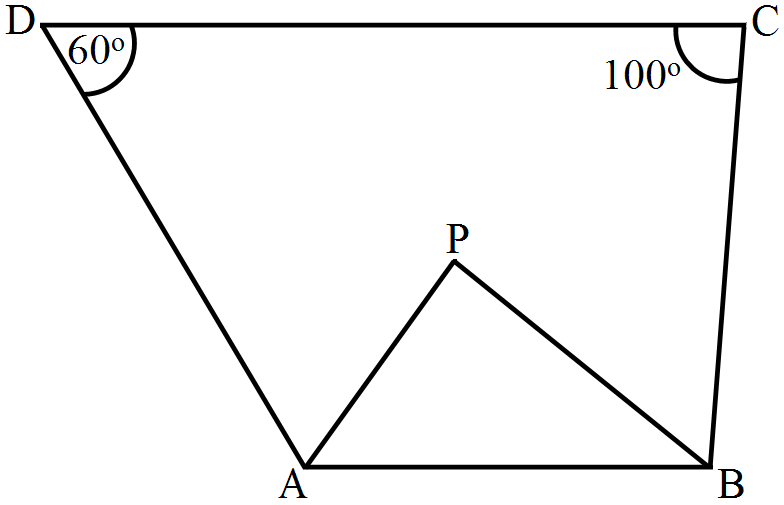
In the adjacent figure, the bisectors of $\angle\text{A}$ and $\angle\text{B}$ meet in a point P. If $\angle\text{C}=100^\circ$ and $\angle\text{D}=60^\circ$ find the measure of $\angle\text{APB}.$
Answer
In quadrilateral ABCD,
$\angle\text{C}=100^\circ,\angle\text{D}=60^\circ$
And $\angle\text{A}+\angle\text{B}+\angle\text{C}+\angle\text{D}=360^\circ$
(Sum of angles of a quadrilateral)
$\therefore\angle\text{A}+\angle\text{B}=360^\circ-(100^\circ+60^\circ)$
$=360^\circ-160^\circ=200^\circ$
But AP and BP are the bisectors of $\angle\text{A}$ and $\angle\text{B},$
$\therefore\frac{1}{2}-(\angle\text{A}+\angle\text{B})=200^\circ\times\frac{1}{2}=100^\circ$
i.e. $\angle1+\angle2=100^\circ$
But in $\triangle\text{APB},$
$\angle1+\angle2+\angle\text{P}=180^\circ$
$\Rightarrow100^\circ+\angle\text{P}=180^\circ$
$\Rightarrow\angle\text{P}=180^\circ-100^\circ=80^\circ$
Or $\angle\text{APB}=80^\circ$
View full question & answer
Question 34 Marks
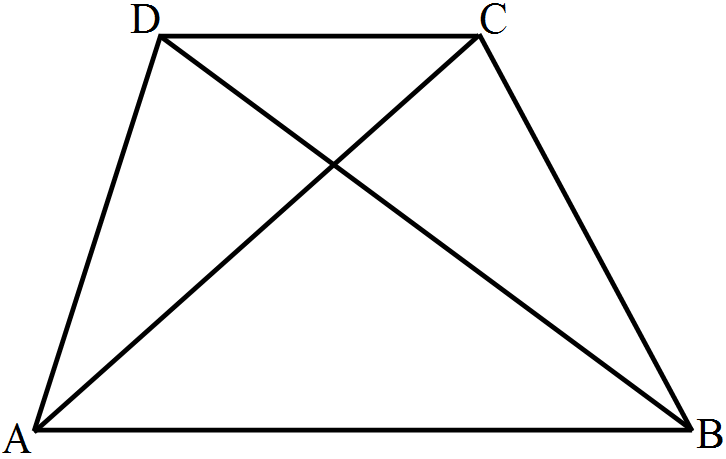
In the adjoining figure, ABCD is a quadrilateral.
  1. How many pairs of adjacent sides are there? Name them.
  2. How many pairs of opposite sides are there? Name them.
  3. How many pairs of adjacent angles are there? Name them.
  4. How many pairs of opposite angles are there? Name them.
  5. How many diagonals are there? Name them.
Answer
  1. There are four pairs of adjacent sides, which are (AB, BC), (BC, CD), (CD, DA) and (DA, AB).
  2. There are two pairs of opposite sides, which are (AB, DC) and (AD, BC).
  3. There are four pairs of adjacent angles, which are $(\angle\text{A},\angle\text{B}),(\angle\text{B},\angle\text{C}),(\angle\text{C},\angle\text{D})$ and $(\angle\text{D},\angle\text{A}).$
  4. There are two pairs of opposite angles, which are $(\angle\text{A},\angle\text{C})$ and $(\angle\text{B},\angle\text{D}).$
  5. There are two diagonals, namely AC and BD.
View full question & answer