Questions

5 Mark Question

Take a timed test

10 questions · self-marked practice — reveal the answer and mark yourself.

Question 15 Marks
A society collected Rs. 92.16. Each member collected as many paise as there were members. How many members were there and how much did each contribute?
Answer
Let M be the number of members.
Let $r$ be the amount in paise donated by each member.
The total contribution can be expressed as follows,
$M x r = Rs$.92.16 = 9216 paise
Since the amount received as donation is the same as the number of members,
$r=M$
Substituting this in the first equation, we get,
$M \times M=9216$
$M^2=2 \times 2 \times 2 \times 2 \times 2 \times 2 \times 2 \times 2 \times 2 \times 2 \times 3 \times 3$
$M^2=(2 \times 2) \times(2 \times 2) \times(2 \times 2) \times(2 \times 2) \times(2 \times 2) \times(3 \times 3)$
$M=2 \times 2 \times 2 \times 2 \times 2 \times 3=96$
To find $r$, we can use the relation $r=M$.
Let M be the number of members.
Let $r$ be the amount in paise donated by each member.
The total contribution can be expressed as follows:
$M \times r=\text { Rs } 92.16=9216 \text { paise }$
Since the amount received as donation is the same as the number of members,
$r=96$
So, there are 96 members and each paid 96 paise.
View full question & answer
Question 25 Marks
Which of the following numbers are squares of even numbers?
121, 225, 256, 324, 1296, 6561, 5476, 4489, 373758
Answer
The numbers whose last digit is odd can never be the square of even numbers. So, we have to leave out 121, 225, 6561 and 4489, leaving only 256, 324, 1296, 5476 and 373758. For each number, use prime factorisation method and make pairs of equal factors.
  1. 256 = 2 × 2 × 2 × 2 × 2 × 2 × 2 × 2
= (2 × 2) × (2 × 2) × (2 × 2) × (2 × 2)

There are no factors that are not paired. Hence, 256 is a perfect square. The square of an even number is always even. Hence, 256 is the square of an even number.
  1. 324 = 2 × 2 × 3 × 3 × 3 × 3
= (2 × 2) × (3 × 3) × (3 × 3)

There are no factors that are not paired. Hence, 324 is a perfect square. The square of an even number is always even. Hence, 324 is the square of an even number.
  1. 1296 = 2 × 2 × 2 × 2 × 3 × 3 × 3 × 3
= (2 × 2) × (2 × 2) × (3 × 3) × (3 × 3)

There are no factors that are not paired. Hence, 1296 is a perfect square. The square of an even number is always even. Hence, 1296 is the square of an even number.
  1. 5476 = 2 × 2 × 37 × 37
= (2 × 2) × (37 × 37)

There are no factors that are not paired. Hence, 5476 is a perfect square. The square of an even number is always even. Hence, 5476 is the square of an even number.
  1. 373758 = 2 × 3 × 7 × 11 × 809
Here, each factor appears only once, so grouping them into pairs of equal factors is not possible. It means that 373758 is not the square of an even number.
Hence, the numbers that are the squares of even numbers are 256, 324, 1296 and 5476.
View full question & answer
Question 35 Marks
Observe the following pattern,
$1=\frac{1}{2}\{1\times(1+1)\}$
$1+2=\frac{1}{2}\{2\times(2+1)\}$
$1+2+3=\frac{1}{2}\{3\times(3+1)\}$
$1+2+3+4=\frac{1}{2}\{4\times(4+1)\}$
and find the values of each of the following:
  1. $1+2+3+4+5+\ .....\ +50$
  2. $31+32+\ ...\ +50$
Answer
Observing the three numbers for right hand side of the equalities:
  • The first equality, whose biggest number on the L.H.S is 1, has 1, 1 and 1 as the three numbers.
  • The second equality, whose biggest number on the L.H.S is 2, has 2, 2 and 1 as the three numbers.
  • The third equality, whose biggest number on the L.H.S is 3, has 3, 3 and 1 as the three numbers.
  • The fourth equality, whose biggest number on the L.H.S is 4, has 4, 4 and 1 as the three numbers.
Hence, if the biggest number on the L.H.S is n, the three numbers on the R.H.S will be n, n and 1.
Using this property, we can calculate the sums for (i) and (ii) as follows:
  1. $1+2+3+\ .....\ +50$
$=\frac{1}{2}\times50\times(50+1)=1275$
  1. The sum can be expressed as the difference of the two sums as follows,
31 + 32 + ...... + 50 = (1 + 2 + 3 + ...... + 50) - (1 + 2 + 3 + ..... + 30)

The result of the first bracket is exactly the same as in part (i)

1 + 2 + ...... + 50 = 1275

Then, the second bracket,

$1+2+\ ....\ +30=\frac{1}{2}(30\times(30+1))=465$

Finally, we have,

31 + 32 + ..... + 50 = 1275 - 465 = 810
View full question & answer
Question 45 Marks
Observe the following pattern,
$2^2-1^2=2+1$
$3^2-2^2=3+2$
$4^2-3^2=4+3$
$5^2-4^2=5+4$
and find the value of,
i. $100^2-99^2$
ii. $111^2-109^2$
iii. $99^2-96^2$
Answer
From the pattern, we can say that the difference between the squares of two consecutive numbers is the sum of the numbers itself. In a formula, $(n+1)^2-(n)^2=(n+1)+n$
Using this formula, we get,
 i.  $100^2-99^2$
$= (99+1)+99$
$= 199$
ii. $111^2-109^2$
$=111^2-110^2+110^2-109^2$
$=(111+110)+(110+109)$
$=440$
iii. $99^2-96^2$
$=99^2-98^2+98^2-97^2+97^2-96^2$
$=99+98+98+97+97+96$
$=585$
View full question & answer
Question 55 Marks
The area of a square field is $5184 cm^2$. A rectangular field, whose length is twice its breadth has its perimeter equal to the perimeter of the square field. Find the area of the rectangular field.
Answer
First, we have to find the perimeter of the square.
The area of the square is $r^2$, where $r$ is the side of the square.
Then, we have the equation as follows,
$r^2=5184=(2 \times 2) \times(2 \times 2) \times(2 \times 2) \times(3 \times 3) \times(3 \times 3)$
Taking the square root, we get $r =2 \times 2 \times 2 \times 3 \times 3=72$
Hence the perimeter of the square is $4 \times r=288 m$
Now let $L$ be the length of the rectangular field.
Let $W$ be the width of the rectangular field.
The perimeter is equal to the perimeter of square. Hence, we have,
$2(L+W)=288$
Moreover, since the length is twice the width,
$L=2 \times W$
Substituting this in the previous equation, we get,
$2 \times(2 \times W+W)=288$
$3 \times W=144$
$W=48$
To find $L$,
$L=2 \times W=2 \times 48=96$
Area of the rectangular field $= L \times W =96 \times 48=4608 m^2$
View full question & answer
Question 65 Marks
Find the square roots of 121 and 169 by the method of repeated subtraction.
Answer
To find the square root of 121,
121 - 1 = 120
120 - 3 = 117
117 - 5 = 112
112 - 7 = 105
105 - 9 = 96
96 - 11 = 85
85 - 13 = 72
72 - 15 = 57
57 - 17 = 40
40 - 19 = 21
21 - 21 = 0
In total, there are 11 numbers to subtract from 121. Hence, the square root of 121 is 11. To find the square are 11 numbers to subtract from 121. Hence, the square root of 121 is 11.
To find the square root of 169.
169 - 1 = 168
168 - 3 = 165
165 - 5 = 160
160 - 7 = 153
153 - 9 = 144
144 - 11 = 133
133 - 13 = 120
120 - 15 = 105
105 - 17 = 88
88 - 19 = 69
69 - 21 = 48
48 - 23 = 25
25 - 25 = 0
In total, there are 13 numbers to subtract from 169. Hence, the square root of 169 is 13.
View full question & answer
Question 75 Marks
Which of the following numbers are perfect squares?
  1. 484
  2. 625
  3. 576
  4. 941
  5. 961
  6. 2500
Answer
  1. $484=22^2$
  2. $625=25^2$
  3. $576=24^2$
  4. Perfect squares closest to 941 are $900\left(30^2\right)$ and $961\left(31^2\right)$. Since 30 and 31 are consecutive numbers, there are no perfect squares between 900 and 961 . Hence, 941 is not a perfect square.
  5. $961=31^2$
  6. $2500=50^2$
Hence, all numbers except that in (iv), i.e. 941 are perfect squares.
View full question & answer
Question 85 Marks
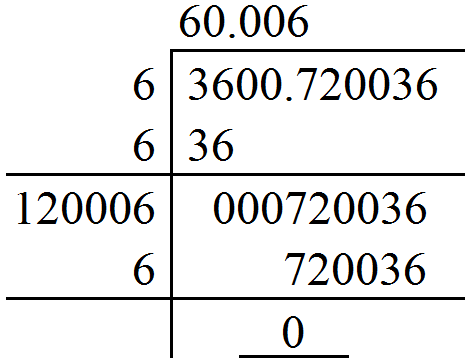
Find the square root in decimal form:
3600.720036
Answer

Hence, the square root of 3600.720036 is 60.006
View full question & answer
Question 95 Marks
Observe the following pattern,
$1^2=\frac{1}{6}\big[1\times(1+1)\times(2\times1+1)\big]$
$1^2+2^2=\frac{1}{6}\big[2\times(2+1)\times(2\times2+1)\big]$
$1^2+2^2+3^2=\frac{1}{6}\big[3\times(3+1)\times(2\times3+1)\big]$
$1^2+2^2+3^2+4^2=\frac{1}{6}\big[4\times(4+1)\times(2\times4+1)\big]$
and find the values of each of the following:
  1. $1^2+2^2+3^2+4^2+\ .....\ +10^2$
  2. $5^2+6^2+7^2+8^2+9^2+10^2+11^2+12^2$
Answer
Observing the six numbers on the R.H.S of the equalities,
  • The first equality, whose biggest number on the L.H.S is 1, has 1, 1, 1, 2, 1 and 1 as the six numbers.
  • The second equality, whose biggest number on the L.H.S is 2, has 2, 2, 1, 2, 2 and 1 as the six numbers.
  • The third equality, whose biggest number on the L.H.S is 3, has 3, 3, 1, 2, 3 and 1 as the six numbers.
  • The fourth equality, whose biggest number on the L.H.S is 4, has numbers 4, 4, 1, 2, 4 and 1 as the six numbers.
Note that the fourth number on the R.H.S is always 2 and the sixth number is always 1. The remaining numbers are equal to the biggest number on the L.H.S
Hence, if the biggest number on the L.H.S is n, the six numbers on the R.H.S would be n, n, 1, 2, n and 1.
Using this property, we can calculate the sums for (i) and (ii) as follows,
  1. $1^2+2^2+\ ....\ +10^2$
$=\frac{1}{6}\times\big[10\times(10+1)\times(2\times10+1)\big]$

$=\frac{1}{6}\times\big[10\times11\times12\big]$

$=385$
  1. The sum can be expressed as the difference of the two sums as follows,
$5^2+6^2+\ ....\ +12^2$

$=(1^2+2^2+\ ....\ 12^2)-(1^2+2^2+\ ....\ +4^2)$

The sum of the first bracket on the R.H.S

$1^2+2^2+\ .....\ +12^2$

$=\frac{1}{6}\big[12\times(12+1)\times(12\times12+1)\big]$

$=650$

The second bracket is,

$1^2+2^2+\ .....\ +4^2$

$=\frac{1}{6}\times[4\times(4+1)\times(2\times4+1)\big]$

$=\frac{1}{6}\times4\times5\times9=30$

Finally, the wanted sum is,

$5^2+6^2+\ .....\ +12^2$

$=(1^2+2^2+\ ....\ +12^2)-(1^2+2^2+\ .....\ +12^2)$

$=650-30=620$
View full question & answer
Question 105 Marks
Which of the following numbers are perfect squares?
$11, 12, 16, 32, 36, 50, 64, 79, 81, 111, 121.$
Answer
  • 11: The perfect squares closest to 11 are $9\left(9=3^2\right)$ and $16\left(16=4^2\right)$.
Since 3 and 4 are consecutive numbers, there are no perfect squares between 9 and 16, which means that 11 is not a perfect square.
  • 12: The perfect squares closest to 12 are $9\left(9=3^2\right)$ and $16\left(16=4^2\right)$.
Since 3 and 4 are consecutive numbers, there are no perfect squares between 9 and 16, which means that 12 is not a perfect square.
  • $16=4^2$
  • 32: The perfect squares closest to 32 are $25\left(25=5^2\right)$ and $36\left(36=6^2\right)$.
Since 5 and 6 are consecutive numbers, there are no perfect squares between 25 and 36, which means that 32 is not a perfect square.
  • $36=6^2$
  • 50 : The perfect squares closest to 50 are $49\left(49=7^2\right)$ and $64\left(64=8^2\right)$.
Since 7 and 8 are consecutive numbers, there are no perfect squares between 49 and 64, which means that 50 is not a perfect square.
  • $64=8^2$
  • 79: The perfect squares closest to 79 are $64\left(64=8^2\right)$ and $81\left(81=9^2\right)$.
Since 8 and 9 are consecutive numbers, there are no perfect squares between 64 and 81, which means that 79 is not a perfect square.
  • $81=9^2$
  • 111: The perfect squares closest to 111 are $100\left(100=10^2\right)$ and $121\left(121=11^2\right)$.
Since 10 and 11 are consecutive numbers, there are no perfect squares between 100 and 121, which means that 111 is not a perfect square.
  • $121=11^2$
Hence, the perfect squares are 16, 36, 64, 81 and 121.
View full question & answer
5 Mark Question - Maths STD 8 Questions - Vidyadip