Questions

Answer the following question.

🎯

Test yourself on this topic

7 questions · timed · auto-graded

Question 13 Marks
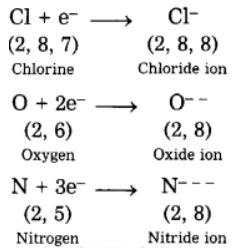
How are non-metal ions formed? Give two examples.
Answer
Non-metals have a tendency to accept electrons in their valence shell to form negatively charged ions called anions.
Examples:

Image

View full question & answer
Question 23 Marks
How do non-metals react with oxygen? Explain with an example.
Answer
Non-metals combine with oxyen to form their oxides.
Non-metal + Oxygen → Non-metal oxide
When carbon burns in air, it combines with oxygen to form carbon dioxide.

Image

View full question & answer
Question 33 Marks
How do metals react with water? Explain with an example.
Answer
Most metals do not react with cold water. But some metals like sodium and potassium react with cold water to form their hydroxides and hydrogen gas.
Sodium reacts with water to form sodium hydroxide.

Image

View full question & answer
Question 43 Marks
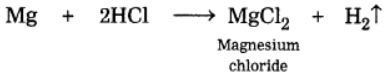
How do metals react with acid? Explain with an example.
Answer
The metals react with dilute acids to form metal salts. Metals liberate hydrogen gas from dilute acids.
Metal + Dilute acid → Metal salt + Hydrogen gas.
Magnesium reacts with dilute HCl to form magnesium chloride and hydrogen gas.

Image

View full question & answer
Question 53 Marks
State the properties of non-metals.
Answer
  1. Non-metals lack lustre.
  2. As non-metals are brittle, they are not malleable.
  3. They are not ductile.
  4. Non-metals are poor conductors of heat and electricity.
  5. At ordinary temperature, non-metals are in the solid or gaseous state. (Exception: Bromine is liquid.)
  6. Non-metals have low density in the solid state.
View full question & answer
Question 63 Marks
State the properties of metals.
Answer
  1. Metals have a lustre.
  2. Metals are malleable. They can be beaten into thin sheets.
  3. Metals are ductile. They can be drawn into wires.
  4. They are good conductors of heat and electricity.
  5. At ordinary temperature, metals are generally solid. (Exception: Mercury is liquid.)
  6. Metals usually have high density.
View full question & answer
Question 73 Marks
What are the adverse effects of i corrosion?
Answer
  1. A reddish coloured deposit (rust) is formed on iron by reaction with oxygen gas.
  2. A greenish coloured deposit (copper carbonate) is formed on copper by reaction with carbon dioxide.
  3. A blackish coloured deposit is formed (silver sulphide) on silver.
  4. Corrosion causes damages to car bodies, bridges, iron railings, ships specially those of iron, silver articles and copper vessels.
View full question & answer
Answer the following question. - Science STD 8 Questions - Vidyadip