Questions

Question Answer (5 Marks)

🎯

Test yourself on this topic

12 questions · timed · auto-graded

Question 15 Marks
Differentiate between internal fertilization and external fertilization. What type of fertilization takes place in?
  1. Frog, and
  2. Fox?
Answer
Differences between internal fertilization and external fertilization:
Internal fertilization External fertilization
It takes place inside the female body. It takes place outside the female body.
Example: Human being. Example: Human being.
  1. In frog, external fertilization takes place.
  2. In fox, internal fertilization takes place.
View full question & answer
Question 25 Marks
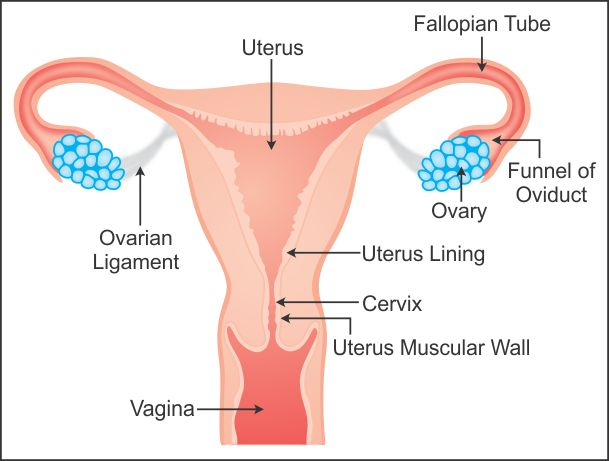
Draw a labeled diagram of the human female reproductive system.
  1. Where in the human body does an egg (or ovum) get fertilized?
  2. Where does a fertilized egg (or zygote) develop into a baby in the human body?
Answer
The diagram of the human female reproductive system is shown below:
  1. In the human body, an egg (or ovum) gets fertilized in the fallopian tubes.
  2. The fertilized egg (or zygote) develops into a baby in the uterus of the human body.
View full question & answer
Question 45 Marks
Describe the various steps involved in the sexual reproduction in animals.
Answer
Following steps are involved in the process of sexual reproduction in an animal:
  1. In the animal, male parent produces male gametes called sperms. Millions of sperms are produced by testes.
  2. The female parent produces female gamete called ova (eggs). Like a sperm, an egg is also a single cell.
  3. The next step is fertilization. In this step, sperm enters the ovum and fuses with it to form a new cell called zygote. The zygote is the beginning of a new individual.
  4. In this step, zygote begins to develop into an embryo. The zygote divides repeatedly to form a large number of cells and ultimately the zygote grows and develops to form a baby.
View full question & answer
Question 55 Marks
X and Y are the two types of animals. The animals like X undergo external fertilization whereas animals like Y undergo internal fertilization. The animals like X lay eggs from which baby animals are hatched. On the other hand, in animals like Y, the young one develops inside the uterus of mother which then gives birth to the baby.
  1. What is the general name of animals like X?
  2. Give two examples of animals like X?
  3. What is the general name of animals like Y?
  4. Write the names if two animals like Y.
Answer
  1. General Name of Animals Like X is Oviparous. Oviparous animals are those which reproduce by laying eggs. The young ones develop inside the eggs.
  2. Examples of Animals like X are Frog, Fish and Star Fish etc.
  3. General Name of Animals Like Y is Viviparous. Viviparous animals are those animals in which the young ones develop inside the uterus of the mother.
  4. Examples of Animals like Y are Human beings, cattle, etc.
View full question & answer
Question 65 Marks
Explain how, chicks are born. How much time does the embryo present in hen’s egg take to develop into a chick (when provided sufficient warmth)?
Answer
In hens, internal fertilization take place but they do not give birth to chicks like human beings. After fertilization, the zygote divides repeatedly to form embryo which travels down the oviduct. As it travels down, many protective layer are formed around it.
The outermost protective layer is hard shell which we can see in a hen’s egg. After the hard shell is formed around the developing embryo, the hen finally lays the egg. The hen, then sits on the egg to provide sufficient warmth to the eggs for the development of the embryo into the chicks. The embryo takes about 3 weeks to develop into a complete chick.
View full question & answer
Question 75 Marks
Give five example each of animals which develop:
  1. Inside the mother.
  2. Inside eggs which the mother lays.
Answer
  1. The animals which give birth to young one are called viviparous animals. In such animals, the baby develops inside the body of the mother.
Examples of Viviparous animals: Human beings, cat, dog, cow, tiger.
  1. The animals that reproduce by laying eggs are called oviparous animals. In such animals, the baby develops inside eggs that the mother lays.
Examples of Oviparous animals: Frog, sparrow, lizard, hen, fish, butterfly.
View full question & answer
Question 85 Marks
The animal A which is classified as an amphibian lays eggs in pond water. The hatching of its eggs produces a tailed-form B which looks very different from the animal A. The form B then undergoes a change C and gets converted into animal A.
  1. Name (i) animal A and (ii) form B.
  2. What is the change C known as?
  3. Name the breathing organs of A.
  4. What are the breathing organs of B?
Answer
  1. Animal A is Frog and form is Tadpole.
  2. The change from Tadpole to Frog is called as Metamorphosis.
  3. Since, A is Frog, hence the breathing organ of Frog is Lungs.
  4. Since, B is Tadpole. The breating organ of Tadpole is gills.
View full question & answer
Question 95 Marks
What is meant by the terms ‘internal fertilization and ‘external fertilization’? Explain with example.
Answer
Internal fertilization: Fertilization which takes place inside the female body is called internal fertilization. Internal fertilization occurs in many animals including humans, cows, dogs and hens.
External fertilization: This type of fertilization in which the fusion of a male and a female gamete takes place outside the body of the female is called external fertilization. It is very common in aquatic animals such as fish, starfish, etc.
View full question & answer
Question 105 Marks
Two very small organisms X and Y both reproduce by the method of budding. Organism X is industrially very important because it is used in making alcohol from sugar. It is also used in making bread. Organisms Y is a tiny animal having tentacles which live in water.
  1. What is organisms X?
  2. Name the process in which X converts sugar into alcohol.
  3. To which class of organism does X belong?
  4. What are organisms Y?
  5. Out of X and Y, which organism is multicellular and which one is unicellular?
Answer
  1. X is Yeast.
Explanation:

Yeasts are unicellular fungi which convert glucose into alcohol through the process of fermentation.
  1. The process in which X converts sugar into alcohol is called Fermentation.
Explanation:

The following chemical reaction takes place:

Yeast + Glucose $\rightarrow$ Alcohol (I) $+ CO _2(g)$.
  1. The organism X i.e. Yeast belongs to the fungi of living organisms.
Explanation:

Yeast is a single-cellular organism which divides by mitosis and shows budding. Fungi have the following characteristics:
  1. They have a cell wall.
  2. They have a nucleus.
  3. They have no chloroplasts.
  1. Organism Y is Hydra.
Explanation:

Hydra is a genus of small fresh-water animals.
  1. Yeast (X) is a unicellular and Hydra (Y) is a Multicellular.
Explanation:

Yeasts are unicellular organisms because they are single-celled organisms.

Hydra are multicellular organisms with complex bodies.
View full question & answer
Question 115 Marks
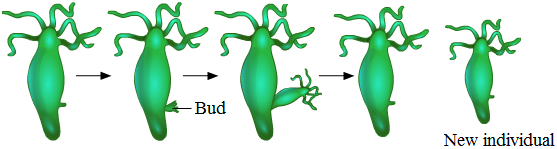
How does a Hydra reproduce? Explain with the help of labeled diagrams.
Answer
Hydra reproduces by budding. In hydra, there may be one or more bulges. These bulges are the developing new individual and they are called buds. This bud then grows gradually to form a small hydra by developing a mouth and tentacles. The tiny new hydra detaches itself from the parent body and become new independent individual.
View full question & answer
Question 125 Marks
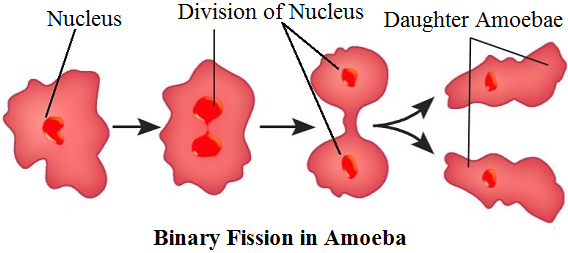
How does an Amoeba reproduce? Describe with the help of labeled diagram.
Answer
Amoeba reproduces by common asexual method called binary fission. In this method, Amoeba cell divides into two equal daughter cells. The nucleus of amoeba first divides into two parts. After that the cytoplasm of amoeba divides into two parts, one part around each nucleus. This leads to the formation of the two daughter Amoebae cell having a nucleus and its own cell organelles.
View full question & answer
Question Answer (5 Marks) - Science STD 8 Questions - Vidyadip