Questions

Question Answer (3 Marks)

🎯

Test yourself on this topic

25 questions · timed · auto-graded

Question 13 Marks
Do all the stars in the sky move? Explain.
Answer
The stars appear to move in the sky. It appears because of the motion of the Earth. Earth is spinning around its own axis and also moves around the Sun. As a result, the stars also appear to move from east to west. A star which rises in the east in the evening, sets in the west in the early morning. All the stars do not appear to move. For example, pole star does not appear to move because it is situated in the direction of earth's axis.
View full question & answer
Question 23 Marks
What is the difference between a meteor and a meteorite?
Answer
Meteor is seen as a bright streak of light coming down the night sky. A meteor is usually a small object that occasionally enters the Earth’s atmosphere with very high speed. The friction due to the atmosphere heats it up and it glows and evaporates quickly. As a result, the bright streak lasts for a very short time. These are commonly known as shooting stars. Meteorites are the large meteors which can reach the Earth before they evaporate completely. Meteorites help scientists in investigating the nature of the material from which the solar system was formed.
View full question & answer
Question 33 Marks
State one important consequence of each of the following:
  1. Rotation of Earth on its axis.
  2. Motion of tilted Earth around the Sun.
Answer
  1. The Earth rotates on its axis taking approximately 24 hours to complete one rotation. Rotation of Earth causes the day night cycle which also creates a corresponding cycle of temperature and humidity.
  2. The plane in which the Earth revolves round the Sun is called the orbital plane of the Earth. The axis of rotation of the Earth is not perpendicular to the plane of its orbit. These two planes are inclined to each other at an angle of 23.5°. This tilt is responsible for the change of seasons on the Earth.
View full question & answer
Question 43 Marks
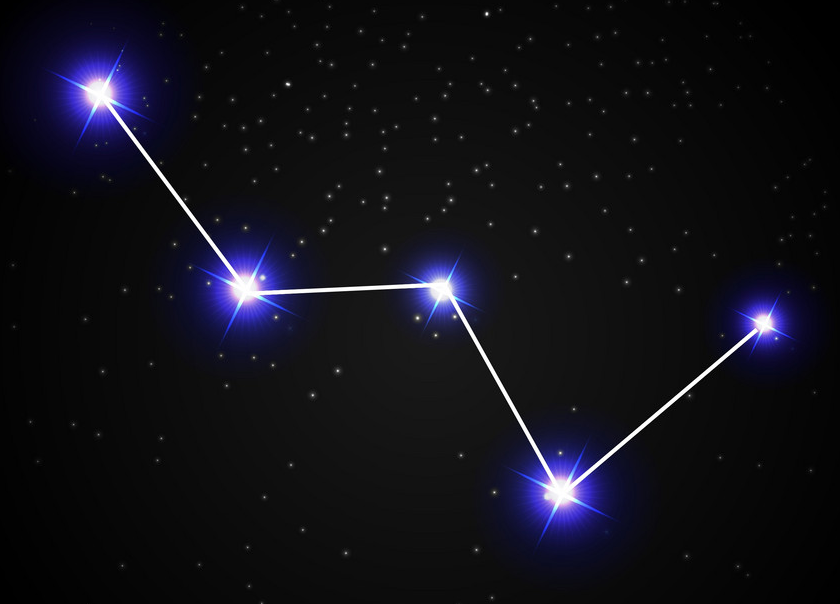
What is the number of main stars in the Cassiopeia constellation? Draw a diagram of Cassiopeia constellation to show the position of main stars in it.
Answer
Cassiopeia is another prominent constellation in the northern sky. It is visible during winter in the early part of the night. It looks like a distorted letter W or M.
View full question & answer
Question 53 Marks
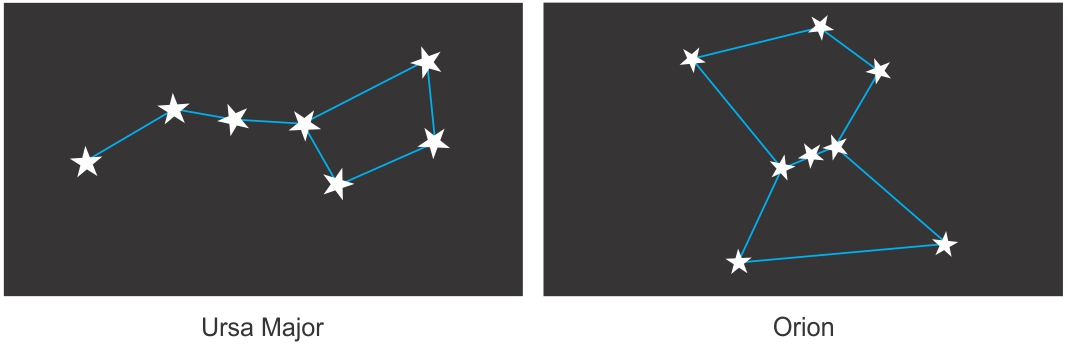
Draw a diagram of the Orion constellation to show the position of prominent stars in it.
Answer
Following is the diagram of Orion and Ursa Major.
View full question & answer
Question 63 Marks
What is Solar System? Name the different types of celestial objects which are members of the Solar System.
Answer
The Sun and the celestial bodies which revolve around it form the Solar System. It consists of large number of bodies such as planets, comets, asteroids and meteors. The Gravitational force keeps the members of the Solar System bound to the Sun. The Sun is the star having a system of planets with one planet called Earth with life on it. Comets are the member of the Solar System which appears in the sky like a bright ball of light with a long glowing tail. Asteroids are the celestial objects which are also called minor planets. Asteroids can only be seen through large telescopes. Meteors are commonly known as shooting stars, although they are not stars. A meteor is usually a small object that occasionally enters the earth’s atmosphere
View full question & answer
Question 73 Marks
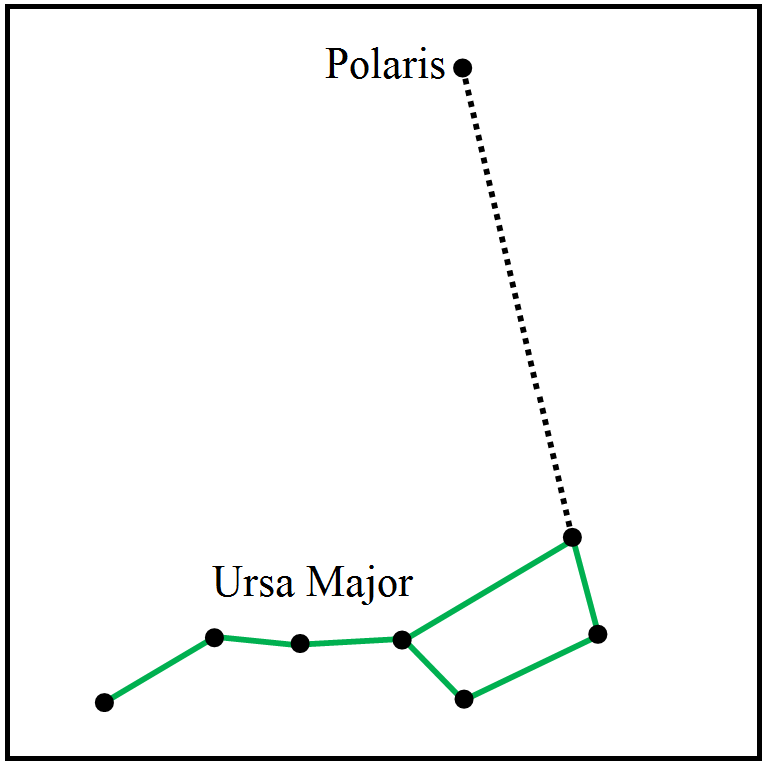
Draw a diagram of Ursa Major constellation to show the position of main stars in it.
Answer
Following is the diagram of Ursa Major constellation.
View full question & answer
Question 83 Marks
What is meant by the phases of the Moon? What causes the phases of the Moon?
Answer
The different shapes of the bright part of the moon as seen during a month are called the phases of the moon. Moon is the natural satellite of the Earth. It revolves around the Earth. It completes one rotation on its axis as it completes one revolution around the Earth. The moon does not have light of its own. We are able to see the moon because the sunlight falling on its surface gets reflected towards us. We, therefore, see only that part of the moon, from which the light of the Sun is reflected towards us. The size of the illuminated part of the moon visible from the Earth increases each day after the new moon day. After the full moon day, the sunlit part of the moon visible from the Earth decreases in size every day. This process leads to the phases of the Moon.
View full question & answer
Question 93 Marks
What are planets? How many planets are there in the Solar System?
Answer
Planets are the members of the Solar System. They look like stars but they do not have light of their own. They reflect the sunlight that fall on them. They keep changing their positions with respect to the stars. A planet revolves around the Sun in a definite path. This path is called an orbit. The time taken by a planet to complete one revolution is called its period of revolution. As the distance of the planet increases from the Sun, the period of revolution increases. A planet also rotates on its axis besides revolving around the Sun. The time taken by the planet to complete one rotation is called its period of rotation. Some planets have moons or satellites revolving around them.
View full question & answer
Question 103 Marks
What is a star? Name the star nearest to the Earth.
Answer
Stars are celestial bodies that emit light of their own. Our sun is also a star. It is convenient to express distances of stars in light years. Stars appear to move from east to west. The pole star appears to be stationary from the Earth, because it is situated close to the direction of the axis of rotation of the Earth. Some groups of stars appear to form recognizable groups known as constellation. The Sun is the star nearest to the Earth. It is the source of almost all energy on the Earth. The Sun is the main source of heat and light for all the planets.
View full question & answer
Question 113 Marks
What is the difference between a full Moon and a new Moon? After how many days a full Moon changes into a new Moon?
Answer
There is a change in the shape of moon every day. There are days when the shape of moon appears perfectly round. Also, there are days when the moon cannot be seen at all even if the sky is clear. The day on which the whole disc of the moon is visible is called the full Moon day. Every night, the size of the bright part of the moon appears to become thinner and thinner. On the fifteenth day, the moon is not visible. This day is called the new Moon day. The next day, only a small portion of the moon appears in the sky. This is known as the crescent moon. Then again, the moon grows larger every day. On the fifteenth day once again we get a full view of the moon. After fifteen days, the full moon changes into a new Moon.
View full question & answer
Question 123 Marks
What is a comet? Name the comet which was last seen in 1986 after a period of 76 years.
Answer
Comets are the member of the Solar System which appears in the sky like a bright ball of light with a long glowing tail. The length of the tail grows in size as it approaches the sun. The tail of a comet is always directed away from the sun. They revolve around the Sun in highly elliptical orbits. The period of revolution of comets around the Sun is usually very long. Many comets are known to appear periodically. Halley's comet appears after nearly every 76 years. It was last seen in 1986.
View full question & answer
Question 133 Marks
Why is it difficult to observe the planet Mercury?
Answer
Mercury is the nearest planet to the Sun. It is the smallest planet of our Solar System. It is very close to the Sun which makes it very difficult to observe. This is because most of the time it hidden in the glare of the Sun. However, it can be observed just before sunrise or just after sunset, near the horizon. Mercury has no satellite of its own.
View full question & answer
Question 143 Marks
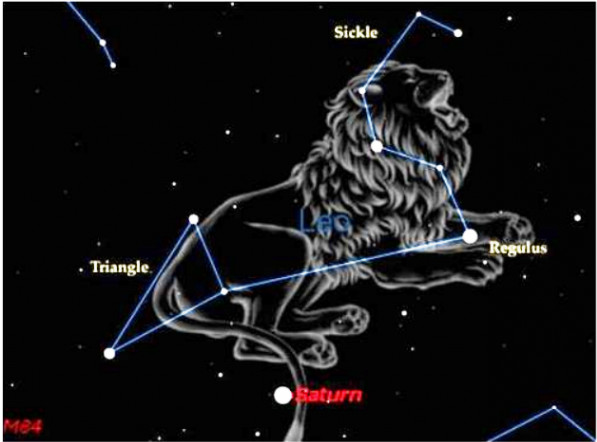
What is the number of main stars in Leo Major constellation? Draw a diagram to show the position of main stars in Leo Major constellation.
Answer
Leo Major appears to have the shape of a big lion. It is visible in the northern hemisphere around the spring. It is easily identifiable through may. Its brightest star is Regulus. Its most prominent pattern of stars is a backwards question mark called the Sickle.
View full question & answer
Question 153 Marks
Moon does not have light of its own. How are we able to see the Moon?
Answer
Moon is the natural satellite of Earth. It revolves around the Earth. The moon completes one rotation on its axis as it completes one revolution around the Earth. The moon does not produce its own light. We are able to see the moon because the sunlight falling on it gets reflected towards us. Therefore, we are able to see only that part of moon, from which the light of the Sun is reflected towards us.
View full question & answer
Question 163 Marks
What is meant by 'celestial objects'? Name any three celestial objects.
Answer
The stars, the planets, the moon and many other objects in the sky are called celestial objects. The moon is the brightest object in the night sky. Stars are celestial bodies that emit light of their own. Our sun is also a star. Moon is the natural satellite of the Earth. The Sun and the celestial bodies which revolve around it form the solar system. These celestial bodies include the planets, comets, asteroids and meteors.
View full question & answer
Question 173 Marks
What are inner planets and outer planets? Name them.
Answer
There are eight planets in the Solar System. The first four planets, Mercury, Venus, Earth and Mars are much nearer the Sun than the other four planets. They are called the inner planets. The inner planets have very few moons. The planets outside the orbit of Mars, namely Jupiter, Saturn, Uranus and Neptune are much farther off than the inner planets. They are called the outer planets. They have a ring system around them. The outer planets have large number of moons. The outer planets can be seen only with the help of large telescopes.
View full question & answer
Question 183 Marks
State two differences between the artificial satellites of the Earth and its natural satellite Moon.
Answer
Natural satellites are formed by nature. Moon is the natural satellite of the Earth. Following are the differences between the Moon and the artificial satellites of the Earth.
S.No.
Moon
Artificial satellites
1.
Moon is the natural satellite of the Earth and is formed by nature. It is permanent.
Artificial satellites are manmade and are launched from the Earth. For example, INSAT, IRS, Kalpana-1, EDUSAT are artificial satellites.
2.
The distance between the moon and the Earth is very large and hence, it does not have any practical application.
They revolve around the Earth much closer than earth's natural satellite, the moon. They have many practical applications. They are used for forecasting weather, transmitting television and radio signals. They are also used for telecommunication and remote sensing.
View full question & answer
Question 193 Marks
What is the difference between a star and a shooting star?
Answer
Stars are celestial bodies that emit light of their own. Our sun is also a star. The stars appear to move from east to west. A star which rises in the east in the evening, sets in the west in the early morning. Meteors are commonly known as shooting stars. Meteor is seen as a bright streak of light coming down the night sky. It is usually a small object that occasionally enters the Earth’s atmosphere with very high speed.
View full question & answer
Question 203 Marks
How much time does light take to reach us from the Sun?
Answer
Sunlight travels at the speed of light. Light emitted from the surface of the Sun has to travel across the vacuum of space to reach our eyes. It takes an average of 8 minutes and 20 seconds for the sunlight to travel from the Sun to the Earth.
View full question & answer
Question 213 Marks
State five uses of artificial satellites.
Answer
Artificial satellites are manmade and are launched from the Earth. They revolve around the Earth much closer than earth's natural satellite, the moon. They have many practical applications.Following are the uses of artificial satellites:
  • They are used for forecasting weather.
  • They are used for transmitting television and radio signals.
  • They are also used for telecommunication and remote sensing.
  • They help in scientific research.
  • They are used in Global positioning system (GPS).
View full question & answer
Question 223 Marks
What is a constellation? Name any two constellations.
Answer
The stars forming a group that has a recognisable shape is called a constellation. We can easily identify them in the night sky. Ursa Major and Orion are the examples of the constellations. Ursa Major is the constellation which reminds us of a large ladle or a question mark in the night sky. It is also known as the Big Dipper, the Great Bear or the Saptarshi. There are seven prominent stars in this constellation. It appears like a big ladle or a question mark. The constellation Orion is visible during winter in the late evenings. It also has seven or eight bright stars. It is also called the Hunter. The three middle stars represent the belt of the hunter. The four bright stars appear to be arranged in the form of a quadrilateral.
View full question & answer
Question 233 Marks
What are meteoroids? Which of two is really a member of the Solar System: Meteoroid or Meteor?
Answer
A meteoroid is a small chunk of rock or iron that travels through space. When it enters the Earth’s atmosphere, it makes a bright trail and is called a meteor. Meteor is seen as a bright streak of light coming down the night sky. A meteor is usually a small object that occasionally enters the Earth’s atmosphere with very high speed. The friction due to the atmosphere heats it up and it glows and evaporates quickly. As a result, the bright streak lasts for a very short time. These are commonly known as shooting stars. Meteors are the part of the Solar System.
View full question & answer
Question 243 Marks
Why does Pole Star appear to be stationary in the sky?
Answer
The pole star appears to be stationary from the Earth, because it is situated close to the direction of the axis of rotation of the Earth. The Pole Star is not visible from the southern hemisphere. Some of the northern constellations like Ursa Major may also not be visible from some points in the southern hemisphere.
View full question & answer
Question 253 Marks
Name all the planets of the Solar System in the order of their increasing distances from the Sun.
Answer
The Sun and the celestial bodies which revolve around it form the Solar System. The Gravitational force keeps the members of the Solar System bound to the Sun. The Earth is a planet. It is the member of the Solar system. The eight planets in their order of their increasing distance from the Sun are: Mercury, Venus, Earth, Mars, Jupiter, Saturn, Uranus and Neptune.
View full question & answer
Question Answer (3 Marks) - Science STD 8 Questions - Vidyadip