Questions

5 Mark Question

Take a timed test

12 questions · self-marked practice — reveal the answer and mark yourself.

Question 15 Marks
Sudhir’s present age is 5 more than three times the age of Viru. Anil’s age is half the age of Sudhir. If the ratio of the sum of Sudhir’s and Viru’s age to three times Anil’s age is 5:6, then find Viru’s age.
Answer
Let Viru's present age be $x$ years.
Sudhir's present age is 5 more than three times the age of Viru.
$\therefore$ Sudhir's present age $=(3 x+5)$ years
Anil's age is half the age of Sudhir.
$\therefore$ Anil's present age $=\left(\frac{3 x+5}{2}\right)$ years
Since, the ratio of the sum of Sudhir's and Viru's age to three times Anil's age is $5: 6$.
$
\begin{aligned}
& \therefore \quad \frac{(3 x+5)+x}{3 \times\left(\frac{3 x+5}{2}\right)}=\frac{5}{6} \\
& \therefore \quad \frac{4 x+5}{\left(\frac{3}{2}\right)(3 x+5)}=\frac{5}{6} \\
& \therefore \quad 6 \times(4 x+5)=\left(\frac{3}{2}\right)(3 x+5) \times 5 \\
& \therefore \quad 24 x+30=\left(\frac{9 x+15}{2}\right) \times 5 \\
& \therefore \quad 24 x+30=\frac{45 x+75}{2} \\
& \therefore 2 \times(24 x+30)=45 x+75 \\
& \therefore 48 x+60=45 x+75 \\
& \therefore 48 x-45 x=75-60 \\
& \therefore 3 x=15 \\
& \therefore x=\frac{15}{3} \\
& \therefore x=5
\end{aligned}
$
$\therefore$ Viru's present age is 5 years.
View full question & answer
Question 25 Marks
A cricket player scored 180 runs in the first match and 257 runs in the second match. Find the number of runs he should score in the third match so that the average of runs in the three matches be 230.
Answer
Let the number of runs required by the cricket player to score in the third match be $x$.
Number of runs scored by the player in first match $=180$
Number of runs scored in second match $=257$
$\therefore$ Total runs scored by the player $=180+257+\mathrm{x}=437+\mathrm{x}$
Average of runs in the three matches $=\frac{437+x}{3}$
Since, the average of runs should be 230 .
$
\begin{aligned}
& \frac{437+x}{3}=230 \\
& \therefore 437+\mathrm{x}=230 \times 3 \\
& \therefore 437+\mathrm{x}=690 \\
& \therefore \mathrm{x}=690-437 \\
& \therefore \mathrm{x}=253
\end{aligned}
$
$\therefore$ The cricket player should score 253 runs in the third match.
View full question & answer
Question 35 Marks
Raju sold a bicycle to Amit at 8% profit. Amit repaired it spending Rs 54. Then he sold the bicycle to Nikhil for Rs 1134 with no loss and no profit. Find the cost price of the bicycle for which Raju purchased it.
Answer
Let the cost price at which Raju purchased the bicycle be Rs x.
Since, Raju sold the bicycle at $8 \%$ profit to Amit.
$\therefore$ Selling price of bicycle for Raju $=x+8 \%$ of $\mathrm{x}$
$
\begin{aligned}
& =x+\frac{8}{100} x \\
& =\frac{100 x+8 x}{100} \\
& =\frac{108 x}{100}
\end{aligned}
$
Since, Amit spent Rs 54 on repairing the bicycle and then sold it to Nikhil for Rs 1134 , at no loss and no profit.
$\therefore$ Selling price of bicycle + repairing cost $=$ Rs 1134
$
\begin{array}{ll}
\therefore & \frac{108 x}{100}+54=1134 \\
\therefore & \frac{108 x}{100}=1134-54 \\
\therefore & \frac{108 x}{100}=1080 \\
\therefore & 108 x=1080 \times 100 \\
\therefore & 108 x=108000 \\
\therefore & x=\frac{108000}{108} \\
\therefore & x=1000
\end{array}
$
$\therefore$ The cost price of the bicycle at which Raju purchased it is Rs 1000 .
View full question & answer
Question 45 Marks
Of the three consecutive natural numbers, five times the smallest number is 9 more than four times the greatest number, find the numbers.
Answer
Let the three consecutive natural numbers be (x – 1), x and (x + 1).
Here, the smallest number is (x – 1) and the greatest number is (x + 1).
Since, five times the smallest number is 9 more than four times the greatest number.
∴ 5 × (x – 1) = [4 × (x + 1)] + 9
∴ 5x – 5 = 4x + 4 + 9
∴ 5x – 5 = 4x + 13
∴ 5x – 4x = 13 + 5
∴ x = 18 .
∴ the three numbers are (18 – 1), 18, (18 + 1)
i. e., 17, 18, 19
∴ The three consecutive natural numbers are 17,18 and 19.
View full question & answer
Question 55 Marks
Some tickets of Rs 200 and some of Rs 100, of a drama in a theatre were sold. The number of tickets of Rs 200 sold was 20 more than the number of tickets of Rs 100. The total amount received by the theatre by sale of tickets was Rs 37000. Find the number of Rs 100 tickets sold.
Answer
Let the number of tickets sold of Rs 100 be x.
The number of tickets of Rs 200 sold was 20 more than the number of tickets of Rs 100.
∴ Number of tickets sold of Rs 200 = (x + 20)
∴ Total amount received by the theatre through the sale of tickets = 100 × x + 200 × (x + 20)
= 100x + 200x + 4000
= 300x + 4000
Since, the total amount received by the theatre through the sale of tickets = Rs 37000
∴ 300x + 4000 = 37000
∴ 300x = 37000 – 4000
∴ 300x = 33000
$\therefore x=\frac{33000}{300}$
∴ x = 110
∴ 110 tickets of Rs 100 were sold.
View full question & answer
Question 65 Marks
In a two-digit number, digit at the ten’s place is twice the digit at unit’s place. If the number obtained by interchanging the digits is added to the original number, the sum is 66. Find the number.
Answer
Let the digit at unit’s place be x.
The digit at the ten’s place is twice the digit at unit’s place.
∴ The digit at ten’s place = 2x

Digit in units placeDigit in tens placeNumber
Original Numberx2x(2x × 10) + x = 20x + x = 21x
New Number2xx(x × 10) + 2x = 10x + 2x = 12x

Since, the sum of the original number and the new number is 66 .
$
\begin{aligned}
& \therefore 21 \mathrm{x}+12 \mathrm{x}=66 \\
& \therefore 33 \mathrm{x}=66 \\
& \therefore \mathrm{x}=\frac{66}{33} \\
& \therefore \mathrm{x}=2
\end{aligned}
$
$\therefore$ Original number $=21 \mathrm{x}=21 \times 2=42$
$\therefore$ the original number is 42 .

View full question & answer
Question 75 Marks
Find three consecutive whole numbers whose sum is more than 45 but less than 54.
Answer
Let the three consecutive whole numbers be $(x-1)$, $x$ and $(x+1)$.
$\therefore$ Sum of the three numbers
$=(x-1)+x+(x+1)$
$=3 x$
Given that, the sum of the three numbers is greater than 45 and less than 54 .
When the sum of the three numbers is 45 ,
$
\begin{aligned}
& 3 \mathrm{x}=45 \\
& \therefore \mathrm{x}=\frac{45}{3} \\
& \therefore \mathrm{x}=15
\end{aligned}
$
When the sum of the three numbers is 54,
$
\begin{aligned}
& \therefore 3 \mathrm{x}=54 \\
& \therefore \mathrm{x}=\frac{54}{3} \\
& \therefore \mathrm{x}=18
\end{aligned}
$
$\therefore$ the value of $\mathrm{x}$ is greater than 15 and less than 18 .
$\therefore$ the value of $\mathrm{x}$ is either 16 or 17

Case I:
If the value of $x$ is 16 , then the three consecutive whole numbers are $(16-1), 16,(16+1)$ i.e., $15,16,17$

Case II:
If the value of $x$ is 17 , then the three consecutive whole numbers are (17-1), $17,(17+1)$ i.e., $16,17,18$.
$\therefore$ The three consecutive whole numbers are $15,16,17$ or $16,17,18$.

View full question & answer
Question 85 Marks
The ratio of the weights of copper and zinc in brass is 13:7. Find the weight of zinc in a brass utensil weighing 700 gm.
Answer
Let the weight of zinc in the brass utensil be $\mathrm{xgm}$.
Since, the ratio of the weights of copper to zinc in brass is $13: 7$.
$
\begin{aligned}
& \therefore \quad \frac{\text { Weight of copper }}{\text { Weight of zinc }}=\frac{13}{7} \\
& \therefore \quad \frac{\text { Weight of copper }}{x}=\frac{13}{7} \\
&
\end{aligned}
$
$\therefore$ Weight of copper in the brass utensil $=\left(\frac{13}{7} x\right) \mathrm{gm}$
The weight of the brass utensil $=700 \mathrm{gm}$
$
\begin{aligned}
& \therefore \frac{13}{7} x+x=700 \\
& \therefore \frac{13}{7} x \mathrm{x} \times 7+\mathrm{x} \times 7=700 \times 7 \\
& \therefore 13 \mathrm{x}+7 \mathrm{x}=4900 \\
& \therefore 20 \mathrm{x}=4900 \\
& \therefore x=\frac{4900}{20} \\
& \therefore \mathrm{x}=245
\end{aligned}
$
$\therefore$ The weight of zinc in the brass utensil is $245 \mathrm{gm}$.
View full question & answer
Question 95 Marks
The denominator of a fraction is greater than its numerator by 12 . If the numerator is decreased by 2 and the denominator is increased by 7 , the new fraction is equivalent to $\frac{1}{2}$. Find the fraction.
Answer
Let the numerator of the fraction be $x$.
The denominator of a fraction is greater than its numerator by 12 .
$\therefore$ Denominator of the fraction $=(x+12)$
$\therefore$ The required fraction $=\frac{x}{x+12}$
For the new fraction,
numerator is decreased by 2 .
$\therefore$ The new numerator $=(x-2)$
Also, denominator is increased by 7 .
$\therefore$ The new denominator $=(x+12)+7$
$=(x+19)$
Since, the new fraction is equivalent to $\frac{1}{2}$.
$
\begin{aligned}
& \therefore \frac{x-2}{x+19}=\frac{1}{2} \\
& \therefore 2(x-2)=1(x+19) \\
& \therefore 2 x-4=x+19 \\
& \therefore 2 x-x=19+4 \\
& \therefore x=23
\end{aligned}
$
$\therefore$ The required fraction $=\frac{x}{x+12}=\frac{23}{23+12}=\frac{23}{35}$
$\therefore$ The required fraction is $\frac{23}{35}$
View full question & answer
Question 105 Marks
Mother is 25 years older than her son. Find son's age, if after 8 years ratio of son's age to mother's age will be $\frac{4}{9}$.
Answer
Let the son's present age be $x$ years.
$\therefore$ Mother's present age $=(x+25)$ years
After 8 years,
Son's age $=(x+8)$ years
Mother's age $=(x+25+8)=(x+33)$ years
Since, the ratio of the son's age to mother's age after 8 years is $\frac{4}{9}$.
$
\begin{aligned}
& \therefore \frac{x+8}{x+33}=\frac{4}{9} \\
& \therefore 9(x+8)=4(x+33) \\
& \therefore 9 x+72=4 x+132 \\
& \therefore 9 x-4 x=132-72 \\
& \therefore 5 x=60 \\
& \therefore x=\frac{60}{5} \\
& \therefore x=12
\end{aligned}
$
$\therefore$ Son's present age is 12 years.
View full question & answer
Question 115 Marks
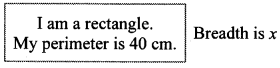
Write correct numbers in the boxes given length is 3 times the breadth
Image
Perimeter of the rectangle = 40
2(__x + __x) = 40
2 × __ x = 40
__ x = 40
x = __
∴ Breadth of rectangle = __ cm and Length of rectangle = __ cm
Answer
length is 3 times the breadth
Image
Perimeter of the rectangle = 40
∴ 2(3x + 1x) = 40
∴ 2 × 4x = 40
∴ 8x = 40
∴ x = 5
∴ Breadth of rectangle = 5 cm and Length of rectangle = 15 cm
View full question & answer
Question 125 Marks
Fill in the boxes to solve the following equations.

i. x + 4 = 9
∴x + 4 – __ = 9 – __
… [Subtracting 4 from both the sides]
∴ x = __

ii. x – 2 = 7
∴x – 2 + __ = 7 + __
… [Adding 2 on both the sides]
∴x = __

iii.$\frac{x}{3}=4$
$
\begin{aligned}
& \therefore \frac{x}{3} \times-=4 \times- \\
& \therefore \mathrm{x}=-
\end{aligned}
$

iv. 4x = 24
∴ __ = __
∴x = __

Answer
i. $x+4=9$
$
\therefore x+4-4=9-4
$
.. [Subtracting 4 from both the sides]
$
\therefore x=5
$
ii. $x-2=7$
$
\therefore x-2+2=7+2
$
... [Adding 2 on both the sides]
$
\therefore \mathrm{x}=9
$
iii. $\frac{x}{3}=4$
$
\therefore \frac{x}{3} \times 3=4 \times 3
$
... [Multiplying both the sides by 3]
$
\therefore \mathrm{x}=12
$
iv. $4 \mathrm{x}=24$
$
\therefore \frac{4 x}{[4]}=\frac{24}{[4]}
$
.. [Dividing both the sides by 4 ]
$
\therefore x=6
$
View full question & answer