Questions

3 Mark Question

Take a timed test

9 questions · self-marked practice — reveal the answer and mark yourself.

Question 13 Marks
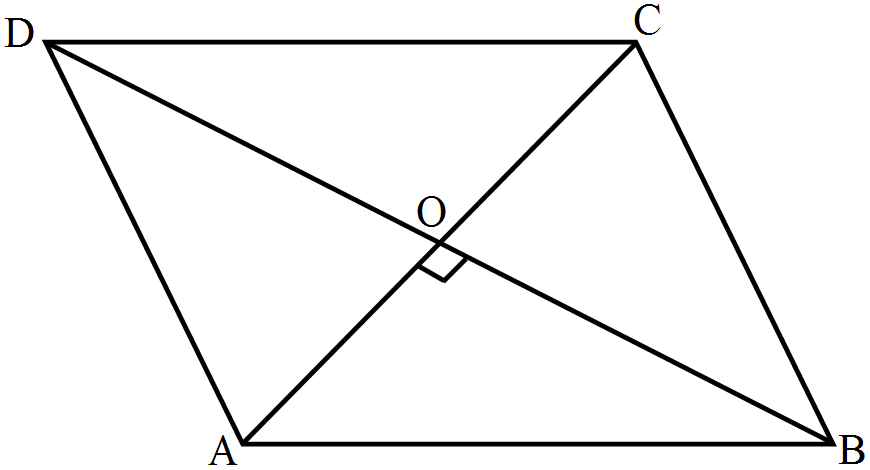
The lengths of the diagonals of a rhombus are 16cm and 12cm respectively. Find the length of each of its sides.
Answer
We know that the diagonals of a rhombus bisect each other at right angles. AC and BD are intersecting at a point O.
$\text{AO}=\frac{1}{2}\text{AC}=\Big(\frac{1}{2}\times16\Big)=8\text{cm}$
$\text{BD}=\frac{1}{2}\text{BD}= \Big(\frac{1}{2}\times12\Big)=6\text{cm}$
From the right $\triangle\text{AOB},$ we have,
$\therefore\text{AB}^2=\text{AO}^2+\text{BO}^2$
$\Rightarrow\text{AB}^2=\big\{(8)^2+(6)^2\big\}\text{cm}^2$
$\Rightarrow\text{AB}=\sqrt{100}=10\text{cm}$
Therefore, length of each side is 10cm. Because all sides of a rhombus are equal.
View full question & answer
Question 23 Marks
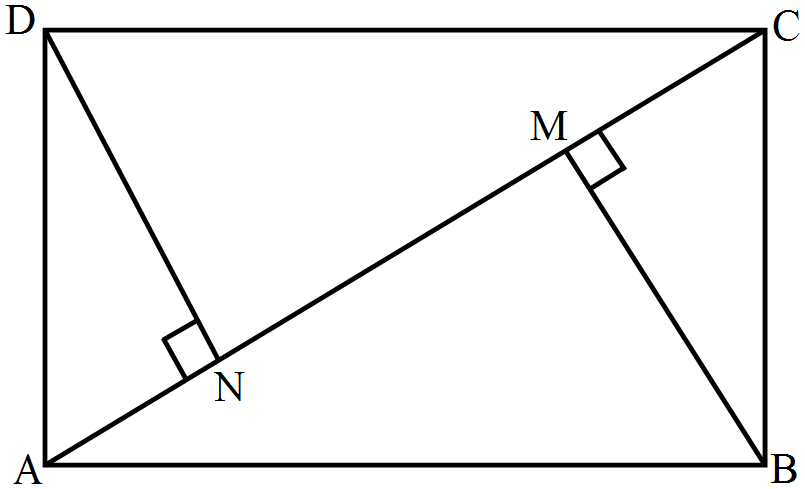
In the adjacent figure, ABCD is a rectangle. If BM and DN are perpendiculars from B and D on AC, prove that $\triangle\text{BMC}\cong\triangle\text{DNA}.$ Is it true that BM = DN?
Answer
In $\triangle\text{BMC}$ and $\triangle\text{DNA}:$
$\angle\text{DNA}=\angle\text{BMC}=90^\circ$
$\angle\text{BCM}=\angle\text{DAN}$ (alternative angles)
BC = DA (opposite sides)
By AAS congruency criteria:
$\triangle\text{BMC}\cong\triangle\text{DNA}$ (proved)
So, we can write BM = DN.
View full question & answer
Question 33 Marks
Two adjacent angles of a parallelogram are in the ratio 4 : 5. Find the measure of each of its angles.
Answer
Let the measure of the adjacent angles be 4x and 5x,
$\therefore4\text{x}+5\text{x}=180$
$\Rightarrow9\text{x}=180$
$\Rightarrow\text{x}=20$
Therefore the measue of the required angle is:
$\angle\text{A}=4\times20=80^\circ$
$\angle\text{B}=5\times20=100^\circ$
$\angle\text{B}+\angle\text{C}=180^\circ$
$\Rightarrow\angle\text{C}=180^\circ-100^\circ=80^\circ$
$\angle\text{C}+\angle\text{D}=180^\circ$
$\Rightarrow\angle\text{D}=180^\circ-80^\circ=100^\circ$
View full question & answer
Question 43 Marks
ABCD is a parallelogram in which $\angle\text{A}=110^\circ.$ Find the measure of each of the angles $\angle\text{A},\angle\text{B}$ and $\angle\text{D.}$
Answer
It is a given that ABCD is a parallelogram in which $\angle\text{A}=110^\circ.$ Since, the sum of any two adjacent angle of a parallelogram is 180º, we have,
$\angle\text{A}+\angle\text{B}=180^\circ$
$\Rightarrow\angle\text{B}=180^\circ-110^\circ$
$\Rightarrow\angle\text{B}=706^\circ$
Also, $\angle\text{B}+\angle\text{C}=180^\circ$
$\Rightarrow\angle\text{C}=180^\circ-70^\circ$
$\Rightarrow\angle\text{C}=110^\circ$
Further, $\angle\text{C}+\angle\text{D}=180^\circ$
$\Rightarrow\angle\text{D}=180^\circ-110^\circ$
$\Rightarrow\angle\text{D}=70^\circ$
$\therefore\angle\text{B}=70^\circ,\angle\text{C}=110^\circ$ and $\angle\text{D}=90^\circ.$
View full question & answer
Question 53 Marks
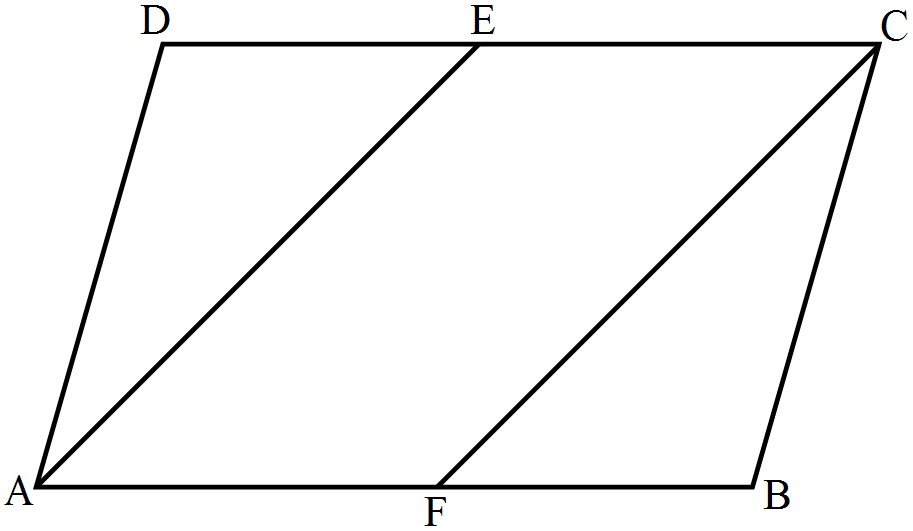
In the adjacent figure, ABCD is a parallelogram and line segments AE and CF bisect the angles A and C respectively. Show that AE || CF.
Answer
In $\triangle\text{AD}$ and $\triangle\text{CBF},$
we have $\text{AD}=\text{BC},\angle\text{B}=\angle\text{D}$ and $\angle\text{DAE}=\angle\text{BCF}$
$\because\angle\text{A}=\angle\text{C}$
$\Rightarrow\frac{1}{2}\angle\text{A}=\frac{1}{2}\angle\text{C}$
$\Rightarrow\angle\text{DAE}=\angle\text{BCF}$
$\therefore\triangle\text{ADE}\cong\triangle\text{CBF}$
And therefore, $\text{CD}-\text{DE}=\text{AB}-\text{BF}$
So, CE = AF
$\therefore$ AECF is a parallelogram,
Hence, AE || CF.
View full question & answer
Question 63 Marks
Two sides of a parallelogram are in the ratio 5 : 3. If its perimeter is 64cm, find the lengths of its sides.
Answer
Let the measure of the sides be 5x and 3x.
Its perimeter = 2(5x + 3x)
$\therefore$ 2(5x + 3x) = 64
⇒ 16x = 64
⇒ x = 4
Therefore, one side = 5 × 4 = 20
Other side = 3 × 4 = 12
View full question & answer
Question 73 Marks
The sum of two opposite angles of a parallelogram is 130°. Find the measure of each of its angles.
Answer
$\angle\text{A}+\angle\text{C}=130$
Let the measure of $\angle\text{A}=\angle\text{C}=\text{x}$
$\therefore2\text{x}=130$
$\Rightarrow\text{x}=65$
Therefore, $\angle\text{A}=65$
$\therefore\angle\text{A}+\angle\text{B}=180$
$\Rightarrow\angle\text{B}=180-65$
$\Rightarrow\angle\text{B}=115$
$\Rightarrow\angle\text{C}=65$
$\therefore\angle\text{C}+\angle\text{D}=180$
$\Rightarrow\angle\text{D}=180-65$
$\Rightarrow\angle\text{D}=115.$
View full question & answer
Question 83 Marks
Two adjacent angles of a parallelogram are (3x - 4)° and (3x + 16)°. Find the value of x and hence find the measure of each of its angles.
Answer
(3x - 4) + (3x + 16) = 180
⇒ 3x - 4 + 3x + 16 = 180
⇒ 6x + 12 = 180
⇒ 6x = 180 - 12
⇒ 6x = 168
⇒ x = 28
Therefore, the measure of the angle is:
$\angle\text{A}=(3\times28-4)=80^\circ$
$\angle\text{B}=(3\times28+16)=100^\circ$
View full question & answer
Question 93 Marks
The perimeter of a parallelogram is 140cm. If one of the sides is longer than the other by 10cm, find the length of each of its sides.
Answer
Let the length of one side be x cm and other is (x + 10)cm.
$\therefore$ 2(x + x + 10) = 140
⇒ 4x + 20 = 140
⇒ 4x = 140 - 20
⇒ 4x = 120
⇒ x = 30
Length of one side is 30cm and other side = (30 + 10) = 40cm.
View full question & answer