Questions

3 Mark Question

Take a timed test

15 questions · self-marked practice — reveal the answer and mark yourself.

Question 13 Marks
Find all possible values of $x$ for which the 4 -digit number $320 x$ is divisible by 3 . Also, find the numbers.
Answer
If a number is divisible by 3 , then the sum of the digits is also divisible by 3 .
$5+x^3+2+0+x=5+x$ must be divisible by 3 .
This is possible in the following cases:
$x=1$
$\therefore 5+x=6$
Thus, the number is 3201 .
$x=4$
$\therefore 5+x=9$
Thus, the number is 3204 .
$x=7$
$\therefore 5+x=12$
Thus, the number is 3207 .
View full question & answer
Question 23 Marks
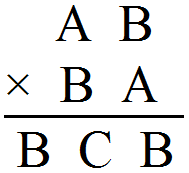
Find the values of A, B, C when:
Answer

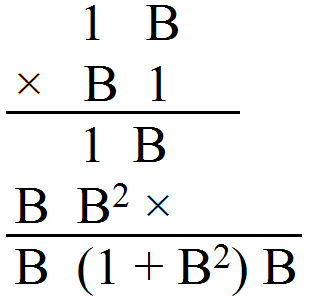
Now $\text{B}\neq\text{A}=1$ and $(1+\text{B}^2)$
$\therefore\text{B}=2$
$​​\text{C}=(1+\text{B}^2)=(1+4)=5$
$\therefore\text{A}=1,\text{B}=2\text{ and }\text{C}=5$
View full question & answer
Question 33 Marks
In a two-digit number, the digit at the units place is double the digit in the tens place. The number exceeds the sum of its digits by 18. Find the number.
Answer
Let the tens digit be x.
The units place digit = 2x.
$\therefore$ Number = 10x + 2x
$\therefore$ (x + 2x) + 18 = (10x + 2x)
⇒ 3x + 18 = 12x
⇒ 12x = 3x + 18
⇒ 12x - 3x + 18
⇒ 9x = 18
⇒ x = 2
Therefore, the number {(10 × 2) + (2 × 2)} = 24
View full question & answer
Question 43 Marks
Replace A, B, C by suitable numerals.
$ \ \ \ \ \ \ \text{AB}\\\underline{ \ \ \ \times \ 3}\\\underline{ \ \ \text{CAB}}$
Answer
(B × 3) = B
Then, B can either be 0 or 5.
If B is 5, then 1 will be carried.
Then A × 3 + 1 = A will not be possible for any number.
$\therefore$ B = 0
A × 3 = A is possible for either 0 or 5.
If we take A = 0, then all number will become 0. however this not a possible.
$\therefore$ A = 5
Then, 1 will be carried.
$\therefore$ C = 1
$\therefore$ A = 5, B = 0 and C = 1
View full question & answer
Question 53 Marks
Give five examples of numbers, each one of which is divisible by 3 but not divisible by 9.
Answer
Let the number 21,Sum of the digits is 2 + 1 = 3,
Which is divisible by 3 but not by 9.
Let the number 24, sum of digits 2 + 4 = 6.
Which is divisible by 3 but not by 9.
Let The number 30, sum of digits 3 + 0 = 3
Which is divisible by 3 but not by 9.
Let the number 33, sum of digits 3 + 3 = 6,
Which is divisible by 3 not by 9.
Let The number 39, sum of digits 3 + 9 = 12,
Which is divisible by 3 not by 9.
View full question & answer
Question 63 Marks
The units digit of a two-digit number is 3 and seven time the sum of the digits is the number itself. Find the number.
Answer
Let the digit be x. Then the units place digit = 3
$\therefore$ Number = (10x + 3)
$\therefore$ 7(x + 3) = (10x + 3)
⇒ 7x + 21 = 10x + 3
⇒ 10x + 3 = 7x + 21
⇒ 10x - 7x = 21 - 3
⇒ 3x = 18
⇒ x = 6
Therefore the number is {(10 × 6) + 3} = 63.
View full question & answer
Question 73 Marks
Replace A, B, C by suitable numerals.
$ \ \ \ \text{C B 5}\\-\underline{2 \ 8\text{ A}}\\ \ \ \ \ \underline{2 \ 5 \ 9 \ }$
Answer
5 - A = 9
This implies That 1 borrowed.
We know,
15 - 6 = 9
⇒ A = 6
B - 5 = 8
But 1 has also been lent.
$\therefore$ B = 4
C - 2 = 2
This implies that 1 has been lent
$\therefore$ C = 5
$\therefore$ A = 6, B = 4 and C = 5.
View full question & answer
Question 83 Marks
Complete the magic square given below, so that the sum of the numbers in each row or in each column or along each diagonal is 15.
6 1  
  5  
     
Answer
6 + 5 + x = 15
⇒ x = 4
Now taking the first over:
6 + 1 + x = 15
⇒ x = 15 - 7 = 8
Taking last colunm:
8 + x + 4 = 15
⇒ x = 15 - 12 = 3
Taking second colunm:
1 + 5 + x = 15
⇒ x = 15 - 6 = 9
Taking second Row:
x + 5 + 3 = 15
⇒ x = 15 - 8 = 7
Taking diagonal that begins with 8:
8 + 5 + x = 15
⇒ x = 2
6 1 8
7 5 3
2 9 4
View full question & answer
Question 93 Marks
In a 3-digit number, the tens digit is thrice the units digit and the hundreds digit is four times the units digit. Also, the sum of its digits is 16. Find the number.
Answer
Let the unit place digit be x. Then, the tens place digit = 3x and the hundred place digit = 4x.
$\therefore$ 4x + 3x + x = 16
⇒ 8x = 16
⇒ x =2
Therefore, Units place digit = 2.
The Tens place digit = (3 × 2) = 6.
The Hundreds place digit = (4 × 2) = 8
Therefore, the number is 862.
View full question & answer
Question 103 Marks
Replace A, B, C by suitable numerals:
$ \ \ \ 5 \ \ 7 \ \ \text{A}\\\underline{-\text{C} \ \text{B} \ \ 8}\\\underline{ \ \ \ 2 \ \ 9 \ \ \ 3 \ \ }$
Answer
A - 8 = 3
This implies that 1 is borrowed.
11 - 8 = 3
⇒ A = 1
Then, 7 - B = 9
1 is borrowed from 7.
$\therefore$ 16 - B = 9
⇒ B = 7
Further, 5 - C = 2
But 1 has been borrowed from 5.
$\therefore$ 4 - C = 2
⇒ C = 2
$\therefore$ A = 1, B = 7 and C = 2
View full question & answer
Question 113 Marks
Replace A, B, C by suitable numerals.
$\ \ \ \ \ 6\text{ A}\\\underline{-\text{A B}}\\\underline{\ \ \ \ 3\ \ 7\ }$
Answer
$6 - \text{A} = 3$
This implies That the maximum value of A can be 3.
$\text{A}\leq3\dots(1)$
The next column has the following:
$\text{A}-\text{B}=7$
To reconcile this with equation (1), borrowing is involved
We know:
$12 - 5 = 7 $
$\therefore\text{A}=2$ and $\text{B}=5$
View full question & answer
Question 123 Marks
Fibonacci numbers Take 10 numbers as shown below:
a, b, (a + b), (a + 2b), (2a + 3b), (3a + 5b), (5a + 8b), (8a + 13b), (13a + 21b), and (21a + 34b). Sum of all these numbers = 11(5a + 8b) = 11 × 7th number.
Taking a = 8, b = 13.,
Write 10 Fibonacci numbers and verify that sum of all these numbers = 11 × 7th number
Hint. I, II, (I + II), (III + II), (IV + III), [V + IV), and so on
Answer
a = 8 and b = 13
The numbers are 8, 13, 21, 34, 55, 89, 144, 233, 377 and 610.
Sum of the numbers = 8 + 13 + 21 + 34 + 55 + 89 + 144 + 233 + 377 + 610 = 1584
11 × 7th number = 11 × 144 = 1584
View full question & answer
Question 133 Marks
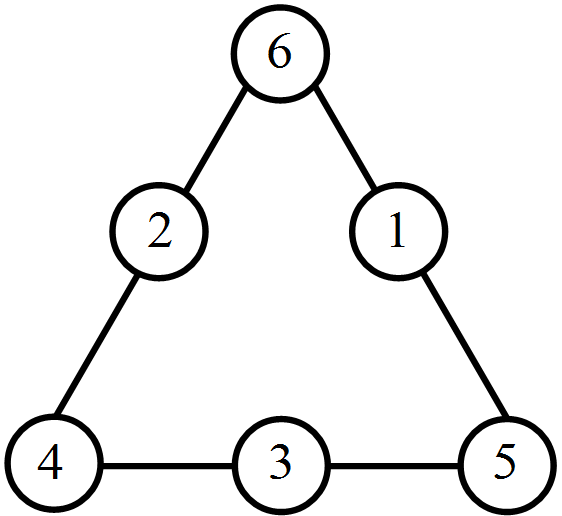
Fill in the numbers from 1 to 6 without repetiflon, so that each side of the triangle adds up to 12
Answer
6 + 2 + 4 = 12
4 + 3 + 5 = 12
6 + 1 + 5 = 1
View full question & answer
Question 143 Marks
Complete the magic square:
  14   0
8   6 11
4     7
  2 1 12
Answer
The magic square is completed assuming that the sum of the row, columns and diagonals is 30. This is because the sum of all the number of the last column is 30.
3 14 13 0
8 5 6 11
4 9 10 7
15 2 1 12
View full question & answer
Question 153 Marks
The difference between a 2-digit number and the number obtained by interchanging its digits is 63. What is the difference between the digits of the number?
Answer
Let the tens and unit digits of the number be a and b respectively.
Then,
$\therefore$ Number = (10a + b)
(10a + b) - (10b + a) = 63
⇒ 10a - b - 10b - a = 63
⇒ 9a - 9b = 63
⇒ 9(a - b) = 63
⇒ a - b = 7
Therefore, the diffrerent between the digits is 7.
View full question & answer