When ice in water melts, this difference equals the volume of the water formed when the part of ice above the surface of water melts. Therefore, the water level remains the same. Hence, there is no overflow of water when the ice melts.
20 questions · self-marked practice — reveal the answer and mark yourself.
When ice in water melts, this difference equals the volume of the water formed when the part of ice above the surface of water melts. Therefore, the water level remains the same. Hence, there is no overflow of water when the ice melts.

2. If the density of the fluid is greater than that of the body, the magnitude of the buoyant force on the body will be greater than that of the weight of the body. Therefore, the body will float in the fluid.
3. If the density of the fluid is equal to that of the body, the magnitude of the buoyant force on the body will be equal to that of the weight of the body. Therefore, the body will remain in equilibrium anywhere within the fluid.
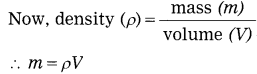
$=V \rho_1 g=\left(\frac{m}{\rho}\right) \rho_1 g=m g\left(\frac{\rho_1}{\rho}\right)\left(\because \rho=\left(\frac{m}{V}\right)\right)$
If the body is partially immersed in the fluid, the volume of the fluid displaced by the immersed part of the body = xV ; here 0 < x < 1.
In this case, the magnitude of the buoyant force
$=x V \rho_1 g=x\left(\frac{m}{\rho}\right) \rho_1 g=x m g\left(\frac{\rho_1}{\rho}\right)$

You will find that the water does not spill. The atmospheric pressure on the card (acting upward) is greater than the pressure of the water in the glass (acting downward). Hence, the water in the glass does not spill.
For example, a body moving with constant speed along a circular path in a horizontal plane will fly tangentially in the sense of motion if the centripetal force (the force directed towards the centre of the circle) is removed completely.


It is greater than the density of water.