The particles in the atomic nucleus are …………….. .
- Aprotons and electrons
- Belectrons
- Celectrons and neutrons
- ✓protons and neutrons
Answer: D.
View full solution →138 questions across 12 question groups — pick any mix to generate a Science paper with step-by-step answer keys.
MCQ
18 Q→02Write the following Statement Is True Or False. & Write True Statement.
21 Q→03Answer the following in one sentece.
25 Q→04Answer the following questions in detail.
3 Q→05Fill In The Blanks.
27 Q→06complete the Graph/Table.
7 Q→07Draw Diagram.
4 Q→08Match The Columns/pair.
4 Q→09Answer the following question.
8 Q→10Complete The Correlation.
7 Q→11Distinguish Between.
4 Q→12Give Scientific Reason.
10 Q→One sample from each question group in this chapter. Select any group above to see the full set with answer keys.
Answer: D.
View full solution →Answer: A.
View full solution →Answer: A.
View full solution →Answer: C.
View full solution →Answer: C.
View full solution →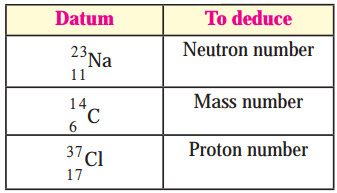
| Isotopes | Proton number | Neutron number |
| 11H | ||
| 21H | ||
| 3517Cl | ||
| 3517Cl | ||
| 3717Cl |
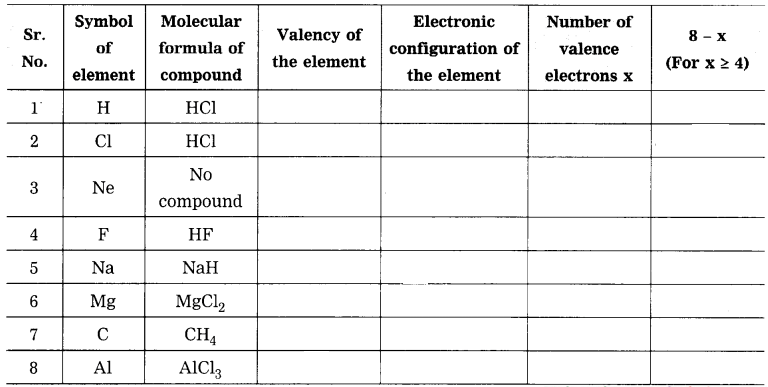
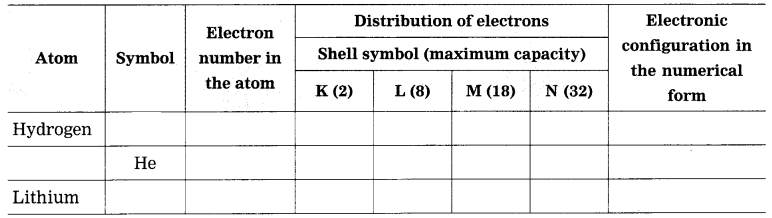
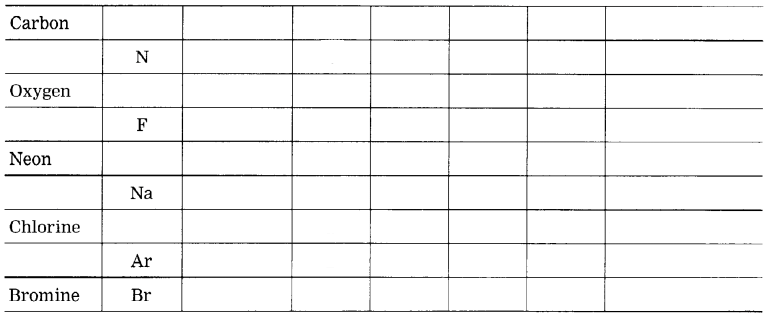
| Column I | Column II |
| 1. Alpha particles | a. Inert element |
| 2. Uranium-235 | b. Negatively charged particles |
| 3. Helium | c. Positively charged particles |
| 4. Isotopes | d. Krypton – 92, Barium 141 |
| e. U-233, Th-232 | |
| f. ${ }^{12} C ,{ }^{13} C { }^{14} C$ |
| Column I | Column II |
| 1. Atom | a. Treatment of goitre |
| 2. Isotopes of iodine | b. Protons + Neutrons |
| 3. Atomic mass number | c. Different number of neutrons |
| 4. Isotopes | d. Electrically neutral |
| Column I | Column II |
| 1. Thomson | a. Well defined orbits |
| 2. Rutherford | b. Neutron |
| 3. Chadwick | c. Scattering experiment |
| 4. Bohr | d. Electron |
| Column I | Column II |
| 1. Proton | a. Negatively charged |
| 2. Electron | b. Neutral |
| 3. Neutron | c. Positively charged |
Pick question groups from the list above, set marks and difficulty, and export a branded PDF with step-by-step answer keys. First 3 chapters free — no signup.