Questions

Answer the following question.

Take a timed test

6 questions · self-marked practice — reveal the answer and mark yourself.

Question 15 Marks
Which type of glass is used in vehicles to avoid injuries in accidents?
Answer
Front and rear doors have tempered glass. The windshield has laminated safety glass. Even if the accident takes place the glass pieces do not injure the passengers. Laminated safety glass combines two curved glass sheets and a plastic lamina between the two layers of the glass.

This glass is tough and protective. Tempered glass on the other hand is toughened glass which is processed by controlled thermal or chemical treatments. Upon breaking, the tempered glasses crumble into small granular chunks instead of splintering into sharp glass pieces. This prevents the injuries.
View full question & answer
Question 25 Marks
To prevent the degradation due to sunlight, some materials are stored in which type of bottles?
Answer

Image

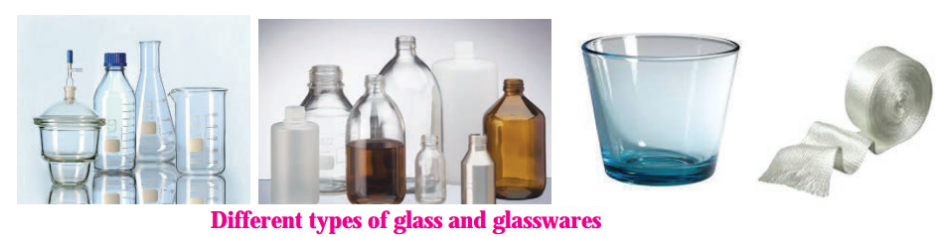
The amber glass or brown coloured glass bottles are used to store the materials that may get degraded due to sunlight. This colour prevents the ultraviolet rays of the sun to enter the bottle and bring about chemical changes in the materials. Especially, for sensitive medicines, brown glass bottles are used.

View full question & answer
Question 35 Marks
Which measures will you arrange to minimize the environmental problems arising due to non-degradable plastic?
Answer:
Answer
  1. The use of plastic should be minimum. Reducing the consumption, reusing the same plastic again and again, recycling the used plastic and making some new products from the used plastic are some of the measures that can be adopted.
  2. There are attempts to use plastic in making roads. Therefore, plastic is bought with good price at some places.
  3. Therefore, instead of disposing of it anywhere, it should be collected and sold in best possible way.
  4. The better alternatives for plastic should be adopted.
  5. The awareness programmes about misuse of plastic should be arranged so that common man can understand the dangers of using plastic.
View full question & answer
Question 45 Marks
Explain the effect of following materials on environment and human health.
1. Plastic
2. Glass.
3. Thermocol.
Answer
1. Plastic:

  1. Plastic is non-degradable substance. Hence if thrown in any ecosystem, it remains unchanged for many years.
  2. It is one of the worst environmental pollutants as its disposal is a major problem.
  3. If thrown in water bodies, it affects the aquatic animals. Many of turtles mistake it for algae and eat the plastic. Eventually such animals die due to choking.
  4. In terrestrial environment, the grazing animals like cattle are affected due to plastic.
  5. If burnt it emits very toxic gases.
  6. In landfill sites, it remains unchanged for thousands of years.

2. Glass:

  1. The glass production is carried out at high temperatures of about 1500 °C. This burning emits many hazardous gases like sulphur dioxide, nitrogen dioxide, carbon dioxide. These gases cause the greenhouse effect.
  2. Moreover, glass being non-degradable, cause pollution.
  3. If broken glass pieces or any waste glass material is disposed into aquatic environment, it affects animals and plants.
  4. Similarly, glass pieces block the drainages.
  5. The waste glass thrown anywhere cause injury to terrestrial fauna.

3. Thermocol:

  1. Thermocol contains carcinogenic ingredients in the form of styrene. If there is prolonged contact with thermocol, there is a possibility of blood cancer like leukemia and lymphoma.
  2. Thermocol is non-degradable. It cannot be degraded into harmless substances easily.
  3. If it is burnt for destruction, it releases toxic gases in atmosphere.
  4. The plates and cups used for food, water, tea, etc. are made up of thermocol. This may affect the health. Reheating the food kept in thermocol releases styrene. This styrene may dissolve in that food, causing health problems like cancer.
View full question & answer
Question 55 Marks
How the plastic is produced?
Answer
  1. Plastics are derived from natural materials such as natural gas, oil, coal, minerals and plants.
  2. The first synthetic plastics were i derived from cellulose, a substance found in plants and trees. This cellulose was heated with chemicals and resulted in a plastic like material.
  3. In modern times, the different raw materials are used for making plastics, but most plastics are made from the hydrocarbons present in the natural gas, oil and coal.
  4. Plastics are simply chains of like molecules linked together. These chains are called polymers. Thus, many plastics begin with “poly,” such as polyethylene, polystyrene and polypropylene.
  5. These polymers are made of carbon and hydrogen and sometimes oxygen, nitrogen, sulphur, chlorine, fluorine, phosphorous or silicon.
  6. Plastic is produced in factories by suitable chemical reactions.
View full question & answer
Question 65 Marks
Write the natural or man-made raw material of the following items.
Mattress, beaker, bangle, chair, gunny bag, broom, knife, pen.
Answer
ItemsNatural raw materialMan-made raw materials
MattressCotton, Coir (Jute fibres)Polypropylene
Beaker___Glass (Silicate or borosilicate glass)
BangleGold, silver, lac, copperPlastic, Glass
ChairWoodPlastic (PVC)
Gunny bagJute, cottonPlastic (PVC)
BroomPlant fibresPlastic fibres (PVC)
KnifeMetals such as ironPlastic
PenMetalsPlastic
View full question & answer