Questions

Question Answer (5 Marks)

🎯

Test yourself on this topic

9 questions · timed · auto-graded

Question 15 Marks
What is an earthquake? What are the two main situations in which earthquakes occur?
Answer
Earthquake is the phenomenon in which the earth shakes suddenly for a very short time. It is caused by a disturbance deep inside the earth’s crust. It is the destructive natural phenomenon which cannot be predicted in advance. The earthquakes can cause floods, landslides and tsunamis. Most earthquakes are caused by the movement of earth’s plates. The magnitude (or intensity) of an earthquake is expressed in terms of Richter scale. The destructive earthquakes have magnitudes higher than 7 on the Richter scale. The outermost layer of the earth is fragmented. Each fragment is called a plate. These plates are in continual motion. When they brush past one another, or a plate goes under another due to collision they cause disturbance in the earth’s crust that shows up as an earthquake on the surface of the earth. The tremors on the earth can be caused when a volcano erupts or when a meteor hits the earth. It can also be caused by an underground nuclear explosion.
View full question & answer
Question 25 Marks
What is lightning? How is lightning produced between clouds in the sky?
Answer
The process of electric discharge between clouds and the earth or between different clouds causes lightning. During the development of a thunderstorm, the water droplets move downwards while the air currents move upward. Due to these strong movements, the separation of charges takes place. The positive charges collect near the upper edges of the clouds and the negative charges collect near the lower edges. There is accumulation of positive charges near the ground as well. When the magnitude of the accumulated charges becomes very large, the air which is normally a poor conductor of electricity, is no longer able to resist their flow. Negative and positive charges meet, producing streaks of bright light and sound. We are able to see these streaks as lightening. The process is called an electric discharge.
View full question & answer
Question 35 Marks
An earthquake measures 3 on Richter Scale:
  1. Would it be recorded by a seismograph?
  2. Is it likely to cause much damage?
Answer
  1. Earthquake is the phenomenon in which the earth shakes suddenly for a very short time. It is caused by a disturbance deep inside the earth’s crust. Seismograph is the instrument which is used to measure and record an earthquake. The tremors produce waves on the surface of the earth. These are called seismic waves. These waves are recorded by the seismograph. Yes, an earthquake measuring 3 on Richter scale will be recorded by a seismograph.
  2. Earthquake is the destructive natural phenomenon which cannot be predicted in advance. The earthquakes can cause floods, landslides and tsunamis. Most earthquakes are caused by the movement of earth’s plates. The magnitude (or intensity) of an earthquake is expressed in terms of Richter scale. The destructive earthquakes have magnitudes higher than 7 on the Richter scale. No, an earthquake which measures 3 on Richter scale is unlikely to cause much damage.
View full question & answer
Question 45 Marks
A glass rod is rubbed with a silk cloth and an inflated rubber balloon is rubbed with a woollen cloth. Now, out of glass rod, silk cloth, rubber balloon and woollen cloth:
  1. which two objects acquire negative charge?
  2. which two objects acquire positive charge?
Answer
  1. Silk cloth and Rubber balloon acquire negative charge. When a glass rod is rubbed with silk, some of the electrons from the glass atoms are transferred to silk. Due to the deficiency of electrons in the glass atoms, it becomes positively charged. Whereas the silk has acquired electrons, it becomes negatively charged. An inflated rubber balloon can be charged by rubbing it against the woolen cloth. Upon rubbing, the wool loses electrons and it causes the electrons to move from the wool to the balloon's surface. The rubbed part of the balloon now has a negative charge.
  2. Glass rod and Woolen cloth acquire positive charge. When a glass rod is rubbed with silk, some of the electrons from the glass atoms are transferred to silk. Due to the deficiency of electrons in the glass atoms, it becomes positively charged. An inflated rubber balloon can be charged by rubbing it against the woolen cloth. Upon rubbing, the wool loses electrons and it causes the electrons to move from the wool to the balloon's surface. The woolen cloth is left with a positive charge.
View full question & answer
Question 55 Marks
How does a lightning conductor protect a tall building? Name the scientist who invented the lightning conductor.
Answer
Lightening conductor is a device which is used to protect a tall building from lightening. Lightening conductor is made up of metal which is a good conductor of electricity. The lightening conductor is made of metal rod with a sharp pointed edge on the top. They are made of conductive material such as copper and aluminium. A metallic rod which is taller than the building is installed in the walls of the building during its construction. One end of the rod is kept out in the air and the other end is buried deep in the ground. The rod provides easy route for the transfer of electric charge to the ground. Lightening conductor was discovered by Benjamin Franklin.
View full question & answer
Question 65 Marks
State any two precautions which should be observed by people living in seismic zones for protection against earthquakes.
Answer
The following measures for protection against earthquakes:
  • The buildings in these zones should be designed so that they can withstand tremors. Modern building technology can make it possible
  • Mud and timber should be used as construction material instead of heavy construction material. The roofs should be kept as light as possible.
  • The cupboards and shelves should be fixed to the walls so that they should not fall easily.
  • Clocks, photo frames and water heaters etc. should be hanged carefully at proper places to avoid damage by them.
  • Sometimes the buildings may catch fire during earthquakes. All the buildings, especially the tall buildings should have the firefighting equipment in working order.
View full question & answer
Question 75 Marks
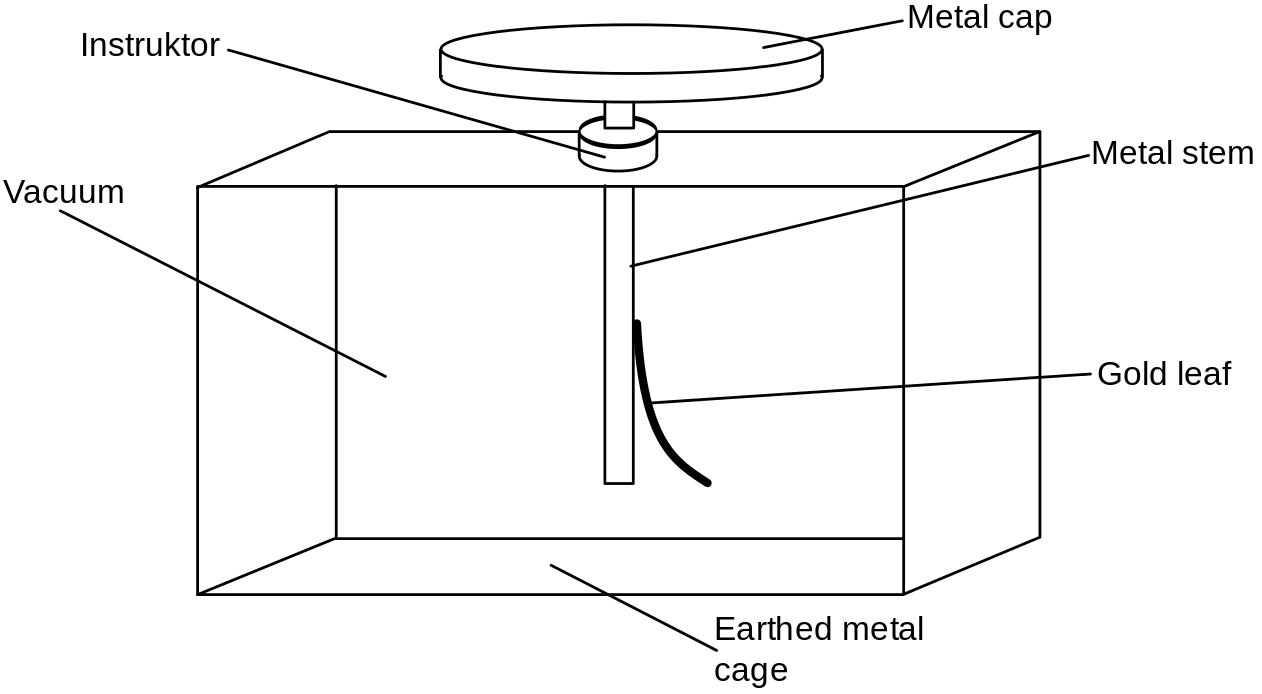
What is an electroscope? Draw a labelled diagram of an electroscope and explain its working.
Answer
Electroscope is the device which is used to detect charge on a body. It is used for detecting, measuring and finding the nature of a charge. An electroscope consists of a large jar. A metal rod is fitted into the mouth of the jar with the help of the cork. At the lower end of the metal rod a pair of thin leaves of gold or aluminium is suspended. If the leaves of the electroscope diverge or open up when an object is touched, the body is charged. The extent of divergence or opening up of the leaves is a measure of the charge on the body. A body with higher charge will cause greater opening up of the leaves.
View full question & answer
Question 85 Marks
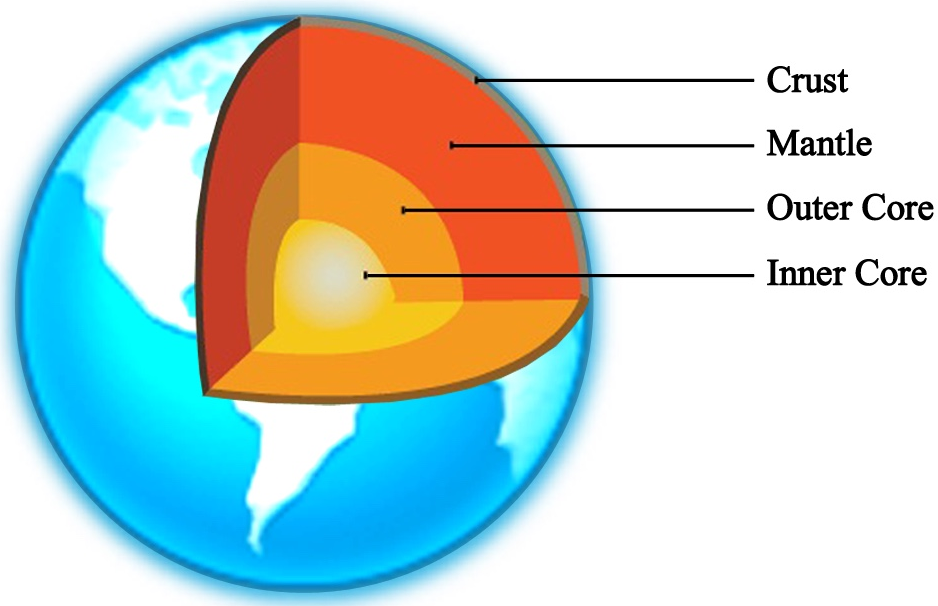
Name the three layers of earth. Draw a labelled diagram to show the structure of earth.
Answer
The Earth consists of four concentric layers: The inner core, outer core, mantle and the crust. The crust is made up of tectonic plates which are in constant motion. Earthquakes and volcanoes are most likely to occur at plate boundaries.The Earth is made up of following distinct layers:
  1. The inner core - It is in the center of the Earth. It is the hottest part of the Earth. It is solid and is made up of iron and nickel. It has a temperature of up to 5,500°C.
  2. The outer core - It is the layer surrounding the inner core. It is a liquid layer. It is also made up of iron and nickel. It is still extremely hot, with temperatures similar to the inner core.
  3. The mantle - It is the widest section of the Earth. It has a thickness of approximately 2,900km. The mantle is made up of semi-molten rock called magma.
  4. The crust - It is the outer layer of the earth. It is a thin layer between 0-60km thick. The crust is the solid rock layer upon which we live.
There are two different types of crust: continental crust, which carries land, and oceanic crust, which carries water.
View full question & answer
Question 95 Marks
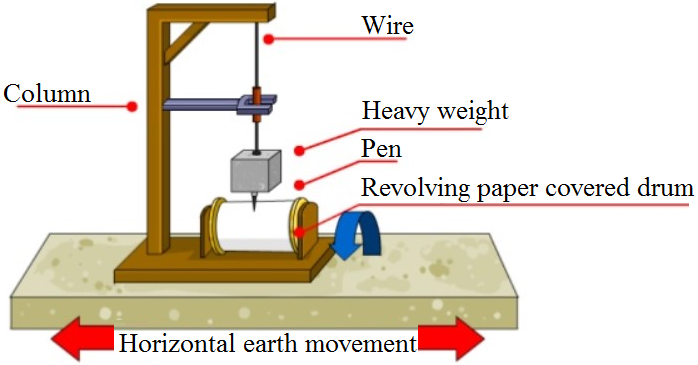
What is a seismograph? Draw a labelled diagram of a seismograph.
Answer
Seismograph is the instrument which is used to measure and record an earthquake. The tremors produce waves on the surface of the earth. These are called seismic waves. These waves are recorded by the seismograph. Following is the well labelled diagram of a seismograph.
View full question & answer
Question Answer (5 Marks) - Science STD 8 Questions - Vidyadip