Questions

Question Answer (2 Marks)

Take a timed test

26 questions · self-marked practice — reveal the answer and mark yourself.
Question 12 Marks
What is a musical sound? Give two examples of musical sounds.
Answer
A pleasant sound is called music. Its like a treat to the ears.
Example:
  1. Beats.
  2. Tones.
View full question & answer
Question 22 Marks
How does sound from a sound producing body travel through air to reach our ears?
Answer
The air particles near the sound producing body vibrate and exchange energy, which is received by our ears and we are able to hear the sounds.
View full question & answer
Question 32 Marks
What is meant by the (a) 'pitch' of sound, and (b) 'quality' of sound?
Answer
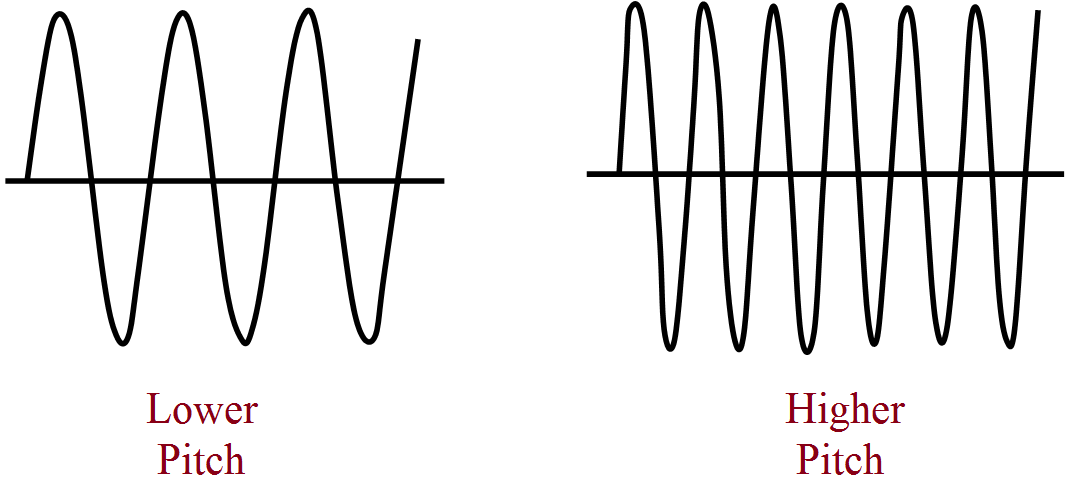
The sensation of frequency is called “pitch” The high frequency indicates high pitch and vice-versa.
View full question & answer
Question 42 Marks
Out of a man and a woman:
  1. Who has shorter vocal cords?
  2. Who produces sound of higher pitch?
Answer
  1. Woman has short vocal chords. The male vocal chords are between 17mm and 25mm in length whereas of a woman are between 12.5mm and 17.5mm long.
  2. Woman produces sound of higher pitch.
View full question & answer
Question 52 Marks
By how much will the loudness of a sound change when the amplitude of vibrations is:
  1. Doubled?
  2. Halved?
Answer
  1. Loudness is also doubled.
  2. Loudness is halved.
View full question & answer
Question 62 Marks
Explain how, noise pollution (or excessive loud noise) is harmful to human beings.
Answer
Noise pollution has adverse effects physical as well as mental behavior. The constant exposure to noise pollution can create many health related problems like hypertension, insomnia, mental disorder and may even lead to loss of hearing.
View full question & answer
Question 72 Marks
Why a sound cannot be heard on the moon?
Answer
Because moon does not have any atmosphere and sound its does not have any medium for sound to travel as sound does not travel in vacuum.
View full question & answer
Question 82 Marks
Calculate the time period of a pendulum which is vibrating with a frequency of 10 hertz.
Answer
Time Period given by the inverse of the frequency. Time period = $ \frac{1}{\text{frequency}}$ = Time period =$\frac{1}{\text{10Hz}}=0.1 \text{sec}$
View full question & answer
Question 92 Marks
What can be done along the roads to reduce noise pollution caused by traffic from reaching the residents of the area?
Answer
The following measures which can be taken to reduce noise pollution caused by traffic from reaching the residents of the area:
  1. The residential area must be declared as no use of horns.
  2. The colonies must be established at a distance than the roads.
View full question & answer
Question 102 Marks
What differences will you hear in a sound if there is an increase in:
  1. Amplitude, and
  2. Frequency?
Answer
  1. The sound will become loud on increasing the amplitude.
  2. The sound will become shrill on increasing the frequency.
View full question & answer
Question 112 Marks
What is a vibration (or an oscillation)? Define 'amplitude' of vibration of an object.
Answer
The to - and – fro motion of an object in a medium is called vibration.
Amplitude is the largest distance from the mean position of the object.
View full question & answer
Question 122 Marks
State one observation from everyday life which shows that sound travels much more slower than light.
Answer
In case of thunder, we see the lightening first and then the sound of thunder. This is because, the velocity of light in air is 3×10⁸ m/s while the velocity of sound in air is 343 m/s.
View full question & answer
Question 132 Marks
Out of solids, liquids and gases:
  1. In which medium sound travels slowest?
  2. In which medium sound travels fastest?
Answer
  1. Sound travels slowest in gas medium.
  2. Sound travels fastest in solid medium.
View full question & answer
Question 142 Marks
What is the frequency of the sound produced when the vocal cords are:
  1. Tight and thin?
  2. Loose and thick?
Answer
  1. The frequency produced by tight and thin vocal chords is quite high. i.e. its high pitch sound.
  2. The frequency produced by loose and thick vocal chords is quite low i.e. its low pitch sound.
View full question & answer
Question 152 Marks
What is noise? Give two examples of sounds which are considered noise.
Answer
The Unwanted sound that is unpleasant to ear is called noise.
Example:
  1. Loud music
  2. The noise of machines.
View full question & answer
Question 162 Marks
When we put our ear to a railway line, we can hear the sound of an approaching train even when the train is far off but its sound cannot be heard through the air. Why?
Answer
Because the track is made of metals and sounds travel faster in solids than air. Thus, we can hear the sound of an approaching train even when the train is far off but its sound cannot be heard through the air.
View full question & answer
Question 172 Marks
Name the characteristic of sound which depends on:
  1. Amplitude.
  2. Frequency.
Answer
  1. Loudness of the sound depends on amplitude.
  2. Pitch of the sound depends on frequency.
View full question & answer
Question 182 Marks
What is the difference between noise and music? Can music become noise sometimes?
Answer
The Unwanted sound that is unpleasant to ear is called noise. A pleasant sound is called music.
Music can become noise at many instances. Music is of many types and everybody may not like each type of music. When someone listens very loud music, it can be noise for someone else.
View full question & answer
Question 192 Marks
Explain why, if we strike a steel tumbler with a metal spoon lightly, we hear a feeble sound but if we hit the tumbler hard, a loud sound is heard.
Answer
This is because the amplitude of vibrations is small when we beat the spoon lightly and so feeble sound is produced but when it is beaten with force then, amplitude of vibrations is large, so loud sound is produced.
View full question & answer
Question 202 Marks
State the various measures which can be taken to control (or reduce) noise pollution in our surroundings.
Answer
The following measures which can be taken to control (or reduce) noise pollution in our surroundings:
  1. Ban the use of loudspeakers after 9pm.
  2. Ban the use of horns in the areas nearby hospital and school.
View full question & answer
Question 212 Marks
State two methods of producing sound.
Answer
Two methods of producing sound are:
  1. Beating the plate and spoon against each other.
  2. Playing guitar.
View full question & answer
Question 222 Marks
Why sound cannot travel through vacuum (or through outer space)?
Answer
Because sound needs material medium to transfer energy from on particle to another particle. If there is vacuum, then no energy transfer takes place.
View full question & answer
Question 232 Marks
What is ultrasound? State two uses of ultrasound.
Answer
Ultrasounds mean the sounds having frequency greater than 20,000Hz.
The uses of ultrasound are:
  1. They are used in sonography.
  2. They used in radars.
View full question & answer
Question 242 Marks
How is pitch related to frequency?
Answer
The pitch of a sound you hear depends on the frequency of the sound wave. A high frequency sound wave has a high pitch, and a low frequency sound wave has a low pitch.
View full question & answer
Question 252 Marks
What is the frequency of a vibrating body whose time-period is 0.05 second?
Answer
Time Period given by the inverse of the frequency.Time period $$$=\frac{1}{\text{frequency}}$
Or frequency $=\frac{1}{\text{Time period}}$
$\Rightarrow\text{frequency}=\frac{1}{0.05\text{ Sec}}=20\text{Hz}$
View full question & answer
Question 262 Marks
Why are the voices of men, women and children different?
Answer
The length of vocal chords varies in all these three, which is the main reason for different voices. Men have the longest vocal chords, while female have little shorter vocal chords than men and children have the smallest vocal chords.
View full question & answer
Question Answer (2 Marks) - Science STD 8 Questions - Vidyadip