MCQ 11 Mark
If the length of a chord of a circle is $16\ cm$ and is at a distance of $15\ cm$ from the centre of the circle, then the radius of the circle is:
- A
$15\ cm.$
- B
$16\ cm.$
- ✓
$17\ cm.$
- D
$34\ cm.$
AnswerCorrect option: C. $17\ cm.$
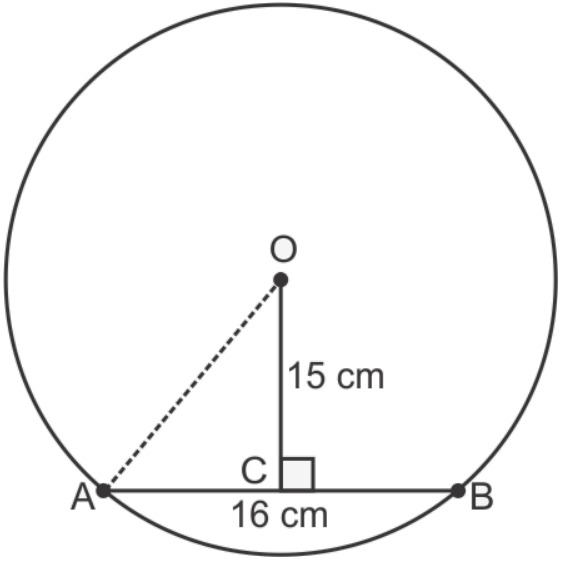
$AB = 16\ cm$
$OC = 15\ cm$
$C$ is the mid $-$ point of $AB$.
$\text{AC}=\text{BC}=\frac{16}{2}=8\text{ cm}$
Consider $\triangle\text{OCA},$
$\text{OC}=\text{15 cm},\ \text{AC}=\text{8 cm}$
$\Rightarrow\text{OA}=\sqrt{(15)^2+(8)^2}$
$=\sqrt{225-64}$
$=\sqrt{289}$
$\Rightarrow\text{OA}=17\text{ cm}$ View full question & answer→MCQ 21 Mark
In the given figure, if $\angle\text{ABC} = 45^\circ,$ then $\angle\text{AOC} =$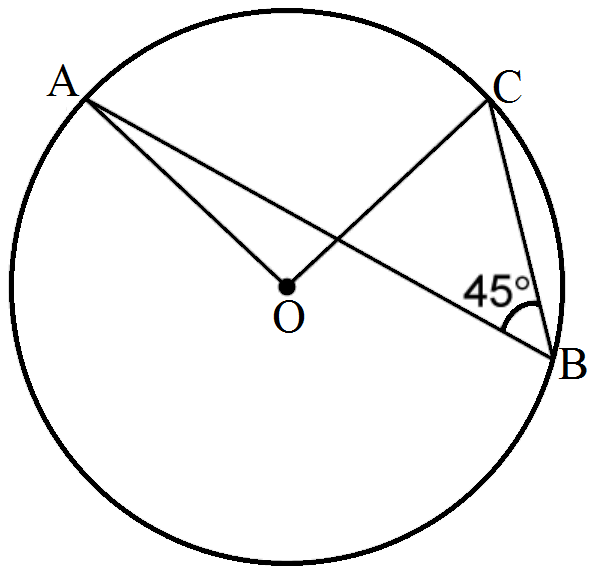
- A
$45^\circ$
- B
$60^\circ$
- C
$75^\circ$
- ✓
$90^\circ$
AnswerCorrect option: D. $90^\circ$
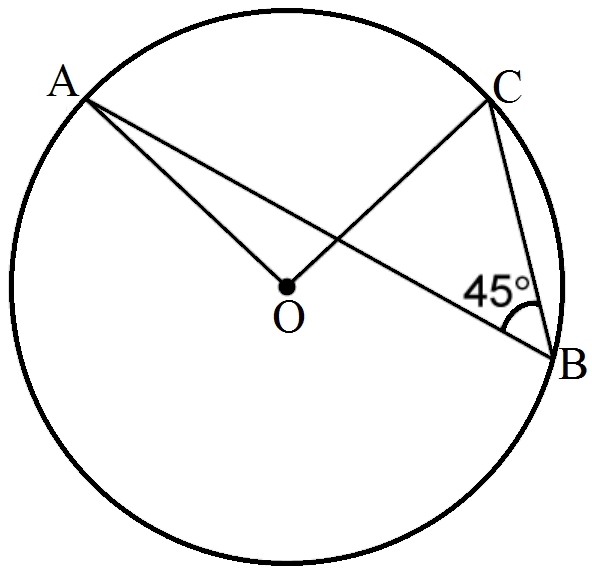
$\angle\text{AOC}$ is made by arc $\widehat{\text{AC}}$ at centre and $\angle\text{ABC}$ is made by $\widehat{\text{AC}}$ on circumference in major segment.
$\Rightarrow\angle\text{ABC}=\frac{1}{2}\angle\text{AOC}$
$\Rightarrow\angle\text{AOC}=2\times\angle\text{ABC}$
$=2\times45^\circ=90^\circ$ View full question & answer→MCQ 31 Mark
$\text{ABC}$ is a triangle with $B$ as right angle, $AC = 5\ cm$ and $AB = 4\ cm$. A circle is drawn with $A$ as centre and $\text{AC}$ as radius. The length of the chord of this circle passing through $C$ and $B$ is:
- A
$3\ cm.$
- B
$4\ cm.$
- C
$5\ cm.$
- ✓
$6\ cm.$
AnswerCorrect option: D. $6\ cm.$
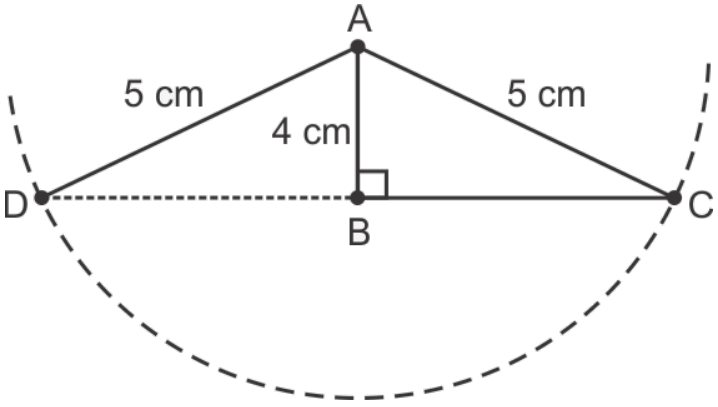
$AD$ and $AC$ are radii of same circle and $CD$ is a chord.
Consider $\triangle\text{ABC},$
$BC^2 = (AC)^2 - (AB)^2$
$=5^2 - 4^2 = 25 - 16 = 9$
$\Rightarrow BC = 3\ cm$
Chord $CD = 2 \times BC = 6\ cm$ View full question & answer→MCQ 41 Mark
If $A , B, C$ are three points on a circle with centre $O$ such that $\angle\text{AOB} = 90^\circ$ and $\angle\text{BOC} = 120^\circ,$ then $\angle\text{ABC} =$
- A
$60^\circ$
- ✓
$75^\circ$
- C
$90^\circ$
- D
$135^\circ$
AnswerCorrect option: B. $75^\circ$
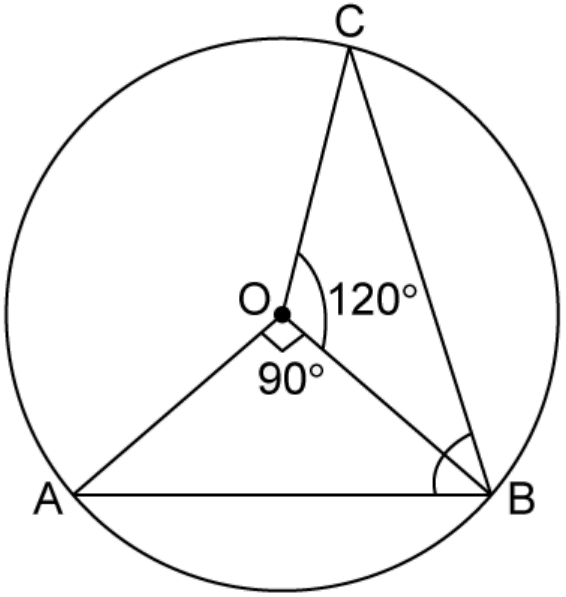
$\angle\text{AOC}=\angle\text{AOB}+\angle\text{BOC}$
$=90^\circ+120^\circ=210^\circ$
$\angle\text{COA}=360^\circ-210^\circ=150^\circ$
If arc $\widehat{\text{COA}}$ makes $150^\circ$ at centre, then it will make half angle of the centre at circumference.
$\Rightarrow\angle\text{CBA}$ or $\angle\text{ABC}=\frac{150^\circ}{2}=75^\circ$ View full question & answer→MCQ 51 Mark
Two equal circles of radius $r$ intersect such that each passes through the centre of the other. The length of the common chord of the circle is:
AnswerCorrect option: C. $\sqrt{3}\text{r}$
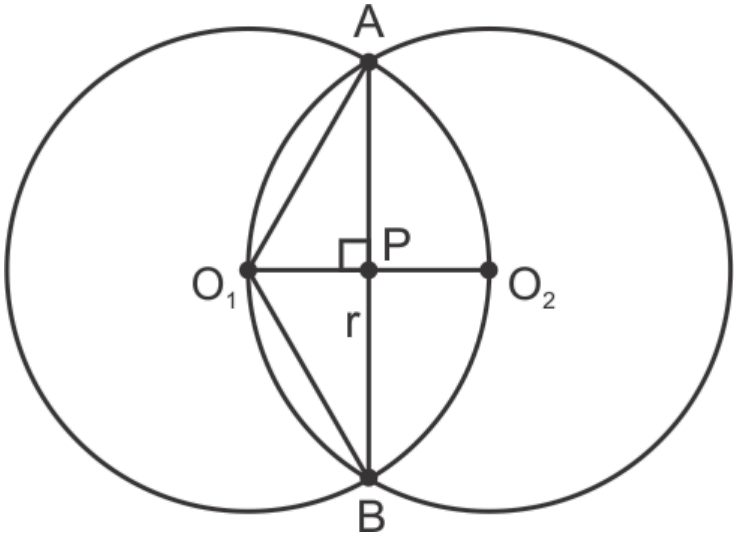
Both the circles pass through the centre of each other
$\Rightarrow O_1O_2 = r$
Common chord is $AB$
We know that perpendicular drawn from centre of circle to any chord bisects it.
$\Rightarrow P$ is the midpoint of $AB$
$\Rightarrow PA = PB$
$O_1A = r ($ radius of circle$)$
Consider $\triangle\text{O}_1\text{PA}$
$\big(\text{O}_1\text{A}\big)^2=\text{AP}^2+\text{O}_1\text{P}^2$
$\Rightarrow\text{r}^2=\text{AP}^2+\Big(\frac{\text{r}}{2}\Big)^2 ...(P$ is also mid$-$point of $O_1O_2)$
$\Rightarrow\text{AP}^2=\text{r}^2-\frac{\text{r}^2}{4}=\frac{\text{3r}^2}{4}$
$\Rightarrow\text{AP}=\frac{\sqrt3}{2}\text{r}$
Lenght of chord $\text{AP}=\text{2AP}=\sqrt{3}\text{r}$ View full question & answer→MCQ 61 Mark
The radius of a circle is 6cm. The perpendicular distance from the centre of the circle to the chord which is 8cm in length, is:
- A
$\sqrt{5}\text{cm}.$
- ✓
$2\sqrt{5}\text{cm}.$
- C
$2\sqrt{7}\text{cm}.$
- D
$\sqrt{7}\text{cm}.$
AnswerCorrect option: B. $2\sqrt{5}\text{cm}.$
$2\sqrt{5}\text{cm}.$
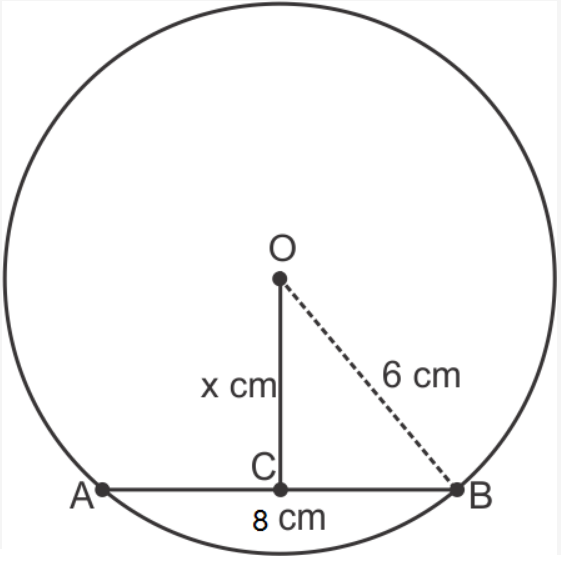
$AB = 8cm$
$\Rightarrow AC = BC = 4cm$
Consider $\triangle\text{OCB},$ where $BC = 8cm,$
$OB = 6cm$
Now, $(OC)^2 + (BC)^2= (OB)^2$
$\Rightarrow (OC)^2 + 4^2 = 6^2$
$\Rightarrow (OC)^2 + 16 = 36$
$\Rightarrow (OC)^2 = 20$
$\Rightarrow\text{OC}=\sqrt{20}=2\sqrt{5}$ View full question & answer→MCQ 71 Mark
If $O$ is the centre of a circle of radius $r$ and $AB$ is a chord of the circle at a distance $\frac{\text{r}}2{}$ from $O,$ then $\angle\text{BAO} =$
- A
$60^\circ$
- B
$45^\circ$
- ✓
$30^\circ$
- D
$15^\circ$
AnswerCorrect option: C. $30^\circ$
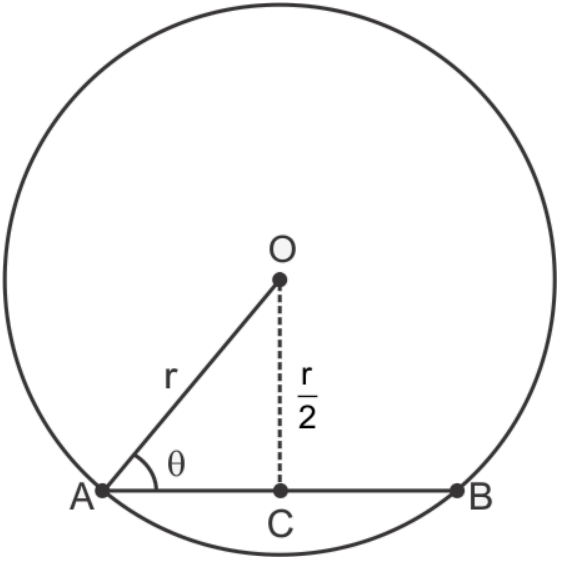
Let $\angle\text{BAO}=\theta$
Consider $\triangle\text{OAC},$
$\sin\theta=\frac{\text{OC}}{\text{OA}}=\frac{\frac{\text{r}}{2}}{\text{r}}$
$=\frac{1}{2}=\sin30^\circ$
$\Rightarrow\theta=30^\circ$ View full question & answer→MCQ 81 Mark
In a circle with centre $O, AB$ and $CD$ are two diameters perpendicular to each other. The length of chord $AC$ is:
AnswerCorrect option: D. $\frac{1}{\sqrt{2}}\text{AB}$
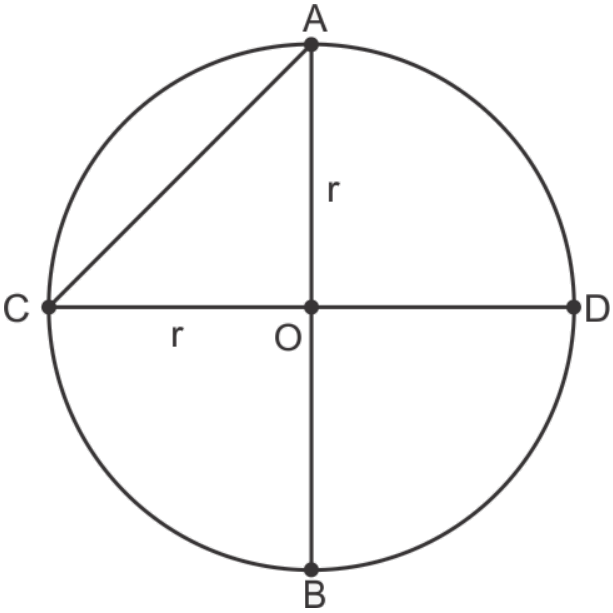
$OC = OA = r ($radius$)$
$AB =$ Diameter $= 2r$
$\text{AC}=\sqrt{(\text{OA})^2+(\text{OC})^2}$
$=\sqrt{\text{r}^2+\text{r}^2}$
$=\sqrt{2}\text{r}$
$=\sqrt{2}\Big(\frac{\text{AB}}2{}\Big)$
$\Rightarrow\text{AC}=\frac{1}{\sqrt2}\text{AB}$ View full question & answer→MCQ 91 Mark
The greatest chord of a circle is called its :
AnswerThe greatest chord of the circle is diameter of the circle.
View full question & answer→MCQ 101 Mark
If two diameters of a circle intersect each other at right angles, then quadrilateral formed by joining their end points is a:
Answer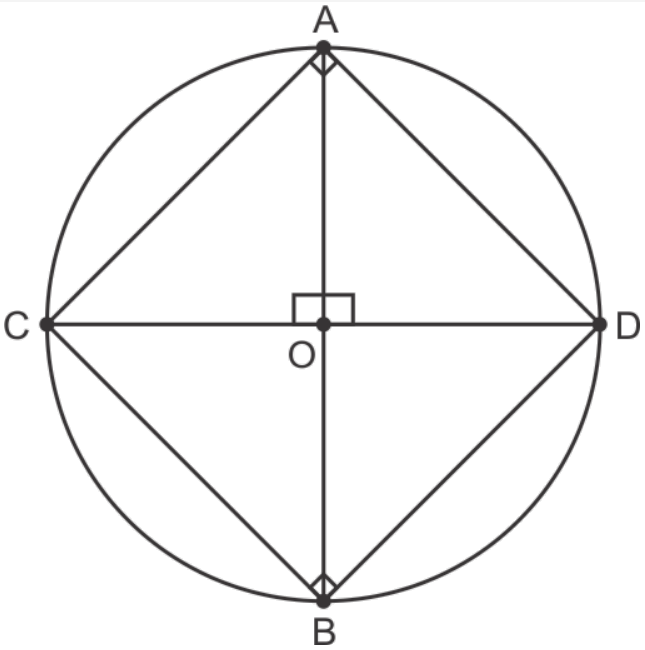
$AB$ and $CD$ are diameters of a circle and diameter makes $90^\circ$ at any point on circle.
$\Rightarrow\angle\text{CAD}=\angle\text{CBD}=\angle\text{BCA}=\angle\text{ADB}=90^\circ$
Also, diagonals $AB$ and $CD$ are perpendicular to each other.
Thus, $\text{ABCD}$ is a square. View full question & answer→MCQ 111 Mark
If $AB, BC$ and $CD$ are equal chords of a circle with $O$ as centre and $AD$ diameter, than $\angle\text{AOB} =$
- ✓
$60^\circ$
- B
$90^\circ$
- C
$120^\circ$
- D
AnswerCorrect option: A. $60^\circ$
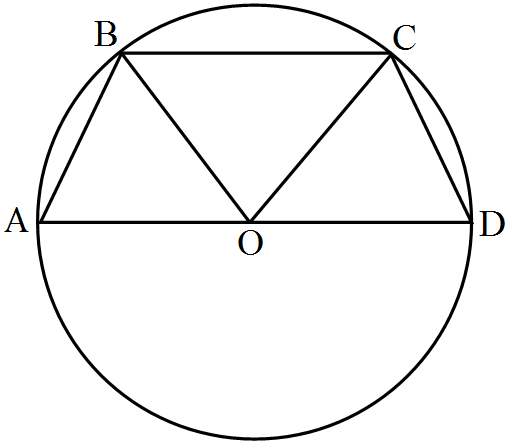
Chord $AB =$ Chord $BC =$ Chord $CD$
$\Rightarrow\angle\text{AOB}=\angle\text{BOC}=\angle\text{COD} ($equal chords subtend equal angles at the center$)$
Now, $\angle\text{AOB}+\angle\text{BOC}+\angle\text{COD}=180^\circ$
$\Rightarrow\angle\text{AOB}+\angle\text{AOB}+\angle\text{AOB}=180^\circ$
$\Rightarrow3\angle\text{AOB}=180^\circ$
$\Rightarrow\angle\text{AOB}=60^\circ$ View full question & answer→MCQ 121 Mark
Let $C$ be the mid $-$ point of an arc $AB$ of a circle such that $\text{m}\widehat{\text{AB}}=183^\circ.$ If the region bounded by the arc $\text{ACB}$ and the line segment $AB$ is denoted by $S,$ then the centre $O$ of the circle lies:
AnswerCorrect option: A. In the interior of $S$.
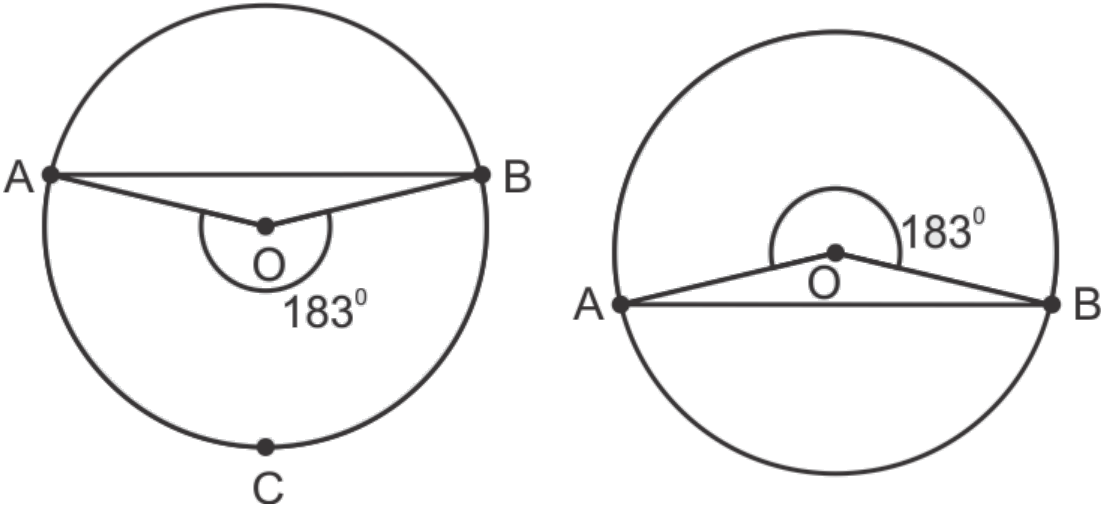
$\text{m}\widehat{\text{AB}}=183^\circ$
$O$ is the center of the circle and $AB$ is a chord.
The region bounded by arc and line segment $AB$ is shaded.
We can see, $'O\ ',$ the center, always lie in the interior of $S$. View full question & answer→MCQ 131 Mark
In the given figure, chords $AD$ and $BC$ intersect each other at right angles at a point $P$. If $\angle\text{DAB} = 35^\circ,$ then $\angle\text{ADC}=$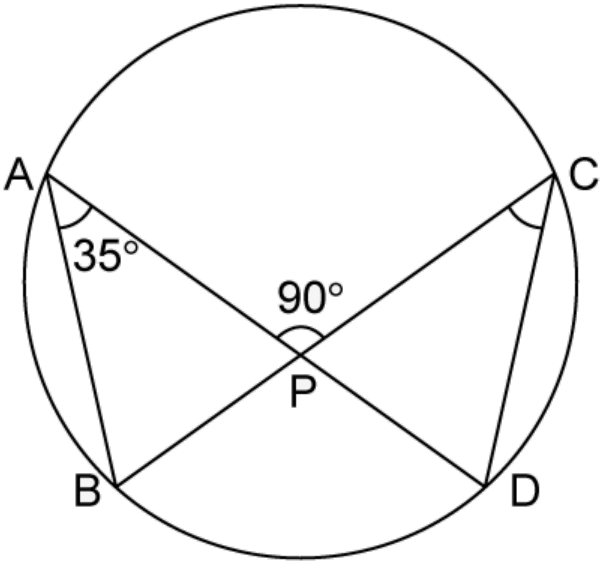
- A
$35^\circ$
- B
$45^\circ$
- ✓
$55^\circ$
- D
$65^\circ$
AnswerCorrect option: C. $55^\circ$
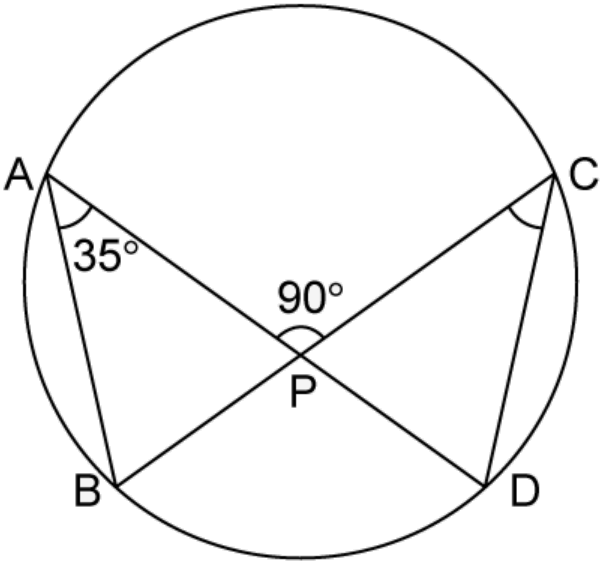
$\angle\text{APC}+\angle\text{APB}=180^\circ$
$\Rightarrow\angle\text{APB}=180^\circ-90^\circ=90^\circ$
In $\triangle\text{APB},$
$\angle\text{ABP}=180^\circ-\angle\text{APB} -\angle\text{BAP}$
$180^\circ-90^\circ-35^\circ=55^\circ$
Now Arc $\widehat{\text{AC}}$ makes $\angle\text{ABC}$ and $\angle\text{ADC}$ on circle.
$\Rightarrow\text{ABC}=\angle\text{ADC}$
$\Rightarrow\angle\text{ADC}=55^\circ$ View full question & answer→MCQ 141 Mark
The chord of a circle is equal to its radius. The angle subtended by this chord at the minor arc of the circle is:
- A
$60^\circ$
- B
$75^\circ$
- C
$120^\circ$
- ✓
$150^\circ$
AnswerCorrect option: D. $150^\circ$
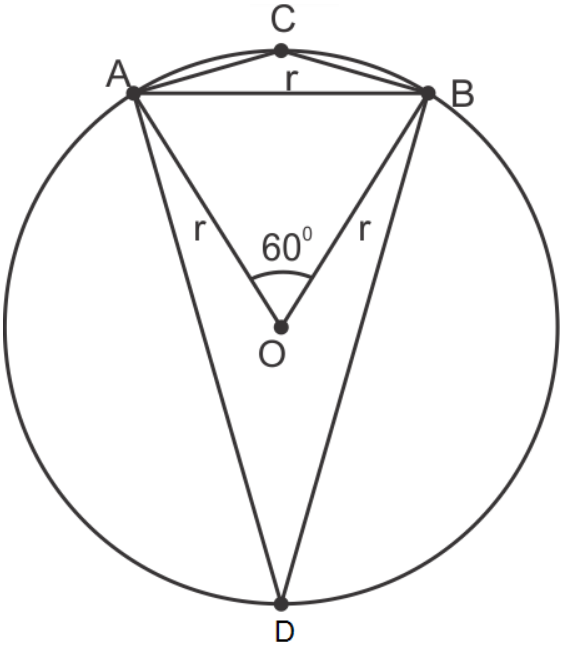
$\angle\text{AOB}=60^\circ$
$($Since $ \triangle\text{AOB}$ is equilateral triangle$)$
Now, $\angle\text{ADB}=30^\circ$
$($Since chord $AB$ makes $60$ at centre, same chord will make half of the angle at circumference of angle made at centre$)$
Now $\angle\text{ACB}$ is angle made by chord at minor arc of circle.
$\text{ABCD}$ is cyclic Quadrilateral.
$\Rightarrow\angle\text{C}+\angle\text{D}=180^\circ$
$\Rightarrow\angle\text{ACB}+\angle\text{ADB}=180^\circ$
$\Rightarrow\angle\text{ACB}=180^\circ-30^\circ=150^\circ$ View full question & answer→MCQ 151 Mark
$AB$ and $CD$ are two parallel chords of a circle with centre $O$ such that $AB = 6\ cm$ and $CD = 12\ cm$. The chords are on the same side of the centre and the distance between them is $3\ cm$. The radius of the circle is:
- A
$6\text{ cm}$
- B
$5\sqrt{2}\text{ cm}$
- C
$7\text{ cm}$
- ✓
$3\sqrt{5}\text{ cm}$
AnswerCorrect option: D. $3\sqrt{5}\text{ cm}$
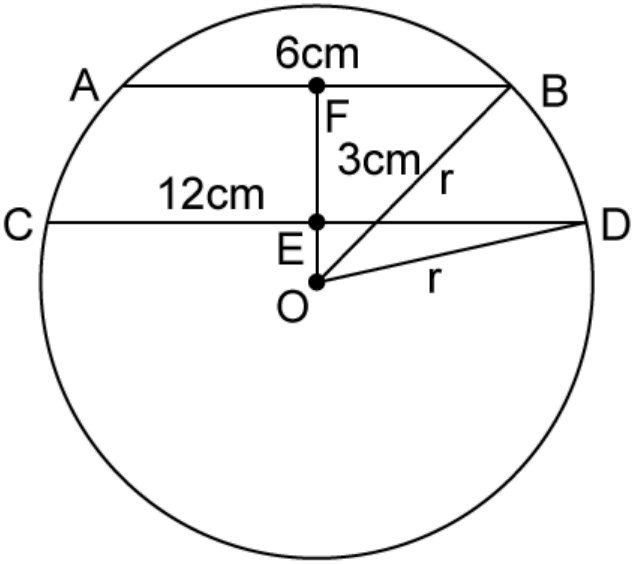
$OB$ and $OD$ are the radii of a circle.
In $\triangle\text{OED},$
$\text{r}^2=\text{OE}^2+\text{ED}^2=\text{OE}^2+(6)^2$
$\Rightarrow\text{OE}=\sqrt{\text{r}^2-36}\dots(1)$
In $\triangle\text{OFB},$
$\text{r}^2=\text{OF}^2+\text{BF}^2=\text{OF}^2+(3)^2$
$\Rightarrow\text{OF}=\sqrt{\text{r}^2-9}\dots(2)$
$\text{OF}-\text{OE}=3\text{ cm}\ ($given$)$
$\sqrt{\text{r}^2-9}-\sqrt{\text{r}^2-36}=3$
$\sqrt{\text{r}^2-9}=\sqrt{\text{r}^2-36}+3\dots(3)$
Squaring equation $(3),$ we have
$\text{r}^2-9=\text{r}^2-36+9+2\times3\sqrt{\text{r}^2-36}$
$\Rightarrow\text{r}^2-9=\text{r}^2-27+6\sqrt{\text{r}^2-36}$
$\Rightarrow18=6\sqrt{\text{r}^2-36}$
$\Rightarrow3=\sqrt{\text{r}^2-36}$
$\Rightarrow9=\text{r}^2-36$
$\Rightarrow\text{r}=\sqrt{45}=3\sqrt{5}\text{ cm}$ View full question & answer→MCQ 161 Mark
If $A$ and $B$ are two points on a circle such that $\text{m}\big(\widehat{\text{AB}}\big)=260^\circ. A$ possible value for the angle subtended by arc $BA$ at a point on the circle is:
- A
$100^\circ$
- B
$75^\circ$
- ✓
$50^\circ$
- D
$25^\circ$
AnswerCorrect option: C. $50^\circ$
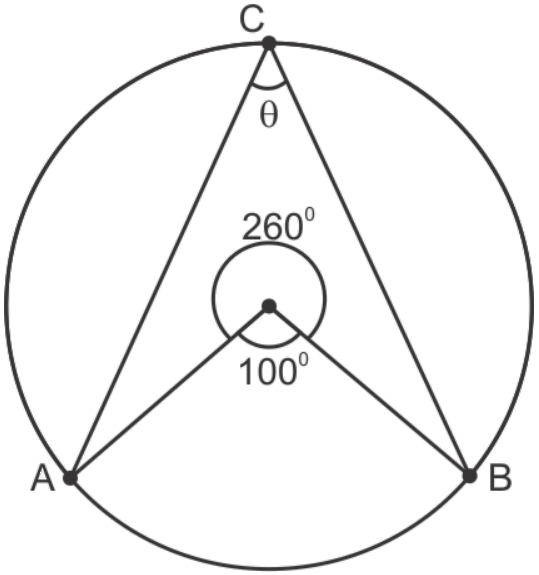
$\text{m}\big(\widehat{\text{AB}}\big)=260^\circ$
$\Rightarrow\text{m}\big(\widehat{\text{BA}}\big)=100^\circ$
Now Let $\widehat{\text{BA}}$ subtend an angle $\theta$ at a point $C$ on circle.
Now, we know that angle subtend by an arc at the center is double the angle subtended at any point on the circle.
$\Rightarrow100^\circ=2\theta$
$\Rightarrow\theta=50^\circ$ View full question & answer→MCQ 171 Mark
If $AB$ is a chord of a circle, $P$ and $Q$ are the two points on the circle different from $A$ and $B,$ then:
- A
$\angle\text{APB}=\angle\text{AQB}$
- ✓
$\angle\text{APB}+\angle\text{AQB}=180^\circ$ or $\angle\text{APB}=\angle\text{AQB}$
- C
$\angle\text{APB}+\angle\text{AQB}=90^\circ$
- D
$\angle\text{APB}+\angle\text{AQB}=180^\circ$
AnswerCorrect option: B. $\angle\text{APB}+\angle\text{AQB}=180^\circ$ or $\angle\text{APB}=\angle\text{AQB}$
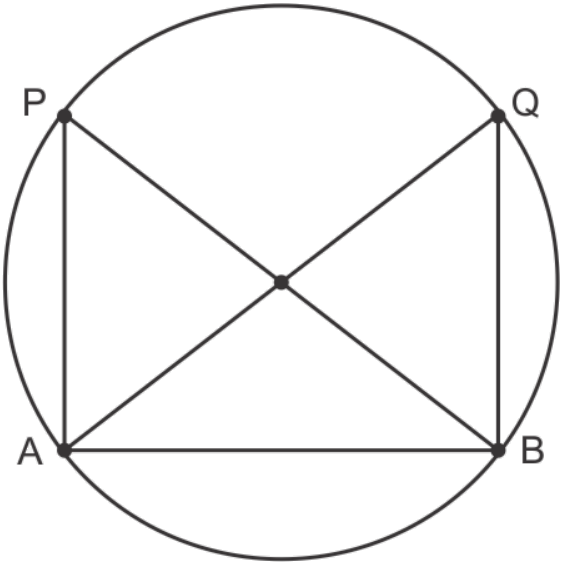
$\angle\text{APB}$ and $\angle\text{AQB}$ are on the same arc.
$\Rightarrow\angle\text{APB}=\angle\text{AQB}$
But, if $AB =$ diameter, then $\angle\text{APB}=\angle\text{AQB}=90^\circ$
$($Because diameter makes Right angle at any point on circumference of circle$)$
$\angle\text{APB}+\angle\text{AQB}=180^\circ$ View full question & answer→MCQ 181 Mark
In a circle, the major arc is $3$ times the minor arc. The corresponding central angles and the degree measures of two arcs are:
- ✓
$90^\circ$ and $270^\circ$
- B
$90^\circ$ and $90^\circ$
- C
$270^\circ$ and $90^\circ$
- D
$60^\circ$ and $210^\circ$
AnswerCorrect option: A. $90^\circ$ and $270^\circ$
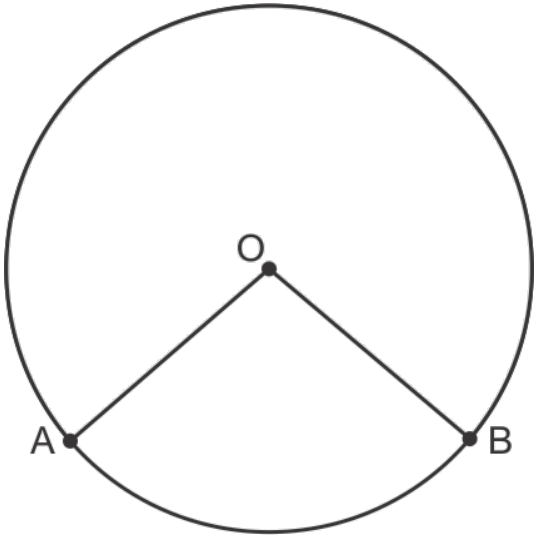
$\frac{\widehat{\text{AB}}\text{ minor}}{\widehat{\text{AB}}\text{ major}}=\frac{1}{3}=\frac{\angle\widehat{\text{AB}}\text{ minor}}{\angle\widehat{\text{AB}}\text{ major}}$
Let $\angle\widehat{\text{AB}}\text{ minor}=\text{x}$
$\Rightarrow\angle\widehat{\text{AB}}\text{ major}=\text{3x}$
Now we know $x + 3x = 360^\circ$
$\Rightarrow 4x = 360^\circ$
$\Rightarrow x = 90^\circ$
$\Rightarrow 3x = 270^\circ$ View full question & answer→MCQ 191 Mark
In a circle of radius $17cm,$ two parallel chords are drawn on opposite side of a diameter. The distance between the chords is $23cm$. If the length of one chord is 16cm, then the length of the other is:
- A
$34cm.$
- B
$15cm.$
- C
$23cm.$
- ✓
$30cm.$
AnswerCorrect option: D. $30cm.$
$30cm.$
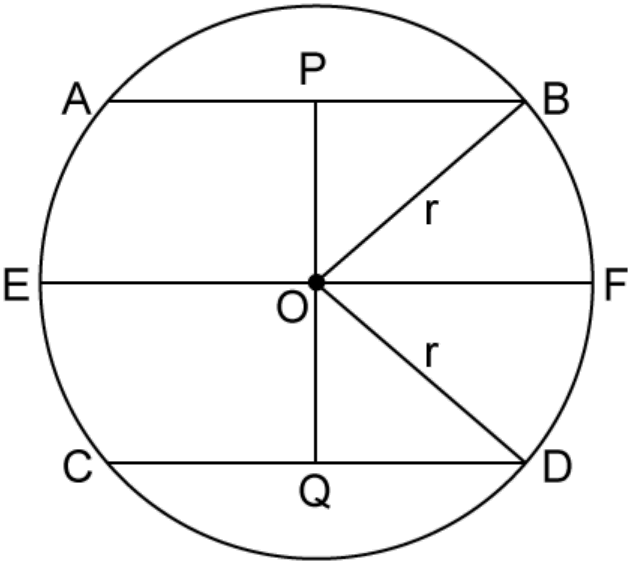
$PQ = 23cm$
$AB = 16cm$
$\Rightarrow BP = AP = 8cm$
$r = 17cm$
$\Rightarrow EF = diameter = 2r = 34cm$
Consider $\triangle\text{OPB},$
$r^2 = OP^2 + BP^2$
$\Rightarrow OP^2= (17)^2 - (8)^2 = 289 - 64 = 225$
$\Rightarrow OP = 15cm$
$\Rightarrow OQ = 23 - 15 = 8cm$
Consider $\triangle\text{OQD},$
$r^2 = OQ^2 + QD^2$
$\Rightarrow QD^2= r^2 - OQ^2 = (17)^2 - (8)^2= 225$
$\Rightarrow OD = 15cm$
$\Rightarrow CD = 2 \times QD = 30cm$ View full question & answer→MCQ 201 Mark
If $\text{ABC}$ is an arc of a circle and $\angle\text{ABC} = 135^\circ,$ then the ratio of arc $\widehat{\text{ABC}}$ to the circumference is:
- ✓
$1 : 4$
- B
$3 : 4$
- C
$3 : 8$
- D
$1 : 2$
AnswerCorrect option: A. $1 : 4$
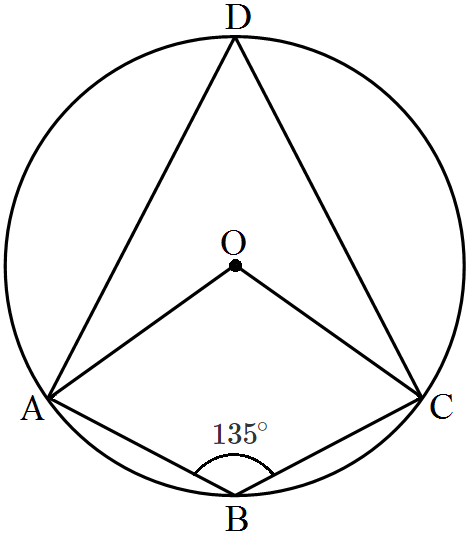
$\text{ABC}$ is an arc of circle.
Take point $D$ in the altrenative segment and join $AD$ and $CD$.
$\angle\text{ABC}=135^\circ ($Given$)$
$\angle\text{ABC}+\angle\text{ADC}=180^\circ ($Sum of opposite angles of cyclic quadrilateral is $180^\circ )$
$\Rightarrow\angle\text{ADC}=180^\circ-\angle\text{ABC}$
$ =180^\circ-135^\circ=45^\circ$
Now, $\angle\text{AOC}=2\times\angle\text{ADC}$
$=2\times45^\circ=90^\circ$
$\widehat{\text{ABC}}=$ measure of the central angle $=\angle\text{AOC}=90^\circ$
$\Rightarrow\text{Required ratio}=\frac{\text{arc}\widehat{\text{ABC}}}{\text{circumference}}$
$=\frac{90^\circ}{360^\circ}=\frac{1}{4}=1:4$ View full question & answer→MCQ 211 Mark
In the given figure, $O$ is the centre of the circle and $\angle\text{BDC} = 42^\circ.$ The measure of $\angle\text{ACB}$ is: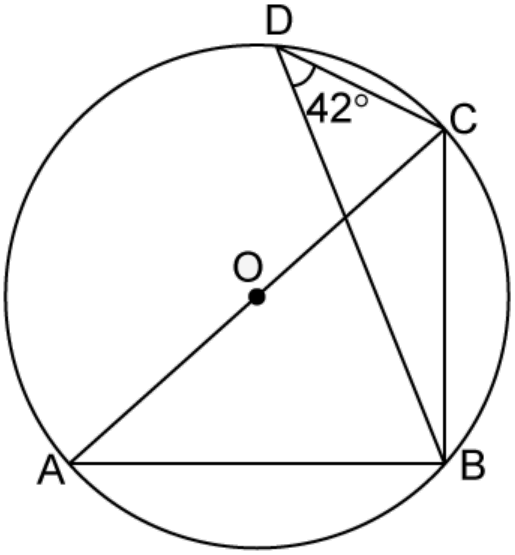
- A
$42^\circ$
- ✓
$48^\circ$
- C
$58^\circ$
- D
$52^\circ$
AnswerCorrect option: B. $48^\circ$
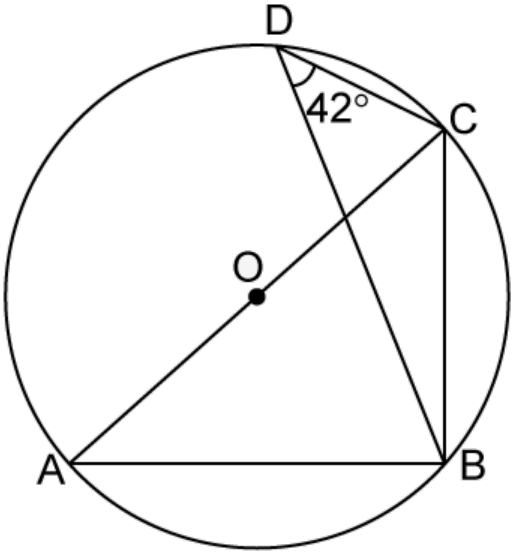
$\angle\text{ABC}=90^\circ ...($ Diameter $AC$ makes $90^\circ$ at circumference$)$
$\angle\text{CDB}=\angle\text{CAB} ..... ($Angles on the same arc$)$
$\Rightarrow\angle\text{CAB}=42^\circ$
In $\triangle\text{ABC},$
$\angle\text{ACB}=180^\circ-90^\circ-42^\circ=48^\circ$ View full question & answer→MCQ 221 Mark
An equilateral triangle $\text{ABC}$ is inscribed in a circle with centre $O$. The measures of $\angle\text{BOC}$ is:
- A
$30^\circ$
- B
$60^\circ$
- C
$90^\circ$
- ✓
$120^\circ$
AnswerCorrect option: D. $120^\circ$
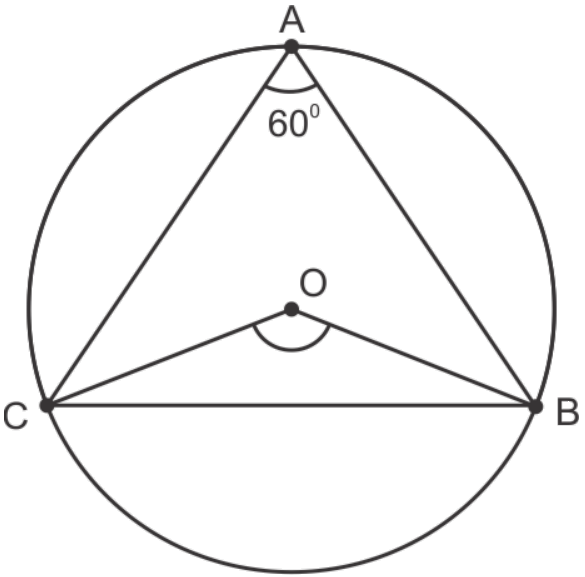
$\angle\text{BAC}=60^\circ ($Angle of equilateral triangle$)$
Arc $\widehat{\text{BC}}$ makes angle $\angle\text{BAC}$ at circle and $\angle\text{BOC}$ at center of circle.
$\Rightarrow\angle\text{BAC}=\frac{1}{2}\angle\text{BOC}$
$\Rightarrow2\times\angle\text{BAC}=\angle\text{BOC}$
$\Rightarrow2\times60^\circ=\angle\text{BOC}$
$\Rightarrow\angle\text{BOC}=120^\circ$ View full question & answer→MCQ 231 Mark
In the given figure, if chords $AB$ and $CD$ of the circle intersect each other at right angles, then $x + y =$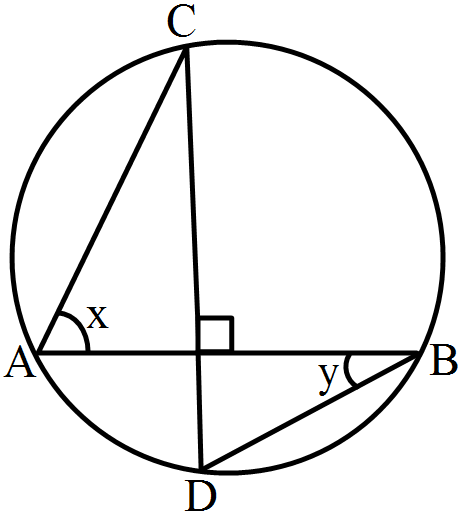
- A
$45^\circ$
- B
$60^\circ$
- C
$75^\circ$
- ✓
$90^\circ$
AnswerCorrect option: D. $90^\circ$
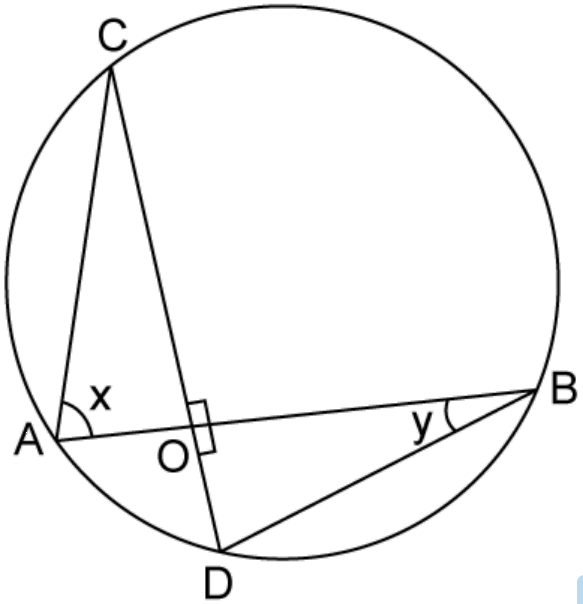
$\angle\text{CAB}=\angle\text{CDB}=\text{x}^\circ ...($Both are on the same arc$)$
Consider $\triangle\text{ODB},$
$\angle\text{DOB}=90^\circ,\ \angle\text{OBD}=\text{y},\ \angle\text{ODB}=\text{x}$
In $\triangle\text{ODB},$
$x + y + 90^\circ = 180^\circ$
$\Rightarrow x + y = 90^\circ$ View full question & answer→MCQ 241 Mark
Angle formed in minor segment of a circle is:
Answer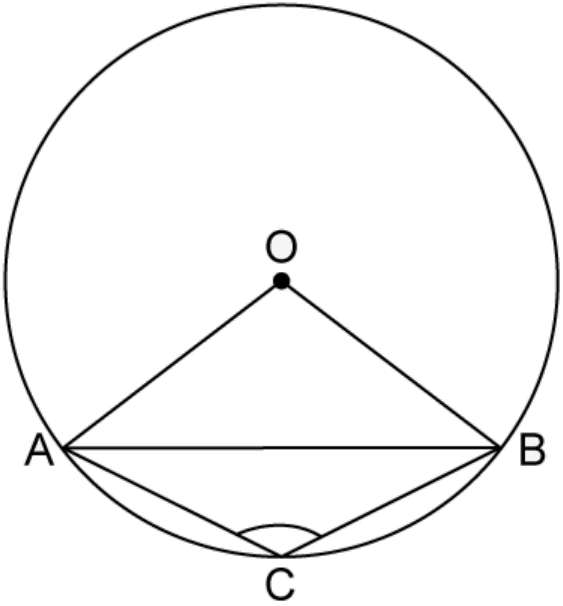
Angle formed in a minor segment is always a obtuse angle.
View full question & answer→MCQ 251 Mark
Number of circles that can be drawn through three non $-$ collinear points is:
Answer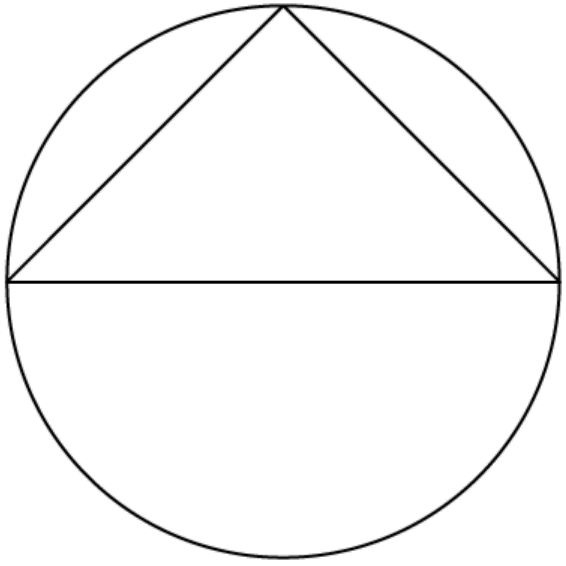
Three non $-$ collinear points make a triangle and there is only one circle that can pass through all three points,
i.e. circumcircle of that triangle. View full question & answer→MCQ 261 Mark
In the given figure, $O$ is the centre of the circle such that $\angle\text{AOC} = 130^\circ,$ then $\angle\text{ABC} =$
- A
$130^\circ$
- ✓
$115^\circ$
- C
$65^\circ$
- D
$165^\circ$
AnswerCorrect option: B. $115^\circ$
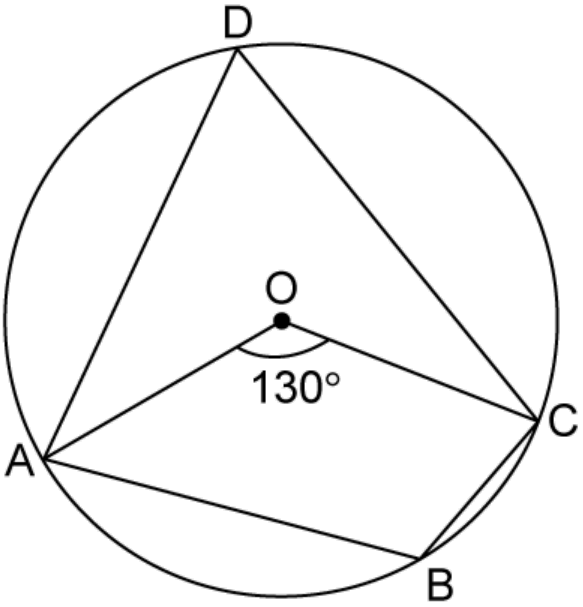
$\angle\text{ADC}=\frac{1}{2}\angle\text{AOC}$
$\big\{\angle\text{ADC}$ and $\angle\text{AOC}$ are made by same $\widehat{\text{AC}}$ on centre and cricumference$\big\}$
$\Rightarrow\angle\text{ADC}=\frac{1}{2}\times130^\circ=65^\circ$
$\text{ADCB}$ is a cyclic Quadrilateral.
$\Rightarrow\angle\text{D}+\angle\text{B}=180^\circ$
$\Rightarrow\angle\text{ABC}=180^\circ-65^\circ=115^\circ$ View full question & answer→MCQ 271 Mark
One chord of a circle is known to be $10\ cm$. The radius of this circle must be:
AnswerCorrect option: B. Greater than $5\ cm.$
The longest chord of a circle is its diameter.
$\Rightarrow$ Diameter $> 10\ cm$
$\Rightarrow 2 \times$ Radius $> 10\ cm$
$\Rightarrow$ Radius $> 5\ cm$
View full question & answer→MCQ 281 Mark
$\text{PQRS}$ is a cyclic quadrilateral such that $PR$ is a diameter of the circle. If $\angle\text{QPR} = 67^\circ$ and $ \angle\text{SPR} = 72^\circ,$ then $\angle\text{QRS} =$
- ✓
$41^\circ$
- B
$23^\circ$
- C
$67^\circ$
- D
$18^\circ$
AnswerCorrect option: A. $41^\circ$
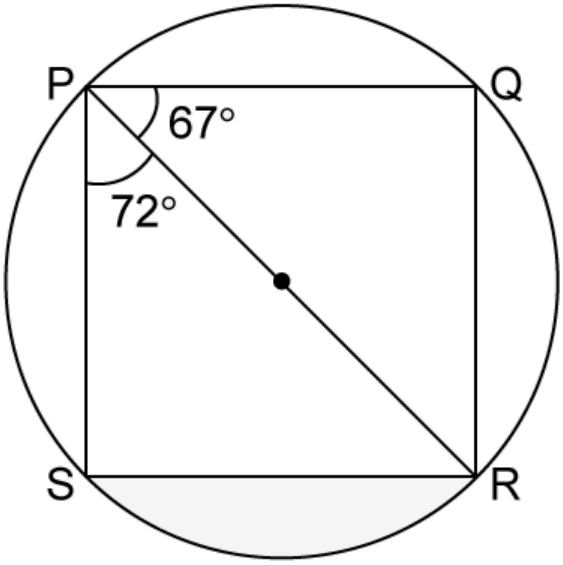
In a cyclic quadrilateral, Opposite angles are supplementary.
$\Rightarrow\angle\text{P}+\angle\text{R}=180^\circ$
Now, $\angle\text{P}=67^\circ+72^\circ=139^\circ$
Thus, $\angle\text{R}=180^\circ-139^\circ=41^\circ$
i.e. $\angle\text{R}=\angle\text{QRS}=41^\circ$ View full question & answer→MCQ 291 Mark
$\text{ABCD}$ is a cyclic quadrilateral such that $\angle\text{ADB} = 30^\circ$ and $\angle\text{DCA} = 80^\circ,$ then $\angle\text{DAB} =$
- ✓
$70^\circ$
- B
$100^\circ$
- C
$125^\circ$
- D
$150^\circ$
AnswerCorrect option: A. $70^\circ$
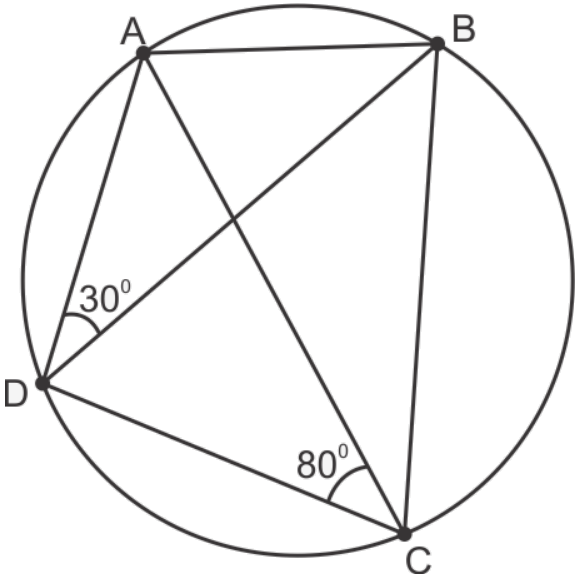
$\text{ABCD}$ is a cyclic Quadrilateral.
Consider $\triangle\text{ABD}$ and $\triangle\text{ABC}.$
Both are on the same base $AB$ and $\angle\text{ADB}$ and $\angle\text{ACB}$ are the angles in the same segment $AB$.
$\Rightarrow\angle\text{ADB}=\angle\text{ACB}=30^\circ$
$\Rightarrow\angle\text{BCD}=80^\circ+30^\circ=110^\circ$
In a cyclic Quadrilateral, sum of opposite angles is $180^\circ$
$\Rightarrow\angle\text{A}+\angle\text{C}=180^\circ$
$\Rightarrow\angle\text{DAB}+\angle\text{BCD}=180^\circ$
$\Rightarrow\angle\text{DAB}=180^\circ-110^\circ=70^\circ$ View full question & answer→