Questions

MCQ(1M)

Take a timed test

20 questions · auto-graded multiple-choice test.

MCQ 11 Mark
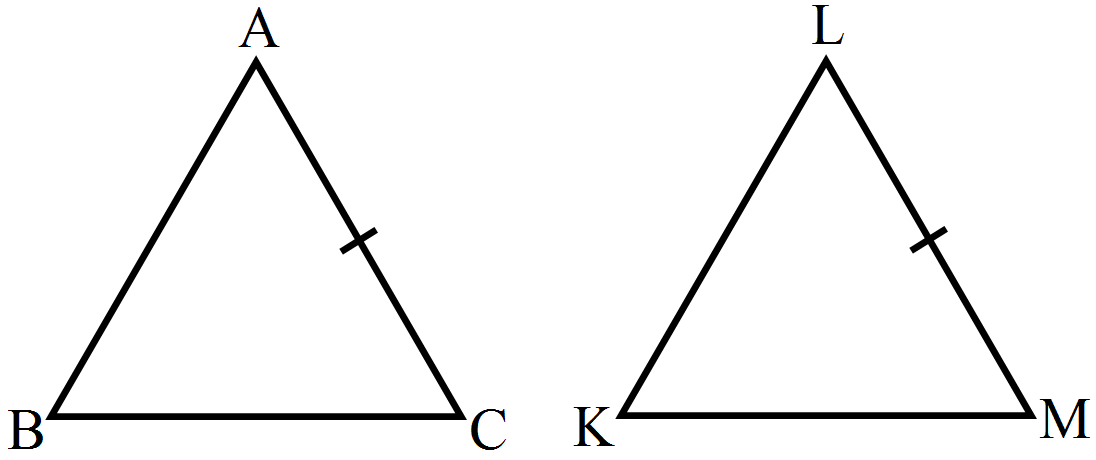
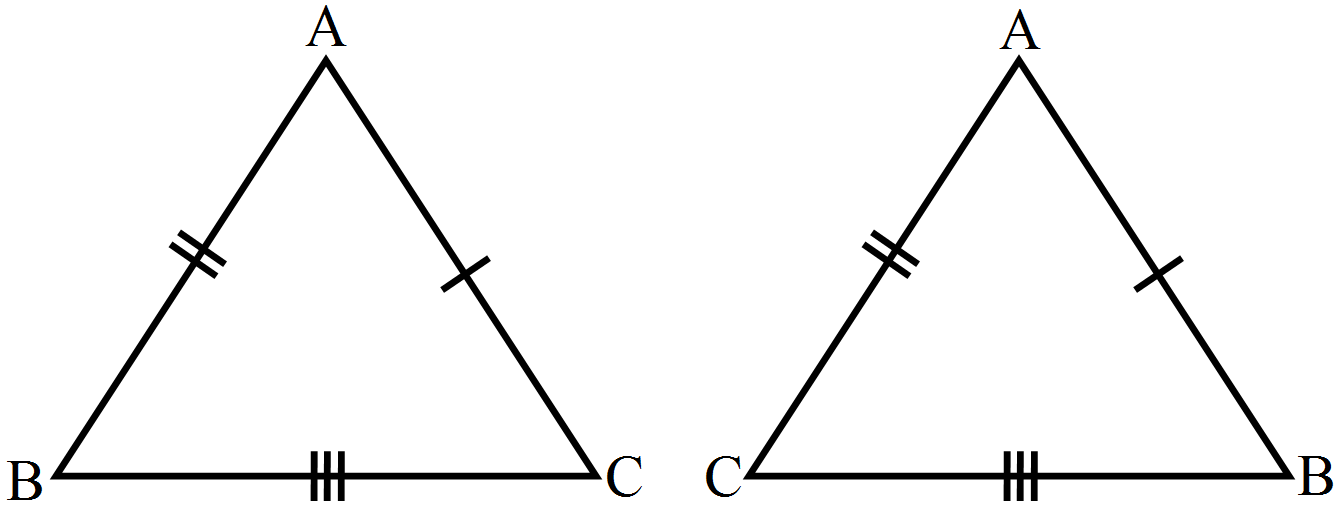
If $\triangle\text{ABC}\cong\triangle\text{LKM},$ then side of $\triangle\text{LKM}$ equal to side $AC$ of $\triangle\text{ABC}$ is:
  • A
    $LK$
  • B
    $KM$
  • $LM$
  • D
    None of these
Answer
Correct option: C.
$LM$

If $\triangle\text{ABC}\cong\triangle\text{LKM},$ then from figure $\text{AC}=\text{LM}.$
Hence, correct option is $(c)$.
View full question & answer
MCQ 21 Mark
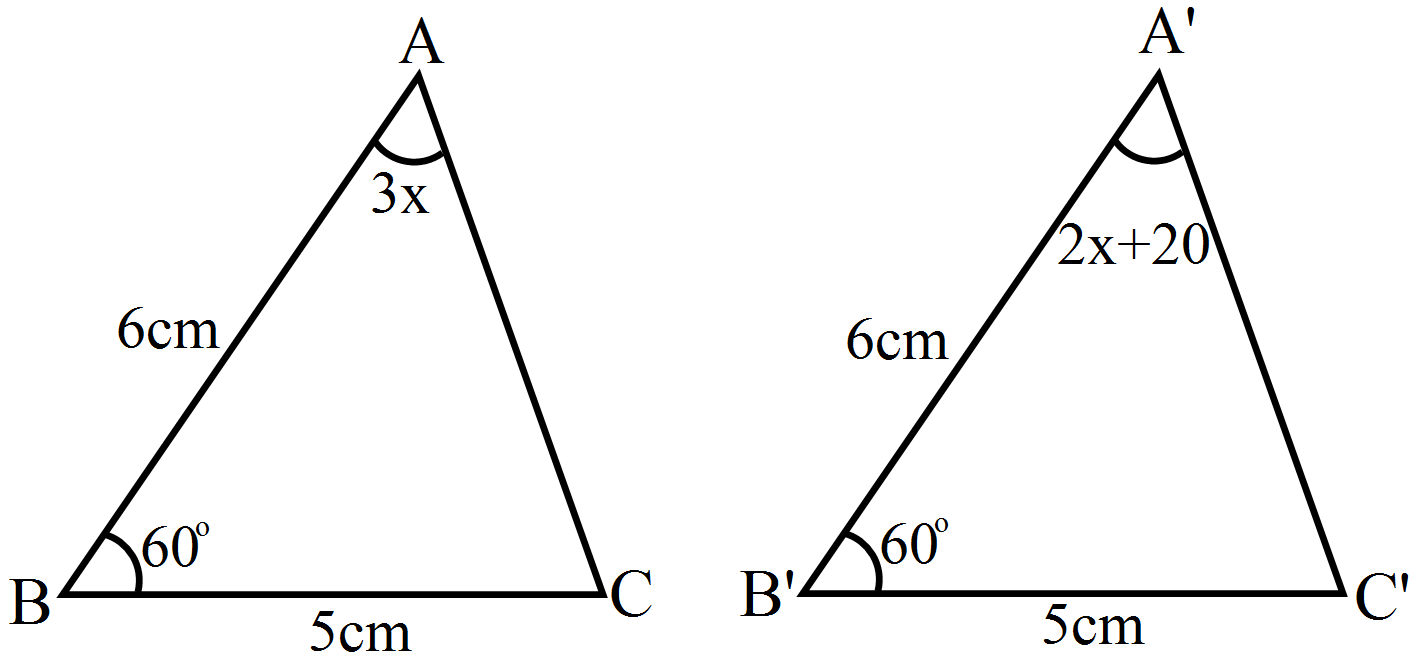
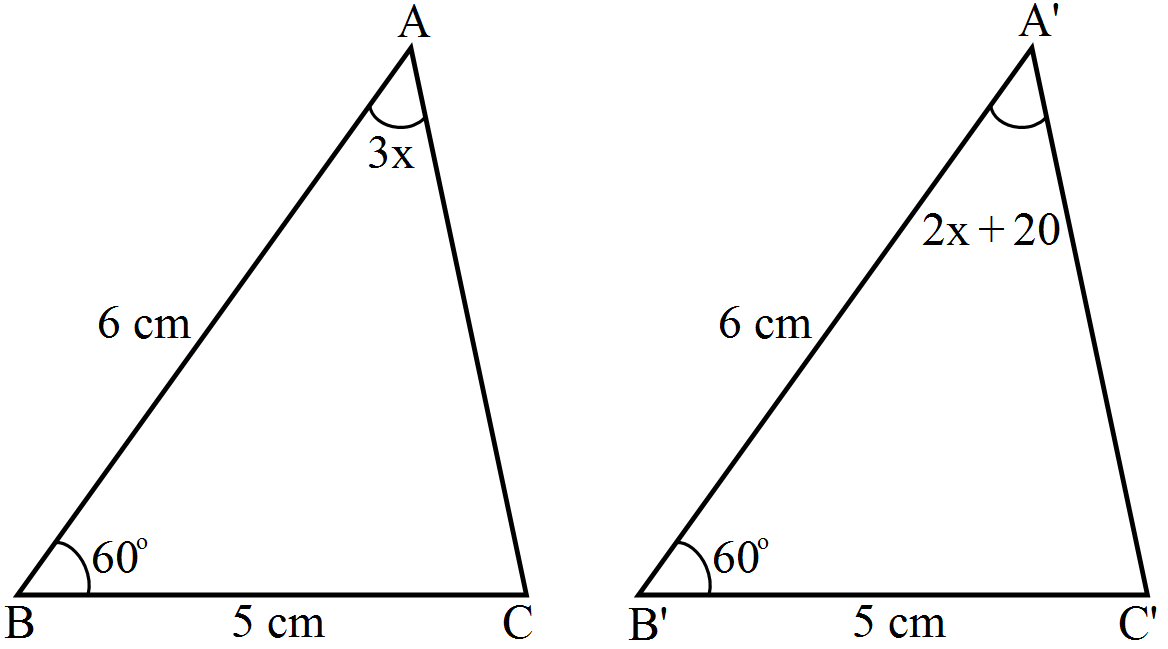
In Fig. The measure of $\angle\text{B}'\text{A}'\text{C}'$ is: 
  • A
    $50^\circ$
  • $60^\circ$
  • C
    $70^\circ$
  • D
    $80^\circ$
Answer
Correct option: B.
$60^\circ$

In $\triangle\text{ABC}$ and $\triangle\text{A}'\text{B}'\text{C},$
$\text{AB}=\text{A}'\text{B}'$
$\text{BC}=\text{B}'\text{C}'$
$\angle\text{ABC}=\angle\text{A}'\text{B}'\text{C}'$
So $\triangle\text{ABC}\cong\triangle\text{A}'\text{B}'\text{C}'$ by $\text{SAS}$ creterion
$\Rightarrow\angle\text{BAC}=\angle\text{B}'\text{A}'\text{C}'$
$\Rightarrow3\text{x}=2\text{x}+20$
$\text{x}=20^\circ$
$2\text{x}+20=2\times20+60^\circ=\angle\text{B}'\text{A}'\text{C}'$
Hence, correct option is $(b)$.
View full question & answer
MCQ 31 Mark
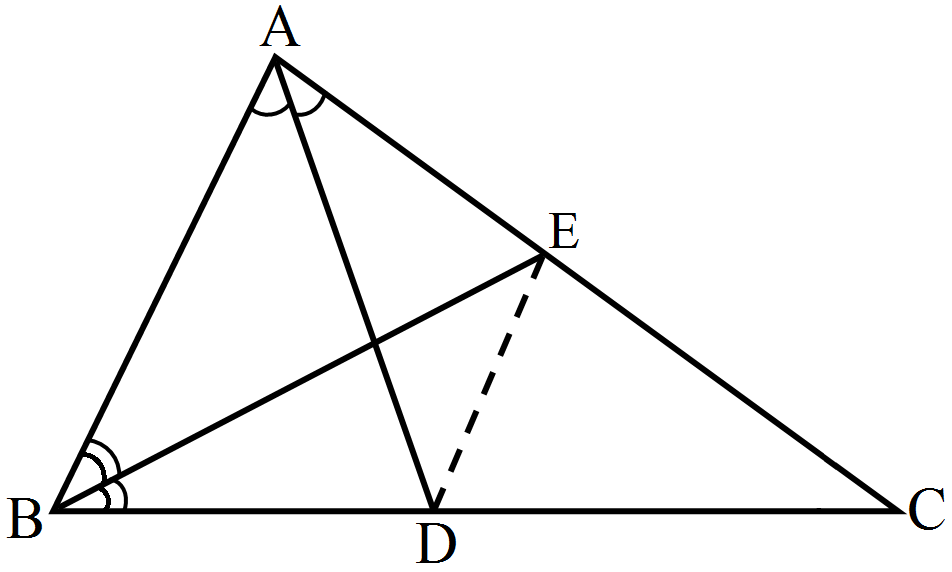
In Fig. $\text{ABC}$ is a triangle in which $\angle\text{B}=2\angle\text{C}. D$ is a point on side $BC$ such that AD bisects $\angle\text{BAC}$ and $\text{AB}=\text{CD}.$ Be is the bisector of $\angle\text{B}.$ The measure of $\angle\text{BAC}$ is:
  • $72^\circ$
  • B
    $95^\circ$
  • C
    $73^\circ$
  • D
    $74^\circ$
Answer
Correct option: A.
$72^\circ$

$\angle\text{ABE}=\angle\text{EBC}$
$(\text{EBC}$ is bisector of $\angle\text{B})$
and $\angle\text{C}=\frac{\angle\text{B}}{2}$
$\Rightarrow\angle\text{EBC}=\angle\text{ECB}$
So $\triangle\text{EBC}$ is isosceles triangle.
$\Rightarrow\text{EB}=\text{EC}\ ....(1)$
Now Consider $\triangle\text{ABE}$ and $\triangle\text{DCE}$
$\text{AB}=\text{DC}\ ($Given$)$
$\text{BE}=\text{CE}\ [$From $(1)]$
$\angle\text{ABE}=\angle\text{DCE} \ ($From above data$)$
So $\triangle\text{ABE}\cong\triangle\text{DCE}$ by $\text{SAS}$ property
$\Rightarrow\text{AE}=\text{DE}$
$\angle\text{BAE}=\angle\text{CDE}=\angle\text{A}$
Now consider $\triangle\text{AED},$
$\text{AE}=\text{DE} \ ($above proved$)$
$\Rightarrow\triangle\text{AED}$ is isosceles triangle
$\Rightarrow\angle\text{EAD}=\angle\text{EDA}=\frac{\angle\text{A}}{2}$
$(AD$ is Bisector of $\angle\text{A})\ ....(2)$
Now, consider $\triangle\text{ABC},$
$\angle\text{A}+\angle\text{B}+\text{C}=180^\circ$
$\Rightarrow\angle\text{A}+2\angle\text{C}+\angle\text{C}=180^\circ(\angle\text{B}=2\angle\text{C)}$
$\Rightarrow\angle\text{A}+3\angle\text{C}=180^\circ\ .....(3)$
Consider $\triangle\text{ADE},$
$\Rightarrow\frac{\angle\text{A}}{2}+\angle\text{ADC}+\angle\text{}\text{C}=180^\circ$
$\Rightarrow\frac{\angle\text{A}}{2}+(\angle\text{EDA}+\angle\text{CDE})+\angle\text{C}=180^\circ$
$\Rightarrow\frac{\angle\text{A}}{2}+\frac{\angle\text{A}}{2}+\angle\text{A}+\angle\text{C}=180^\circ$
$\Rightarrow\angle\text{}A+\angle\text{A}+\angle\text{C}=180^\circ$
$\Rightarrow2\angle\text{A}+\angle\text{C}=180^\circ\ .....(4)$
Right hand side of equations $(3)$ and $(4)$ are equal, hence Left hand side.
$\Rightarrow\angle\text{A}+3\angle\text{C}=2\angle\text{A}+\angle\text{C}$
$\Rightarrow\angle\text{A}=2\angle\text{C}$
Substituting in equation $(3),$
$2\angle\text{C}+3\angle\text{C}=180^\circ$
$\Rightarrow5\angle\text{C}=180^\circ$
$\Rightarrow\angle\text{C}=36^\circ$
$\Rightarrow\angle\text{A}=2\times36^\circ=72^\circ$
Hence, correct option is $(a)$.
View full question & answer
MCQ 41 Mark
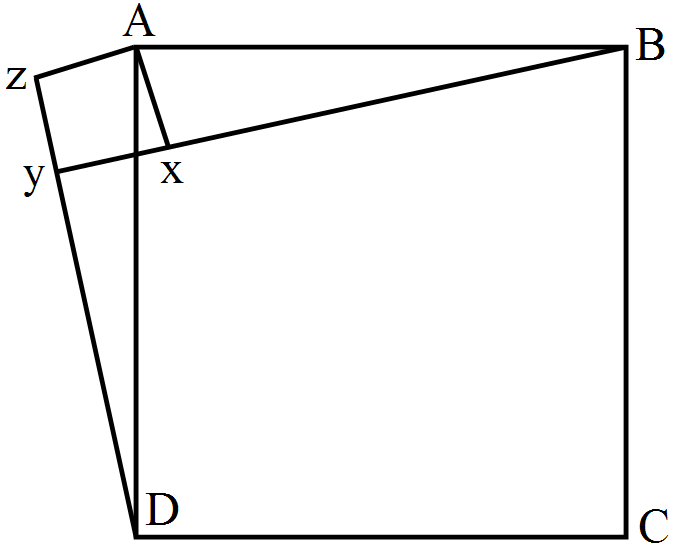
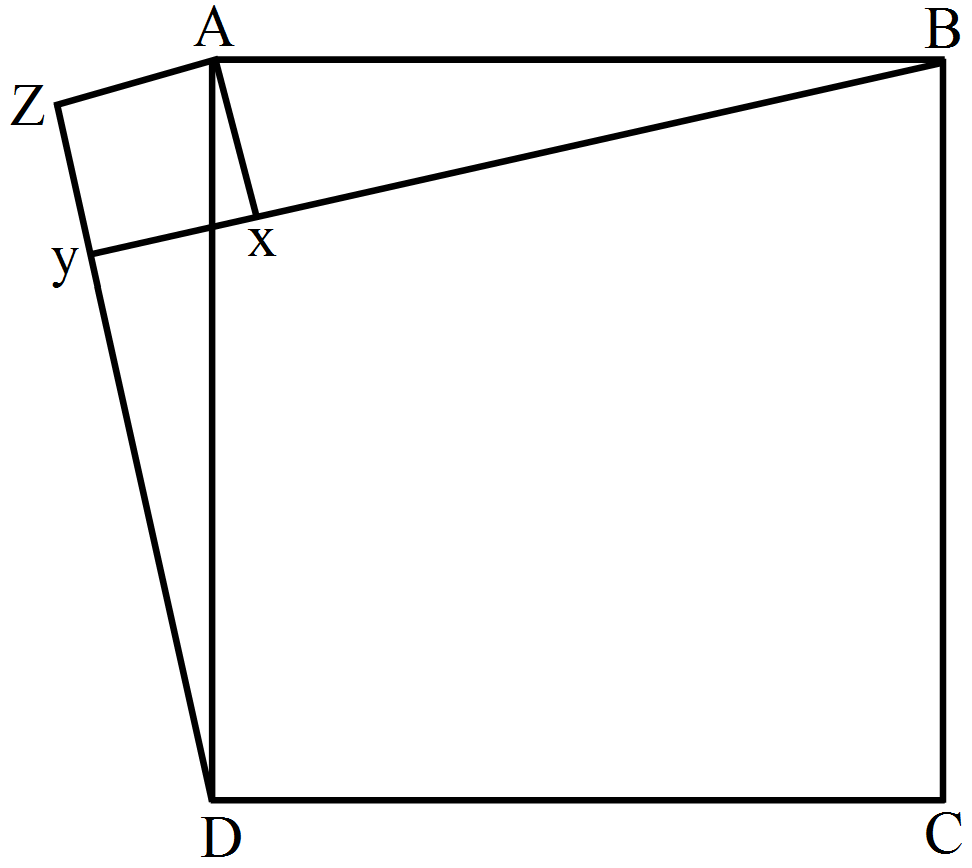
In Fig. $X$ is a point in the interior of square $\text{ABCD. AXYZ}$ is also a square. If $DY = 3\ cm$ and $AZ = 2\ cm$, then $BY =$
  • A
    $5\ cm$
  • B
    $6\ cm$
  • $7\ cm$
  • D
    $8\ cm$
Answer
Correct option: C.
$7\ cm$

Consider $\triangle\text{ AZD}$ and $\triangle\text{AXB}$
$\text{AZ}=\text{AX}=2\text{cm}\ (\text{AXYZ}$ is a square$)$
$\angle\text{AZD}=\angle\text{AXB}=90^\circ$
$\text{AD}=\text{AB}\ (\text{ABCD}$ is a square$)$
So by $\text{RHS}$ creterion, $\triangle\text{AZD}\cong\triangle\text{AXB}$
$\Rightarrow\text{ZD}=\text{XB}$
Now, $\text{ZD}=\text{ZY}+\text{DY}$
$=2\ cm + 3\ cm (ZY = AZ = 2\ cm)$
$=5\ cm$
$\Rightarrow XB = 5\ cm$
$\Rightarrow BY = YX + XB $
$= 2\ cm + 5\ cm = 7\ cm$
Hence, correct option is $(c)$
View full question & answer
MCQ 51 Mark
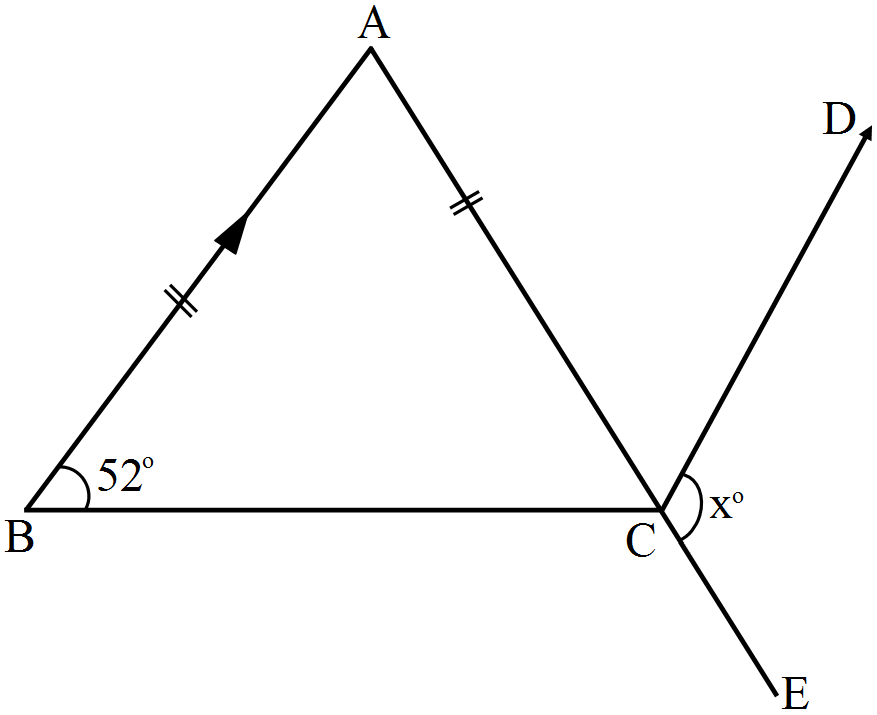
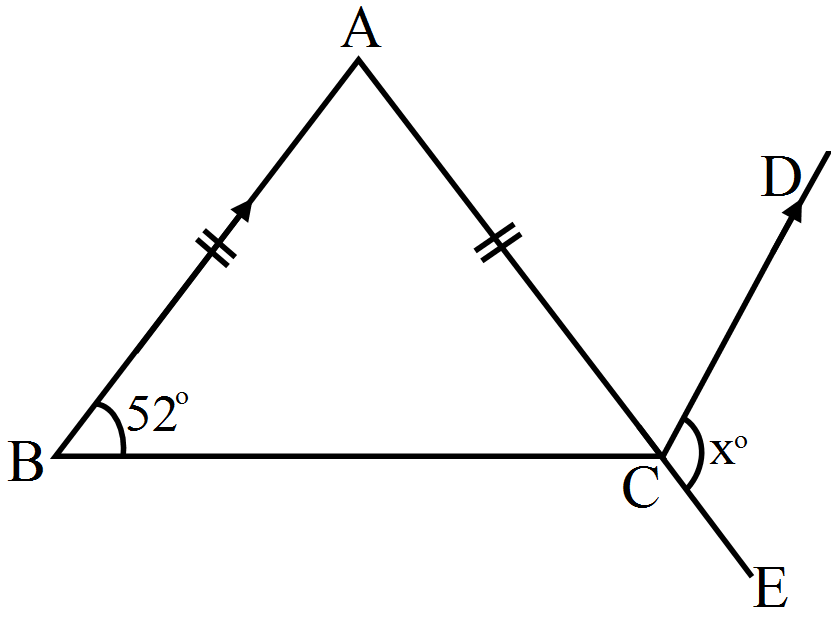
In Fig. $\text{ABC}$ ids an isosceles triangle whose side $AC$ is produced to $E$. Through $C, CD$ is drawn parallel to $BA$. The value of $x$ is:
  • A
    $52^\circ$
  • B
    $76^\circ$
  • C
    $156^\circ$
  • $104^\circ$
Answer
Correct option: D.
$104^\circ$

$\triangle\text{ABC}$ is isosceles
$\angle\text{ABC}=\angle\text{ACB}=52^\circ$
then $\angle\text{BAC}=180^\circ-52^\circ-52^\circ=76^\circ$
If $\text{AB}\parallel\text{CD}, AC$ is transversal
then $\angle\text{BAC}=\angle\text{ACD}\ ($alternate angles$)$
$\Rightarrow\angle\text{ACD}=76^\circ$
Now from figure,
$\angle\text{ACD}+\text{x}^\circ=180^\circ$
$\Rightarrow\text{x}^\circ=180^\circ-76^\circ$
$\Rightarrow\text{x}^\circ=104^\circ$
Hence, correct option is $(d)$.
View full question & answer
MCQ 61 Mark
$D, E, F$ are the mid-point of the sides $BC, CA$ and $AB$ respectively of $\triangle\text{ABC}.$ Then $\triangle\text{DEF}$ is congruent to triangle.
  • A
    $\text{ABC}$
  • B
    $\text{AEF}$
  • C
    $\text{BFD, CDE}$
  • $\text{AFE, BFD, CDE}$
Answer
Correct option: D.
$\text{AFE, BFD, CDE}$
In anytriangle, a line joining the mid $-$ points of any two sides is parallel to the third side.
$\Rightarrow EF \| BC\ \  EF \| DC$ and $BD$
Similiarly $DF \| EC$
$\Rightarrow DF || AE$ and $EC$
Also $DE \| AB.$
$\Rightarrow DE \| AF$ and $BF$
From this information it is clear that $\text{EFDC, EFBD, EAFD}$
are the parallelogram by property.
Now consider one parallelogram $\text{EFDC}$
Consider $\triangle\text{DEF}$ and $\triangle\text{EDC}$
$\text{DE}=\text{ED} \ ($common$)$
$\angle\text{DEF}=\angle\text{EDC}$
$\angle\text{EDF}=\angle\text{DEC} (\text{ASA}$ property$)$
$\Rightarrow\triangle\text{DEF}\cong\triangle\text{EDC}$
Similiarly in parallelogram $\text{EAFD},$
$\triangle\text{DEF}\cong\triangle\text{AFC}$
And in parallelogram $\text{EFBD}$
$\triangle\text{DEF}\cong\triangle\text{FBD}$
Hence, correct option is $(d)$.
Note: Option $(d)$ modified.
View full question & answer
MCQ 71 Mark
If $\text{ABC}$ and $\text{DEF}$ are two triangles such that $\triangle\text{ABC}\cong\triangle\text{FDE}$ and $\text{AB}=5\text{m},\angle\text{B}=40^\circ$ and $\angle\text{A}=80^\circ.$ Then, which of the following is true?
  • A
    $\text{DF}=5\text{ cm},\angle\text{F}=60^\circ$
  • B
    $\text{DE}=5\text{ cm},\angle\text{E}=60^\circ$
  • $\text{DF}=5\text{ cm},\angle\text{E}=60^\circ$
  • D
    $\text{DE}=5\text{ cm},\angle\text{D}=40^\circ$
Answer
Correct option: C.
$\text{DF}=5\text{ cm},\angle\text{E}=60^\circ$
In $\triangle\text{ABC},$
$\angle\text{C}=180^\circ-\angle\text{A}+\angle\text{B}=180^\circ-80^\circ-40^\circ=60^\circ$
$\triangle\text{ABC}\cong\triangle\text{FDE}$
$\Rightarrow\text{AB}=\text{FD}=5\text{ cm}$
$\Rightarrow\angle\text{B}=\angle\text{D}=40^\circ$
$\Rightarrow\angle\text{A}=\angle\text{F}=80^\circ$
$\Rightarrow\angle\text{C}=\angle\text{E}=60^\circ$
$\Rightarrow\text{DF}=\text{FD}=5\text{ cm}$ and $\angle\text{E}=60^\circ$
Hence, correct option is $(c).$
View full question & answer
MCQ 81 Mark
In an isosceles triangle, if the vertex angle is twice the sum of the base angles, then the measure of vertex angle of the triangle is:
  • A
    $100^\circ$
  • $120^\circ$
  • C
    $110^\circ$
  • D
    $130^\circ$
Answer
Correct option: B.
$120^\circ$
Let $\triangle\text{ABC}$ be an isosceles triangle with
vertex angle $= \angle\text{A}$ and base angles $=\angle\text{B}$ and $\angle\text{C}$
Now, $\angle\text{A}=2(\angle\text{B}+\angle\text{C})$
$\Rightarrow\frac{\angle\text{A}}{2}=\angle\text{B}+\angle\text{C}\ ....(1)$
Also in $\triangle\text{ABC},$
$\angle\text{A}+\angle\text{B}+\angle\text{C}=180^\circ$
$\Rightarrow\angle\text{A}+(\angle\text{B}+\angle\text{C})=180^\circ$
$\Rightarrow\angle\text{A}+\frac{\angle\text{A}}{2}=180^\circ .....[$From $(1)]$
$\Rightarrow\frac{3}{2}\angle\text{A}=180^\circ$
$\Rightarrow\angle\text{A}=\frac{180^\circ\times2}{3}$
$\Rightarrow\angle\text{A}=120^\circ$
Hence, correct option is $(b)$.
View full question & answer
MCQ 91 Mark
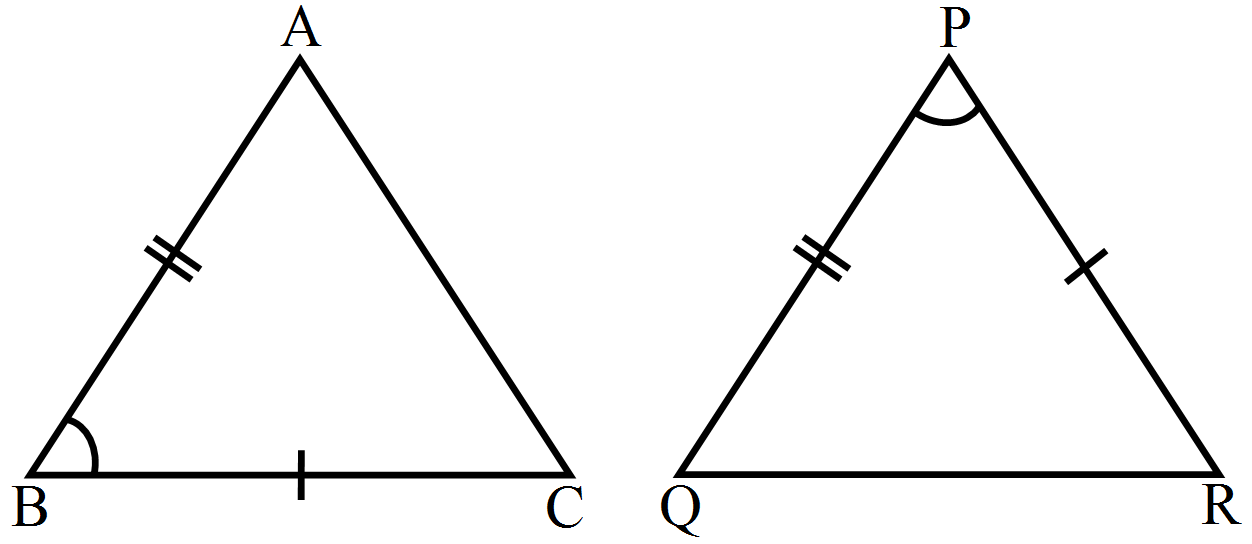
In triangles $\text{ABC}$ and $\text{PQR}$ three equality relation between some parts are as follows : $\text{AB}=\text{QP},\angle\text{B}=\angle\text{P}$ and $\text {BC}=\text{PR}$ State which of the congruence conditions applies:
  • $\text{SAS}$
  • B
    $\text{ASA}$
  • C
    $\text{SSS}$
  • D
    $\text{RHS}$
Answer
Correct option: A.
$\text{SAS}$

From given conditions, we have
$\text{AB}=\text{PQ}$
$\text{BC}=\text{PR}$
And the angle between these sides are also equal
i.e. $\angle\text{B}=\angle\text{P}$
So $\text{SAS}$ property.
Hence, correct option is $(a)$.
View full question & answer
MCQ 101 Mark
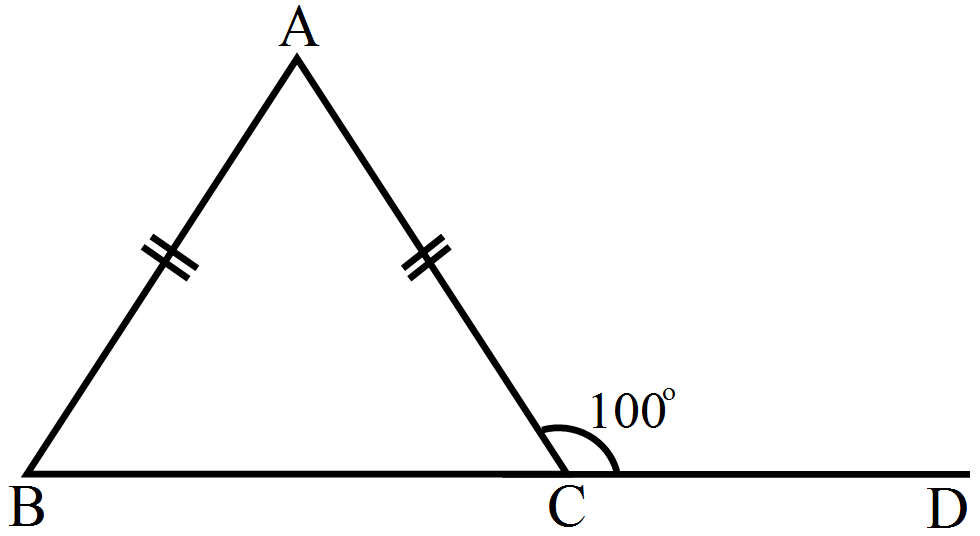
In a $\triangle\text{ABC},$ if $\text{AB}=\text{AC}$ and $BC$ is produced to $D$ such that $\angle\text{ACD}=100^\circ$ then $\angle\text{A}=$
  • $20^\circ$
  • B
    $40^\circ$
  • C
    $60^\circ$
  • D
    $80^\circ$
Answer
Correct option: A.
$20^\circ$

$\text{AB}=\text{AC}$
$\Rightarrow\angle\text{ABC}=\angle\text{ACB} \ ($Isoscles $\triangle$ Property$)$
$\angle\text{ACB}=180^\circ-100^\circ=80^\circ$
$\Rightarrow\angle\text{ABC}-=\angle\text{ACB}=80^\circ$
$\angle\text{A}=180^\circ-\angle\text{ACB}-\angle\text{ABC}$
$=180^\circ-80^\circ-80^\circ=20^\circ$
Hence, correct option is $(a)$.
View full question & answer
MCQ 111 Mark
If $\triangle\text{ABC}\cong\triangle\text{PQR}$ and $\triangle\text{ABC}$ is not congruent to $\triangle\text{RPQ},$ then which of the following is not true:
  • $BC = PQ$
  • B
    $AC = PR$
  • C
    $AB = PQ$
  • D
    $RQ = BC$
Answer
Correct option: A.
$BC = PQ$
$\triangle\text{ABC}\cong\triangle\text{PQR}$
$\Rightarrow\text{AB}=\text{PR},\text{AC}=\text{PR},\text{BC}=\text{QR}$
$\triangle\text{ABC}\not\cong\triangle\text{RQP}$
$\Rightarrow\text{AB}\not=\text{QR},\text{AC}\not=\text{RP},\text{BC}\not=\text{PQ}$
Hence, correct option $(a)$.
View full question & answer
MCQ 121 Mark
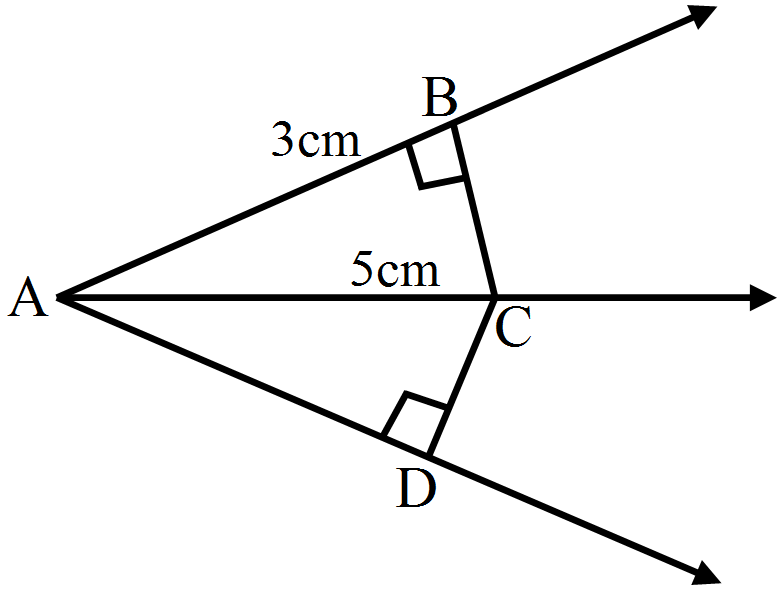
In Fig, if $AC$ is bisector of $\angle\text{BAD}$ such that $AB = 3\ cm$ and $AC = 5\ cm$, then $CD =$
  • A
    $2\ cm$
  • B
    $3\ cm$
  • $4\ cm$
  • D
    $5\ cm$
Answer
Correct option: C.
$4\ cm$

Consider $\triangle\text{ABC}$ and $\triangle\text{ADC}$
$\angle\text{ABC}=\angle\text{ADC}=90^\circ$
$\angle\text{BAC}=\angle\text{CAD}$ $( AC$ is bisector of $\angle\text{A})$
Also if two angles are equal, then the third angle will also be equal.
$\Rightarrow\angle\text{BCA}=\angle\text{DCA}$
Now, $\text{AC}=\text{AC} \ ($common$)$
So by $\text{ASA}$ property, $\triangle\text{ABC}\cong\triangle\text{ADC}$
$\Rightarrow\text{BC}=\text{CD}$
And $,BC =\sqrt{\text{AC}^2-\text{AB}^2}$
$=\sqrt{25-9}=4\text{ cm}$
$\Rightarrow\text{CD}=4\text{ cm}$
Hence, correct option is $(c)$.
View full question & answer
MCQ 131 Mark
If $\triangle\text{PQR}\cong\triangle\text{EFD},$ then $ED =$
  • A
    $PQ$
  • B
    $QR$
  • $PR$
  • D
    None of these
Answer
Correct option: C.
$PR$
$\triangle\text{PQR}\cong\triangle\text{EFD},$
$\Rightarrow\text{ED}=\text{PR}\ ($congruent sides of congruent triangles$)$
Hence, correct option is $(c)$
View full question & answer
MCQ 141 Mark
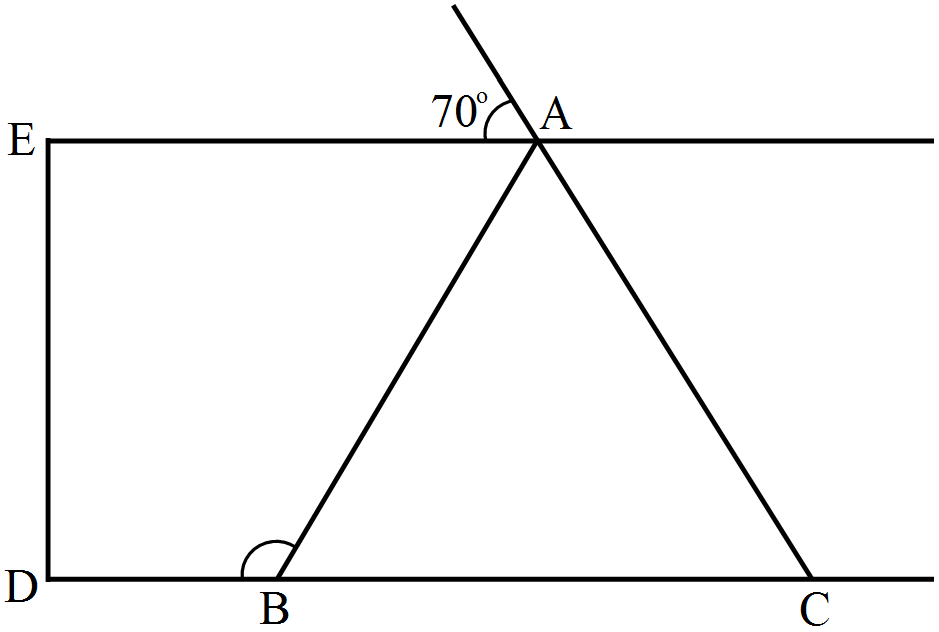
In Fig. if $\text {DC}\parallel\text{DC}$ and $\text{AB}=\text{AC},$ the value of $\angle\text{ABD}$ is:
  • A
    $70^\circ$
  • $110^\circ$
  • C
    $120^\circ$
  • D
    $130^\circ$
Answer
Correct option: B.
$110^\circ$

If $\text{AE}\parallel\text{DC}$ and $AC$ is transversal,
then $\angle\text{FAC}=70^\circ \ ($opposite angles$)$
Also $\angle\text{FAC}-=\angle\text{ACB}=70^\circ \ ($Alternate angles$)$
Since $\text{AB}=\text{AC},\triangle\text{ABC}$ is isosceles.
So $\angle\text{ABC}=\angle\text{ACB}$
$\Rightarrow\angle\text{ABC}=70^\circ$
Now $\angle\text{ABD}=180^\circ-\angle\text{ABC}$
$=180^\circ-70^\circ=110^\circ$
Hence, correct option is $(b).$
View full question & answer
MCQ 151 Mark
Which of the following is not a criterion for congruence of triangles?
  • A
    $\text{SAS}$
  • $\text{SSA}$
  • C
    $\text{ASA}$
  • D
    $\text{SSS}$
Answer
Correct option: B.
$\text{SSA}$
If two triangles have two congruent sides and a congruent non $-$ included angle,
then $\triangle s$ are not necessarily corgruent.
This is why there is no 'side side angle'
i.e. $\text{SSA}$ postulate.
Hence, correct option is $(b)$.
View full question & answer
MCQ 161 Mark
In triangles $\text{ABC}$ and $\text{PQR},$ if $\angle\text{A}=\angle\text{R},\angle\text{B}=\angle\text{P}$ and $\text{AB}=\text{RP},$ then which one of the following congruence conditioins applies:
  • A
    $\text{SAS}$
  • $\text{ASA}$
  • C
    $\text{SSS}$
  • D
    $\text{RHS}$
Answer
Correct option: B.
$\text{ASA}$
From given conditions,
$\angle\text{B}=\angle\text{P}$
$\angle\text{A}=\angle\text{R}$
And the side containing then is also equal
i.e $\text{AB}=\text{PR}$
So $\text{ASA}$ property.
Hence, correct option is $(b)$.
View full question & answer
MCQ 171 Mark
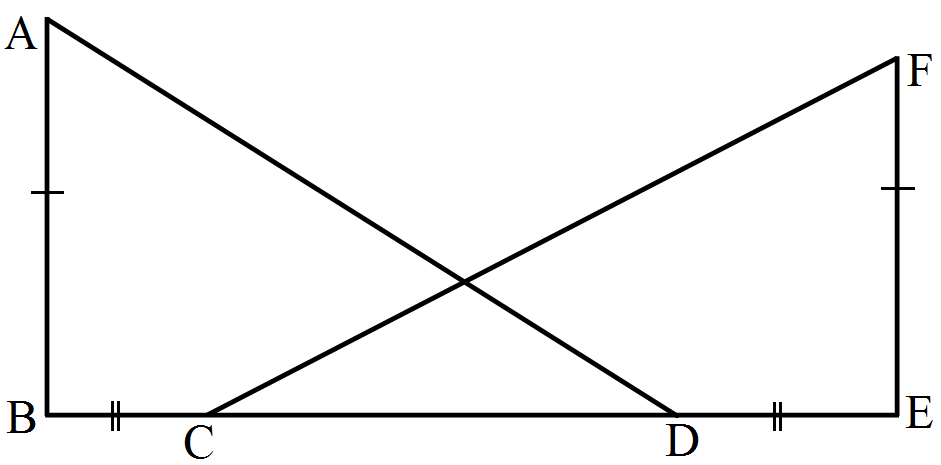
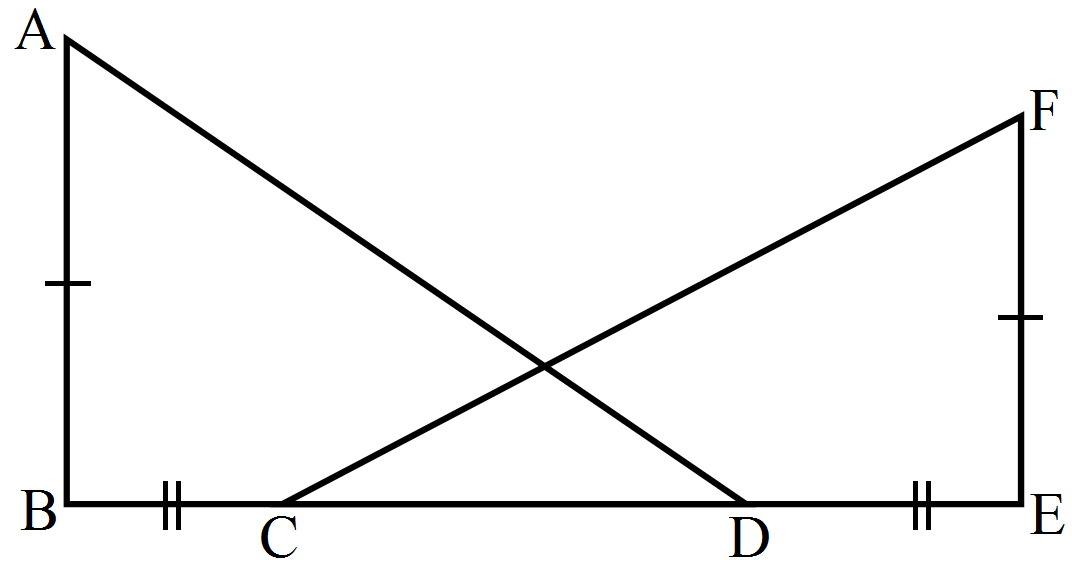
In Fig. $\text{AB}\perp\text{BE}$ and $\text{FE}\perp\text{BE},$ If $\text{BC}=\text{DE}$ and $\text{AB}=\text{EF},$ then $\triangle\text{ABD}$ is congruent to: 
  • A
    $\triangle\text{EFC}$
  • B
    $\triangle\text{ECF}$
  • C
    $\triangle\text{CEF}$
  • $\triangle\text{FEC}$
Answer
Correct option: D.
$\triangle\text{FEC}$

$AB = EF$
$BC = DE$
$BC + CD = DE + CD \ ($adding $CD$ both sides$)$
$BC + CD = BD, DE + CD = CE$
So $BD = CE$
Now Consider $\triangle\text{ABD},\triangle\text{FEC}$
$\text{AB}=\text{FE}$
$\text{BD}=\text{EC}$
$\angle\text{ABD}=\angle\text{FEC}=90^\circ$
So $\triangle\text{ABD}\cong\triangle\text{FEC}$ by $\text{SAS}$ creterion.
Hence, correct option is $(d)$.
View full question & answer
MCQ 181 Mark
If $\triangle\text{PQR}\cong\triangle\text{EFD},$ then $\angle\text{E}=$
  • $\angle\text{P}$
  • B
    $\angle\text{Q}$
  • C
    $\angle\text{R}$
  • D
    None of these
Answer
Correct option: A.
$\angle\text{P}$
$\triangle\text{PQR}\cong\triangle\text{EFD},$
$\Rightarrow\angle\text{E}=\angle\text{P} ($congruent angles of congruent triangles$)$
Hence, correct option is $(a)$.
View full question & answer
MCQ 191 Mark
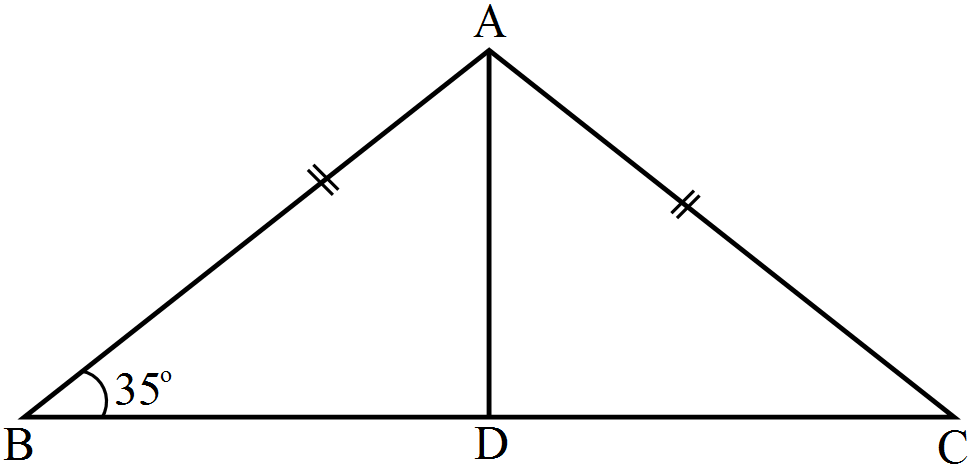
$\text{ABC}$ is an isosceles triangle such that $AB = AC$ and $AD$ is the median to base $BC$. Then, $\angle\text{BAD}=$
  • $55^\circ$
  • B
    $70^\circ$
  • C
    $35^\circ$
  • D
    $110^\circ$
Answer
Correct option: A.
$55^\circ$

If $AD$ is the median, then $D$ is the mid $-$ point of $BC$.
$\text{BD}=\text{DC}$
So consider $\triangle\text{ADB}$ and $\triangle\text{ADC}$
$\text{AD}=\text{AD} \ ($common$)$
$\text{DB}=\text{DC}$
$\text{BA}=\text{CA}$
So by $\text{SSS}, \triangle\text{ADB}\cong\triangle\text{ADC}$
Now $\angle\text{B}=\angle\text{C}=35^\circ$
$\Rightarrow\angle\text{BAD}=\angle\text{DAC}$
So in $\triangle\text{ABC},$
$\angle\text{A}+\angle\text{B}+\angle\text{C}=180^\circ$
$\Rightarrow2\angle\text{BAD}+35^\circ+35^\circ=180^\circ$
$\Rightarrow2\angle\text{BAD}=110^\circ$
$\Rightarrow\angle\text{BAD}=55^\circ$
Hence, correct option is $(a)$.
View full question & answer
MCQ 201 Mark
If $\triangle\text{ABC}\cong\triangle\text{ACB},$ then $\triangle\text{ABC}$ is isosceles with.
  • $AB = AC$
  • B
    $AB = BC$
  • C
    $AC = BC$
  • D
    None of these
Answer
Correct option: A.
$AB = AC$

$\triangle\text{ABC}\cong\triangle\text{ACB}$
$\Rightarrow\text{AB}=\text{AC}$
or $\text{AC}=\text{AB}$
So, in $\triangle\text{ABC}$ is isosceles with $\text{AB}=\text{AC}.$
Hence, correct option $(a)$.
View full question & answer