Questions

True False With Reason

Take a timed test

15 questions · self-marked practice — reveal the answer and mark yourself.

Question 12 Marks
The following statements are true (T) and which are false (F):If the bisector of the verical angle of a triangle bisects the base, then the triangle may be isosceles.
Answer
False.Explenation:
The angular bisector of the vertex angle is also a mediam.
⇒ The tirnagle must be a isosceles and also may be an equilateral triangle.
View full question & answer
Question 22 Marks
The following statement are true (T) and which are false (F):Angles opposite to equal sides of a triangle are equal.
Answer
True.
Explenation:
Since the sides are equal, the corresponding opposite angles must be equal.
View full question & answer
Question 32 Marks
The following statements are true and which are false?
Sum of any two sides of a triangle is greater than twice the median drown to the third side.
Answer
True. Explanation:
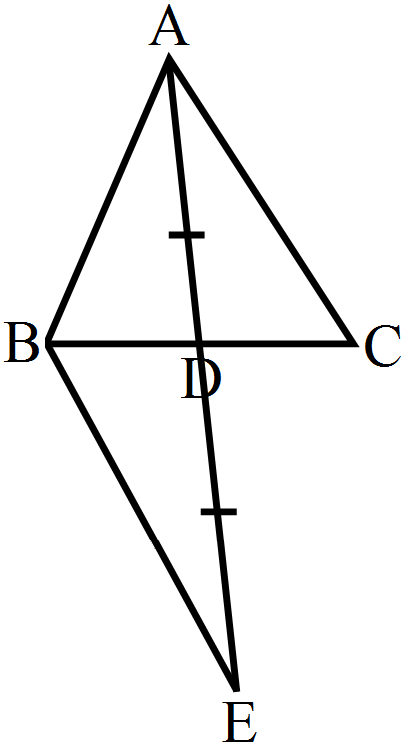
Given: In triangle ABC, AD is the median drawn from A to BC. To prove: AB + AC > AD Construction: Produce AD to E so that DE = AD, Join BE. Proof: Now in $\triangle\text{ADC}$ and $\triangle\text{EDB},$ AD = DE (by const) DC = BD(as D is mid-point)$\angle\text{ADC}=\angle\text{EDB}$ $\big($vertically opp, $\angle\text{S}\big)$
Therefore,$\triangle\text{ABE}, ​​\triangle\text{ADC}\cong\triangle\text{EDB}$ (by SAS)
This gives, BE = AC. AB + BE > AE AB + AC > 2AD $\big(\therefore$ AD = DE and BE = AC$\big)$ Hence the sum of any two sides of a triangle is greater than the median drawn to the third side.
View full question & answer
Question 42 Marks
The following statements are true and which are false?
Of all the line segments that can be drawn from a point to a line not containing it, the perpendicular line segment is the shortest one.
Answer
True.
Explanation:
The perpendicular distance is the shortest distance from a point to a line not containing it.
View full question & answer
Question 52 Marks
The following statements are true (T) and which are false (F):The two alitutde corresponding to two equal sides of a triangle need not be equal.
Answer
False.Explenation:
Since two sides are equal, the triangle is an isosceles triangle. The two altitudes corresponding to two equal side must be equal.
View full question & answer
Question 62 Marks
The following statements are true (T) and which are false (F):The bisectors of two equal angles of a triangle are equal.
Answer
True.Explenation:
Since it an isosceles triangle, the lenghts of bisectors of the two equal angles are equal.
View full question & answer
Question 72 Marks
The following statements are true and which are false?
Sum of the three sides of a triangle is less than the sum of its three altitudes.
Answer
False.
Explanation:
Sum of these sides of a triangle is greater than sum of its three altitudes.
View full question & answer
Question 82 Marks
The following statements are true and which are false?
If two angles of a triangle are unequal, then the greater angle has the larger side opposite to it.
Answer
True.
Explanation:
The side opposite to greater angle is longer and smaller angle is shorter in a triangle.
View full question & answer
Question 92 Marks
The following statement are true (T) and which are false (F):
Side opposite to equal angles of a triangle may be unequal.
Answer
False.
Explenation:
Side opposite to equal angles of a triangle are equal.
View full question & answer
Question 102 Marks
The following statements are true and which are false?
Difference of any two sides of a triangle is equal to the third side.
Answer
False.
Explanation:
The difference of any two sides of a triangle is less than third side.
View full question & answer
Question 112 Marks
The following statement are true (T) and which are false (F):If the altitude from one vertex of a triangle bisects the opposite side, then the triangle may be isosceles.
Answer
False.
Explenation:
Here the altitude from the vertex is also the perpendicular bisector of the opposite side.
The triangle must be isosceles and may be an equilateral triangle.
View full question & answer
Question 122 Marks
The following statements are true and which are false?
Sum of any two sides of a triangle is greater than the third side.
Answer
True. Explanation:
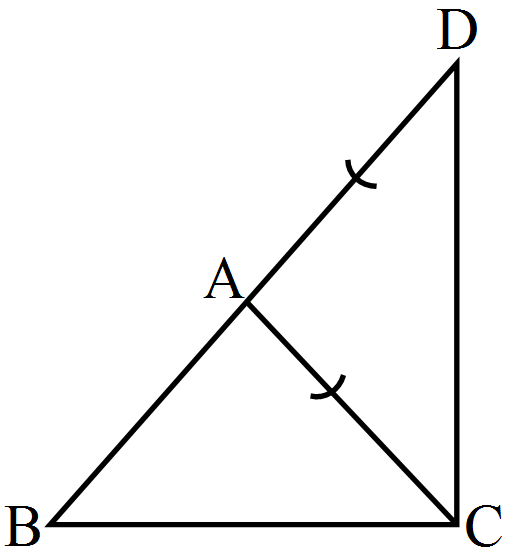
Given $\triangle\text{ABC},$ extend BA to D such that AD = AC.
Now in $\triangle\text{DBC},$
$\angle\text{ADC} = \angle\text{ACD } $ [Angles opposite to equal sides are equal]
Hence $\angle\text{BCD} > \angle\text{BDC}$
That is BD > BC [The side opposite to the larger (greater) angle is longer]
⇒ AB + AD > BC
$\therefore$ AB + AC > BC [Since AD = AC)
Thus sum of two sides of a triangle is always greater than third side.
View full question & answer
Question 132 Marks
The following statements are true (T) and which are false (F):Two right triangles are congruent if hypoenuse and a side of the other trianlge.
Answer
True.Explenation:
According to RHS congruence criterion the given statment is true.
View full question & answer
Question 142 Marks
The following statements are true (T) and which are false (F):If any two sides of a right triangle are respectively equal to two sides of other right triangle then the two triangle are congruent.
Answer
False.Explenation:
The two right triangles may or may not be congrunt.
View full question & answer
Question 152 Marks
The following statement are true (T) and which are false (F):The measure of each angle of an equilateral triangle 60º.
Answer
True.
Explenation:
Since all the three angles of equilateral triangles are equal and sum of the three angles is 180º, each angle will be equal to $\frac{180^\circ}{3}=60^\circ.$
View full question & answer