Questions

MCQ(1M)

🎯

Test yourself on this topic

15 questions · timed · auto-graded

MCQ 11 Mark
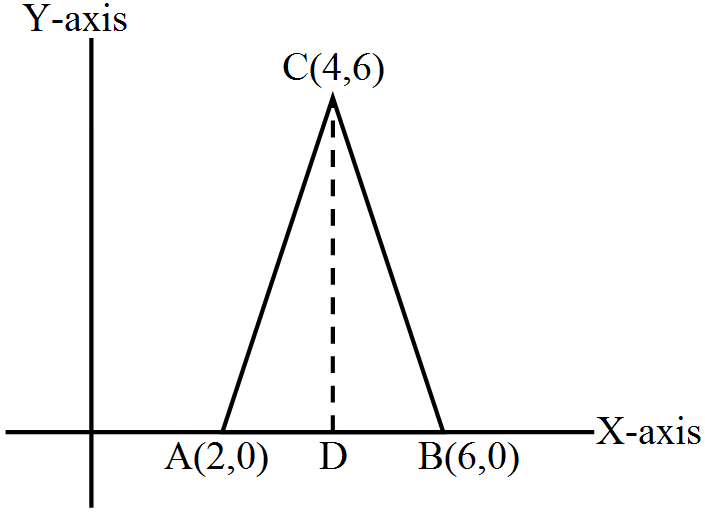
The area of the triangle formed by the points $A(2, 0), B(6, 0)$ and $C(4, 6)$ is:
  • A
    $24$ sq. unit
  • $12$ sq. unit
  • C
    $10$ sq. unit
  • D
    None of these
Answer
Correct option: B.
$12$ sq. unit

Let $CD$ be perpendicular drawn from $C$ to $AB$.
The length of the perpendicular will be equal to the ordinate of point $C$.
$\Rightarrow CD = 6 $ unit
$AB = 4$ unit
Now, area of $\triangle\text{ABC}=\frac{1}{2}\times\text{Base}\times\text{height}$
$\triangle\text{ABC}=\frac{1}{2}\times\text{5}\times\text{6}$
$12\text{sq. units}$
View full question & answer
MCQ 21 Mark
A point whose abscissa is $-3$ and ordinate $2$ lies in:
  • A
    First quadrant.
  • Second quadrant.
  • C
    Third quadrant.
  • D
    Fourth quadrant.
Answer
Correct option: B.
Second quadrant.
If absciss $= -3$
Intercept on $Y$ axis is $= 2$
$Y > 0$
So, Point is in Second Quadrant.
View full question & answer
MCQ 31 Mark
A point whose abscissa and ordinate are $2$ and $-5$ respectively, lies in :
  • A
    First quadrant.
  • B
    Second quadrant.
  • C
    Third quadrant.
  • Fourth quadrant.
Answer
Correct option: D.
Fourth quadrant.
Abscissa is $= 2\ ($positive intercept on $X-$ axis$)$
and ordinate $= -5\ ($ negative intercept on $Y-$ axis$)$
so $X-$ value is positive and $Y-$ value is negative, i.e. Fourth Quadrant.
View full question & answer
MCQ 41 Mark
The ordinate of any point on $x-$ axis is:
  • $0$
  • B
    $1$
  • C
    $-1$
  • D
    Any number
Answer
Correct option: A.
$0$
On $X-$ axis, all points have their $Y-$ intercept $= 0$
So their ordinate $= 0$
View full question & answer
MCQ 51 Mark
The abscissa of a point is positive in the:
  • A
    First and Second quadrant.
  • B
    Second and Third quadrant.
  • C
    Third and Fourth quadrant.
  • Fourth and First quadrant.
Answer
Correct option: D.
Fourth and First quadrant.
Abscissa $=$ Intercept on $X-$ axis
If intercept on $X-$ axis is positive, means First and Fourth quadrant
View full question & answer
MCQ 61 Mark
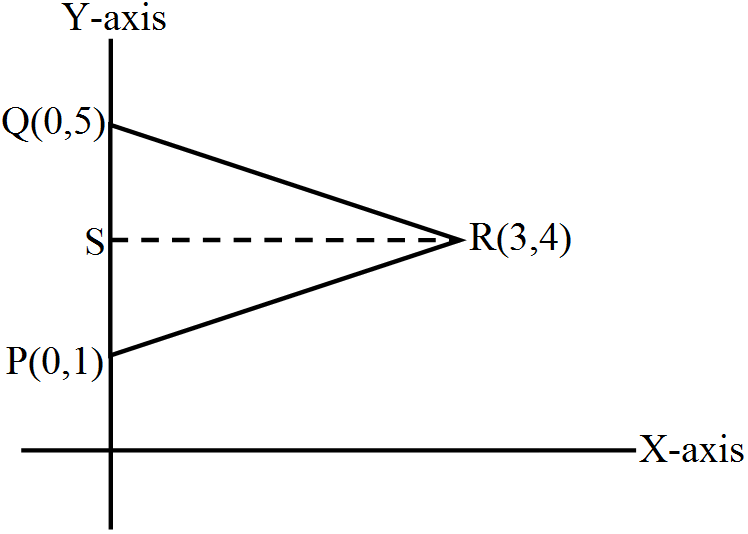
The area of the triangle formed by the points $P(0, 1), Q(0, 5)$ and $R(3, 4)$ is:
  • A
    $16$ sq. units
  • $6$ sq. units
  • C
    $4$ sq. units
  • D
    $6$ sq. units
Answer
Correct option: B.
$6$ sq. units

$PQ = 4$ units
Let $RS$ be perpendicular drawn from $R$ to $PQ$.
Lenght of $RS =$ abscissa of $(3, 4)$
$\Rightarrow RS = 3$ units
Area of $\triangle\text{RQP}=\frac{1}{2}\times\text{PQ}\times\text{RS}$
$=\frac{1}{2}\times\text{4}\times\text{3}$
$=6\text{sq. units}.$
View full question & answer
MCQ 71 Mark
The perpendicular distance of the point $P(4, 3)$ from $y-$ axis is:
  • $4$
  • B
    $3$
  • C
    $5$
  • D
    None of these
Answer
Correct option: A.
$4$
If we draw a perpendicular from point $P(4, 3)$ to $Y-$ axis, the measure of perpendicular is equal to abscissa of point $P$.
So perpendicular distance form $Y-$ axis $=$ abscissa $= 4$
View full question & answer
MCQ 81 Mark
Two point having same abscissae but different ordinates lie on:
  • A
    $x-$ axis
  • B
    $a-$ axis
  • A line parallel to $y-$ axis
  • D
    A line parallel to $x-$ axis
Answer
Correct option: C.
A line parallel to $y-$ axis
Let two points be $(a, b)$ and $(a, c)$.
If abscissa is same $= a$
and ordinate is different then all such points will lie on a line parallel to $Y$
axis because value of $X-$ intercept
i.e. abscissa is fixed.
View full question & answer
MCQ 91 Mark
The abscissa and ordinate of the origin are:
  • $(0, 0)$
  • B
    $(1, 0)$
  • C
    $(0, 1)$
  • D
    $(1, 1)$
Answer
Correct option: A.
$(0, 0)$
Absciss $=$ intercept pon $X -$ axis $= 0$
Ordinate $=$ intercept on $Y -$ axis $= 0$
$\Rightarrow (0, 0)$ is the answer.
View full question & answer
MCQ 101 Mark
The perpendicular distance of the point $P(4, 3)$ from $x-$ axis is:
  • A
    $4$
  • $3$
  • C
    $5$
  • D
    None of these
Answer
Correct option: B.
$3$
If perpendicular drawn from $P$ to $X-$ axis, then the perpendicular is equal to measure of ordinate of point $P$.
So, perpendicular distance of point $P$ form $X-$ axis $= 3$
View full question & answer
MCQ 111 Mark
The measure of the angle between the coordinate axes is:
  • A
    $0^\circ$
  • $90^\circ$
  • C
    $180^\circ$
  • D
    $360^\circ$
Answer
Correct option: B.
$90^\circ$
The angle between the co $-$ ordinate axes is $90^\circ$ because $\text{X}-\text{axis}\perp\text{Y}-\text{axis}.$
View full question & answer
MCQ 121 Mark
Points $(-4, 0)$ and $(7, 0)$ lie:
  • On $x-$ axis.
  • B
    $Y-$ axis.
  • C
    In first quadrant.
  • D
    In second quadrant.
Answer
Correct option: A.
On $x-$ axis.
In $(-4, 0)$ and $(7, 0),$
measure of ordinate $= 0$
That means, intercept on $Y-$ axis $= 0$
So, points lies on $X-$ axis.
View full question & answer
MCQ 131 Mark
The abscissa of any point on $y-$ axis is:
  • $0$
  • B
    $1$
  • C
    $-1$
  • D
    Any number
Answer
Correct option: A.
$0$
Every point on $Y-$ axis have $X-$ intercept $= 0$
Thus, their abscissa $= 0$
View full question & answer
MCQ 141 Mark
The point of intersect of the coordinate axes is:
  • A
    Ordinate
  • B
    Abscissa
  • C
    Quadrant
  • Origin
Answer
Correct option: D.
Origin
The point of intersection of co $-$ ordinate axes
i.e. $X-$axis and $Y-$ axis is $(0, 0),$ which is called origin.
View full question & answer
MCQ 151 Mark
The distance of the point $P(4, 3)$ from the origin is:
  • A
    $4$
  • B
    $3$
  • $5$
  • D
    $7$
Answer
Correct option: C.
$5$
Point $P(4, 3)$ and Origin $O(0, 0)$
Required distance $=\text{OP}=\sqrt{(0-4)^2+(0-3)^2}\ ($by distance formula$)$
$=\sqrt{16+9}$
$=\sqrt{25}$
$=5$
View full question & answer
MCQ(1M) - Maths STD 9 Questions - Vidyadip