Questions

4 Mark Question

Take a timed test

4 questions · self-marked practice — reveal the answer and mark yourself.

Question 14 Marks
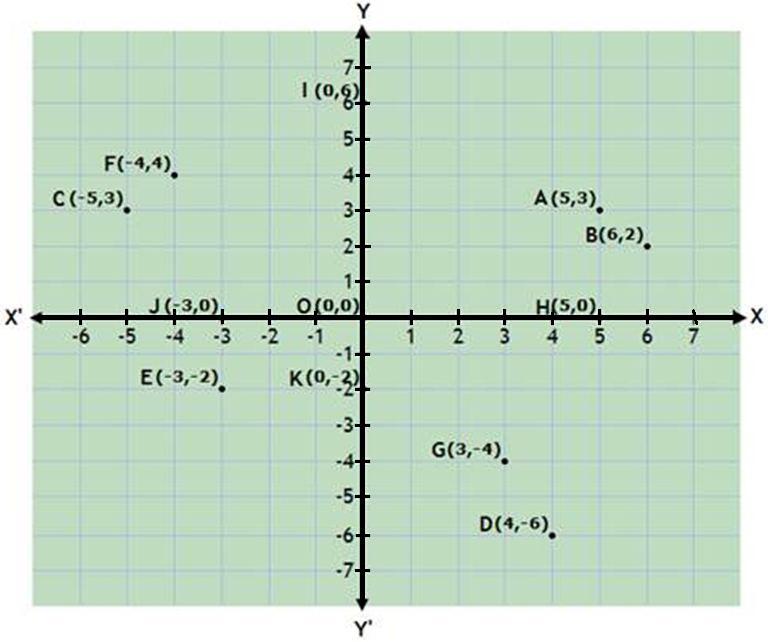
On the plane of a graph paper draw X' OX and YOY' as coordinate axes and plot each of the following points.
  1. A(5, 3)
  2. B(6, 2)
  3. C(-5, 3)
  4. D(4, -6)
  5. E(-3, -2)
  6. F(-4, 4)
  7. G(3, -4)
  8. H(5, 4)
  9. I(0, 6)
  10. J(-3, 0)
  11. K (0, -2)
  12. O(0, 0)
Answer
The given points are plotted as follows:
View full question & answer
Question 24 Marks
Three vertices of a rectangle ABCD are A(3, 1), B(-3, 1) and C(-3, 3). plot these points on a graph paper and find the coordinates of the fourth vertex D. Also find the area of rectangle ABCD.
Answer
Let A(3, 1), B(-3, 1) and C(-3, 3) be three vertices of a rectangle ABCD. Let the y-axis cut the rectangle ABCD at the points P and Q respectively. (Image) Abscissa of D = Abscissa of A = 3. Ordinate of D = ordinate of C = 3.$\therefore$ coordinates of D are (3, 3).
AB = (BP + PA) = (3 + 3) units = 6 units. BC = (OQ - OP) = (3 - 1) units = 2 units. Ar(rectangle ABCD) = (AB × BC) = (6 × 2)sq. units = 12sq. units Hence, the area of rectangle ABCD 12 square units.
View full question & answer
Question 34 Marks
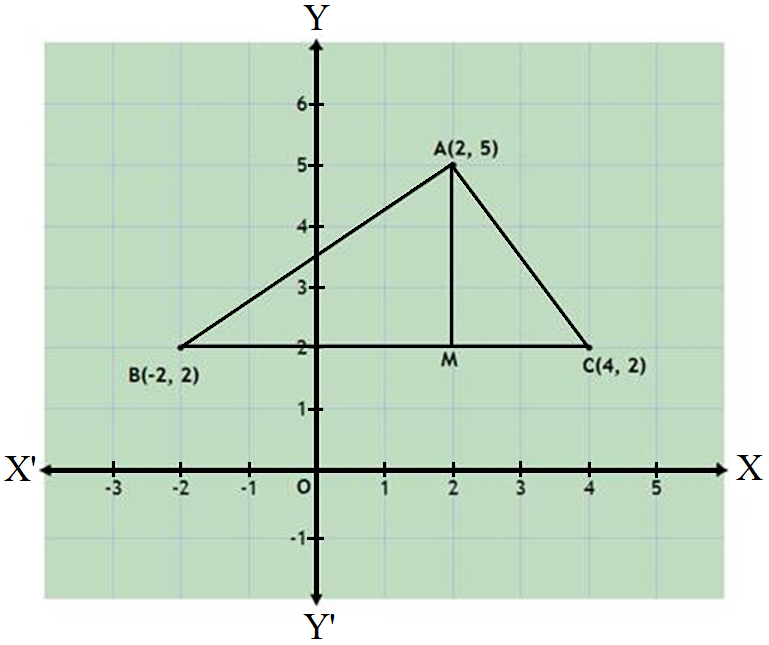
Plot the points A(2, 5), B(-2, 2) and C(4, 2) on a graph paper. Join AB, BC and AC. Calculate the area of $\triangle\text{ABC}.$
Answer
The given points are plotted on the graph paper as follows: Draw $\text{AM}\perp\text{BC}.$ Area of $\triangle\text{ABC}=\frac{1}{2}\times\text{Base}\times\text{Height}$$=\frac{1}{2}\times\text{BC}\times\text{AM}$
$=\frac{1}{2}\times6\times3$
= 9 square units.
View full question & answer
Question 44 Marks
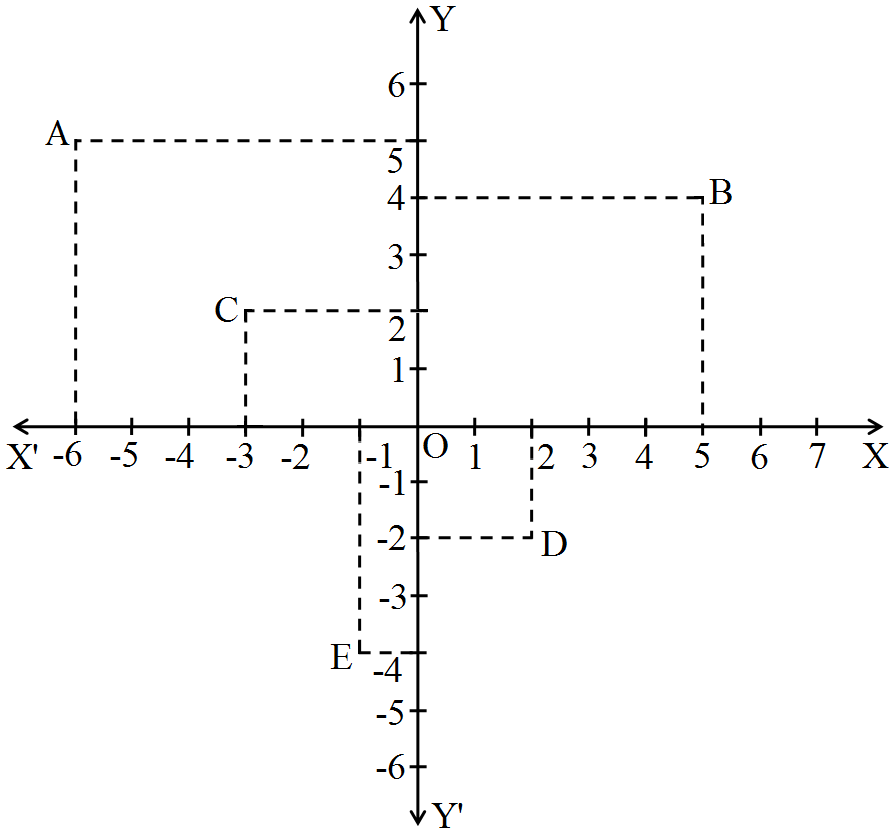
Write down the coordinates of each of the following points A, B, C, D, and E.
Answer
Draw the perpendiculars from the AF, BG, CH, DI and EJ on the x-axis.
  1. The distance of A from the y-axis = OF = -6 units
The distance of A from the x-axis = AF = 5 units

Hence, the coordinate of A are (-6, 5)
  1. The distance of B from the y-axis = OG = 5 units
The distance of B from the x-axis = BG = 4 units

Hence, the coordinate of B are (5, 4)
  1. The distance of C from the y-axis = OH = -3 units
The distance of C from the x-axis = HC = 2 units

Hence, the coordinate of C are (-3, 2)
  1. The distance of D from the y-axis = OI = 2 units
The distance of D from the x-axis = ID = -2 units

Hence, the coordinate of D are (2, -2)
  1. The distance of E from the y-axis = OJ = -1 unit
The distance of E from the x-axis = JE = -4 units

Hence, the coordinate of E are (-1, -4)

Thus, the coordinates of A, B, C, D and E are respectively, A(-6, 5), B(5, 4), C(-3, 2), D(2, -2) and E(-1, -4)
View full question & answer