Questions

MCQ(1M)

Take a timed test

22 questions · auto-graded multiple-choice test.

MCQ 11 Mark
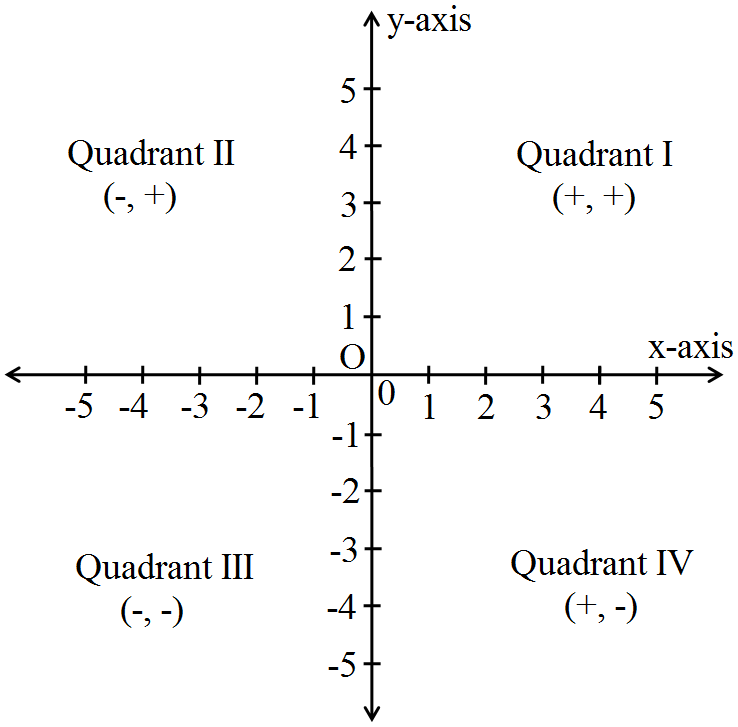
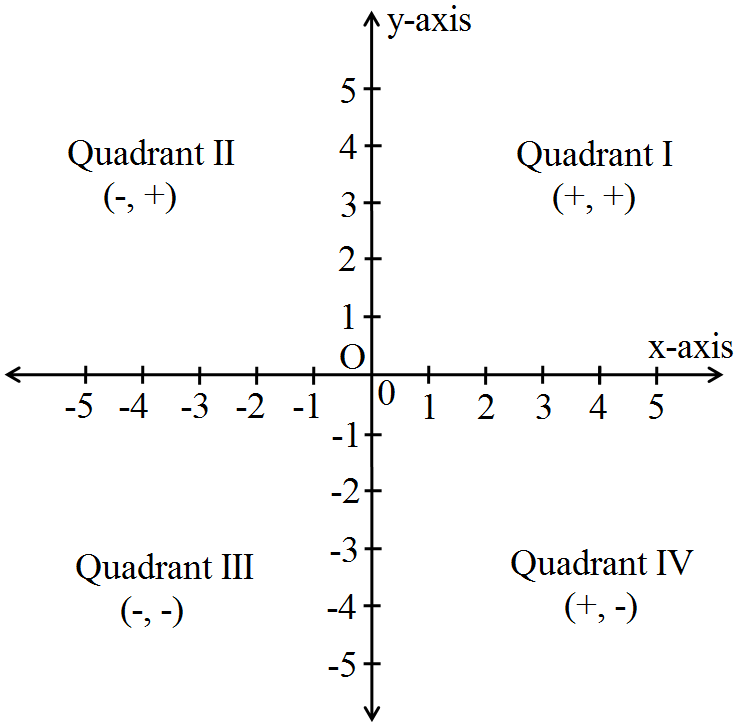
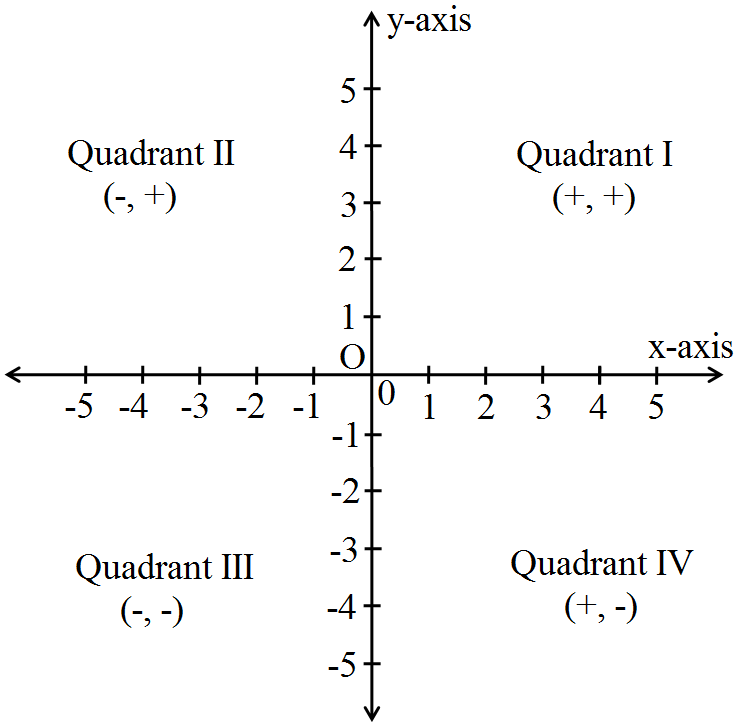
If $a > 0$ and $b > 0$ then the point $(a, b)$ lies in quadrant.
  • A
    $IV$
  • $II$
  • C
    $III$
  • D
    None of these.
Answer
Correct option: B.
$II$
Since $,x$  co $-$ ordinate is negative and $y$  co $-$ ordinate is positive, the given point lies in Quadrant $II$.
View full question & answer
MCQ 21 Mark
The ordinate of every point on the $x-$ axis is:
  • A
    $1$
  • B
    $-1$
  • $0$
  • D
    Any real numbers.
Answer
Correct option: C.
$0$
The ordinate $(y$  co $-$ ordinate$)$ of every point on the $x-$ axis is $0$.
View full question & answer
MCQ 31 Mark
A point both of whose coordinates are negative lies in quadrant.
  • A
    $I$
  • B
    $II$
  • $III$
  • D
    $IV$
Answer
Correct option: C.
$III$

A point both of whose coordinates are negative, that is, of the from $(-, -)$ lies in quadrant $III$.
View full question & answer
MCQ 41 Mark
The point at which the two coordinate axes meet is called the:
  • A
    Abscissa.
  • B
    Ordinate.
  • Origin.
  • D
    Quadrant.
Answer
Correct option: C.
Origin.
The point at which the two coordinate axes meet is called the origin.
View full question & answer
MCQ 51 Mark
Abcissa of a point is positive in:
  • A
    $I$ and $II$ quadrant.
  • $I$ and $IV$ quadrant.
  • C
    $I$ quadrant only.
  • D
    $II$ quadrant only.
Answer
Correct option: B.
$I$ and $IV$ quadrant.

Absissa of a point is positive when the points are of the form $(+, +)$ and $(+, -)$.
So, the absissa of the point is positive in quadrant $I$ and $IV$.
View full question & answer
MCQ 61 Mark
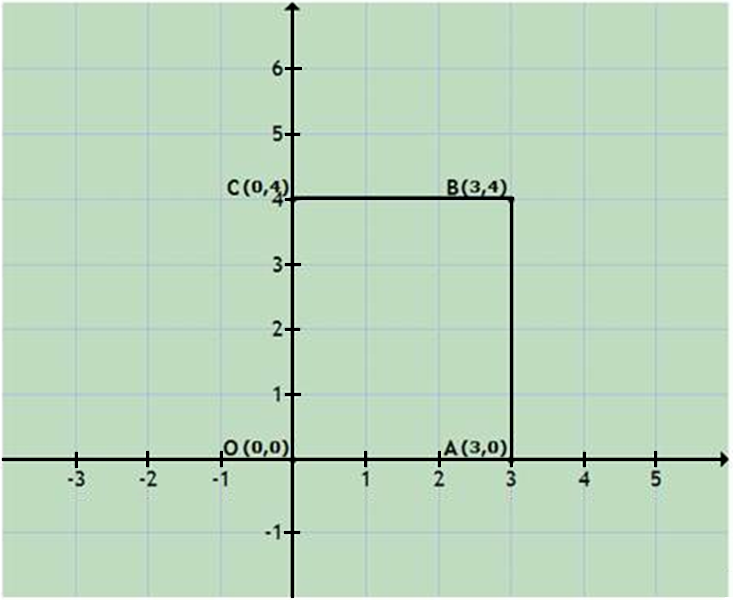
If $O(0, 0), A(3, 0), B(3, 4), C(0, 4)$ are four given points then the figure $\text{OABC}$ is a:
  • A
    Square.
  • Rectangle.
  • C
    Trapezium.
  • D
    Rhombus.
Answer
Correct option: B.
Rectangle.
By plotting the given points, we find that figure $\text{OABC}$ is a rectangle.
View full question & answer
MCQ 71 Mark
Which of the following points does not lie in any quadrant?
  • A
    $(1, 7)$
  • B
    $(2, 10)$
  • C
    $(-1, 1)$
  • $(4, 12)$
Answer
Correct option: D.
$(4, 12)$
For the point to lie on the line $y = 3x + 4,$ it has to satisfy the equation of the line.
Putting $x = 1,$ in $y = 3x + 4,$ we get $y = 3(1) + 4 \Rightarrow y = 7$
So, the point satisfies the equation and hence lies on the given line.
Putting $x = 2,$ in $y = 3x + 4,$ we get $y = 3(2) + 4 \Rightarrow y = 10$
So, the point satisfies the equation and hence lies on the given line.
Putting $x = 1,$ in $y = 3x + 4,$ we get $y = 3(-1) + 4 \Rightarrow y = 1$
So, the point satisfies the equation and hence lies on the given line.
Putting $x = 4,$ in $y = 3x + 4,$ we get $y = 3(4) + 4 \Rightarrow y = 16$
But $y = 12.$
So, the point not satisfy the equation and hence lies on the given line.
View full question & answer
MCQ 81 Mark
Point $(-7, 0)$ lies.
  • On the negative direction of $x-$ axis.
  • B
    On the negative direction of $y-$ axis.
  • C
    In the $III$ quadrant.
  • D
    In the $IV$ quadrant.
Answer
Correct option: A.
On the negative direction of $x-$ axis.
Point $(-7, 0)$ lies on negative direction of the $x-$ axis as its $x$  co $-$ ordinate is negative and $y$  co $-$ ordinate is zero.
View full question & answer
MCQ 91 Mark
If $A (-2, 3)$ and $B(-3, 5)$ are two given points then $($abscissa of $A) - ($abscissa of $B) =$ ?
  • A
    $-2$
  • $1$
  • C
    $-1$
  • D
    $2$
Answer
Correct option: B.
$1$
Abscissa of $A -$ Abscissa of $B$
$= -2 - (-3)$
$= -2 + 3$
$= 1$
View full question & answer
MCQ 101 Mark
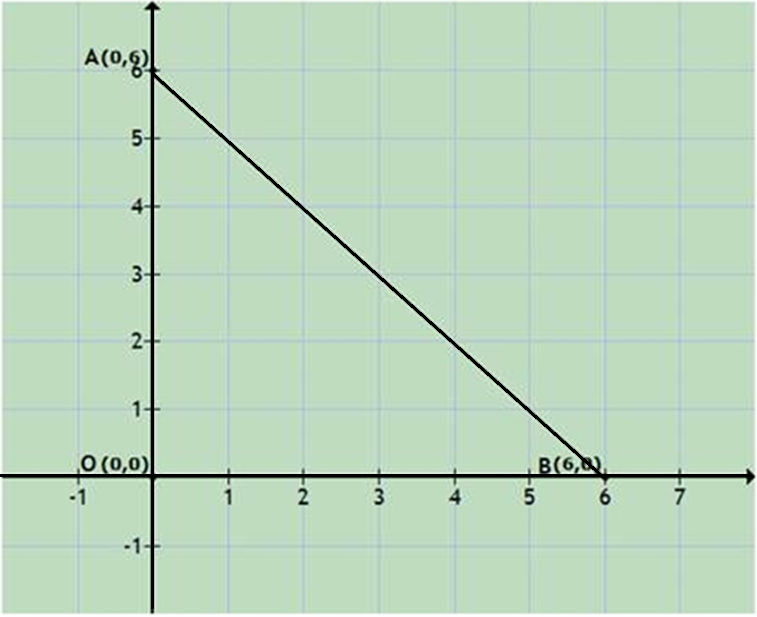
The area of $\triangle\text{AOB}$ having vertices $A(0, 6), O(0, 0)$ and $B(6, 0)$ is :
  • A
    $12$ sq units.
  • B
    $36$ sq units.
  • $18$ sq units.
  • D
    $24$ sq units.
Answer
Correct option: C.
$18$ sq units.

Clearly, $\triangle\text{AOB}$ is a right $-$ angled triangle.
$\therefore$ Area of $\triangle\text{AOB}=\frac{1}{2}\times\text{Base}\times\text{Height}$
$=\frac{1}{2}\times\text{OB}\times\text{OA}$
$=\frac{1}{2}\times6\times6$
$= 18$ square units.
View full question & answer
MCQ 111 Mark
Points $\{(1, -1), (2, -2), (-3, -4), (4, -5)\}$
  • All lie in the $II$ quadrant.
  • B
    All in the $III$ quadrant.
  • C
    All lie in the $IV$ quadrant.
  • D
    Do not lie in the same quadrant.
Answer
Correct option: A.
All lie in the $II$ quadrant.
Points $\{(1, -1), (2, -2)\}$ and $(4, -5)$ lie in
Quadrant $IV,$ but point $(-3, -4)$ lies in Quadrant $III$.
Hence, all the given points do not lie in the same quadrant.
View full question & answer
MCQ 121 Mark
In the which quadrant does the point $(-7, -4)$ lie?
  • A
    $IV$
  • B
    $II$
  • $III$
  • D
    None of these.
Answer
Correct option: C.
$III$
Since, both the coordinates of given point are negative, it lies in Quadrant $III.$
View full question & answer
MCQ 131 Mark
The point $($other than origin$)$ for which abscissa is equal to the ordinate will lie in quadrant.
  • A
    $I$ only
  • B
    $I$ or $II$
  • $I$ or $III$
  • D
    $II$ or $IV$
Answer
Correct option: C.
$I$ or $III$

The points are same when they are of the form $(m, m)$ or $(-n, -n).$
This happens only in quadrant $I$ and quadrant $III$.
So, the points $($other than the origin$)$ for which the abscissa is equal to the ordinate lie in quadrant $I$ and quadrant $III$.
View full question & answer
MCQ 141 Mark
The point which lies on the $y-$ axis at a distance of $5$ units in the negative direction of the $y-$ axis is:
  • A
    $(-5, 0)$
  • $(0, -5)$
  • C
    $(5, 0)$
  • D
    $(0, 5)$
Answer
Correct option: B.
$(0, -5)$
The point which lies on the $y-$ axis at a distance of $5$ units in the negative direction of the $y-$ axis is $(0, -5).$
View full question & answer
MCQ 151 Mark
Which of the following points lies on the line $y = 2x + 3$?
  • A
    $(2, 8)$
  • $(3, 9)$
  • C
    $(4, 12)$
  • D
    $(5, 15)$
Answer
Correct option: B.
$(3, 9)$
For the point to lie on the line $y = 2x + 3,$ it has to satisfy the equation of the line.
Putting $x = 2,$ in $y = 2x + 3,$ we get $y = 2(2) + 3 \Rightarrow y = 7$
But $y = 8$.
So, the point does not satisfy the equation and hence does not lie on the given line.
Putting $x = 3,$ in $y = 2x + 3,$ we get $y = 2(3) + 3 \Rightarrow y = 9$
So, the point satisfies the equation and hence lies on the given line.
Putting $x = 4,$ in $y = 2x + 3,$ we get $y = 2(4) + 3 \Rightarrow y = 11$
But $y = 12.$
So, the point does not satisfy the equation and hence does not lie on the given line.
Putting $x = 5,$ in $y = 2x + 3,$ we get $y = 2(5) + 3 \Rightarrow y = 13$
But $y = 15.$
So, the point does not satisfy the equation and hence does not lie on the given line.
View full question & answer
MCQ 161 Mark
If $x > 0$ and $y < 0$ then the point $(x, y) $ lies in quadrant.
  • A
    $I$
  • B
    $III$
  • C
    $II$
  • $IV$
Answer
Correct option: D.
$IV$

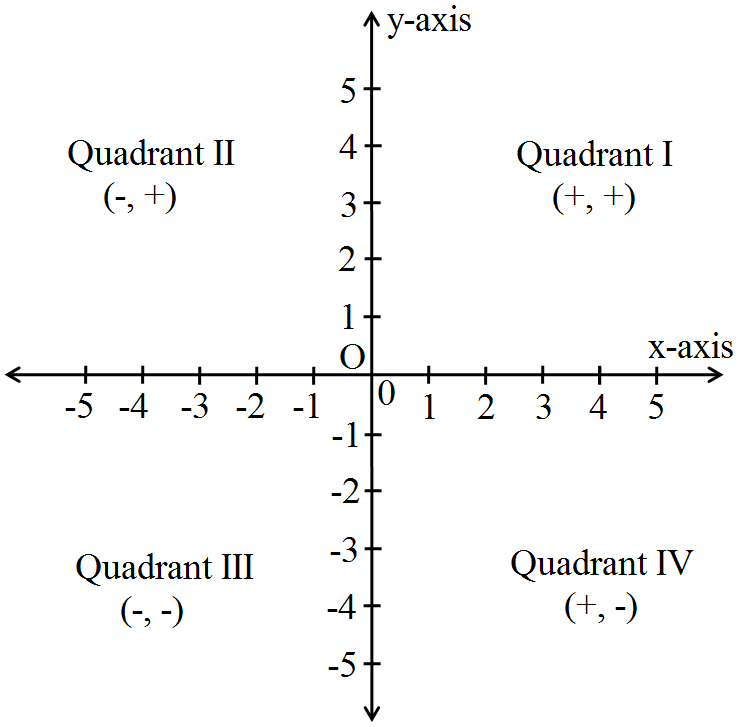
Points of the type $(+, -)$ lie in the 4th quadrant.
Since $x > 0$ and $y < 0,$ the point $(x, y)$ lies in quadrant $IV.$
View full question & answer
MCQ 171 Mark
If the $y-$ coordinate of a point is zero then this point always lies.
  • A
    On the $y-$ axis.
  • On the $x-$ axis.
  • C
    In the $I$ quadrant.
  • D
    In the $IV$ quadrant.
Answer
Correct option: B.
On the $x-$ axis.
If the $y-$ coordinate of a point is zero then this point always lies on the $x-$ axis.
View full question & answer
MCQ 181 Mark
The points $(-5, 3)$ and $(3, -5)$ lie in the.
  • A
    same quadrant
  • B
    $II$ and $III$ quadrants respectively.
  • $II$ and $IV$ quadrants respectively.
  • D
    $IV$ and $II$ quadrants respectively.
Answer
Correct option: C.
$II$ and $IV$ quadrants respectively.
For point $(-5, 3),$ the $x$  co $-$ ordinate is negative and the $y$  co $-$ ordinate is positive.
Hence, it lies in Quadrant $II$.
For point $(3, -5),$ the $x$  co $-$ ordinate is positive and the $y$  co $-$ ordinate is negative.
Hence, it lies in Quadrant $IV$.
View full question & answer
MCQ 191 Mark
The point at whose ordinate is $3$ and which lies on the $y-$ axis is:
  • A
    $(3, 0)$
  • $(0, 3)$
  • C
    $(3, 3)$
  • D
    $(1, 3)$
Answer
Correct option: B.
$(0, 3)$
If a point lies on $y-$ axis, then its abscissa is $0$.
Hence, the point whose ordinate is $3$ and which lies on the $y-$ axis is $(0, 3).$
View full question & answer
MCQ 201 Mark
Point $(0, -8)$ lies.
  • A
    In the $II$ quadrant.
  • B
    In the $IV$ quadrant.
  • C
    On the $x-$ axis.
  • On the $y-$ axis.
Answer
Correct option: D.
On the $y-$ axis.
Point $(0, -8)$ lies on $y-$ axis as its $x$  co $-$ ordinate is $0$.
View full question & answer
MCQ 211 Mark
Which of the following points does not lie in any quadrant?
  • A
    $(3, -6)$
  • B
    $(-3, 4)$
  • C
    $(5, 7)$
  • $(0, 3)$
Answer
Correct option: D.
$(0, 3)$
The abscissa of point $(0, 3)$ is $0$.
Hence, it lies on $y-$ axis.
View full question & answer
MCQ 221 Mark
The perpendicular distance of the point $A(3, 4)$ from the $y-$ axis is:
  • $3$
  • B
    $4$
  • C
    $5$
  • D
    $7$
Answer
Correct option: A.
$3$
The perpendicular distance of the point $A(3, 4)$ from the $y-$ axis is $ 3$ units.
View full question & answer