Questions

5 Mark Question

Take a timed test

14 questions · self-marked practice — reveal the answer and mark yourself.

Question 15 Marks
Compute the income tax payable by following individuals.
i. Mr. Kadam who is 35 years old and has a taxable income of ₹13,35,000.
ii. Mr. Khan is 65 years of age and his taxable income is ₹4,50,000.
iii. Miss Varsha (Age 26 years) has a taxable income of ₹2,30,000.
Answer
i. Mr. Kadam is 35 years old and his taxable income is ₹13,35,000.
Mr. Kadam’s income is more than ₹ 10,00,000.
∴ Income tax = ₹1,12,500 + 30% of (taxable income -10,00,000)
= ₹ 1,12,500 + 30% of (13,35,000 – 10,00,000)
$=112500+\frac{30}{100} \times 335000100$
= 112500+ 100500
= ₹ 213000
Education cess = 2% of income tax
$=\frac{2}{100} \times 213000$
Secondary and Higher Education cess
= 1% of income tax
$=\frac{1}{100} \times 213000100$= 2130
Total income tax = Income tax + Education cess + Secondary and higher education cess
= 213000 + 4260 + 2130 = ₹ 2,19,390
∴ Mr. Kadam will have to pay income tax of ₹ 2,19,390.
ii. Mr. Khan is 65 years old and his taxable income is ₹ 4,50,000.
Mr. Khan’s income falls in the slab ₹ 3,00,001 to ₹ 5,00,000.
∴ Income tax
= 5% of (taxable income – 300000)
= 5% of (450000 – 300000)
$=\frac{5}{100} \times 150000100$
$=₹ 7500$
Education cess $=2 \%$ of income tax
$=\frac{2}{100} \times 7500$
$=₹ 150$
Secondary and Higher Education cess $=1 \%$ of income tax
$=\frac{1}{100} \times 7500$
= 75
Total income tax = Income tax + Education cess + Secondary and higher education cess
= 7500+ 150 + 75
= ₹ 7725
Mr. Khan will have to pay income tax of ₹7725.
iii. Taxable income = ₹2,30,000
age = 26 years
The yearly income of Miss Varsha is less than ₹ 2,50,000.
Hence, Miss Varsha will not have to pay income tax.
View full question & answer
Question 25 Marks
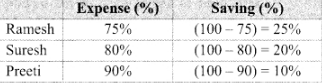
Total income of Ramesh, Suresh and Preeti is ₹ 8,07,000. The percentages of their expenses are 75%, 80% and 90% respectively. If the ratio of their savings is 16 : 17 : 12, then find the annual saving of each of them.
Answer
Let the annual income of Ramesh, Suresh and Preeti be ₹ x, t y and ₹ z respectively.
Total income of Ramesh, Suresh and Preeti = ₹ 8,07,000
∴ x + y + z = 807000 …(i)
Image
$\therefore \text { Savings of Ramesh }=25 \% \text { of } x$
$=₹ \frac{25 x}{100} . \text { (ii) }$
$\text { Savings of Suresh }=20 \% \text { of } y$
$=₹ \frac{20 y}{100} \ldots \text { (iii) }$
$\text { Savings of Preeti }=10 \% \text { of } z$
$=₹ \frac{10 z}{100} \ldots . \text { (iv) }$
Ratio of their savings = 16 : 17 : 12
Let the common multiple be k.
Savings of Ramesh = ₹ 16 k … (v)
Savings of Suresh = ₹ 17 k … (vi)
Savings of Preeti = ₹ 12 k .. .(vii)
$\therefore  \frac{25 x}{100}=16 k$
$\therefore  x=16 k \times \frac{100}{25}$
$\therefore  x=64 k$
$ \frac{20 y }{100}=17 k$
$\therefore \quad  y=17 k \times \frac{100}{20}$
$\therefore \quad  y=85 k$
$ \frac{10 z }{100}=12 k$
$\therefore  z =12 k \times \frac{100}{10}$
...[From (ii) and (v)]
...[From (iii) and (vi)]
...[From (iv) and (vii)]
∴ z = 120k …(x)
From (i), (viii), (ix) and (x), we get
64k + 85k + 120k = 807000
269k = 807000
$k=\frac{807000}{269}$
k = 3000
∴ Annual saving of Ramesh = 16k
= 16 x 3000
= ₹ 48,000
Annual saving of Suresh = 17k
= 17 x 3000
= ₹ 51,000
Annual saving of Preeti = 12k
= 12 x 3000
= ₹ 36,000
The annual savings of Ramesh, Suresh and Preeti are ₹ 48,000, ₹ 51,000 and ₹ 36,000 respectively.
View full question & answer
Question 35 Marks
Kailash used to spend 85% of his income. When his income increased by 36% his expenses also increased by 40% of his earlier expenses. How much percentage of his earning he saves now ?
Answer
Let the income of Kailash be ₹ x.
Kailash spends 85% of his income.
∴ Kailash’s expenditure = 85% of x
$=\frac{85}{100} \times x=0.85 x$
$\text { Kailash's income increased by } 36 \%$
$\therefore \text { Kailash's new income }=x+36 \% \text { of } x$
$=x+\frac{36}{100} \times x$
$=x+0.36 x$
$=1.36 x$
$\text { Kailash's expenses increased by } 40 \% \text {. }$
$\therefore \text { Kailash's new expenditure }=0.85 x+40 \% \text { of } 0.85 x$
$=0.85 x+\frac{40}{100} \times 0.85 \times 100$
= 0.85x + 0.4 × 0.85x
= 0.85x (1 + 0.4)
= 0.85x × 1.4
= 1.19x
∴ Kailash’s new saving = Kailash’s new income – Kailash’s new expenditure
= 1.36x – 1.19x
= 0.17x
Percentage of Kailash’s new saving
$=\frac{0.17 x}{1.36 x} \times 100$
$=12.5 \%$
$\therefore$ Kailash saves $12.5 \%$ of his new earning.
View full question & answer
Question 45 Marks
Mr. Manohar gave 20% of his income to his elder son and 30% to his younger son. He gave 10% of the balance income as donation to a school. He still had ₹ 1,80,000 for himself. What was Mr. Manohar’s income ?
Answer
Let the income of Mr. Manohar be ₹ x.
Amount given to elder son = 20% of x
Amount given to younger son = 30% of x
Total amount given to both sons = (20 + 30)% of x = 50% of x
∴ Amount remaining with Mr. Manohar = (100 – 50)% of x
= 50% of x 50
$=\frac{50}{100} \times 100$
$=0.5 \times$
He gave $10 \%$ of the balance income as donation to a school.
Amount donated to school $=10 \%$ of $0.5 x$
$=\frac{10}{100} \times 0.5 x$
$=0.05 x$
$\therefore$ Amount remaining with Mr. Manohar after donating to school $=0.5 x -0.05 x$ $=0.45 x$
Mr. Manohar still had 1,80,000 for himself after donating to school.
$\therefore 180000=0.45 x$
$\therefore x=\frac{180000}{0.45}=\frac{180000 \times 100}{0.45 \times 100}=\frac{18000000}{45}=400000$
$\therefore$ The income of Mr. Manoliar is $₹ 4,00,000$.
View full question & answer
Question 55 Marks
At the start of a year there were ₹ 24,000 in a savings account. After adding ₹ 56,000 to this the entire amount was invested in the bank at 7.5% compound interest. What will be the total amount after 3 years ?
Answer
Here, $P=24000+56000$
$=₹ 80000$
$R=7.5 \%, n=3 \text { years }$
Total amount after 3 years
$=P\left[1+\frac{R}{100}\right]^n$
$=80000 \times\left(1+\frac{7.5}{100}\right)^3$
$=80000(1+0.075)^3$
$=80000(1.075)^3$
$=80000 \times 1.242297$
$=99383.76$
$\therefore$ The total amount after 3 years is ₹ 99383.76.
View full question & answer
Question 65 Marks
Mr. Hiralal invested ₹ 2,15,000 in a Mutual Fund. He got ₹ 3,05,000 after 2 years. Mr. Ramniklal invested ₹ 1,40,000 at 8% compound interest for 2 years in a bank. Find out the percent gain of each of them. Whose investment was more profitable ?
Answer
Mr. Hiralal:
Amount invested by Mr. Hiralal in mutual fund = ₹ 2,15,000
Amount received by Mr. Hiralal = ₹ 3,05,000
∴ Mr. Hiralal’s profit = Amount received – Amount invested
= 305000 – 215000 = ₹ 90000
Mr. Hirala’s percentage of profit
$=\frac{90000}{215000} \times 100$
$=41.86 \%$
Mr. Ramniklal:
P = ₹ 140000, R = 8%, n = 2 years
∴ Compound interest (I)
= A – P
$=A-P$
$=P\left(1+\frac{R}{100}\right)^n-P$
$=P\left[\left(1+\frac{R}{100}\right)^n-1\right]$
$=140000\left[\left(1+\frac{8}{100}\right)^2-1\right]$
$=140000\left[(1+0.08)^2-1\right]$
$=140000\left[(1.08)^2-1\right]$
$=140000(1.1664-1)$
$=140000 \times 0.1664$
$=₹ 23296$
$\therefore \text { Mr. Ramniklal's percentage of profit }$
$=\frac{23296}{140000} \times 100$
$=16.64 \%$
∴ The percentage gains of Mr. Hiralal and Mr. Ramniklal are 41.86% and 16.64% respectively, and hence, Mr. Hiralal’s investment was more profitable.
View full question & answer
Question 75 Marks
Mr. Shekhar spends 60% of his income. From the balance he donates ₹ 300 to an orphanage. He is then left with ₹ 3,200. What is his income ?
Answer
Let the income of Shekhar be ₹ x.
Shekhar spends 60% of his income.
∴ Shekhar’s expenditure = 60% of x
∴ Amount remaining with Shekhar = (100 – 60)% of x
= 40% of x
$=\frac{1}{2} \times x$
= 0.4x
From the balance left, he donates ₹ 300 to an orphanage.
∴ Amount left with Shekhar = 0.4x – 300
Now, the amount left with him is ₹ 3200.
∴ 3200 = 0.4x- 300
∴ 0.4x = 3500
$
\begin{aligned}
\therefore \quad x & =\frac{3500}{0.4} \\
& =\frac{3500 \times 10}{0.4 \times 10} \\
& =\frac{35000}{4} \\
& =8750
\end{aligned}
$
$\therefore$ The income of Mr. Shekhar is ₹ 8750 .
View full question & answer
Question 85 Marks
Use table lito carry out the following activity.
Mr. Pandit is 75 years old. Last year his annual income was ₹ 13,25,000. How much is his taxable income? How much tax does he have to pay? (Textbook pg. no. 103)
Answer
Mr. Pandit’s age = 75 years (Age 60 to 80 years)
Mr. Pandit’s income is more than 10,00,000.
According to the table,
Income tax = ₹ 1,10,000 + 30 % of (taxable income – 10,00,000)
Taxable income – 10,00,000 = 13,25,000 – 10,00,000 = 3,25,000
In addition, on ₹ 3,25,000 rupees he has to pay 30% income tax.
$3,25,000 \times \frac{30}{100}=₹ 97500$
Therefore, his total income tax amounts to $1,10,000+97,500 ₹ 207500$
Besides this, education cess willi be $2 \%$ of income tax $207500 \times \frac{2}{100}=₹ 4150$.
A secondary and higher education cess at $1 \%$ of income tax $=207500 \times \frac{1}{100}=₹ 2075$.
$\therefore$ Total income $\operatorname{tax}=$ Income tax + education cess + secondary and higher education cess
$=207500+4150+2075$
$=₹ 2,13,725$
View full question & answer
Question 95 Marks
Mr. Kartarsingh (age 48 years) works in a private company. His monthly income after deduction of allowances is ₹ 42,000 and every month he contributes ₹ 3000 to GPF. He has also bought ₹ 15,000 worth of NSC (National Savings Certificate) and donated ₹ 12,000 to the PM’s Relief Fund. Compute his income tax.
Answer
Mr. Kartarsingh’s monthly income = ₹ 42,000
Mr. Kartarsingh’s yearly income = 42,000 x 12 = ₹ 5,04,000Mr. Kartarsingh’s investment
= GPF + NSC
= (3000 x 12)+ 15,000
= 36,000 + 15,000
= ₹ 51,000
Donation to PM’s relief fund = ₹ 12, 000
∴ Taxable income
= yearly income – (investment + donation)
= 5,04,000 – (51,000 + 12,000)
= 5,04,000 – 63,000 = ₹ 4,41,000
Mr. Kartarsingh income falls in the slab 2,50,001 to 5,00,000.
∴ Income tax = 5% of (Taxable income – 250000) = 5% of (4,41,000 – 2,50,000)
$=\frac{5}{100} \times 1,91,000100$
$=₹ 9550$
$\text { Education cess }=2 \% \text { of income tax }$
$=\frac{2}{100} \times 9550$
$=191$
Secondary and Higher Education cess $=1 \%$ of income tax
$=\frac{1}{100} \times 9550100$
Total income tax = Income tax + Education cess + Secondary and higher education cess
= 9550 + 191 + 95.50
= ₹ 9836.50
∴ Mr. Kartarsingh’s income tax is ₹ 9836.50
View full question & answer
Question 105 Marks
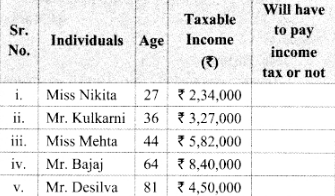
Observe the table given below. Check and decide, whether the individuals have to pay income tax.

Image

Answer
i. Miss Nikita’s age = 27 years < 60 years
Miss Nikita’s income = ₹ 2,34,000
Miss Nikita’s income is below the basic
exemption limit of ₹ 2,50,000.
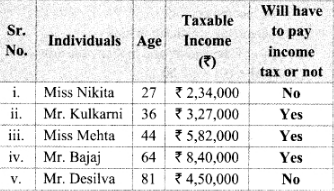
∴ Miss Nikita will not have to pay income tax.

ii. Mr. Kulkarni’s age 36 years < 60 years
Mr. Kulkarni’s income = ₹3,27,000
Mr. Kulkarni’s income is above the basic exemption Limit of ₹2,50,000.
∴ Mr. Kulkarni will have to pay income tax.

iii. Miss Mehta’s age = 44 years < 60 years Miss Mehta’s income = ₹5.82,000
Miss Mehta’s income is above the basic exemption limit of ₹2,50,000.
∴ Miss Mehta will have to pay income tax.

iv. Mr. Bajaj’s age = 64 years (Age 60 to 80 years)
Mr. Bajaj’s income = ₹8,40,000
Mr. Bajaj’s income is above the basic exemption Limit of ₹3,00,000.
∴ Mr. Bajaj will have to pay income tax.

v. Mr. Desilva’s age = 81 years > 80 years
Mr. Desilva’s income = ₹4,50,000
Mr. Desilva’s income is below the basic exemption limit of ₹ 5,00.000.
∴ Mr. Desilva will not have to pay income tax.

Image

View full question & answer
Question 115 Marks
Mr. Sayyad kept ₹ 40,000 in a bank at 8% compound interest for 2 years. Mr. Fernandes invested ₹ 1,20,000 in a mutual fund for 2 years. After 2 years, Mr. Fernandes got ₹ 1,92,000. Whose investment turned out to be more profitable?
Answer
Mr. Sayyad:
Mr. Sayyad kept ₹ 40,000 in a bank at 8% compound interest for 2 years P = ₹ 40000, R = 8%, n = 2 years
∴ Compound interest (I)
= Amount (A) – Principal (P)
$=P\left(1+\frac{R}{100}\right)^n-P$
$=P\left[\left(1+\frac{R}{100}\right)^n-1\right]$
$=40000\left[\left(1+\frac{8}{100}\right)^2-1\right]$
$=40000\left[(1+0.08)^2-1\right]$
$=40000\left[(1.08)^2-1\right]$
$=40000(1.1664-1)$
$=40000(0.1664)$
$=₹ 6656$
$\therefore \text { Mr. Sayyad's percentage of profit Interest }$
$=\frac{\text { Interest }}{\text { Amountinvested }} \times 100$
$=\frac{6656}{40000} \times 100 \quad \ldots \text {...(i) }$
$=16.64 \%$
Mr. Fernandes:
Amount invested by Mr. Fernandes in mutual fund = ₹ 120000
Amount received by Mr. Fernandes after 2 years = ₹ 192000
∴ Profit earned by Mr. Fernandes
= Amount received – Amount invested
= 192000- 120000
= ₹72000
∴ Mr. Fernandes percentage of profit Profit earned
$=\frac{\text { Profit earned }}{\text { Amount invested }} \times 100$
$=\frac{72000}{120000} \times 100$
$=60 \%$
From (i) and (ii),
Investment of Mr. Fernandes turned out to be more profitable.
View full question & answer
Question 125 Marks
Nikhil spent 5% of his monthly income on his children’s education, invested 14% in shares, deposited 3% in a bank and used 40% for his daily expenses. He was left with a balance of ₹ 19,000. What was his income that month?
Answer
Let the monthly income of Nikhil be ₹ x.
Nikhil invested 14% in shares and deposited 3% in a bank.
∴ Total investment = (14% + 3%) of x
= 17% of x
$=\frac{17}{100} \times \times$

= 0.1 7 x
Nikhil spent 5% on his children’s education and used 40% for his daily expenses.

∴ Total expenditure = (5% + 40%) of x
= 45% of x
$=\frac{45}{100} \times \times$
= 0.45x
Amount left with Nikhil = 19,000
Amount left with Nikhil = Income – (Total investment + Total expenditure)
∴ 19000 = x – (0.17x + 0.45x)
∴ 19000 = x – 0.62x ,
∴ 19000 = 0.38x
$\therefore x=\frac{19000}{0.38}=\frac{19000 \times 100}{0.38 \times 100}=\frac{1900000}{38}$
= 50000
∴ The monthly income of Nikhil is ₹ 50000.

View full question & answer
Question 135 Marks
Sumit borrowed a capital of ₹ 50,000 to start his food products business. In the first year he suffered a loss of 20%. He invested the remaining capital in a new sweets business and made a profit of 5%. How much was his profit or loss computed on his original capital ?
Answer
Original capital borrowed by Sumit = ₹ 50000
Sumit suffered a loss of 20% in his food products business.
∴ Loss suffered in the first year = 20% of 50000
$=\frac{20}{100} \times 50000$
$=₹ 10000$
$\text { Remaining capital = Original capital }- \text { loss suffered }=50000-10000$
$=₹ 40000$
Sumit invested the remaining capital i.e. $₹ 40,000$ in a new sweets business. He made a profit of $5 \%$.
Profit in sweets business $=5 \%$ of 40000
$=\frac{5}{100} \times 40000100$
$=₹ 2000$
New capital with Sumit after the profit in new sweets business = 40000 + 2000 = ₹42000
Since, the new capital is less than the original capital, we can conclude that Sumit suffered a loss.
Total loss on original capital = Original capital – New capital
= 50000 – 42000 = ₹ 8000
$\therefore \quad \text { Percentage of loss }  =\frac{\text { Totalloss }}{\text { Original capital }} \times 100$
$ =\frac{8000}{50000} \times 100$
$ =16 \%$
$\therefore$ Sumit suffered a loss of $16 \%$ on the original capital.
View full question & answer
Question 145 Marks
Amita invested some part of ₹ 35000 at 4% and the rest at 5% interest for one year. Altogether her gain was ₹ 1530. Find out the amounts she had invested at the two different rates. Write your answer in words.
Answer
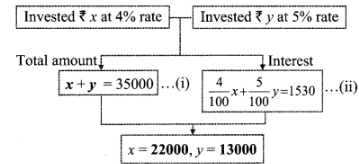
Let the amount invested at the rate of 4% and 5% be ₹ x and ₹ y respectively.
According to the first condition, total amount invested = ₹ 35000
∴ x + y = 35000 …(i)
According to the second condition,
total interest received at 4% and 5% is ₹ 1530.
∴ 4 % of x + 5 % of y = 1530
$\therefore \frac{4}{100} \times x+\frac{5}{100} \times y=1530$
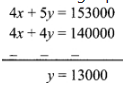
$\therefore 4 x+5 y=153000 \ldots \text { (ii) }$
Multiplying equation (i) by 4 , we get
$4 x+4 y=140000 \text {...(iii) }$
Image
Subtracting equation (iii) from (ii),
Substituting y = 13000 in equation (i),
x + 13000 = 35000
∴ x = 35000 – 13000 = 22000
Image
∴ Amita invested ₹ 22000 at the rate of 4% and ₹ 13000 at the rate of 5%.
View full question & answer