Questions

MCQ(1M)

Take a timed test

14 questions · auto-graded multiple-choice test.

MCQ 11 Mark
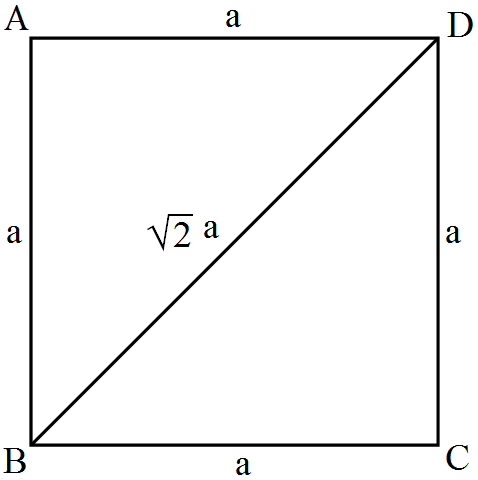
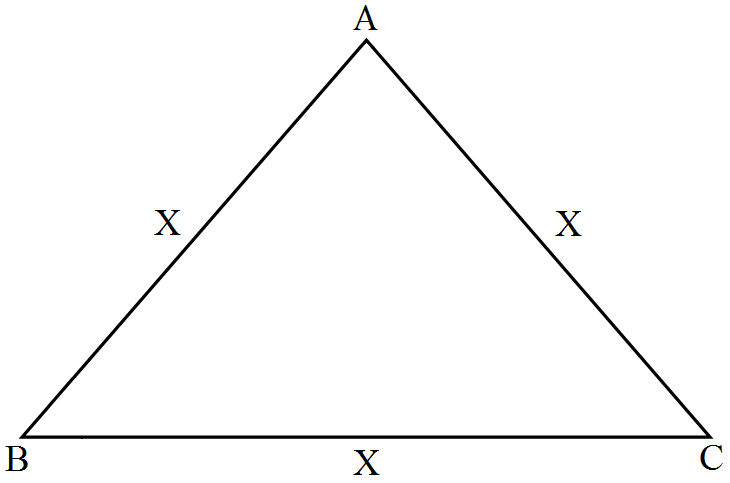
A square and an equilateral triangle have equal perimeters. If the diagonal of the square is $12\sqrt{2}\text{ cm},$ then area of the triangle is:
  • A
    $24\sqrt{2}\text{ cm}^2$
  • B
    $24\sqrt{3}\text{ cm}^2$
  • C
    $48\sqrt{3}\text{ cm}^2$
  • $64\sqrt{3}\text{ cm}^2$
Answer
Correct option: D.
$64\sqrt{3}\text{ cm}^2$


If side of a square is a $\ cm$
Then, its diagonal $=\sqrt{2}\text{a}\text{ cm}$
But diagonal $=12\sqrt{2}\text{ cm}$
$\Rightarrow\sqrt{2}\text{a}=12\sqrt{2}$
$\Rightarrow a = 12\ cm$
$\Rightarrow$ Perimeter of a square $= 4a = 4 \times 12 = 48\ cm$
Now, perimeter of an equilateral triangle with side $x = 3x \ cm$
But perimeter of equilateral triangle $ =$ Perimeter of square
$\Rightarrow 3x = 48$
$\Rightarrow x = 16\ cm$
Now, Area of equilateral $\triangle$
$=\frac{\sqrt{3}\text{x}^2}{4}=\frac{\sqrt{3}}{4}\times16\times16=64\sqrt{3}\text{ cm}^2$
Hence, correct option is $(d)$.
View full question & answer
MCQ 21 Mark
The sides of a triangle are $11\ m, 60\ m$ and $61\ m$. The altitude to the smallest side is:
  • A
    $11\ cm$
  • B
    $66\ cm$
  • C
    $50\ cm$
  • $60\ cm$
Answer
Correct option: D.
$60\ cm$
Area of $\triangle=\frac12\text{Base}\times\text{Height}$
The smallest side is $11\ m$
$\Rightarrow\text{Area}=\frac12\times11\times\text{Height}\dots(1)$
Area by Heron's Formula $=\sqrt{\text{s}(\text{s}-\text{a})(\text{s}-\text{b})(\text{s}-\text{c})}$
$\text{s}=\frac{11+60+61}{2}=66\text{ m}$
$\Rightarrow\text{Area}=\sqrt{66\times55\times6\times5}=330\text{ m}^2$
From eq. $(1)$
$330=\frac12\times11\times\text{Height}$
$\Rightarrow\text{Height}=\frac{2\times330}{11}=60\text{ m}$
Hence, correct option is $(d)$.
View full question & answer
MCQ 31 Mark
The length of each side of an equilateral triangle of area $4\sqrt{3}\text{cm}^2,$ is:
  • $4\ \text{cm}$
  • B
    $\frac{4}{\sqrt{3}}\ \text{cm}$
  • C
    $\frac{\sqrt{3}}{4}\ \text{cm}$
  • D
    $3\ \text{cm}$
Answer
Correct option: A.
$4\ \text{cm}$
If side of an equilateral triangle is $'a\ ',$ then its
Area $=\frac{\sqrt{3}}{4}\text{a}^2$
Now, $\frac{\sqrt{3}}{4}\text{a}^2=4\sqrt{3}$
$\Rightarrow a^2 = 4^2$
$\Rightarrow a = 4cm$
Hence, correct option is $(a).$
View full question & answer
MCQ 41 Mark
If every side of a triangle is doubled, then increase in the area of the triangle is:
  • A
    $100\sqrt{2}\%$
  • B
    $200\%$
  • $300\%$
  • D
    $400\%$
Answer
Correct option: C.
$300\%$
$\text{s}=\frac{\text{a}+\text{b}+\text{c}}{2},\text{A}=\sqrt{\text{s}(\text{s}-\text{a})(\text{s}-\text{b})(\text{s}-\text{c})}$
Now, if $a\ ' = 2a, b\ ' = 2b$ and $c\ ' = 2c$
Then, $\text{s}'=\frac{\text{a}'+\text{b}'+c'}{2}=\frac{2\text{a}+2\text{b}+2\text{c}}{2}=2\text{s}$
$\text{A}'=\sqrt{\text{s}'(\text{s},-\text{a}')(\text{s}'-\text{b}')(\text{s}'-\text{c}')}$
$=\sqrt{2\text{s}(2\text{s}-2\text{a})(2\text{s}-2\text{b})(2\text{s}-2\text{c})}$
$=4\sqrt{\text{s}(\text{s}-\text{a})(\text{s}-\text{b})(\text{s}-\text{c})}$
$\Rightarrow\text{A}' = 4\text{A}$
$\Rightarrow$ Increase in Area $=\frac{4\text{A}-\text{A}}{\text{A}}\times100\%=300\%$
Hence, correct optin is $(c).$
View full question & answer
MCQ 51 Mark
The sides of a triangle are $7\ cm, 9\ cm$ and $14\ cm$. Its area is:
  • $12\sqrt{5}\text{ cm}^2$
  • B
    $12\sqrt{3}\text{ cm}^2$
  • C
    $24\sqrt{5}\text{ cm}^2$
  • D
    $63\text{ cm}^2$
Answer
Correct option: A.
$12\sqrt{5}\text{ cm}^2$
Let $a = 7\ cm, b = 9\ cm, c = 14\ cm$
Semi $-$ perimeter $= \text{s}=\frac{\text{a}+\text{b}+\text{c}}{2}=\frac{7+9+14}{2}=15\text{ cm}$
$s - a = 15 -7 = 8\ cm, s - b = 15 - 9 = 6\ cm$ and $s - c = 15 - 14 = 1\ cm$
Area of a triangle $=\sqrt{\text{s}(\text{s}-\text{a})(\text{s}-\text{b})(\text{s}-\text{c})}$
$=\sqrt{15\times8\times6\times1}$
$=\sqrt{5\times3\times4\times2\times3\times2}$
$=2\sqrt{5}\text{ cm}^2$
Hence, correct option is $(a).$
View full question & answer
MCQ 61 Mark
The sides of a triangle are $11\ cm, 15\ cm$ and $16\ cm$. The altitude to the largest side is:
  • A
    $30\sqrt{7}\text{ cm}$
  • B
    $\frac{15\sqrt{7}}{2}\text{ cm}$
  • $\frac{15\sqrt{7}}{2}\text{ cm}$
  • D
    $30\text{ cm}$
Answer
Correct option: C.
$\frac{15\sqrt{7}}{2}\text{ cm}$
$\text{s}=\frac{11+60+61}{2}=66\text{ m}$
Area of $\triangle=\sqrt{\text{s}(\text{s}-\text{a})(\text{s}-\text{b})(\text{s}-\text{c})}$
$=\sqrt{21\times10\times6\times5}=30\sqrt{7}\text{ cm}^2$
Also if we choose largest side and its Altitude, the area would be
$\text{A}=\frac12\times\text{largest side}\times\text{h}$
$330=\frac12\times11\times\text{Height}$
$\Rightarrow\text{Height}=\frac{2\times330}{11}=60\text{ m}$
Hence, correct option is $(d)$.
View full question & answer
MCQ 71 Mark
The sides of a triangle are $16\ cm, 30\ cm, 34\ cm$. Its area is:
  • A
    $225\text{ cm}^2$
  • $225\sqrt{3}\text{ cm}^2$
  • C
    $225\sqrt{2}\text{ cm}^2$
  • D
    $450\text{ cm}^2$
Answer
Correct option: B.
$225\sqrt{3}\text{ cm}^2$
Let $a = 16\ cm, b = 30\ cm, c = 34\ cm$
Semi $-$ perimeter of a triangle $=\frac{\text{a}+\text{b}+\text{c}}{2}=\frac{16+30+34}{2}=40$
Now $, s - a = 24\ cm, s - b = 10\ cm$ and $s - c = 6\ cm$
By Heron's formula.
Area of a triangle $=\sqrt{\text{s}(\text{s}-\text{a})(\text{s}-\text{b})(\text{s}-\text{c})}$
$=\sqrt{40\times24\times10\times6}$
$=\sqrt{4\times10\times4\times6\times10\times6}$
$=\sqrt{4^2\times10^2\times6^2}$
$=4\times10\times6$
$= 240\text{ cm}^2$
Note: Correct option not given.
View full question & answer
MCQ 81 Mark
The lengths of the sides of $\triangle\text{ABC}$ are consecutive integers. It $\triangle\text{ABC}$ has the same perimeter as an equilateral triangle with a side of length $9\ cm,$ what is the length of the shortest side of $\triangle\text{ABC}?$
  • A
    $4$
  • B
    $6$
  • $8$
  • D
    $10$
Answer
Correct option: C.
$8$
Let the sides of $\triangle\text{ABC}$ be $n, n + 1, n + 2.$
$\Rightarrow$ Perimeter $= n + n + 1 + n + 2$
$\Rightarrow (9 + 9 + 9) = 3n + 3$
$\Rightarrow 3n = 24$
$\Rightarrow n = 8\ cm$
Thus, the shortest side is $8\ cm.$
Hence, correct option is $(c)$.
View full question & answer
MCQ 91 Mark
If the length of a median of an equilateral triangle is $x \ cm,$ then its area is:
  • A
    $\text{x}^2$
  • B
    $\frac{\sqrt{3}}{2}\text{x}^2$
  • $\frac{\text{x}^2}{\sqrt{3}}$
  • D
    $\frac{\text{x}^2}{2}$
Answer
Correct option: C.
$\frac{\text{x}^2}{\sqrt{3}}$

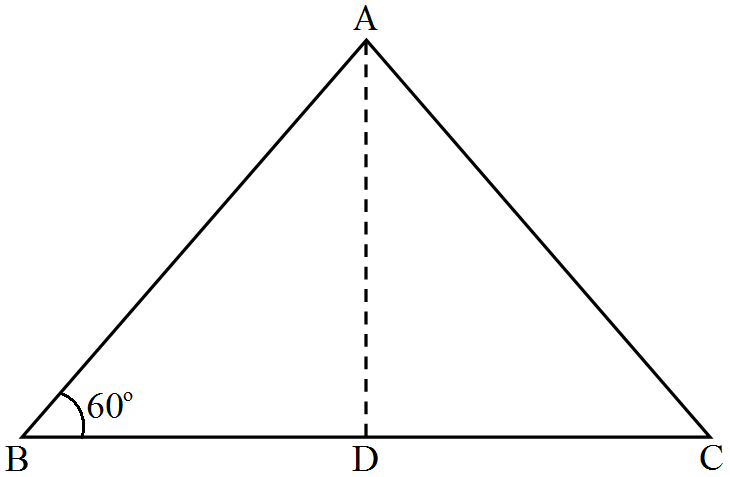
Let the side of equilateral $\triangle\text{ABC}$ be $a \ cm$
The median of equilateral triangle is its altitude drawn from $A$ to $BC$.
$\big($i.e. the height of $\triangle$ over Base $BC\big)$
$\Rightarrow\text{x}=\frac{\text{a}\sqrt{3}}{2}\  [AD = x($given$)]$
$\Rightarrow\text{a}=\frac{2\text{x}}{\sqrt{3}}$
Area of equilateral $\triangle$ of side a
$=\frac{\sqrt{3}\text{a}^2}{4}$
$=\frac{\sqrt{3}}{4}\Big(\frac{2\text{x}}{\sqrt{3}}\Big)^3$
$=\frac{\text{x}^2}{\sqrt{3}}$
Hence, correct option is $(c).$
View full question & answer
MCQ 101 Mark
If the area of an isosceles right triangle is $8\ cm^2$, what is the perimeter of the triangle?
  • A
    $8+\sqrt{2}\text{cm}^2$
  • $8+4{\sqrt{2}}\text{cm}^2$
  • C
    $4+8{\sqrt{2}}{}\text{cm}^2$
  • D
    $12\sqrt{2}\text{cm}^2$
Answer
Correct option: B.
$8+4{\sqrt{2}}\text{cm}^2$
Let each of the two equal sides of an isosceles right triangle be a $cm.$
Then, third side $=\text{a}\sqrt{2}\ \text{cm}$
Area of $\triangle=\frac12\times\text{a}\times\text{a}$
$\Rightarrow8=\frac{\text{a}^2}{2}$
$\Rightarrow a^2 = 16$
$\Rightarrow a = 4\ cm$
$\Rightarrow$ Perimeter $\Rightarrow\text{a}+\text{a}+\text{a}\sqrt{2}=4+4+4\sqrt{2}\ \text{cm}$
Hence, correct option is $(b).$
View full question & answer
MCQ 111 Mark
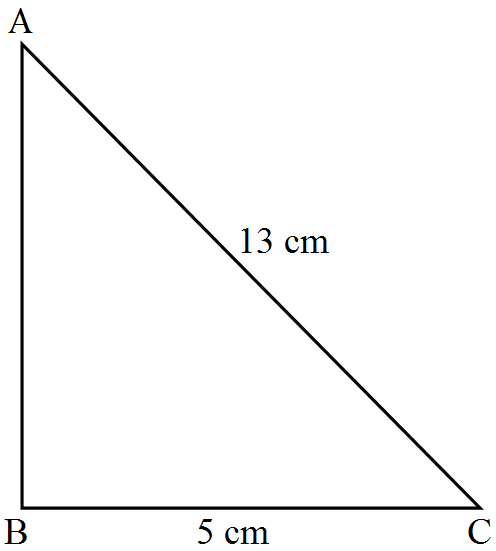
The base and hypotenuse of a right triangle are respectively $5\ cm$ and $13\ cm$ long. Its area is:
  • A
    $25\ cm^2$
  • B
    $28\ cm^2$
  • $30\ cm^2$
  • D
    $40\ cm^2$
Answer
Correct option: C.
$30\ cm^2$

$\text{AB}=\sqrt{(13)^2-(5)^2}=12\ \text{cm}$
$\text{Area}=\frac{1}{2}\times\text{BC}\times\text{AB}=\frac12\times5\times12=30\ \text{cm}^2$
Hence, correct option is $(c).$
View full question & answer
MCQ 121 Mark
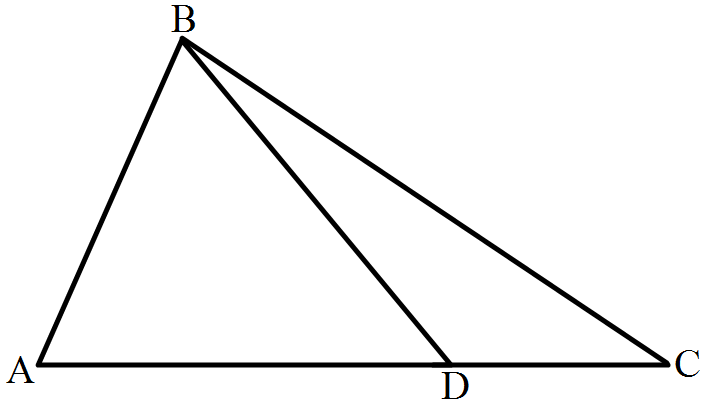
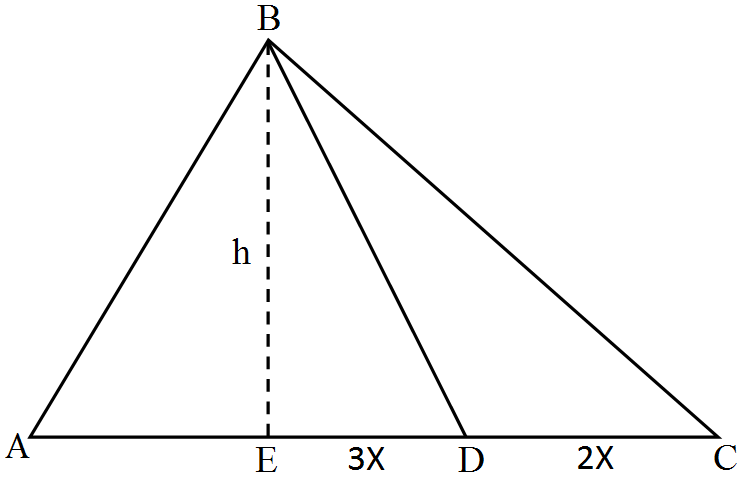
In the given figure, the ratio $AD$ to $DC$ is $3$ to $2$. If the area of $\triangle\text{ABC}$ is $40\ cm^2$, what is the area of $\triangle\text{BDC}?$
 
  • $16\ cm^2$
  • B
    $24\ cm^2$
  • C
    $30\ cm^2$
  • D
    $36\ cm^2$
Answer
Correct option: A.
$16\ cm^2$

$\frac{\text{AD}}{\text{DC}}=\frac32$
Let $AD = 3x$ and $DC = 2x$
Area of $\triangle\text{ABC}=\frac12\times\text{AC}\times\text{BC} (\text{BE = h})$
$\Rightarrow40=\frac12\times5\text{x}\times\text{h}$
$\Rightarrow 80 = 5xh$
$\Rightarrow xh = 16\ cm^2 ....(1)$
Now, Area of $\triangle\text{ABD}=\frac12\times3\text{x}\times\text{h}=\frac{3\times\text{h}}{2}=\frac{3}{2}\times16=24\text{cm}^2$
Area of $\triangle\text{BDC}=$ Area of $\triangle\text{ABC}-$ Area of $\triangle\text{ABD}=40-24=16\text{cm}^2$
Hence, correct option is $(a).$
View full question & answer
MCQ 131 Mark
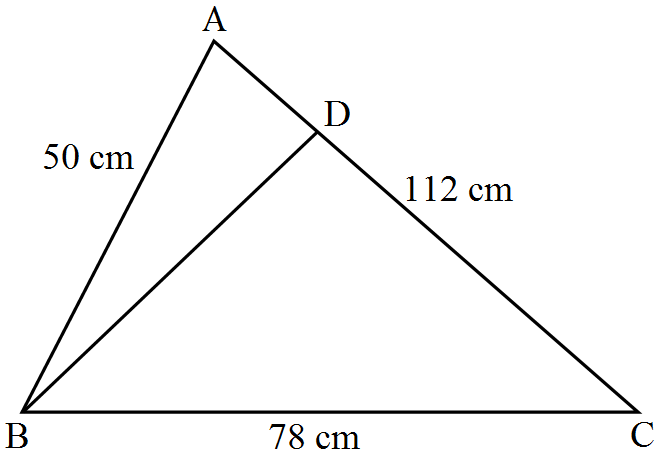
The sides of a triangle are $50\ cm$, $78\ cm$ and $112\ cm.$ The smallest altitude is:
  • A
    $20\ cm$
  • $30\ cm$
  • C
    $40\ cm$
  • D
    $50\ cm$
Answer
Correct option: B.
$30\ cm$

The smallest altitude is $\perp$ drawn to the largest side of a $\triangle$ From opposite point. i. e. $BD$
Area of $\triangle=\frac12\times\text{AC}\times\text{BD}=\frac12\times112\times\text{BD}=56\times\text{BD}$
$\text{s}=\frac{\text{a}+\text{b}+\text{c}}{2}=\frac{50+78+115}{2}=120\text{cm}$
$s - AB = 70\ cm, s - BC = 42\ cm, s - AC = 8\ cm$
Area $=\sqrt{\text{s}(\text{s}-\text{a})(\text{s}-\text{b})(\text{s}-\text{c})}$
$=\sqrt{120\times70\times42\times8}=1680\text{cm}^2$
Now, $56 \times BD = 1680\ cm^2$
$\Rightarrow\text{BD}=\frac{1680}{56}=30\text{cm}$
Hence, correct option is $(b)$.
View full question & answer
MCQ 141 Mark
The sides of a triangular field are $325m$, $300m$ and $125m$. Its area is:
 
  • $18750m^2$
  • B
    $37500m^2$
  • C
    $97500m^2$
  • D
    $48750m^2$
Answer
Correct option: A.
$18750m^2$
$a = 325m, b = 30m, c = 125m$
$\text{s}=\frac{\text{a}+\text{b}+\text{c}}{2}=\frac{325+300+125}{2}=375\text{m}$
$s - a = 50m, s - b = 75m, s - c = 250m$
Area $=\sqrt{\text{s}(\text{s}-\text{a})(\text{s}-\text{b})(\text{s}-\text{c})}$
$=\sqrt{375\times50\times75\times250}$
$=\sqrt{15\times25\times25\times2\times3\times25\times25\times10}$
$=\sqrt{\underline{25\times25}\times\underline{25\times25}\times\underline{30\times30}}$
$=25\times25\times30$
$= 18750\text{m}^2$
Hence, correct option is $(a).$
View full question & answer