Questions

4 Mark Question

Take a timed test

4 questions · self-marked practice — reveal the answer and mark yourself.

Question 14 Marks
What is the difference between a theorem and an axiom?
Answer
Axiom: An axiom is a basic fact that is taken for granted without proof.
Examples:
  1. Halves of equals are equal.
  2. The whole is greater than each of its parts.
Theorem: A statement that requires proof is called theorem.
Examples:
  1. The sum of all the angles around a point is 360°.
  2. The sum of all the angles of triangle is 180°.
View full question & answer
Question 24 Marks
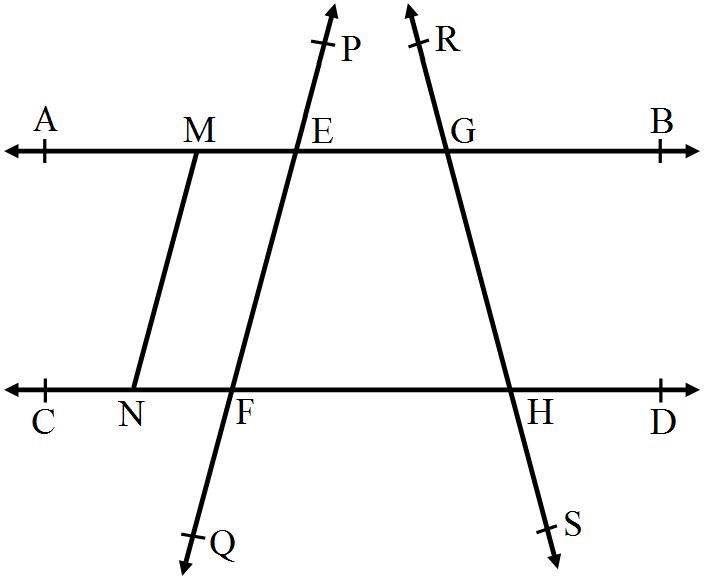
In the adjoining figure, name:
  1. Six points.
  2. Five lines segments.
  3. Four rays.
  4. Four lines.
  5. Four collinear points.
Answer
  1. Points are A, B, C, D, P and R.
  2. $\overline{\text{EF}},\ \overline{\text{GH}},\ \overline{\text{FH}},\ \overline{\text{EG}},\ \overline{\text{MN}}$
  3. $\overrightarrow{\text{EP}},\ \overrightarrow{\text{GR}},\ \overrightarrow{\text{HS}},\ \overrightarrow{\text{FQ}}$
  4. $\overleftrightarrow{\text{AB}},\ \overleftrightarrow{\text{CD}},\ \overleftrightarrow{\text{PQ}},\ \overleftrightarrow{\text{RS}}$
  5. Collinear points are M, E, G and B.
View full question & answer
Question 34 Marks
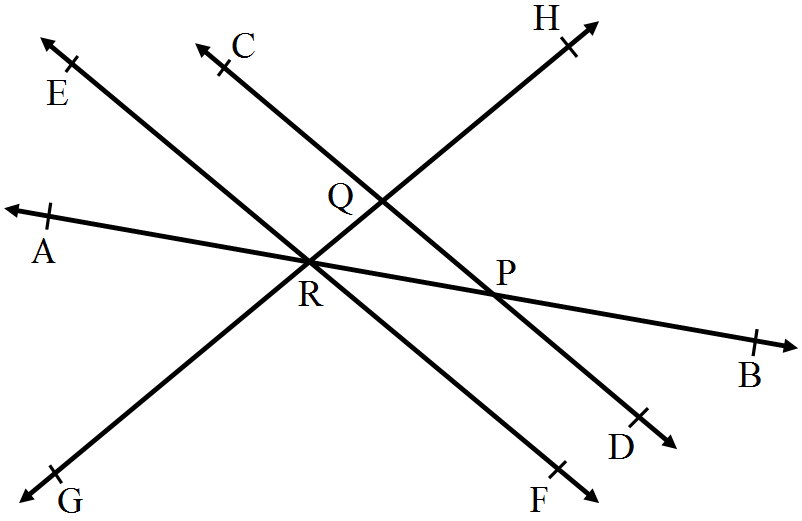
In the adjoining figure, name:
  1. Two pairs of intersecting lines and their corresponding points of intersection.
  2. Three concurrent lines and their points of intersection.
  3. Three rays.
  4. Two line segments.
Answer
  1. Two pairs of intersecting lines and their point of intersection are.
$\bigg\{\overleftrightarrow{\text{EF}},\ \overleftrightarrow{\text{GH}},\ \text{point}\text{ R}\bigg\},\bigg\{\overleftrightarrow{\text{AB}},\ \overleftrightarrow{\text{CD}},\ \text{point}\text{ P}\bigg\}$
  1. Three concurrent lines are.
$\bigg\{\overleftrightarrow{\text{AB}},\ \overleftrightarrow{\text{EF}},\ \overleftrightarrow{\text{GH}},\ \text{point}\text{ R}\bigg\}$
  1. Three rays are.
$\bigg\{\overrightarrow{\text{RB}},\ \overrightarrow{\text{RH}},\ \overrightarrow{\text{RF}}\bigg\}$
  1. Two line segments are.
$\Big\{\overline{\text{RQ}}\text{ and }\overline{\text{RP}}\Big\}$
View full question & answer
Question 44 Marks
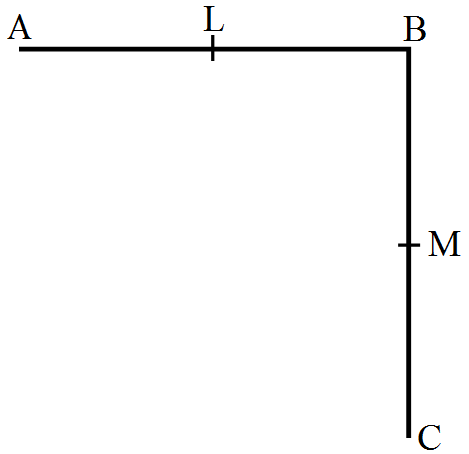
In the given figure, L and M are the mid-points of AB and BC respectively.
  1. If AB = BC, prove that AL = MC.
  2. If BL = BM, prove that AB = BC.
Hint:
  1. $\text{AB}=\text{BC}\Rightarrow\frac{1}{2}\text{AB}=\frac{1}{2}\text{BC}\Rightarrow\text{AL}=\text{MC}.$
  2. $\text{BL}=\text{BM}\Rightarrow2\text{BL}=2\text{BM}\Rightarrow\text{AB}=\text{BC}.$
Answer
  1. It is given that L is the mid-point of AB.
$\therefore\text{AL}=\text{BL}=\frac{1}{2}\text{AB}\ .....(1)$

Also, M is the mid-point of BC.

$\therefore\text{BM}=\text{MC}=\frac{1}{2}\text{BC}\ .....(2)$

$\text{AB}=\text{BC}$ (Given)

$\Rightarrow\frac{1}{2}\text{AB}=\frac{1}{2}\text{BC}$ (Things which are halves of the same thing are equal to one another)

$\text{AL}=\text{MC}$ [From (1) and (2)]
  1. It is given that L is the mid-point of AB.
$\therefore\text{AL}=\text{BL}=\frac{1}{2}\text{AB}$

$\Rightarrow2\text{AL}=2\text{BL}=\text{AB}\ .....(3)$

Also, M is the mid-point of BC.

$\therefore\text{BM}=\text{MC}=\frac{1}{2}\text{BC}$

$\Rightarrow2\text{BM}=2\text{MC}=\text{BC}\ .....(4)$

$\text{BL}=\text{BM}$ (Given)

$\Rightarrow2\text{BL}=2\text{BM}$ (Things which are double of the same thing are equal to one another)

$\Rightarrow\text{AB}=\text{BC}$ [From (3) and (4)]
View full question & answer