Questions

MCQ(1M)

Take a timed test

27 questions · auto-graded multiple-choice test.
MCQ 11 Mark
The side faces of a pyramid are:
  • Triangles.
  • B
    Squares.
  • C
    Trapeziums.
  • D
    Polygons.
Answer
Correct option: A.
Triangles.
The side faces of a pyramid are triangles.
View full question & answer
MCQ 21 Mark
A pyramid is a solid figure, whose base is:
  • A
    Only a triangle.
  • B
    Only a square.
  • C
    Only a rectangle.
  • Any polygon.
Answer
Correct option: D.
Any polygon.
A pyramid is a solid figure, whose base is any polygon.
View full question & answer
MCQ 31 Mark
Which of the following is a true statement?
  • A
    Only a unique line can be drawn through a given point.
  • B
    Infinitely many lines can be drawn through two given points.
  • If two circles are equal, then their radii are equal.
  • D
    A line has a definite length.
Answer
Correct option: C.
If two circles are equal, then their radii are equal.
In option $(a),$ infinite number of line can be drawn to pass through a given point.
So, it is not a true statement.
In option $(b),$ only one line can be drawn to pass through two given points.
So, it is not a true statement.
In option $(c),$ 'If two circles are equal, then their radii are equal' is the true statement.
In option $(d), A$ line has no end points. $A$ line has an indefinite length.
So, it is not a true statement.
View full question & answer
MCQ 41 Mark
In ancient India, the shapes of altars used for household rituals were:
  • A
    Squares and rectangles.
  • Squares and circles.
  • C
    Triangles and rectangles.
  • D
    Trapeziums and pyramids.
Answer
Correct option: B.
Squares and circles.
Squares and circular altars were used for household rituals.
Whereas altars having shapes as combinatiotanglens of recs, triangles and trapeziums were used for public worship.
View full question & answer
MCQ 51 Mark
Which of the following needs a proof?
  • A
    Axiom.
  • B
    Postulate.
  • C
    Definition.
  • Theorem.
Answer
Correct option: D.
Theorem.
A statement that requires a proof is called a theorem.
View full question & answer
MCQ 61 Mark
Which of the following is a true statement?
  • A
    The floor and a wall of a room are parallel planes.
  • B
    The ceiling and a wall of a room are parallel planes.
  • The floor and the ceiling of a room are parallel planes.
  • D
    Two adjacent walls of a room are parallel planes.
Answer
Correct option: C.
The floor and the ceiling of a room are parallel planes.
Two lines are said to be parallel, if they have no point in common.
Options $(a), (b)$ and $(d)$ have a common point, hence they are not parallel.
In option $(c),$ the floor and the ceiling of a room are parallel to each other is a true statement.
View full question & answer
MCQ 71 Mark
Euclid stated that 'all right angles are equal to each other', in the form of:
  • A
    A definition.
  • An axiom.
  • C
    A postulate.
  • D
    A proof.
Answer
Correct option: B.
An axiom.
Euclid stated that 'All right angles are equal to each other' in the form of a postulate.
This is Euclid's Postulate $4.$
Note: The answer in the book is option $(a)$.
But if you have a look at the Euclid's postulate, the answer is a postulate.
View full question & answer
MCQ 81 Mark
A point $C$ is said to lie between the points $A$ and $B$ if.
  • A
    $AC = CB.$
  • B
    $AC + CB = AB.$
  • Point $A, C$ and $B$ are collinear.
  • D
    None of these.
Answer
Correct option: C.
Point $A, C$ and $B$ are collinear.
If direction ratios of three vectors $a, b, c$ are proportional then they are collinear.
View full question & answer
MCQ 91 Mark
Which of the following is a false statement?
  • A
    An infinity number of lines can be drawn to pass through a given point.
  • B
    A unique line can be drawn to pass through two given points.
  • $\text{Ray }\overrightarrow{\text{AB}}=\text{ray}\ \overrightarrow{\text{BA}}.$
  • D
    A ray has one end point.
Answer
Correct option: C.
$\text{Ray }\overrightarrow{\text{AB}}=\text{ray}\ \overrightarrow{\text{BA}}.$
Option $(a)$ is true, since we can pass an infinite number of lines through a given point
Option $(b)$ is true, since a unique line can be drawn to pass through two given points.
Consider option $(c).$
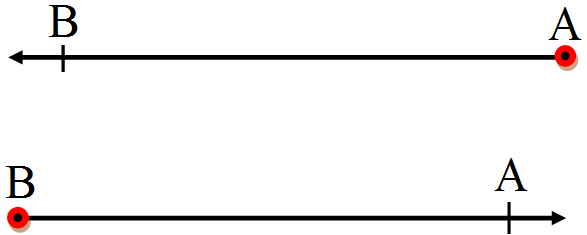
A ray is a line segment that extends indefinitely in one direction as shown below.
$\text{Ray }\overrightarrow{\text{AB}}=\text{ray}\ \overrightarrow{\text{BA}}$ is a false statement since clearly the lines extend indefinitely.

As shown in the above diagram, a ray has only one end $-$ point.
So, option $(d)$ is true.
Hence, the only false statement is option $(c)$.
View full question & answer
MCQ 101 Mark
Boundaries of solids are:
  • A
    Lines.
  • B
    Curves.
  • Surfaces.
  • D
    None of these.
Answer
Correct option: C.
Surfaces.
Boundaries of solids are surfaces.
View full question & answer
MCQ 111 Mark
The number of planes passing through $3$ non $-$ collinear points is:
  • A
    $4$
  • B
    $3$
  • C
    $2$
  • $1$
Answer
Correct option: D.
$1$
The number of planes passing through three non $ -$ collinear points is $1.$
View full question & answer
MCQ 121 Mark
A point $C$ is called the mid $-$ point of a line segment $\overrightarrow{\text{AB}}$ if.
  • A
    $C$ is an interior point of $AB$.
  • B
    $AC = CB.$
  • $C$ is an interior point of $AB$ such that $\overrightarrow{\text{AC}}=\overrightarrow{\text{CB}}.$
  • D
    $AC + CB = AB.$
Answer
Correct option: C.
$C$ is an interior point of $AB$ such that $\overrightarrow{\text{AC}}=\overrightarrow{\text{CB}}.$
A point $C$ is called the midpoint of a line segment $\overline{\text{AB}},$ if $C$ is an interior point of $AB$ such that $\overrightarrow{\text{AC}}=\overrightarrow{\text{CB}}.$
View full question & answer
MCQ 131 Mark
Axioms are assumed:
  • A
    Definitions.
  • B
    Theorems.
  • C
    Universal truths specific to geometry.
  • Universal truths in all branches of mathematics.
Answer
Correct option: D.
Universal truths in all branches of mathematics.
Axioms are assumed as universal truths in all branches of mathematics because they are taken for granted, without proof.
View full question & answer
MCQ 141 Mark
In Indus Valley Civilisation $($about $BC\  3000)$, the bricks used for construction work were having dimensions in the ratio of:
  • A
    $\{5 : 3 : 2\}$
  • $\{4 : 2 : 1\}$
  • C
    $\{4 : 3 : 2\}$
  • D
    $\{6 : 4 : 2\}$
Answer
Correct option: B.
$\{4 : 2 : 1\}$
In Indus Valley Civilization $($about $300\ BC)$ the bricks used for construction work were having dimensions in the ratio is $\{4 : 2 : 1\}.$
View full question & answer
MCQ 151 Mark
Into how many chapters was the famous treatise, 'The Elements' divided by Euclid?
  • $13$
  • B
    $12$
  • C
    $11$
  • D
    $9$
Answer
Correct option: A.
$13$
The famous treatise 'The Elements' was divided into $13$ chapters by Euclid.
View full question & answer
MCQ 161 Mark
Boundaries of surfaces are:
  • A
    Lines.
  • Curves.
  • C
    Polygons.
  • D
    None of these.
Answer
Correct option: B.
Curves.
Boundaries of surfaces are curves.
View full question & answer
MCQ 171 Mark
$A$ is of the same age as $B$ and $C$ is of the same age as $B$. Euclid's which axiom illustrates the relative ages of $A$ and $C$?
  • Frist axiom.
  • B
    Second exiom.
  • C
    Third axiom.
  • D
    Fourth axiom.
Answer
Correct option: A.
Frist axiom.
Euclid's first axiom states that 'Things which are equal to the same thing are equal to one another'.
That is,
$A\ 's$ age $= B\ 's$ age and $C\ 's$ age $= B\ '$ age
$\Rightarrow A\ 's$ age $= C\ 's$ age
View full question & answer
MCQ 181 Mark
The number of dimensions of a surface are:
  • A
    $1$
  • $2$
  • C
    $3$
  • D
    $0$
Answer
Correct option: B.
$2$
A surface has $2$ dimensions.
View full question & answer
MCQ 191 Mark
Euclid belongs to the country:
  • A
    India.
  • Greece.
  • C
    Japan.
  • D
    Egypt.
Answer
Correct option: B.
Greece.
Euclid belongs to the country, Greece.
View full question & answer
MCQ 201 Mark
The number of dimensions of a solid are:
  • A
    $1$
  • B
    $2$
  • $3$
  • D
    $5$
Answer
Correct option: C.
$3$
A solid has $3$ dimensions.
View full question & answer
MCQ 211 Mark
Pythagoras was a student of:
  • A
    Euclid.
  • Thales.
  • C
    Archimedes.
  • D
    Bhaskara.
Answer
Correct option: B.
Thales.
Pythagoras was a student of Thales.
View full question & answer
MCQ 221 Mark
How many dimensions does a point have:
  • $0$
  • B
    $1$
  • C
    $2$
  • D
    $3$
Answer
Correct option: A.
$0$
A point is an exact location.
A fine dot represents a point.
So, a point has $0$ dimensions.
View full question & answer
MCQ 231 Mark
Thales belongs to the country:
  • A
    India.
  • B
    Egypt.
  • Greece.
  • D
    Babylonia.
Answer
Correct option: C.
Greece.
Thales belongs to the country, Greece.
View full question & answer
MCQ 241 Mark
The number of interwoven isosceles triangles in a Sriyantra is:
  • A
    Five.
  • B
    Seven.
  • Nine.
  • D
    Eleven.
Answer
Correct option: C.
Nine.
The Sriyantra consists of nine interwoven isosceles triangles.
View full question & answer
MCQ 251 Mark
In ancient India, altars with combination of shapes like rectangles, triangles and trapeziums were used for:
  • A
    Household rituals.
  • Public rituals.
  • C
    Both $(a)$ and $(b)$.
  • D
    None of $(a), (b)$ and $(c)$.
Answer
Correct option: B.
Public rituals.
In ancient India, altars with combination of shapes like rectangles, triangles and trapeziums were used for public rituals.
View full question & answer
MCQ 261 Mark
Euclid's which axiom illustrates the statement that when $x + y = 15$ then $x + y + 2 = 15 + z?$
  • A
    Frist.
  • Second.
  • C
    Third.
  • D
    Fourth.
Answer
Correct option: B.
Second.
Euclid's second axiom states that 'If equals are added to equals, the wholes are equal'.
Hence, when $x + y = 15, $ then $x + y + z = 15 + z.$
View full question & answer
MCQ 271 Mark
The statement that 'the lines are parallel if they do not intersect' is in the form of:
  • A definition.
  • B
    An axiom.
  • C
    A postulate.
  • D
    A theorem.
Answer
Correct option: A.
A definition.
Lines are parallel if they do not intersect' is started in the form of a definition.
View full question & answer
