MCQ 11 Mark
The equation $2x + 5y = 7$ has a unique solution, if $x$ and $y$ are:
AnswerThe equation $2x + 5y = 7$ has a unique solution, if $x$ and $y$ are natural numbers.
If we take $x = 1$ and $y = 1,$ the given equation is satisfied.
View full question & answer→MCQ 21 Mark
A linear equation in two variables $x$ and $y$ is of the form $ax = by + c = 0,$ where:
- ✓
$\text{a}\neq0,\ \text{b}\neq0$
- B
$\text{a}\neq0,\ \text{b}=0$
- C
$\text{a}=0,\ \text{b}\neq0$
- D
$\text{a}=0,\ \text{c}=0$
AnswerCorrect option: A. $\text{a}\neq0,\ \text{b}\neq0$
A linear equation in tow variables $x$ and $y$ is of the form $ax + by + c = 0,$ where $\text{a}\neq0$ and $\text{b}\neq0,$
Since if either $a$ or $b$ is $0,$ the degree of the equation would be but it would not be a linear equation in tow variables.
If both $a$ and $b$ are $0,$ then the equation is not linear.
View full question & answer→MCQ 31 Mark
Any point on the $x-$ axis is of the form :
AnswerAny point on $x-a$ xis is of the form $(x, 0), $ where $\text{x}\neq0,$
Since its $y-c$ oordinate will be $0$ always.
View full question & answer→MCQ 41 Mark
The linear equation $3x - 5y = 15$ has:
- A
- B
- ✓
Infinitely many solutions.
- D
AnswerCorrect option: C. Infinitely many solutions.
The linear equation $3x - 5y = 15$ has infinitely many solutions since any every point on this line will be a solution of this equation.
For different values of $x,$ we will get get the corresponding different values of $y$.
Since $x$ can take infinitely many values, $y$ will also have infinite values.
Hence, the line will have infinitely many solutions.
View full question & answer→MCQ 51 Mark
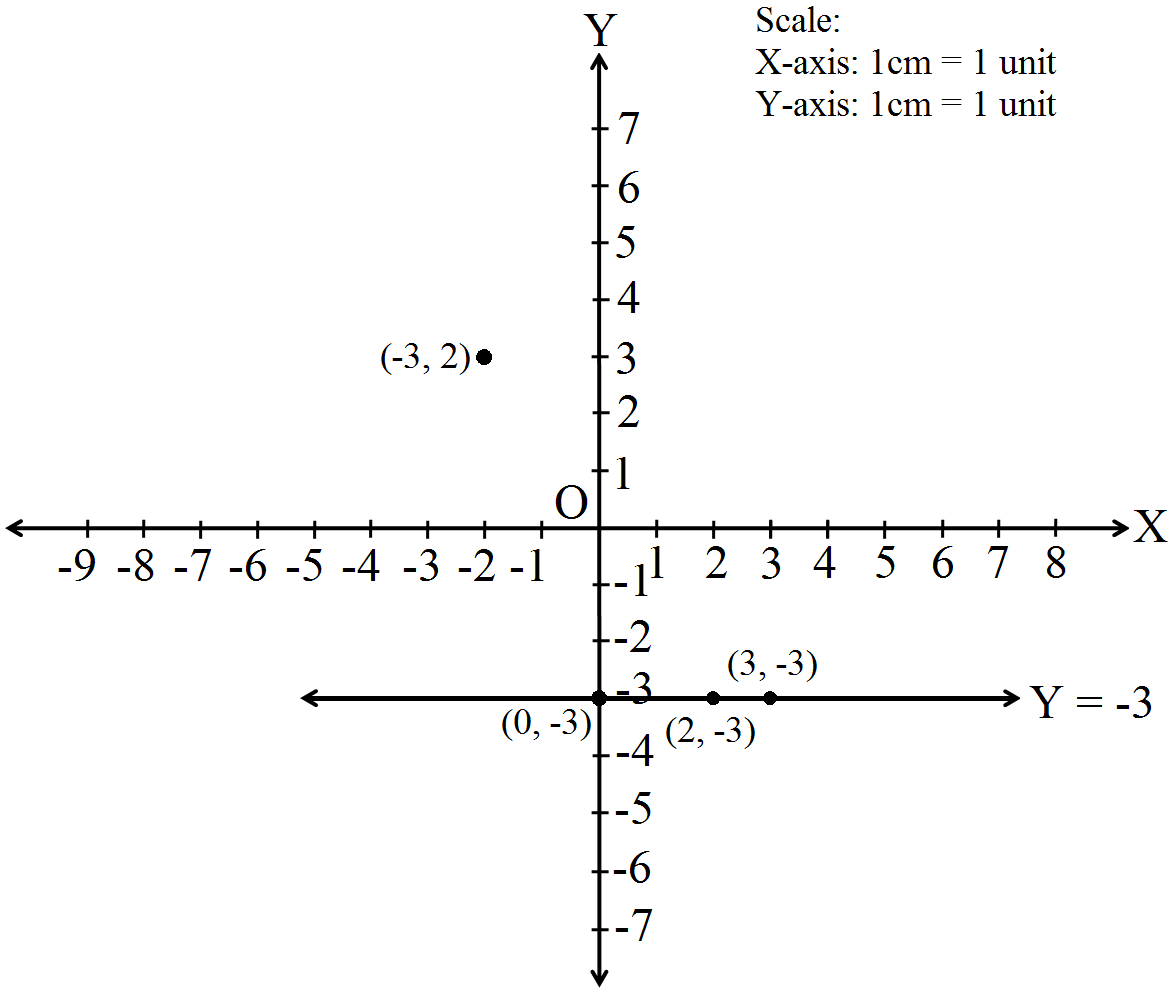
The graph of the line $y = -3$ does not pass through the point:
AnswerThe line $y = -3$ does not pass through the point $(-3, 2)$ since $\text{y}\neq2.$
View full question & answer→MCQ 61 Mark
The point of the form $(\text{a},-\text{a}),\ \text{a}\neq0$ lies on:
AnswerA point which lies on the $x-$ axis has its $y-$ coordinate $= 0$
While a point which lies on the $y-$ axis has its $x-$ coordinate $= 0.$
So, the points of the form $(a, -a)$ will not lie on either axes.
Also, it does not satisfy the equation on of the line $y = x$.
The point of the form $(a, -a)$ lies on the line $x + y = 0$ since it satisifes the equation of the given line.
View full question & answer→MCQ 71 Mark
If the point $(3, 4)$ lies on the graph of $3y = ax + 7$ then the value of a is:
- A
$\frac{2}{5}$
- ✓
$\frac{5}{3}$
- C
$\frac{3}{5}$
- D
$\frac{2}{7}$
AnswerCorrect option: B. $\frac{5}{3}$
Since the point $(3, 4)$ lies on the graph of $3y = ax + 7,$
substituting $x = 3$ and $y = 4$ in the given equation,
We get:
$3(4) = a(3) + 7$
$\Rightarrow 12 = 3a + 7$
$\Rightarrow 3a = 5$
$\Rightarrow\text{a}=\frac{5}{3}$
View full question & answer→MCQ 81 Mark
The graph of the linear equation $2x + 3y = 6$ meets the $y-$ axis at the point:
AnswerWhen a graph meets the $y-$ axis, the $x$ coordinate is zero.
Thus, substituting $x = 0$ in the given equation,
We get:
$2(0) + 3y = 6$
$\Rightarrow 3y = 6$
$\Rightarrow y = 2$
Hence, the required point is $(0, 2).$
View full question & answer→MCQ 91 Mark
The graph of $x = 4$ is a line:
- A
Making an intercept $4$ on the $x-$ axis.
- B
Making an intercept $4$ on the $y-$ axis.
- C
Parallel to the $x-$ axis at a distance of $4$ units from the origin.
- ✓
Parallel to the $y-$ axis at a distance of $4$ units from the origin.
AnswerCorrect option: D. Parallel to the $y-$ axis at a distance of $4$ units from the origin.
The graph of $x = 4$ is a line parallel to the $y-$ axis at a distance of $4$ units from the origin.
View full question & answer→MCQ 101 Mark
The graph of $y + 2 = 0$ is a line:
- A
Making an intercept $-2$ on the $x-$ axis.
- B
Making an intercept $-2$ on the $y-$ axis.
- ✓
Parallel to the $x-$ axis at a distance of $2$ units below the $x-$ axis.
- D
Parallel to the $y-$ axis at a distance of $2$ units to the left of $y-$ axis.
AnswerCorrect option: C. Parallel to the $x-$ axis at a distance of $2$ units below the $x-$ axis.
The graph of $y + 2 = 0$ is a line parallel to the $x-$ axis at a distance of $2$ units below the $x-$ axis.
View full question & answer→MCQ 111 Mark
The graph of the line $x - y = 0 $ passes through the point:
- A
$\Big(\frac{-1}{2},\frac{1}{2}\Big)$
- B
$\Big(\frac{3}{2},\frac{-3}{2}\Big)$
- C
$(0,-1)$
- ✓
$(1, 1)$
AnswerCorrect option: D. $(1, 1)$
The given linear equation is $x = y = 0.$
We have to check which of the point satisfy the given equation.
consider option $(a)$:
Substituting $\text{x}=-\frac{1}{2}$ and $\text{y}=\frac{1}{2}$ in the $\text{LHS}$ if the given linear equation
$\therefore\ \text{x}-\text{y}=-\frac{1}{2}-\frac{1}{2}=-1\neq\text{RHS}$
$\therefore\ \text{x}=-\frac{1}{2}$ and $\text{y}=\frac{1}{2}$ does not satisfy the given linear equation.
Consider option $(b)$:
Substituting $\text{a}=\frac{3}{2}$ and $\text{y}=-\frac{3}{2}$ in the $\text{LHS}$ if the given linear equation on
$\therefore\ \text{x}-\text{y}=\frac{3}{2}+\frac{3}{2}=3\neq\text{RHS}$
$\therefore\ \text{x}=-\frac{3}{2}$ and $\text{y}=-\frac{3}{2}$ does not satisfy the given linear eqation on.
Consider option $(c)$:
$x = o , y = -1$
$x \neq y$ not on the line
Consider option $(d)$:
Substitution $x = 1$ and $y = 1$ in the $\text{LHS}$ if the given linear equation
$\therefore \ x - y = 1 - 1 = 0 = \text{RHS}$
$\therefore \ x = 1 $ and $y = 1$ satisfies the given linear equation.
View full question & answer→MCQ 121 Mark
The point of the form $(\text{a},\ \text{a}),\ \text{a}\neq0$ lies on :
AnswerGiven, a point of the form $(a, a),$ where $\text{a}\neq0$
When $a = 1,$ the point is $(1, 1)$
When $a = 2,$ the point is $(2, 2) ...$ and so on.
Plot the points $(1, 1)$ and $(2, 2) ...$ and so on.
Join the points and extend them in both the direction.
You will get equation of the line $y = x$.
View full question & answer→MCQ 131 Mark
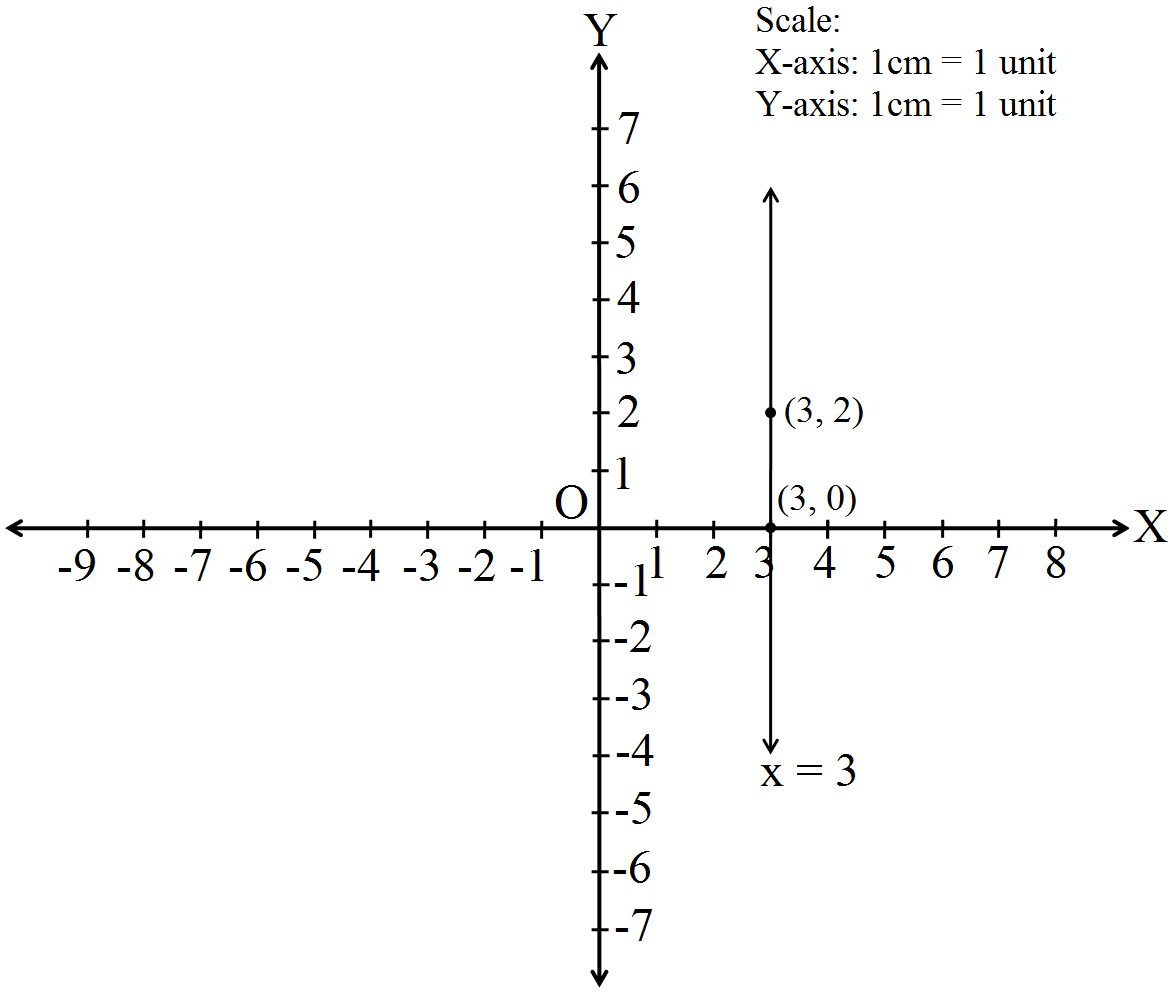
The graph of the line $x = 3$ passes through the point:
AnswerThe line $x = 3$ passes through the point $(3, 2)$.
View full question & answer→MCQ 141 Mark
The equation of the $x-$ axis is :
AnswerThe equation of the $x-$ axis is $y = 0.$
View full question & answer→MCQ 151 Mark
The graph of the linear equation $2x + 5y = 10$ meets the $x-$ axis at the point:
AnswerWhen a graph meets the $x-$ axis, the $y$ coordinate is zero.
Thus, substituting $y = 0$ in the given equation,
We get:
$2x + 5(0) = 10$
$\Rightarrow 2x = 10$
$\Rightarrow x = 5$
Hence, the required point is $(5, 0)$.
View full question & answer→MCQ 161 Mark
If $(2, 0)$ is a solution of the linear equation $2x + 3y = k$ then the value of $k$ is:
AnswerSince, $(2, 0)$ is a solution of the linear equation $2x + 3y = k,$ substituting $x = 2$ and $y = 0$ in the given equation,
We have:
$2(2) + 3(0) = k$
$\Rightarrow 4 + 0 = k$
$\Rightarrow k = 4$
View full question & answer→MCQ 171 Mark
The graph of the line $y = 3$ passes through the point:
AnswerSince, the $y$ coordinate is $3,$ the graph of the line $y = 3$ passes through the point $(2, 3)$.
View full question & answer→MCQ 181 Mark
The equation of the $y-$ axis is:
AnswerThe equation of the $y-$ axis is $x = 0.$
View full question & answer→MCQ 191 Mark
The graph of $y = 5$ is a line :
- A
Making an intercept $5$ on the $x-$ axis.
- B
Making an intercept $5$ on the $y-$ axis.
- ✓
Parallel to the $x-$ axis at a distance of $5$ units from the origin.
- D
Parallel to the $y-$ axis at a distance of $5$ units from the origin.
AnswerCorrect option: C. Parallel to the $x-$ axis at a distance of $5$ units from the origin.
The graph of $y = 5$ is a line parallel to the $x-$ axis at a distance of $5$ units from the origin.
View full question & answer→MCQ 201 Mark
$x = 5, y = 2$ is a solution of the linear equation:
AnswerSubstituting $x = 5$ and $y = 2$ in $\text{L.H.S}$. of equation $x + y = 7,$
We get:
$\text{LHS} = 5 + 2$
$7 = \text{RHS}$
Hence $, x = 5$ and $y = 2$ is a solution of the linear equation $x + y = 7.$
View full question & answer→MCQ 211 Mark
The graph of $x + 3 = 0$ is a line :
- A
Making an intercept $-3$ on the $x-$ axis.
- B
Making an intercept $-3$ on the $y-$ axis.
- ✓
Parallel to the $y-$ axis at a distance of $3$ units to the left of $y-$ axis.
- D
Parallel to the $x-$ axis at a distance of $3$ units below the $x-$ axis.
AnswerCorrect option: C. Parallel to the $y-$ axis at a distance of $3$ units to the left of $y-$ axis.
The graph of $x + 3 = 0$ is a line parallel to the $y-$ axis at a distance of $3$ units to the left of $y-$ axis.
View full question & answer→MCQ 221 Mark
Each of the points $(-2, 2), (0, 0), (2, 2)$ satisfies the linear equation:
AnswerSince given that each of the three points is a solution of the linear equation, all three points have to satisfy the linear equation.
We need to check for each of the four given equations.
Substituting $x = -2$ and $y = 2$ in option $(b),$
We get:
$\text{LHS} = x + y$
$= -2 + 2$
$0 = \text{RHS}$
$\therefore\ x = -2 $ and $y = 2$
Satisfy the given linear equation.
Substituting $x = 0$ and $y = 0$ in option $(b),$
We get:
$\text{LHS} = x + y$
$= 0 + 0$
$0 = \text{RHS}$
$\therefore\ x = 0$ and $y = 0$
Satisfy the given linear equation.
Substituting $x = -2$ and $y = 2$ in option $(b),$
We get:
$\text{LHS}$
$= x + y$
$= 2 - 2$
$0 = \text{RHS}$
$\therefore\ x = 2$ and $y = -2$
Satisfy the given linear equation.
So, clearly all the three points satisfy the equation
$x + y = 0.$
View full question & answer→MCQ 231 Mark
Any point on the $y-$ axis is of the form :
AnswerAny point on $y-$ axis is of the form $(0, y),$ where $\text{y}\neq0,$
Since its $x-$ coordinate will always be $0$.
View full question & answer→MCQ 241 Mark
How many linear equation can be satisfied by $x = 2$ and $y = 3$?
AnswerInfinitely many linear equations can be satisfied by $x = 2$ and $y = 3$.
View full question & answer→