Questions

2 Mark Question

Take a timed test

28 questions · self-marked practice — reveal the answer and mark yourself.

Question 12 Marks
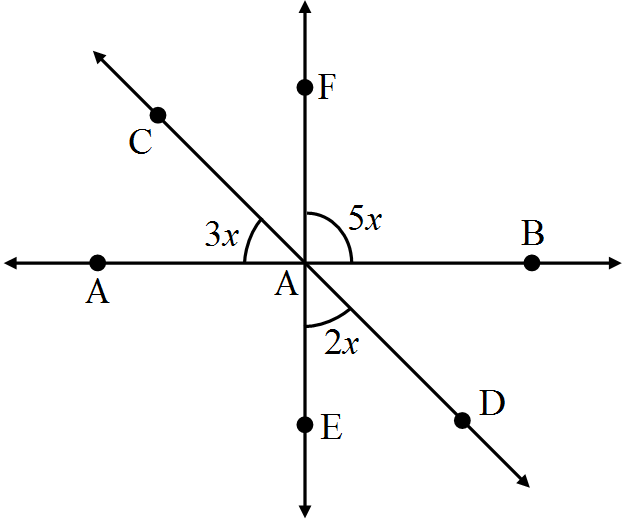
In figure, find the value of x.
Answer
$\angle\text{AOE}=\angle\text{BOF}=5\text{x}$ [vertically opposite angle]$\angle\text{COA}+\angle\text{AOE}+\angle\text{EOD}=180^\circ$ [linear pair]
⇒ 3x + 5x + 2x = 180°
⇒ 10x = 180°
⇒ x = 18°
View full question & answer
Question 22 Marks
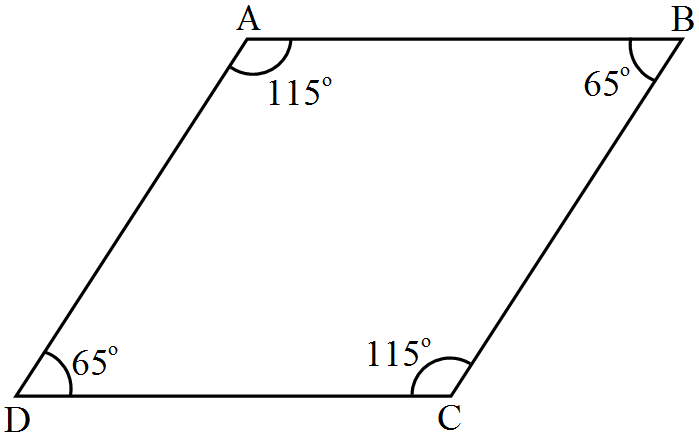
Which pair of lines in the below figure is parallel? Give reasons.
Answer
$\angle\text{A}+\angle\text{B}=115+65=180^\circ$Therefore, AB || BC [As sum of co interior angles are supplementary]
$\angle\text{B}+\angle\text{C}=65+115=180^\circ$
Therefore, AB || CD [As sum of interior angles are supplementary]
View full question & answer
Question 32 Marks
An angle is equal to 8 times its complement. Determine its measure.
Answer
Let the measure of an angle be x°.
Therefore, its complement will be (90 - x)°.
It is given that
⇒ x° = 8(90 - x)°
⇒ x = 720 - 8x
⇒ 9x = 720
⇒ x = 80
Therefore, the measure of the angles is 80°
View full question & answer
Question 42 Marks
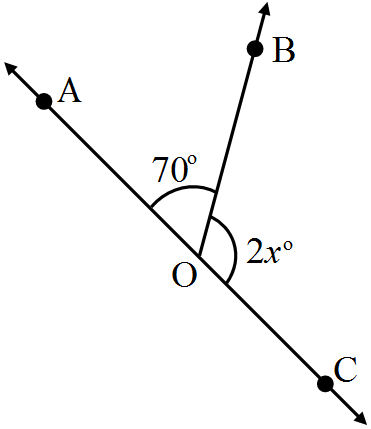
In figure, AOC is a line, find x.
Answer
Since $\angle\text{AOB}$ and $\angle\text{BOC}$ are linear pairs,$\angle\text{AOB}+\angle\text{BOC}=180^\circ$
70 + 2x = 180 2x = 180 - 70 2x = 110$\text{x}=\frac{110}{2}$
x = 55 Hence, the value of x is 55°
View full question & answer
Question 52 Marks
Write the supplement of an angle of measure 2y°.
Answer
Let the required angle measures x°.
It is given that two angles measuring x° and 2y° are supplementary.
Therefore, their sum must be equal to 180°.
Or, we can say that:
x + 2y = 180
x = 180 - 2y
Hence, the required angle measures (180 - 2y)°
View full question & answer
Question 62 Marks
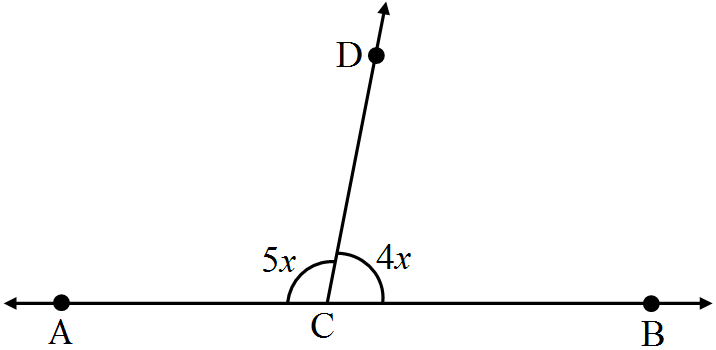
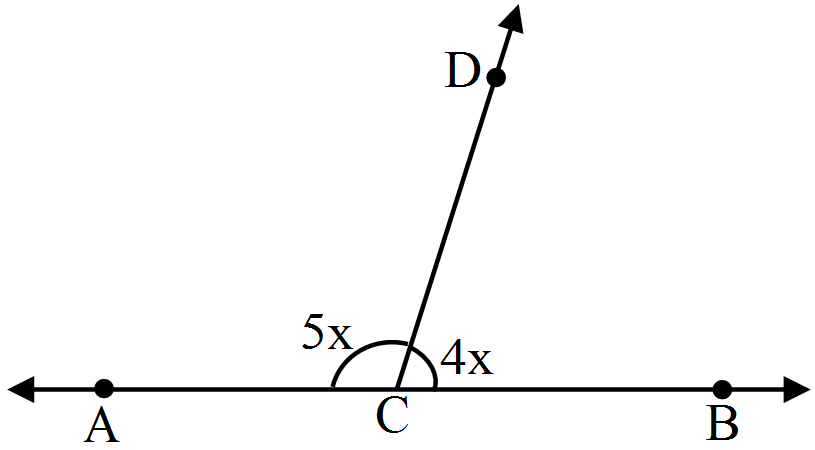
In figure, ACB is a line such that $\angle\text{DCA}=5\text{x}$ and $\angle\text{DCB}=4\text{x}.$ Find the values of $\angle\text{DCA}$ and $\angle\text{DCB}.$
Answer
It is given that ACB is a line in the figure given below. Thus, $\angle\text{ACD}$ and $\angle\text{BCD}$ from a linear pair. Therefore, their sum must be equal to 180°. Or, we can say that$\angle\text{ACD}+\angle\text{BCD}=180^\circ$
Also,$\angle\text{ACD}=4\text{x}$ and $\angle\text{BCD}=5\text{x}.$ This further simplifies to:
4x + 5x = 180 9x = 180$\text{x}=\frac{180}{9}$
x = 20$\therefore\angle\text{DCA}=5\text{x}=5\times20^\circ=100^\circ$
$\angle\text{DCB}=4\text{x}=4\times20^\circ=80^\circ$
Hence, the values of $\angle\text{DCA}$ and $\angle\text{DCB}$ are 100° and 80° respectively.
View full question & answer
Question 72 Marks
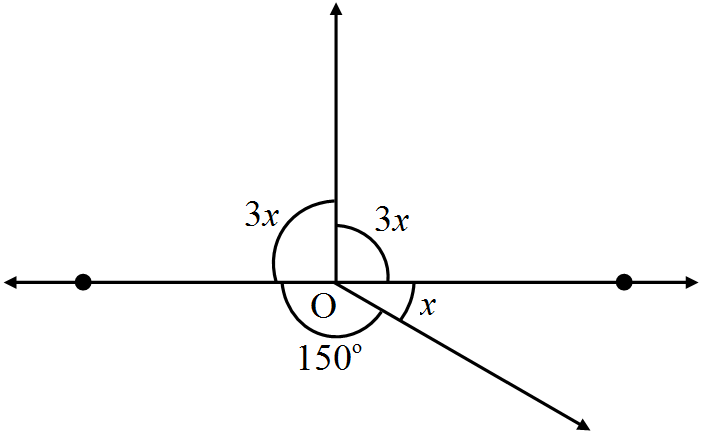
In figure, determine the value of x.
Answer
Since the sum of all the angles round a point is equal to 360° 3x + 3x + 150 + x = 360 7x = 360 - 150 7x = 210$\text{x}=\frac{210}{7}$
x = 30 Value of x is 30°
View full question & answer
Question 82 Marks
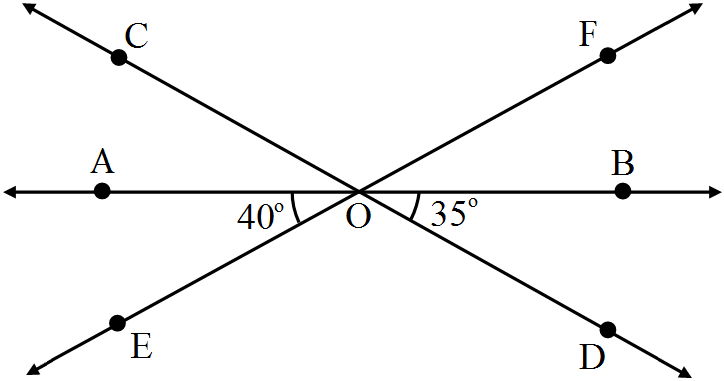
In figure, lines AB, CD and EF intersect at O. Find the measures of $\angle\text{AOC},\angle\text{COF},\angle\text{DOE}$ and $\angle\text{BOF}.$
Answer
$\angle\text{AOE}+\angle\text{DOE}+\angle\text{BOD}=180^\circ$ [linear pair]$\Rightarrow\ \angle\text{DOE}=180^\circ-40^\circ-35^\circ=105^\circ$
$\angle\text{DOE}=\angle\text{COF}=105^\circ$ [vertically opposite angles]
Now,
$\angle\text{AOE}+\angle\text{AOF}=180^\circ$ [lineat pair]
$\Rightarrow\ \angle\text{AOE}+\angle\text{AOC}+\angle\text{COF}=180^\circ$
$\Rightarrow\ 40^\circ+\angle\text{AOC}+105^\circ=180^\circ $
$\Rightarrow\ \angle\text{AOC}=35^\circ$
Also,
$\angle\text{BOF}=\angle\text{AOE}=40^\circ$ [vertically opposite angles]
View full question & answer
Question 92 Marks
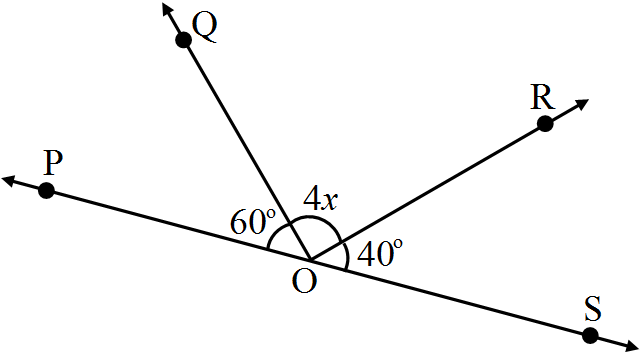
In figure, POS is a line, Find x.
Answer
Since $\angle\text{POQ}$ and $\angle\text{QOS}$ are linear pairs$\angle\text{POQ}+\angle\text{QOS}=180^\circ$
$\angle\text{POQ}+\angle\text{QOR}+\angle\text{SOR}=180^\circ$
60 + 4x + 40 = 180 4x = 180 - 100 4x = 80 x = 20 Hence, Value of x = 20
View full question & answer
Question 102 Marks
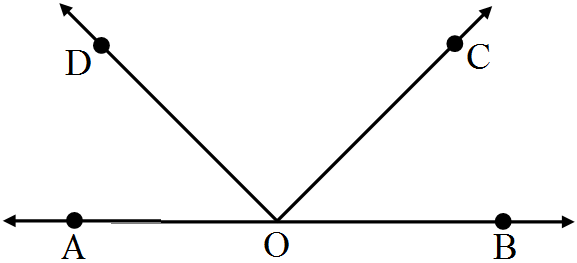
In figure, write all pairs of adjacent angles and all the linear pairs.
Answer
Adjacent angles are:
  1. $\angle\text{AOD},\angle\text{COD}$
  2. $\angle\text{BOC},\angle\text{COD}$
  3. $\angle\text{AOD},\angle\text{BOD}$
  4. $\angle\text{AOC},\angle\text{BOC}$
Linear pairs:
  1. $\angle\text{AOD},\angle\text{BOD}$
  2. $\angle\text{AOC},\angle\text{BOC}$
View full question & answer
Question 112 Marks
Two supplementary angles are in the ratio 4 : 5. Find the angles.
Answer
Let the angles be 4x and 5x. It is given that they are supplem entary angles.$\therefore$ 4x + 5x = 180
⇒ 9x = 180 ⇒ x = 20° Hence 4x = 80, 5x = 100$\therefore$ Angle are 80° and 100°.
View full question & answer
Question 122 Marks
If the angles (2x - 10)° and (x - 5)° are complementary angles, find x.
Answer
Since the angles are complementry.
Theefore their sum will be 90°.
⇒ (2x - 10)° + (x - 5)° = 90°
⇒ 2x - 10 + x - 5 = 90
⇒ 3x = 105°
⇒ x = 35°
View full question & answer
Question 132 Marks
Two supplementary angles differ by 48°. Find the angles.
Answer
Let the measure of an angle x°.$\therefore$ Its supplem entary will be (180 - x)°.
It is given that (180 - x°) - x° = 48° ⇒ 180 - 2x = 48 ⇒ 132 = 2x ⇒ x = 66° Hence, 180 - x = 180 - 66 = 114°. Therefore, angles are 66° and 114°.
View full question & answer
Question 142 Marks
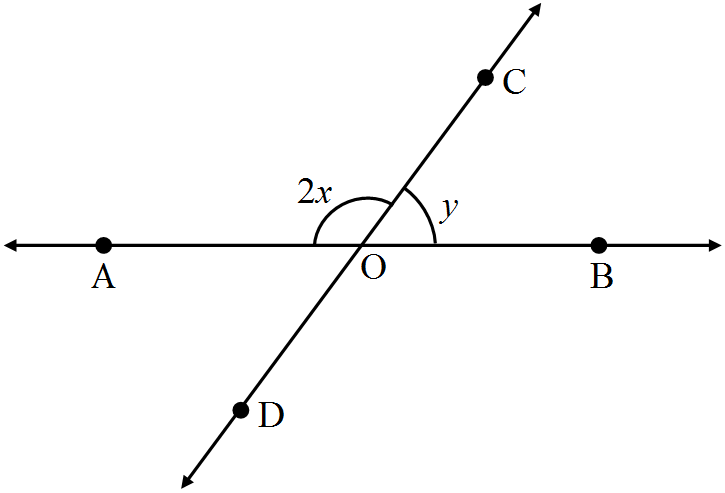
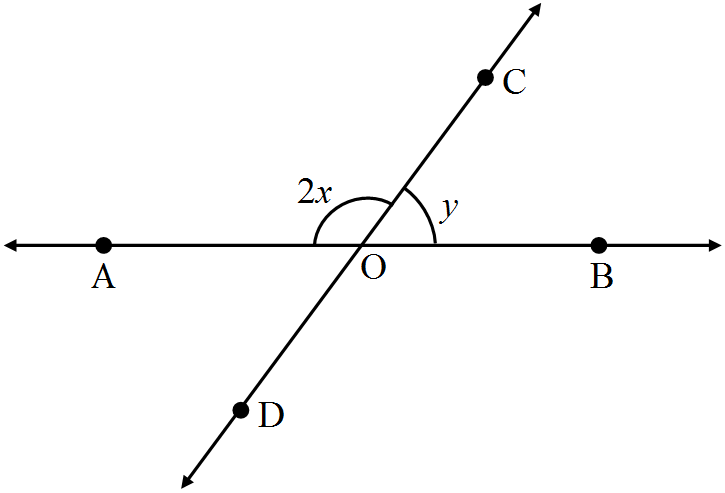
In figure, rays AB and CD intersect at O.
Determine x when y = 40°.
Answer
Here,$\angle\text{AOC}+\angle\text{BOC}=180^\circ$ [linear pair]
⇒ 2x + y = 180° ⇒ 2x + 40 = 180° ⇒ 2x = 180 - 40 = 140° ⇒ 2x = 140° ⇒ x = 70°
View full question & answer
Question 152 Marks
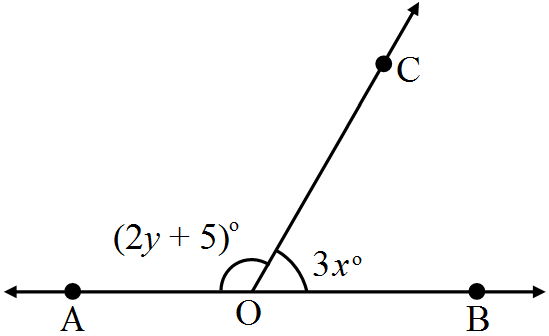
In figure, OA and OB are opposite rays: If y = 35°, what is the value of x?
Answer
Given that, y = 35°$\angle\text{AOC}+\angle\text{BOC}=180^\circ$
(2y + 5) + 3x = 180 (2(35) + 5) + 3x = 180 (70 + 5) + 3x = 180 3x = 180 - 75 3x = 105 x = 35
View full question & answer
Question 162 Marks
If an angle differs from its complement by 10°, find the angle.
Answer
Let the measure of the angle be x°.$\therefore$ its complement will be (90 - x)°.
It is given that x° - (90 - x)° = 10° ⇒ x - 90 + x = 10 ⇒ 2x = 100 ⇒ x = 50$\therefore$ The measure of the angle will be 50°.
View full question & answer
Question 172 Marks
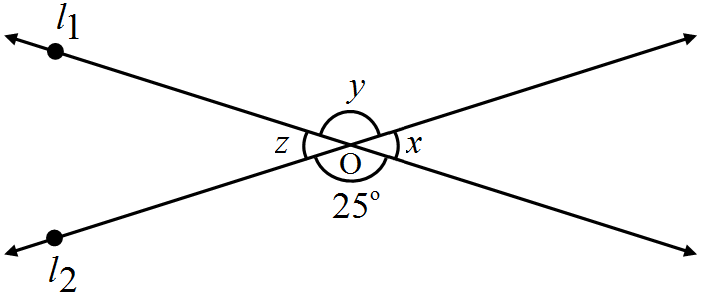
In figure, find the values of x, y and z.
Answer
From the given figure:$\angle\text{y}=25^\circ$ [vertically opposite angle]
Now,$\angle\text{x}+\angle\text{y}=180^\circ$ [linear pair]
$\Rightarrow\ \angle\text{x}=180^\circ-25^\circ$
$\Rightarrow\ \angle\text{x}=155^\circ$
Also,$\angle\text{z}=\angle\text{x}=155^\circ$ [vertically opposite angle]
$\therefore \angle\text{y}=25^\circ$
$\angle\text{z}=\angle\text{x}=155^\circ$
View full question & answer
Question 182 Marks
If an angle is 28° less than its complement, find its measure.
Answer
Let the measure of the angle be x°.$\therefore$ Its complement will be (90 - x)°
It is given that Angle = complement - 28°.$\therefore$ x° = (90 - x)° - 28°
⇒ 2x° = 62° ⇒ x = 31°$\therefore$ Angle measure dis 31°.
View full question & answer
Question 192 Marks
If the supplement of an angle is two-third of itself. Determine the angle and its supplement.
Answer
Let the measure of the angle be x°.$\therefore$ its supplement will be (180 - x)°.
It is given that$(180-\text{x})^\circ=\frac{2}{3}\text{x}^\circ$
$\Rightarrow\ 180-\text{x}=\frac{2}{3}\text{x}$
$\Rightarrow\ \frac{2}{3}\text{x}+\text{x}=180$
$\Rightarrow\ \frac{5}{3}\text{x}=180$
$\Rightarrow\ \text{x}=108^\circ$
Hence, supplement = 180 - 108 = 72°$\therefore$ Angle will be 108° and its supplement will be 72°.
View full question & answer
Question 202 Marks
If the supplement of an angle is three times its complement, find the angle.
Answer
Let the measure of the angle be x°.$\therefore$ Its supplement will be (180 - x)°.
And its complement will be (90 - x)°. It is given that (180 - x)° = 3(90 - x)° ⇒ 180 - x = 270 - 3x ⇒ 2x = 90 ⇒ x = 45$\therefore$ The measure of the angle will be 45°.
View full question & answer
Question 212 Marks
If l, m, n are three lines such that l ∥ m and $\text{n}\perp\text{l},$ prove that $\text{n}\perp\text{m}.$
Answer
Given, l || m, $\text{n}\perp\text{l}$ To prove: $\text{n}\perp\text{m}$ Since l || m and n intersects$\therefore\ \angle{1}=\angle{2}$ [Corresponding angles]
But, U = 90$\Rightarrow\ \angle{2}=90^\circ$
Hence n is perpendicular to m.
View full question & answer
Question 222 Marks
If an angle is 30° more than one half of its complement, find the measure of the angle.
Answer
Let the measure of the angle be x°.$\therefore$ its complement will be (90 - x)°.
It is given that Angle = 30° + $\frac{1}{2}$ complement$\Rightarrow\ \text{x}^\circ+\frac{1}{2}(90-\text{x})^\circ$
$\Rightarrow\ \text{x}=\frac{60^\circ+90-\text{x}}{2}$
⇒ 2x = 60° + 90 - x ⇒ 3x = 150 ⇒ x = 50$\therefore$ Angle is 50°.
View full question & answer
Question 232 Marks
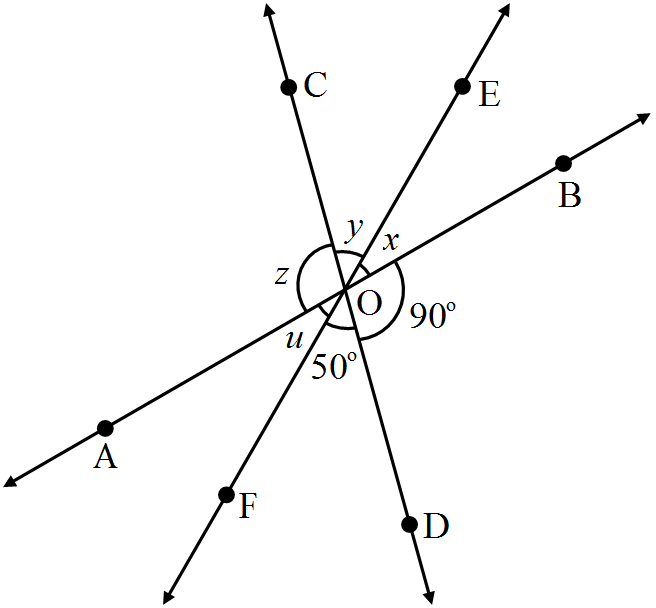
In figure, three coplanar lines intersect at a point O, forming angles as shown in the figure. Find the values of x, y, z and u.
Answer
$\text{z}=\angle\text{BOD}=90^\circ$ [vertically opposite angle]$\text{y}=\angle\text{DOF}=50^\circ$ [vertically oppposite angle]
Now,
x + y + z = 180°
⇒ x + 90° + 50° = 180°
⇒ x = 180° - 140° = 40°
View full question & answer
Question 242 Marks
The measure of an angle is twice the measure of its supplementary angle. Find its measure.
Answer
Let the measure of angle is x°.$\therefore$ Its supplementary will be (180 - x)°.
It is given that x° = 2(180 - x)° ⇒ x = 360 - 2x ⇒ 3x = 360 ⇒ x = 120°$\therefore$ The measure of angle is 120°.
View full question & answer
Question 252 Marks
Write the complement of an angle of measure x°.
Answer
We have to write the complement of an angle which measures x°.
Let the other angle be y°.
We know that the sum of the complementary angles be 90°.
Therefore,
x° + y° = 90°
y° = (90 - x)°
View full question & answer
Question 262 Marks
In figure, rays AB and CD intersect at O.
Determine y when x = 60°.
Answer
Here,$\angle\text{AOC}+\angle\text{BOC}=180^\circ$ [linear pair]
⇒ 2x + y = 180° [linear pair] ⇒ 2 × 60° + y = 180° ⇒ y = 180° - 120° = 60°$\therefore$ y = 60°
View full question & answer
Question 272 Marks
How many pairs of adjacent angles are formed when two lines intersect in a point?
Answer
Four pairs of adjacent angles will be formed when two lines intersect at a point. Considering two lines AB and CD intersecting at O. The 4 pairs are:$(\angle\text{AOD},\angle\text{DOB})$
$(\angle\text{DOB},\angle\text{BOC})$
$(\angle\text{COA},\angle\text{AOD})$
And $(\angle\text{BOC},\angle\text{COA})$ Hence, 4 pairs of adjacent angles are formed when two lines intersect at a point.
View full question & answer
Question 282 Marks
An angle is 14° more than its complementary angle. What is its measure?
Answer
Let the angle measures x°. Therefore, the measure of its complement becomes (90 - x)° According to the given statement, the angle is 14 more than its complement. Thus, we have, x = 14 + (90 - x) x = 104 - x x + x = 104 2x = 104$\text{x}=\frac{104}{2}$
x = 52 The measure of its complement becomes 90 - x = 90 - 52 = 38 Hence, the required angle measures 52° and its complement measures 38°.
View full question & answer