Questions

4 Mark Question

Take a timed test

22 questions · self-marked practice — reveal the answer and mark yourself.

Question 14 Marks
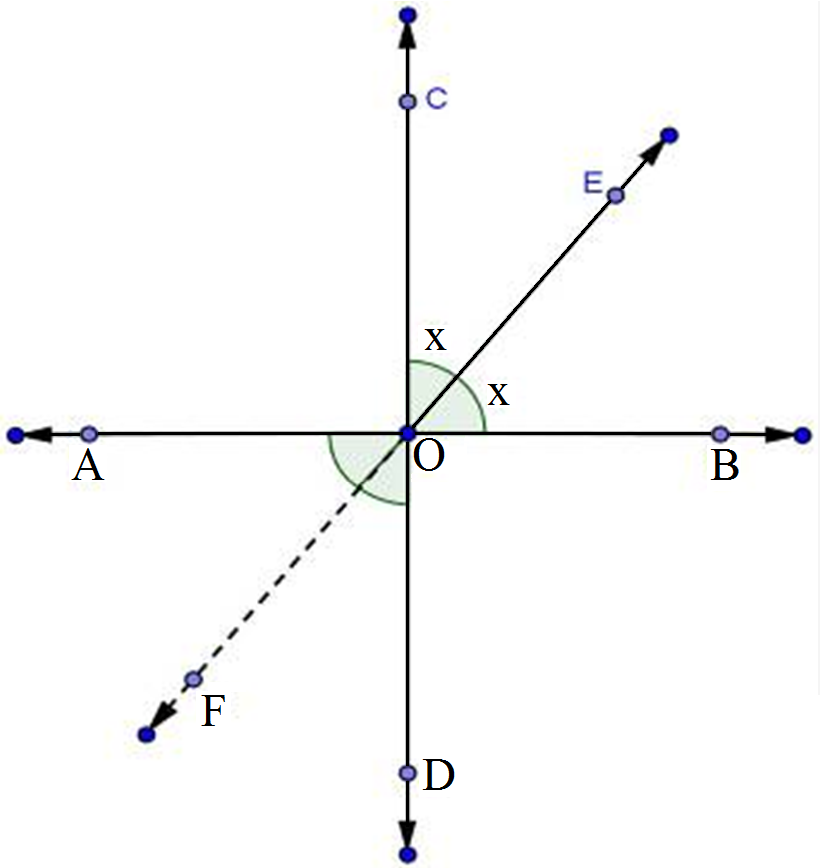
Prove that the bisectors of a pair of vertically opposite angles are in the same straight line.
Answer
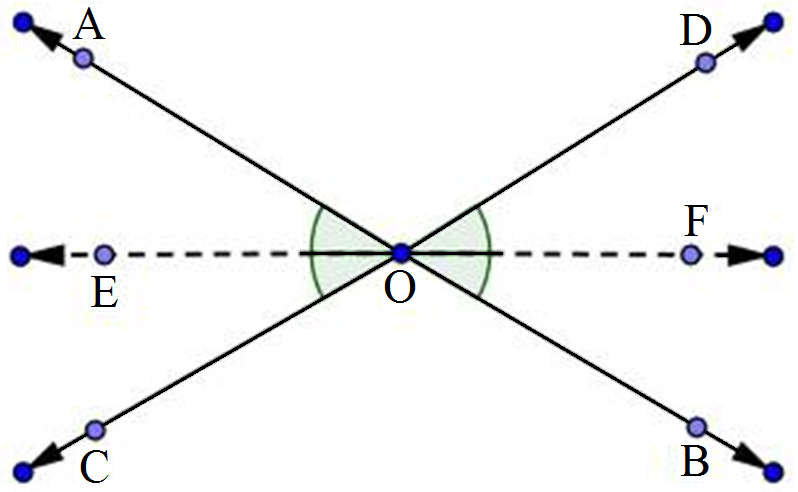
Given: Lines AOB and COD intersect at point O. Such that $\angle\text{AOC}=\angle\text{BOD}.$ Also, OE is the bisector $\angle\text{AOC}$ and OF is the bisector $\angle\text{BOD}.$ To prove: EOF is a straight line.$\angle\text{AOD}=\angle\text{BOC}=5\text{x}\dots(1)$ ( [vertically opposite angle]
Also,$\angle\text{AOD}+\angle\text{BOC}$ [vertically opposite angle]
$\Rightarrow\ 2\angle\text{AOE}=2\angle\text{DOF}\dots(2)$
Now,$\angle\text{AOD}+\angle\text{AOC}+\angle\text{BOC}+\angle\text{BOD}=360^\circ$ [Sum of all angles around a point is 360°]
$\Rightarrow\ 2\angle\text{AOD}+2\angle\text{AOE}+2\angle\text{DOF}=360^\circ$
$\Rightarrow\ \angle\text{AOD}+\angle\text{AOE}+\angle\text{DOF}=180^\circ$
From this we conclude that EOF is a straight line.
View full question & answer
Question 24 Marks
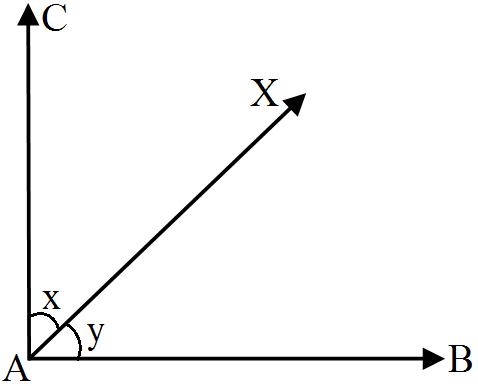
Define complementary angles.
Answer
Complementary Angles: Two angles, the sum of whose measures is 90°, are called complementary angles.
Thus,
angles $\angle\text{BAX}$ and $\angle\text{XAC}$ are complementary angles.
If x + y = 90°

Example 1: Angles of measure 50° and 40° are complementary angles, because
50° + 40° = 90°
Example 2: Angles of measure 60° and 30° are complementary angles, because
60° + 30° = 90°
View full question & answer
Question 34 Marks
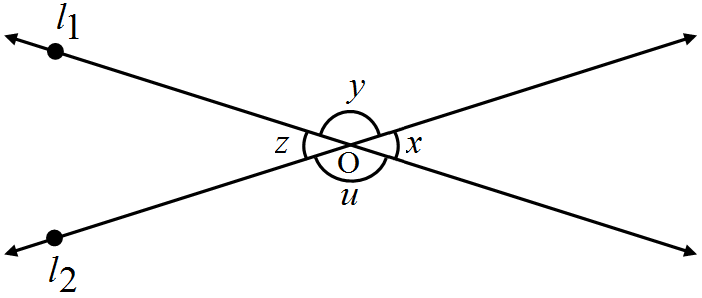
In figure, Line $I _1$ and $I _2$ intersect at O , forming angles as shown in the figure. If $x=45$, find the value of $y, z$ and $u$.

Answer
Given $x=45^{\circ}$
$\therefore z=x=45^{\circ}$ [Vertically opposite angle]
Now, $z + u =180^{\circ}$ [Linear pair]
$\Rightarrow 45^{\circ}+u=180^{\circ}$
$\Rightarrow u=135^{\circ} \text { Also, }$
$x+y=180^{\circ} \text { [Linear pair] }$
$\Rightarrow y=180^{\circ}-x$
$=180^{\circ}-45^{\circ}$
$=135^{\circ}$
$\therefore y=135^{\circ}$
View full question & answer
Question 44 Marks
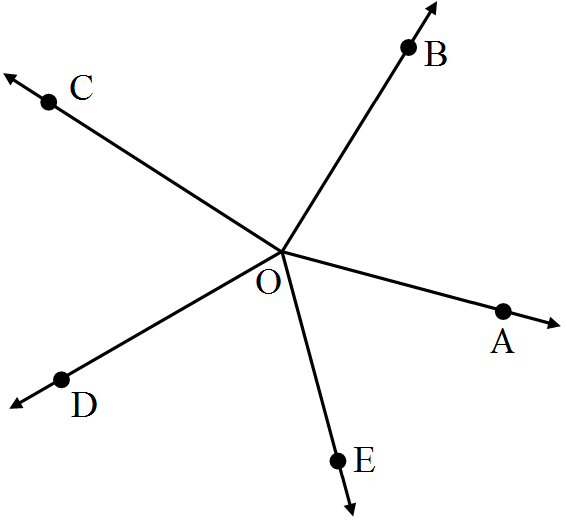
In figure, rays OA, OB, OC, OD and OE have the common end point O. Show that $\angle\text{AOB}+\angle\text{BOC}+\angle\text{COD}+\angle\text{DOE}+\angle\text{EOA}=360^\circ.$
Answer
Given that OA, OB, OD and OE have the common end point O. A ray opposite to OA is drawn. Since $\angle\text{AOB},\angle\text{BOF}$ are linear pairs,$\angle\text{AOB}+\angle\text{BOF}+180^\circ$
$\angle\text{AOB}+\angle\text{BOC}+\angle\text{COF}=180^\circ\dots(\text{i})$
Also,$\angle\text{AOE}$ and $\angle\text{EOF}$ are linear pairs
$\angle\text{AOE}+\angle\text{EOF}=180^\circ$
$\angle\text{AOE}+\angle\text{DOF}+\angle\text{DOE}=180^\circ\dots(\text{ii})$
By adding (i) and (ii) equations we get:$\angle\text{AOB}+\angle\text{BOC}+\angle\text{COF}+\angle\text{AOE}+\angle\text{DOF}+\angle\text{DOE}=180^\circ$
$\angle\text{AOB}+\angle\text{BOC}+\angle\text{COD}+\angle\text{DOE}+\angle\text{EOA}=180^\circ$
Hence proved.
View full question & answer
Question 54 Marks
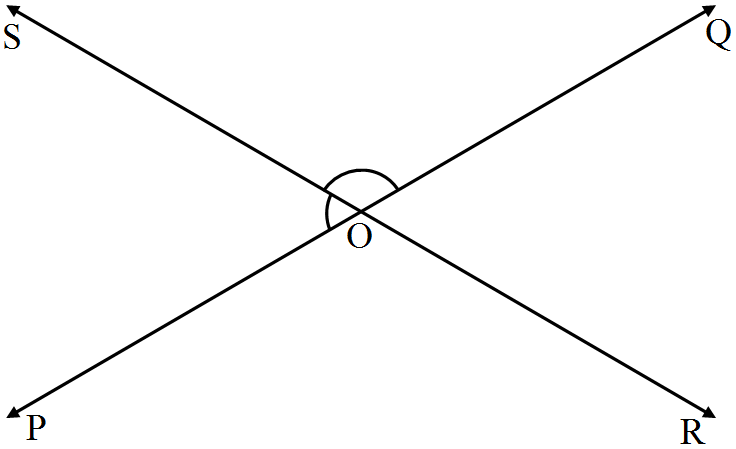
In figure, lines PQ and RS intersect each other at point O. If $\angle\text{POR}:\angle\text{ROQ}=5:7,$ find all the angles.
Answer
Given$\angle\text{POR}$ and $\angle\text{ROP}$ is linear pair
$\angle\text{POR}+\angle\text{ROP}=180^\circ$
Given that$\angle\text{POR}:\angle\text{ROP}=5:7$
Hence,$\text{POR}=\Big(\frac{5}{12}\Big)\times180=75$
Similarly$\text{ROQ}=\Big(\frac{7}{7}+5\Big)\times180=105$
Now POS = ROQ = 105° [Vertically opposite angles] Also, SOQ = POR = 75° [Vertically opposite angles]
View full question & answer
Question 64 Marks
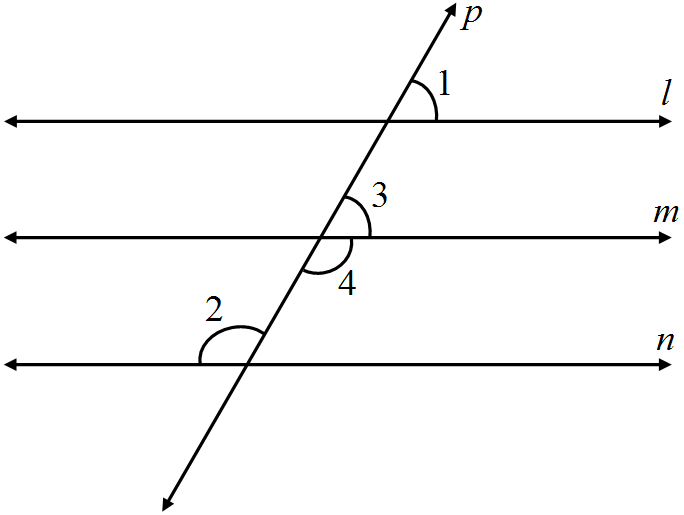
In figure, if l ∥ m ∥ n and $\angle{1}=60^\circ,$ Find $\angle{2}.$
Answer
Since l parallel to m and p is the transversal Therefore, Given: l ∥ m ∥ n$\angle{1}=60^\circ$
To find: $\angle{2}$$\angle{1}=\angle{3}=60^\circ$ [Corresponding angles]
Now,$\angle{3}$ and $\angle{4}$ are linear pair of angles
$\angle{3}+\angle{4}=180^\circ$
$60+\angle{4}=180^\circ$
$\angle{4}=180-60$
$\Rightarrow\ 120$
Also, m || n and P is the transversal Therefore,$\angle{4}=\angle{2}=120$ [Alternative interior angle]
Hence $2\angle{2}=120.$
View full question & answer
Question 74 Marks
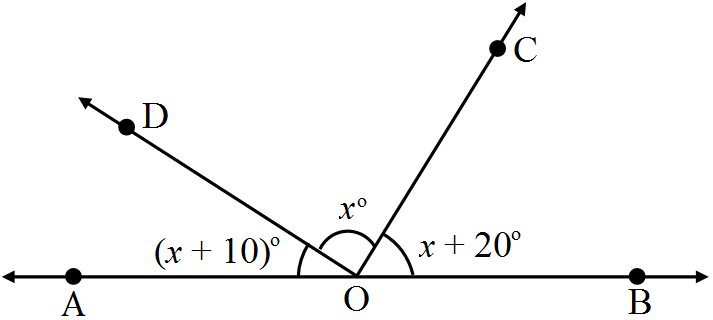
In figure, find x. Further find $\angle\text{BOC},\angle\text{COD}$ and $\angle\text{AOD}.$
Answer
Since $\angle\text{AOD}$ and $\angle\text{BOD}$ form a line pair,$\angle\text{AOD}+\angle\text{BOD}=180^\circ$
$\angle\text{AOD}+\angle\text{BOC}+\angle\text{COD}=180^\circ$
Given that,$\angle\text{AOD}=(\text{x}+10)^\circ,\angle\text{COD}=\text{x}^\circ,\angle\text{BOC}=(\text{x}+20)^\circ$
$(\text{x}+10)+\text{x}+(\text{x}+20)=180$
$3\text{x}+30=180$
$3\text{x}=180-30$
$3\text{x}=\frac{150}{3}$
$\text{x}=50$
Therefore,$\angle\text{AOD}=(\text{x}+10)$
$=50+10=60$
$\angle\text{COD}=\text{x}=50^\circ$
$\angle\text{COD}=(\text{x}+20)$
$=50+20=70$
$\angle\text{AOD}=60^\circ,\angle\text{COD}=50^\circ,\angle\text{BOC}=70^\circ$
View full question & answer
Question 84 Marks
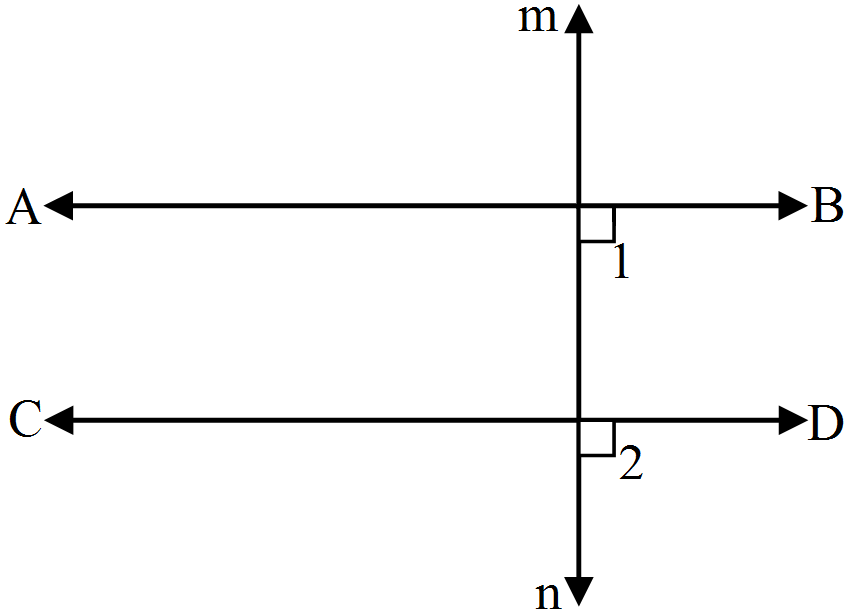
If each of the two lines is perpendicular to the same line, what kind of lines are they to each other?
Answer

Let AB and CD be perpendicular to MN
ABD = 90 ...(i) [AB perpendicular to MN]
CON = 90 ...(ii) [CO perpendicular to MN]
Now,
ABD = CDN = 90 (From (i) and (ii))
AB parallel to CD,
Since corresponding angles are equal.
View full question & answer
Question 94 Marks
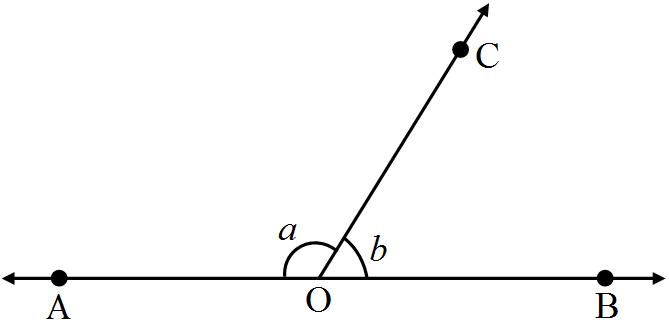
In figure, $\angle\text{AOC}$ and $\angle\text{BOC}$ from a linear pair. If a - 2b = 30°, find a and b.
Answer
Given that,$\angle\text{AOC}$ and $\angle\text{BOC}$ form a linear pair
If a - b = 30$\angle\text{AOC}=\text{a}^\circ,\angle\text{BOC}=\text{b}^\circ$
Therefore, a + b = 180 ...(i) Given a - 2b = 30 ...(ii) By subtracting (i) and (ii) a + b - a + 2b = 180 - 30 3b = 150$\text{b}=\frac{150}{3}$
b = 50 Since a - 2b = 30 a - 2(50) = 30 a = 30 + 100 a = 130 Hence, the values of a and b are 130° and 50° respectively.
View full question & answer
Question 104 Marks
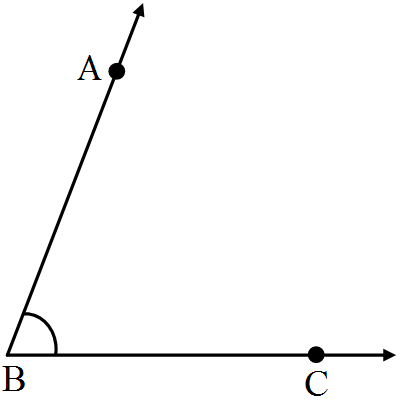
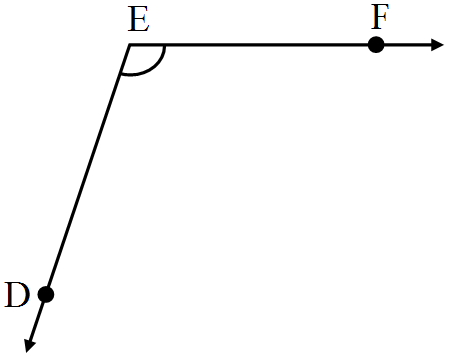
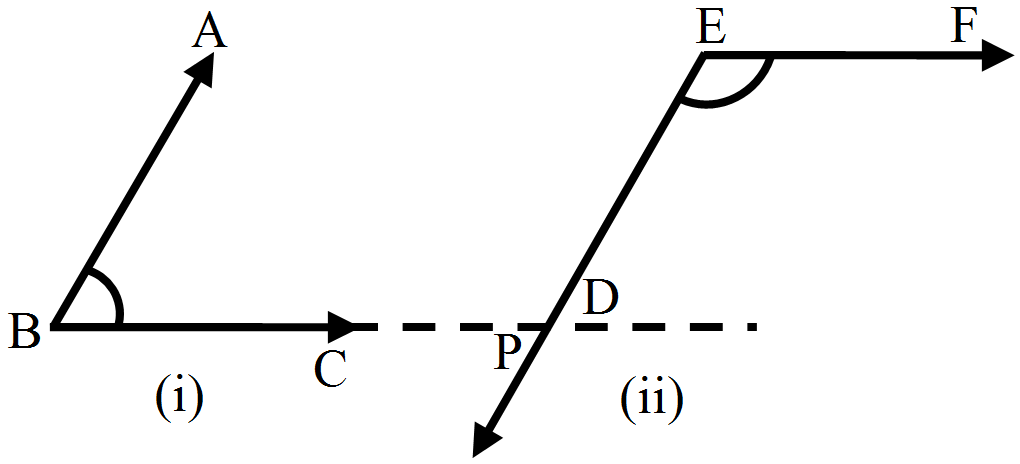
In figure, arms BA and BC of $\angle\text{ABC}$ are respectively parallel to arms ED and EF of $\angle\text{DEF}$ Prove that$\angle\text{ABC}+\angle\text{DEF}=180^\circ.$

Answer
Given: AB || DE, BC || EF To prove:$\angle\text{ABC}+\angle\text{DEF}=180^\circ$
Construction: Produce BC to intersect DE at M Proof: Since AB || EM and BL is the transversal$\angle\text{ABC}=\angle\text{EML}\dots(\text{i})$ [Corresponding angle]
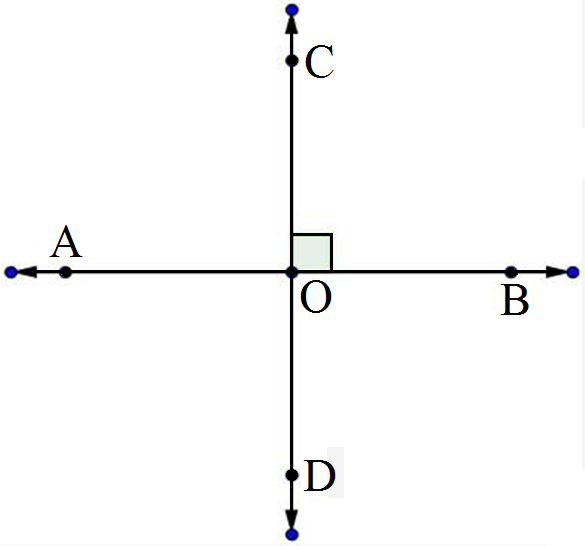
Also, EF || ML and EM is the transversal By the property of co-interior angles are supplementary$\angle\text{DEF}+\angle\text{EML}=180^\circ\dots(\text{ii})$
From (i) and (ii) we have Therefore$\angle\text{DEF}+\angle\text{ABC}=180^\circ$
View full question & answer
Question 114 Marks
If one of the four angles formed by two intersecting lines is a right angle, then show that each of the four angles is a right a angle.
Answer
Given: AB and CD are two lines intersecting at O such that $\angle\text{BOC}=90^\circ.$ R.T.P:$\angle\text{AOC}=90^\circ,\angle\text{AOD}=90^\circ$ and $\angle\text{BOD}=90^\circ$
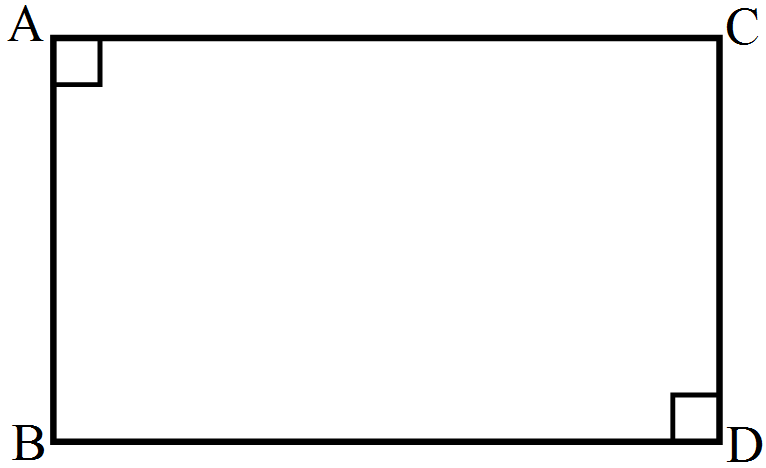
Proof: We have,$\angle\text{BOC}=90^\circ$ [given]
Also,$\angle\text{BOC}=\angle\text{AOD}=90^\circ$ [vertically opposite angles]
$\angle\text{AOC}+\angle\text{BOC}=180^\circ$ [linear pair]
$\Rightarrow\ \angle\text{AOC}+90^\circ=180^\circ$
$\Rightarrow\ \angle\text{AOC}=90^\circ$
Now,$\angle\text{AOC}=\angle\text{BOD}=90^\circ$ [vertically opposite angles]
Hence,$\angle\text{AOC}=\angle\text{BOC}=\angle\text{BOD}=\angle\text{AOD}=90^\circ$
View full question & answer
Question 124 Marks
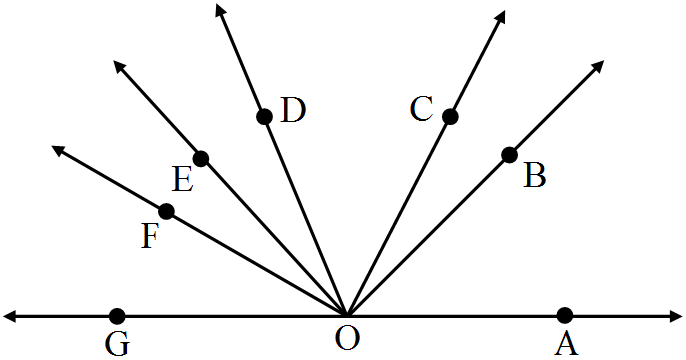
In figure, $\angle\text{AOF}$ and $\angle\text{FOG}$ from a linear pair. If $\angle\text{EOB}=\angle\text{FOC}=90^\circ$ and $\angle\text{DOC}=\angle\text{FOG}=\angle\text{AOB}=30^\circ.$
  1. Find the measure of $\angle\text{FOE},\angle\text{COB}$ and $\angle\text{DOE}.$
  2. Name all the right angles.
  3. Name three pairs of adjacent complementary angles.
  4. Name three pairs of adjacent supplementary angles.
  5. Name three pairs of adjacent angles
Answer
  1. $\angle\text{FOE}=\text{x},\angle\text{DOE}=\text{y}$ and $\angle\text{BOC}=\text{z}$
Since $\angle\text{AOF},\angle\text{FOG}$ is a linear pair

$\angle\text{AOF}+30=180$

$\angle\text{AOF}=180-30$

$\angle\text{AOF}=150$

$\angle\text{AOB}+\angle\text{BOC}+\angle\text{COD}+\angle\text{DOE}+\angle\text{EOF}=150$

30 + z + 30 + y + x = 150

x + y + z =150 - 30 - 30

x + y + z = 90 ...(1)

$\angle\text{FOC}=90^\circ$

$\angle\text{FOE}+\angle\text{EOD}+\angle\text{DOC}=90^\circ$

x + y + 30 = 90

x + y = 90 - 30

x + y = 60 ...(2)

Substituting (2) in (1)

x + y + z = 90

60 + z = 90

z = 90 - 60 = 30

Given BOE = 90

$\angle\text{BOC}+\angle\text{COD}+\angle\text{DOE}=90^\circ$

30 + 30 + DOE = 90

DOE = 90 - 60 = 30

DOE = x = 30

We also know that,

x + y = 60

y = 60 - x

y = 60 - 30

y = 30

Thus we have $\angle\text{FOE}=30,\angle\text{COB}=30$ and $\angle\text{DOE}=30$
  1. Right angles are:
    $\angle\text{DOG},\angle\text{COF},\angle\text{BOF},\angle\text{AOD}.$
  2. Adjacent complementary angles are:
$(\angle\text{AOB},\angle\text{BOD});(\angle\text{AOC},\angle\text{COD});(\angle\text{BOC},\angle\text{COE}).$
  1. Adjacent supplementary angles are:
$(\angle\text{AOB},\angle\text{BOG});(\angle\text{AOC},\angle\text{COG});(\angle\text{AOD},\angle\text{DOG}).$
  1. Adjacent angles are:
$(\angle\text{BOC},\angle\text{COD});(\angle\text{COD},\angle\text{DOE});(\angle\text{DOE},\angle\text{EOF}).$
View full question & answer
Question 134 Marks
Prove that if the two arms of an angle are perpendicular to the two arms of another angle, then the angles are either equal or supplementary.
Answer
Consider be angles AOB and ACB. Given OA perpendicular to AO, also OB perpendicular to BO. To Prove: $\angle\text{AOB}+\angle\text{ACB}=180^\circ$
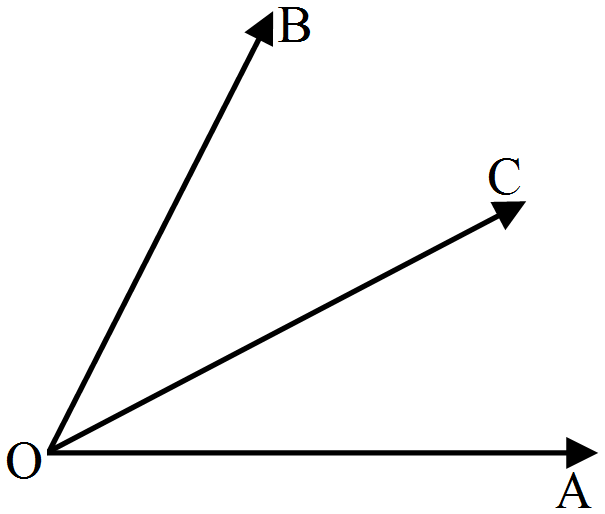
Proof: In a quadrilateral $=\angle\text{A}+\angle\text{O}+\angle\text{B}+\angle\text{C}=360^\circ$[Sum of angles of quadrilateral is 360] ⇒ 180 + O + B + C = 360 ⇒ O + C = 360 - 180 Hence, AOB + ACB = 180 ...(1) Also, B + ACB = 180 ⇒ ACB = 180 - 90 = ACES = 90° ...(2) From (1) and (2), ACB = A0B = 90 Hence, the angles are equal as well as supplementary.
View full question & answer
Question 144 Marks
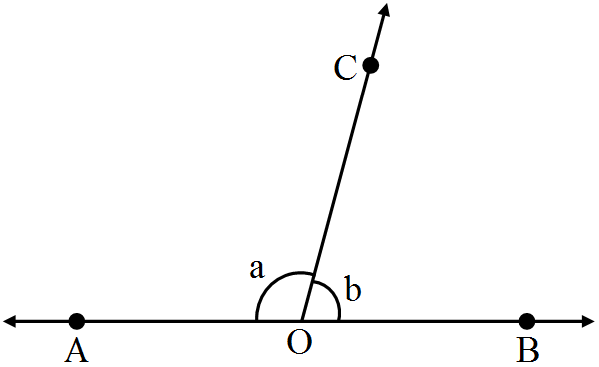
Define adjacent angles.
Answer
Adjacent angles: Two angles are called adjacent angles, if:
  1. They have the same vertex.
  2. They have a common arm, and
  3. Uncommon arms are on either side of the common arm.

In the figure above, $\angle\text{AOC}$ and $\angle\text{BOC}$ have a common vertex O.
Also, they have a common arm OC and the distinct arms AO and BO, lies on the opposite sides of the line OC.
Therefore, $\angle\text{AOC}$ and $\angle\text{BOC}$ are adjacent angles.
View full question & answer
Question 154 Marks
In Figure, if a is greater than b by one third of a right angle. Find the value of a and b.
Answer
Since a and b are linear a + b = 180 a = 180 - b ...(1) From given data, a is greater than b by one third of a right angle$\text{a}=\text{b}+\frac{90}{3}$
a = b + 30 a - b = 30 ...(2) Equating (1) and (2) 180 - b = b + 30 180 - 30 = 2b$\text{b}=\frac{150}{2}$
b = 75 From (1) a = 180 - b a = 180 - 75 a = 105 Hence the values of a and b are 105° and 75° respectively.
View full question & answer
Question 164 Marks
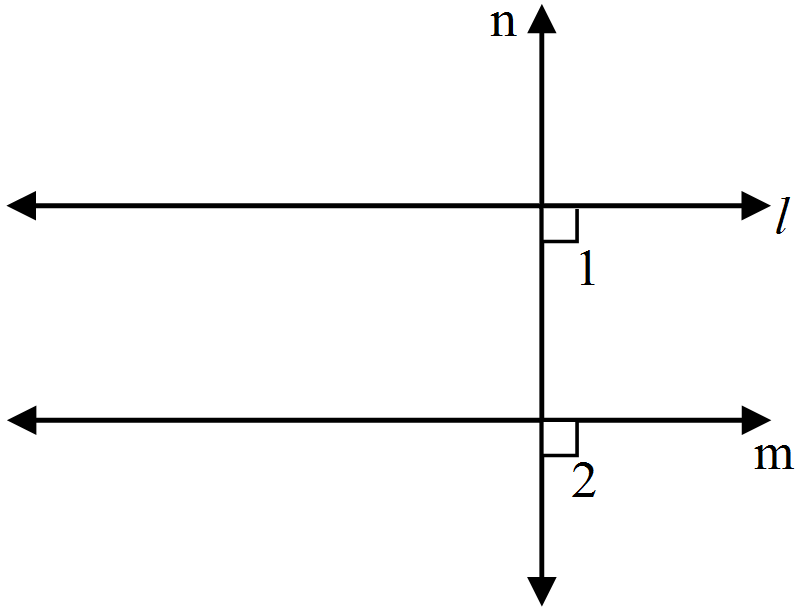
If two straight lines are perpendicular to the same line, prove that they are parallel to each other.
Answer
Given m perpendicular t and l perpendicular to t.$\angle{1}=\angle{2}=90^\circ$
Since, I and m are two lines and it is transversal and the corresponding angles are equal L || M Hence proved.
View full question & answer
Question 174 Marks
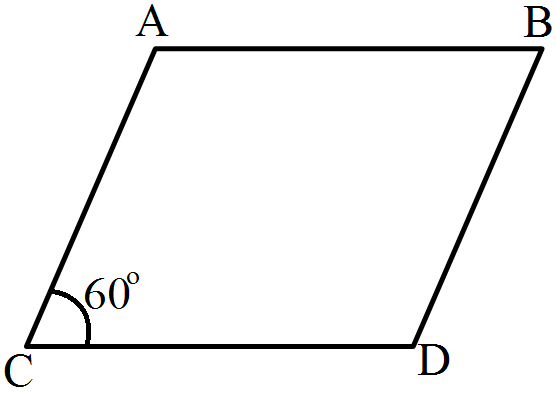
The opposite sides of a quadrilateral are parallel. If one angle of the quadrilateral is 60°. Find the other angles.
Answer
Given AB || CD AD || BC Since AB || CD and AD is the transversal Therefore, A + D = 180 [Co-interior angles are supplementary] 60 + D = 180 D = 180 - 60 D = 120 Now, AD || BC and AB is the transversal A + B = 180 [Co-interior angles are supplementary] 60 + B = 180 B = 180 - 60 = 120 Hence,$\angle\text{A}=\angle\text{C}=60^\circ$ and $\angle\text{B}=\angle\text{D}=120^\circ$
View full question & answer
Question 184 Marks
If two straight lines intersect each other, prove that the ray opposite to the bisector of one of the angles thus formed bisects the vertically opposite angle.
Answer
Given: AB and CD intersect each other at O. OE bisects $\angle\text{COB}$ To prove:$\angle\text{AOF}=\angle\text{DOF}$
Proof: Let$\angle\text{COE}=\angle\text{EOB}=\text{x}$ $[\because$ OE bisects $\angle\text{COB}]$
$\angle\text{COE}=\angle\text{DOF}=\text{x}\dots(1)$ [vertically opposite angles]
$\angle\text{BOE}=\angle\text{AOF}=\text{x}\dots(2)$ [vertically opposite angles]
From (1) and (2)$\angle\text{AOF}=\angle\text{DOF}=\text{x}$
View full question & answer
Question 194 Marks
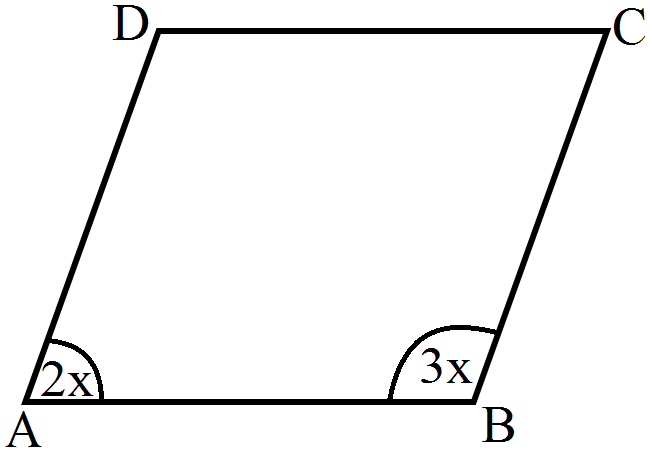
Two unequal angles of a parallelogram are in the ratio 2 : 3. Find all its angles in degrees.
Answer
Let A = 2x and B = 3x Now, A + B = 180 [Co-interior angles are supplementary] 2x + 3x - 180 [AD || BC and AB is the transversal] ⇒ 5x = 180$\text{x}=\frac{180}{5}$
x = 36 Therefore, A = 2 × 36 = 72 B = 3 × 36 = 108 Now, A = C = 72 [Opposite side angles of a parallelogram are equal] B = D = 108
View full question & answer
Question 204 Marks
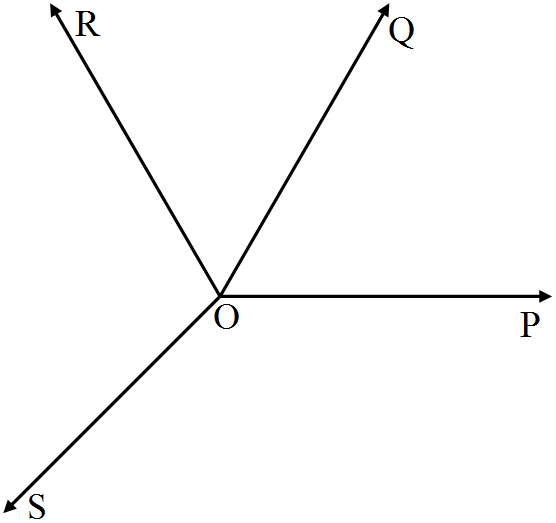
In figure, OP, OQ, OR and OS are four rays. Prove that: $\angle\text{POQ}+\angle\text{QOR}+\angle\text{SOR}+\angle\text{POS}=360^\circ$
Answer
Given that OP, OQ, OR and OS are four ray. You need to produce any of the ray OP, OQ, OR and OS backwards to a point in the figure. Let us produce ray OQ backwards to a point T. So that TOQ is a line. Ray OP stands on the TOQ Since $\angle\text{TOP},\angle\text{POQ}$ is a linear pair$\angle\text{TOP}+\angle\text{POQ}=180^\circ\dots(1)$
Similarly, Ray OS stands on the line TOQ$\angle\text{TOS}+\angle\text{SOQ}=180^\circ\dots(2)$
But$\angle\text{SOQ}=\angle\text{SOR}+\angle\text{QOR}\dots{(3)}$
So, eq. (2) becomes$\angle\text{TOS}+\angle\text{SOR}+\angle\text{OQR}=180^\circ$
Now, adding (1) and (3) you get:$\angle\text{TOP}+\angle\text{POQ}+\angle\text{TOS}+\angle\text{SOR}+\angle\text{QOR}=360^\circ$
$\angle\text{TOP}+\angle\text{TOS}=\angle\text{POS}$
Equation (4) becomes$\angle\text{POQ}+\angle\text{QOR}+\angle\text{SOR}+\angle\text{POS}=360^\circ$
View full question & answer
Question 214 Marks
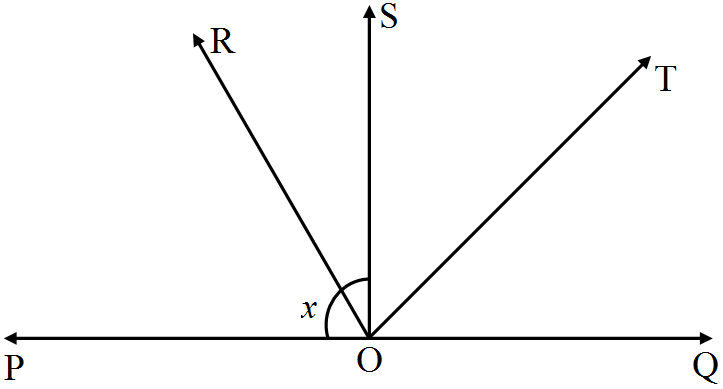
In figure, ray OS stand on a line POQ. Ray OR and ray OT are angle bisectors of $\angle\text{POS}$ and $\angle\text{SOQ}$ respectively. If $\angle\text{POS}=\text{x},$ find $\angle\text{ROT}.$
Answer
Given, Ray OS stand on a line POQ Ray OR and Ray OT are angle bisectors of $\angle\text{POS}$ and $\angle\text{SOQ}$ respectively.$\angle\text{POS}=\text{x}$
$\angle\text{POS}$ and $\angle\text{SOQ}$ is linear pair
$\angle\text{POS}+\angle\text{QOS}=180^\circ$
x + QOS = 180 QOS = 180 - x Now, ray or bisector POS$\angle\text{ROS}=\frac{1}{2}\angle\text{POS}$
$=\frac{\text{x}}{2}$
$\text{ROS}=\frac{\text{x}}{2}$ [Since POS = x]
Similarly ray OT bisector QOS$\angle\text{TOS}=\frac{1}{2}\angle\text{QOS}$
$=\frac{(180-\text{x})}{2}$ [QOS = 180 - x]
$=90-\frac{\text{x}}{2}$
Hence,$\angle\text{ROT}=\angle\text{ROS}+\angle\text{ROT}$
$=\frac{\text{x}}{2}+90-\frac{\text{x}}{2}$
$=90$
$\angle\text{ROT}=180^\circ$
View full question & answer
Question 224 Marks
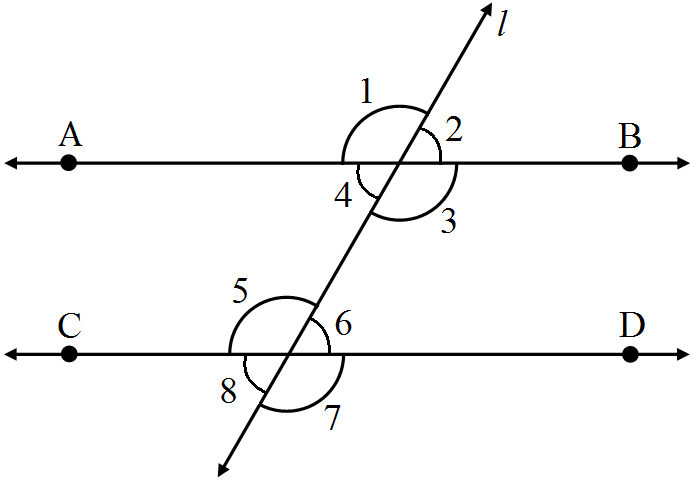
In figure AB || CD and $\angle\text{1}$ and $\angle\text{2}$ are in the ratio 3 : 2. Determine all angles from 1 to 8.
Answer
Let:$\angle\text{1}=3\text{x}$ and $\angle\text{2}=2\text{x}$
$\angle\text{1}$ and $\angle\text{2}$ are linear pair of angle. Now, $\angle\text{1}$ and $\angle\text{2}$ $\Rightarrow\ 3\text{x}+2\text{x}=180$
$\Rightarrow\ 5\text{x}=180$
$\Rightarrow\ \text{x}=\frac{180}{5}$
$\Rightarrow\ \text{x}=36$
$\angle\text{1}=3\text{x}=108^\circ,\angle\text{2}=2\text{x}=72^\circ$
We know, Vertically opposite angles are equal$\angle\text{1}=\angle\text{3}=108^\circ$
$\angle\text{2}=\angle\text{4}=72^\circ$
$\angle\text{6}=\angle\text{7}=108^\circ$
$\angle\text{5}=\angle\text{8}=72^\circ$
We also know, corresponding angles are equal$\angle\text{1}=\angle\text{5}=108^\circ$
$\angle\text{2}=\angle\text{6}=72^\circ$
View full question & answer