Questions

2 Mark Question

Take a timed test

10 questions · self-marked practice — reveal the answer and mark yourself.

Question 12 Marks
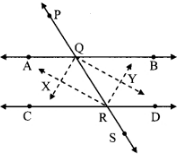
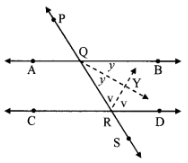
In the given figure, line PS is a transversal of parallel line AB and line CD. If Ray QX, ray QY, ray RX, ray RY are angle bisectors, then prove that □ QXRY is a rectangle.

Image
Given: line AB || line CD
Rays QX, RX, QY, RY are the bisectors of ∠AQR, ∠QRC, ∠BQR and ∠QRD respectively.
To prove: □QXRY is a rectangle.

Answer
Proof:
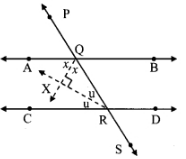
∠XQA = ∠XQR = x° ……(i) [Ray QX bisects ∠AQR]
∠YQR = ∠YQB =y° …….(ii) [Ray QY bisects ∠BQR]
∠XRQ = ∠XRC = u° …….. (iii) [Ray RX bisects ∠CRQ]
∠YRQ = ∠YRD = v° ……(iv) [Ray RY bisects ∠DRQ]
line AB || line CD and line PS is their transversal.
Image
∠AQR+ ∠CRQ= 180° [Interior angles]
(∠XQA + ∠XQR) + (∠XRQ + ∠XRC) = 180° [Angle addition property]
∴ (x + x) + (u + u) = 180° [From (i) and (ii)]
∴ 2x + 2u = 180°
∴ 2(x + u) = 180°
∴ x + u = 90° ……..(v)
In ∆XQR
∠XQR + ∠XRQ + ∠QXR = 180° [Sum of the measures of the angles of triangle is 180°]
∴ x + u + ∠QXR = 180° [From (i) and (iii)]
∴ 90 + ∠QXR = 180° [From (v)]
∴ ∠QXR = 180°- 90°
∴ ∠QXR = 90° …..(vi)
Similarily we can prove that,
Image
∴ y + v = 90°
Hence ∠QYR = 90° ……(vii)
Now, ∠AQR + ∠BQR = 180° [Angles is linear pair]
(∠XQA + ∠XQR) + (∠YQR + ∠YQB) = 180° [Angle addition property]
∴ (x + x) + (y + y) = 180° [From (i) and (ii)]
∴ 2x + 2y = 180°
∴ 2(x+y) = 180°
∴ x +y = 90°
i.e. ∠XQR + ∠YQR = 90° [From (i) and (ii)]
∴ ∠XQY = 90° ….(viii) [Angle addition property]
Similarly we can prove that,
∠XRY = 90° …(ix)
In □QXRY
∠QXR = ∠QYR = ∠XQY = ∠XRY = 90° [From (vi), (vii), (viii) and (ix)]
∴□ QXRY is a rectangle.
View full question & answer
Question 22 Marks
In the given figure, if line q || line r, line p is their transversal and if a = 80°, find the values of f and g.

Image
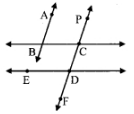
Given: line AB || line CF and line BC || line ED
To prove: ∠ABC = ∠FDE

Answer
Proof:
line AB || line PF and line BC is their transversal.
∴ ∠ABC = ∠BCD ….(i) [Alternate angles]
line BC || line ED and line CD is their transversal.
∴ ∠BCD = ∠FDE ….(ii) [Corresponding angles]
∴ ∠ABC = ∠FDE [From (i) and (ii)]
View full question & answer
Question 32 Marks
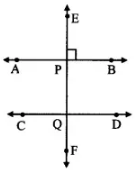
Prove that, if a line is perpendicular to one of the two parallel lines, then it is perpendicular to the other line also.

Image
Given: line AB || line CD and line EF intersects them at P and Q respectively.
line EF ⊥ line AB
To prove: line EF ⊥ line CD

Answer
Proof:
line EF ⊥ line AB [Given]
∴ ∠APR = 90° ….(i)
line AB || line CD and line EF is their transversal.
∴ ∠EPB ≅ ∠PQD …..(ii) [Corresponding angles]
∴ ∠PQD = 90° [From (i) and (ii)]
∴ line EF ⊥ line CD
View full question & answer
Question 42 Marks
Prove the Theorem : If a pair of corresponding angles formed by a transversal of two lines is congruent then the two lines are parallel.
View full question & answer
Question 52 Marks
Prove the Theorem : If a pair of alternate angles formed by a transversal of two lines is congruent then the two lines are parallel.
View full question & answer
Question 62 Marks
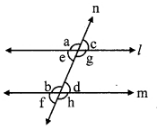
When one pair of interior angles on one side of the transversal is supplementary, then the other pair of interior angles is also supplementary.
Answer
For the given diagram,
If ∠e + ∠b = 180°, then ∠g + ∠d = 180°.
View full question & answer
Question 72 Marks
When one pair of alternate angles is congruent, then all the remaining pairs of alternate angles are congruent.
Answer
For the given diagram,
If ∠e ≅ ∠d, then ∠g ≅ ∠b
Also, ∠a ≅ ∠h and ∠c ≅ ∠f

Image

View full question & answer
Question 82 Marks
When one pair of corresponding angles is congruent, then all the remaining pairs of corresponding angles are congruent.
Answer
In the given diagram,
If ∠a ≅ ∠b
then ∠e ≅ ∠f, ∠c ≅ ∠d and ∠g ≅ ∠h
View full question & answer
Question 92 Marks
The angles in a linear pair are supplementary.
Answer
For the given diagram,
∠a and ∠c are in linear pair
∴ ∠a + ∠c = 180°
Also, ∠d and ∠b are in linear pair
∴ ∠d + ∠b = 180°

Image

View full question & answer
Question 102 Marks
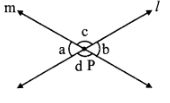
When two lines intersect, the pairs of vertically opposite angles formed are congruent.
Answer
In the given diagram,
line l and m intersect at point P.
The pairs of vertically opposite angles that are congruent are:
i. ∠a ≅ ∠b
ii. ∠c ≅ ∠d
View full question & answer