Questions

2 Mark Question

Take a timed test

4 questions · self-marked practice — reveal the answer and mark yourself.

Question 12 Marks
Three angles of a quadrilateral are 75°, 90° and 75°. Find the measure of the fourth angle.
Answer
Given: Three angles of a quadrilateral are 75°, 90° and 75°.
Let the fourth angle be x.
Using angle sum property of quadrilateral,
75° + 90° + 75° + x = 360°
⇒ 240° + x = 360°
⇒ x = 360° - 240°
⇒ x = 120°
So, the measure of the fourth angle is 120°.
View full question & answer
Question 22 Marks
The angles of a quadrilateral are in the ratio $2 : 4 : 5 : 7.$ Find the angles.
Answer
Let $\angle\text{A}=2\text{x}^{\circ}.$ Then $\angle\text{B}=(4\text{x})^{\circ},\angle\text{C}=(5\text{x})^{\circ}$ and $\angle\text{D}=(7\text{x})^{\circ}$ Since the sum of the angles of a quadrilateral is $360^o$, we have:$2\text{x}+4\text{x}+5\text{x}+7\text{x}=360^{\circ}$
$\Rightarrow18\text{x}=360^{\circ}$
$\Rightarrow\text{x}=20^{\circ}$
$\therefore\angle\text{A}=40^{\circ};\angle\text{B}=80^{\circ};\angle\text{C}=100^{\circ};\angle\text{D}=140^{\circ}$
View full question & answer
Question 32 Marks
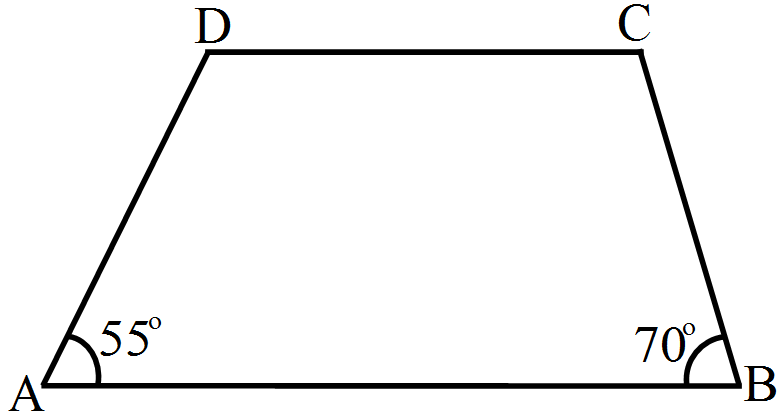
In the adjoining figure, ABCD is a trapezium in which AB || DC. If $\angle\text{A}=55^{\circ}$ and $\angle\text{B}=70^{\circ},$ find $\angle\text{C}$ and $\angle\text{D}.$
Answer
We have AB || DC.$\angle\text{A}$ and $\angle\text{D}$ are the interior angles on the same side of transversal line AD, whereas $\angle\text{B}$ and $\angle\text{C}$ are the interior angles on the same side of transversal line BC.
Now, $\angle\text{A}+\angle\text{D}=180^{\circ}$$\Rightarrow\angle\text{D}=180^{\circ}-\angle\text{A}$
$\therefore\angle\text{D}=180^{\circ}-55^{\circ}=125 ^{\circ}$
Again, $\angle\text{B}+\angle\text{C}=180^{\circ}$$\Rightarrow\angle\text{C}=180^{\circ}-\angle\text{B}$
$\therefore\angle\text{C}=180^{\circ}-70^{\circ}=110^{\circ}$
View full question & answer
Question 42 Marks
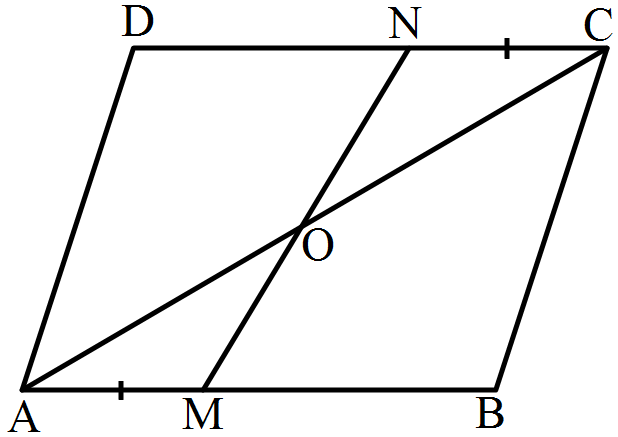
In a parallelogram ABCD, points M and N have been taken on opposite sides AB and CD respectively such that AM = CN. Show that AC and MN bisect each other.
Answer
In $\triangle\text{AMO}$ and $\triangle\text{CNO}$$\angle\text{MAO = }\angle\text{NCO}$ (AB || CD, alternate angles)
$\text{AM = CN}$ (given)
$\angle\text{AOM}=\angle\text{CON}$ (vertically opposite angles)
$\therefore\triangle\text{AMO}\cong\triangle\text{CNO}$ (by ASA congruence criterion)
$\Rightarrow\text{AO = CO}$ and $\text{MO = NO}$ (CP.C.T.)
$\Rightarrow\text{AC}$ and $\text{MN}$ bisect each other.
View full question & answer