Questions · Page 2 of 2

MCQ(1M)

MCQ 511 Mark
If $\text{ABCD}$ is a parallelogram with two adjacent angles $\angle\text{A}=\angle\text{B}$ then the parallelogram is a:
  • A
    Rhombus.
  • B
    Trapezium.
  • Rectangle.
  • D
    None of these.
Answer
Correct option: C.
Rectangle.
Given that $\text{ABCD}$ is a parallelogram.
We konw that, opposite sides of a parallelogram are parallel.
$\Rightarrow\angle\text{A}+\angle\text{B}=180^{\circ} ...($interior angles$)$
Also, $\angle\text{A}=\angle\text{B}=90^{\circ} ...($Given$)$
Since opposite angles of a parallelogram are equal,
$\angle\text{A}=\angle\text{C}$ and $\angle\text{B}=\angle\text{D}$
So, $\angle\text{A}=\angle\text{C}=\angle\text{B}=\angle\text{D}=90^{\circ}$
$\therefore \text{ABCD}$ is a rectangle.
View full question & answer
MCQ 521 Mark
The figure formed by joining the mid $-$ points of the adjacent sides of a rectangle is a:
  • Rhombus.
  • B
    Square.
  • C
    Rectangle.
  • D
    Parallelogram.
Answer
Correct option: A.
Rhombus.
The figure formed by joining the mid points of the adjacent sides of a rectangle is a rhombus.
View full question & answer
Question 531 Mark
Short Answer Questions.
Diagonals of a parallelogram are perpendicular to each other. Is this statement true? Give reasons for your answer.
Answer
The given statement is false.
Diagonals of a parallelogram bisect each other.
View full question & answer
MCQ 541 Mark
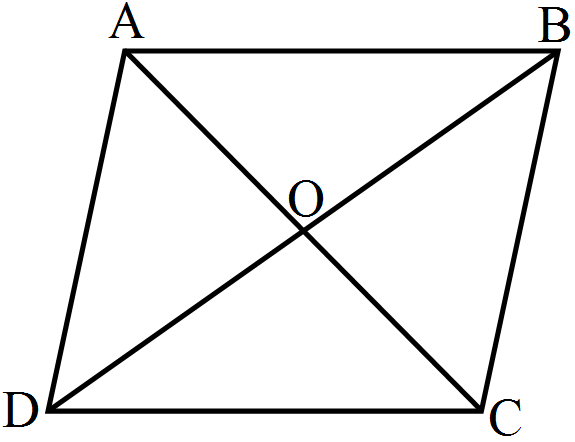
$\text{ABCD}$ is a rhombus such that $\angle\text{ACB}=50^{\circ}.$ Then, $\angle\text{ADB}=?$
  • $40^\circ$
  • B
    $25^\circ$
  • C
    $65^\circ$
  • D
    $130^\circ$
Answer
Correct option: A.
$40^\circ$

$\text{ABCD}$ is a rhombus.
$\Rightarrow AD \| BC$ and $\text{AC}$ is the transversal.
$\Rightarrow\angle\text{DAC}=\angle\text{ACB} \ ($alternate angles$)$
$\Rightarrow\angle\text{DAC}=50^{\circ}$
In $\triangle\text{AOD},$ by angle sum property,
$\angle\text{AOD}+\angle\text{DAO}+\angle\text{ADO}=180^{\circ}$
$\Rightarrow90^{\circ}+\angle\text{50}^{\circ}+\angle\text{ADO}=180^{\circ}$
$\Rightarrow\angle\text{ADO}=40^{\circ}$
$\Rightarrow\angle\text{ADB}=40^{\circ}$
View full question & answer
MCQ 551 Mark
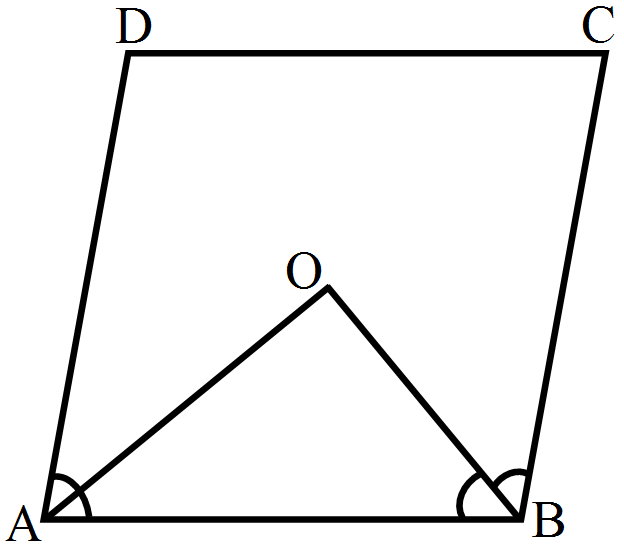
In a quadrilateral $\text{ABCD}$, if $AO$ and $BO$ are the bisectors of $\angle\text{A}$ and $\angle\text{B}$ respectively, $\angle\text{C}=70^{\circ}$ and $\angle\text{D}=30^{\circ}.$ Then, $\angle\text{AOB}=?$
  • A
    $40^\circ$
  • $50^\circ$
  • C
    $80^\circ$
  • D
    $100^\circ$
Answer
Correct option: B.
$50^\circ$

We know that, sum of the angles of a quadrilateral is $360^\circ .$
$\Rightarrow\angle\text{A}+\angle\text{B}+\angle\text{C}+\angle\text{D}=360^{\circ}$
$\Rightarrow\angle\text{A}+\angle\text{B}+70^{\circ}+30^{\circ}=360^{\circ}$
$\Rightarrow\angle\text{A}+\angle\text{B}=260^{\circ}$
$\Rightarrow\frac{1}{2}\angle\text{A}+\frac{1}{2}\angle\text{B}=\frac{1}{2}(260)^{\circ}$
$\Rightarrow\angle\text{BAO}+\angle\text{ABO}=130^{\circ}...(\text{i})$
In $\triangle\text{AOB},$
$\angle\text{BAO}+\angle\text{ABO}+\angle\text{AOB}=180^{\circ} ... ($Angle sum Property)
$\Rightarrow130^{\circ}+\angle\text{AOB}=180^{\circ} ... ($from $(i))$
$\Rightarrow\angle\text{AOB}=50^{\circ}$
View full question & answer
MCQ 561 Mark
Is quadrilateral $\text{ABCD} \ a \| gm$?
       $(i) $Diagonals $AC$ and $BD$ bisect each other.
       $(ii)$ Diagonals $AC$ and $BD$ are equal.
  • If the question can be answered by one of the given statements alone and not by the other;
  • B
    If the question can be answered by either statement alone;
  • C
    If the question can be answered by both the statements together but not by any one of the two;
  • D
    If the question cannot be answered by using both the statements together.
Answer
Correct option: A.
If the question can be answered by one of the given statements alone and not by the other;
If the diagonals of a quad. $\text{ABCD}$ bisect each other, then the quad. $\text{ABCD}$ is a parallelogram.
So, $I$ gives the answer.
If the diagonals are equal, then the quad. $\text{ABCD}$ is a parallelogram.
So, $II$ gives the answer.
View full question & answer