Questions

3 Mark Question

Take a timed test

18 questions · self-marked practice — reveal the answer and mark yourself.

Question 13 Marks
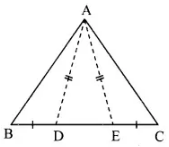
In the adjoining figure, points D and E are on side BC of ∆ABC, such that BD = CE and AD AE. Show that ∆ABD ≅ ∆ACE.
Image
Given: Points D and E are on side BC of ∆ABC,
such that BD = CE and AD = AE.
To prove: ∆ABD ≅ ∆ACE

Answer
Proof:
In ∆ADE,
seg AD = seg AE [Given]
∴ ∠AED = ∠ADE …(i) [Isosceles triangle theorem]
Now, ∠ADE + ∠ADB = 180° …(ii) [Angles in a linear pair]
∴ ∠AED + ∠AEC = 180° ….(iii) [Angles in a linear pair]
∴ ∠ADE + ∠ADB = ∠AED + ∠AEC [From (ii) and (iii)]
∴ ∠ADE + ∠ADB = ∠ADE + ∠AEC [From (i)]
∴ ∠ADB = ∠AEC ….(iv) [Eliminating ∠ADE from both sides]
In ∆ABD and ∆ACE,
seg BD ≅ seg CE [Given]
∠ADB = ∠AEC [From (iv)]
seg AD ≅ seg AE [Given]
∴ ∆ABD ≅ ∆ACE [SAS test]
View full question & answer
Question 23 Marks
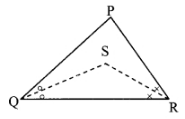
In ∆PQR, if PQ > PR and bisectors of ∠Q and ∠R intersect at S. Show that SQ > SR.
Given: In APQR, PQ > PR and bisectors of ∠Q and ∠R intersect at S.
To prove: SQ > SR
Image
Answer
Proof:
$\left.\angle SQR =\frac{1}{2} \angle PQR \ldots \text {...(i) [Ray QS bisects } \angle PQR \right]$
$\left.\angle SRQ =\frac{1}{2} \angle PRQ \ldots \text {...(ii) [Ray RS bisects } \angle PRQ \right]$
In ∆PQR,
PQ > PR [Given]
∴ ∠R > ∠Q [Angle opposite to greater side is greater.]
$\therefore \frac{1}{2}(\angle R )>\frac{1}{2}(\angle Q )\left[\right.$ Multiplying both sides by $\frac{1}{2}$ ]
∴ ∠SRQ > ∠SQR ….(iii) [From (i) and (ii)]
In ∆SQR,
∠SRQ > ∠SQR [From (iii)]
∴ SQ > SR [Side opposite to greater angle is greater]
View full question & answer
Question 33 Marks
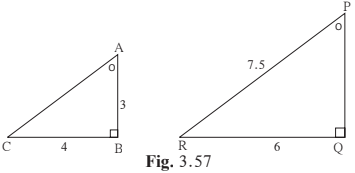
Some information is shown in △ ABC and △ PQR in figure 3.57. Observe it. Hence find the lengths of side AC and PQ.

Image

View full question & answer
Question 53 Marks
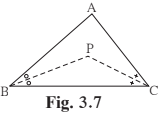
In figure 3.7, bisectors of ∠B and ∠C of D ABC intersect at point P.
Prove that ∠BPC = 90 + $\frac{1}{2}$ ∠BAC.

Image

Answer
In ∆ABC,
∠BAC + ∠ABC + ∠ACB = 180° …[Sum of the measures of the angles of a triangle is 180°]
∴ ∠BAC + – ∠ABC + ∠ACB = 180 …
[Multiplying each term by (1/2)]
∴ ∠BAC + ∠PBC + ∠PCB = 90°
∴ ∠PBC + ∠PCB = 90° – 1
∠BAC ………(i)
In∆BPC,
∠BPC + ∠PBC + ∠PCB = 180° …….[Sum of measures of angles of a triangle]
∴ ∠BPC + 90° – (1/2) ∠BAC = 180° ……[From (i)]
∴ ∠BPC = 180° – 90° (1/2) ∠BAC
= 180°- 90°+ (1/2) ∠BAC
= 90°+ (1/2) ∠BAC
View full question & answer
Question 63 Marks
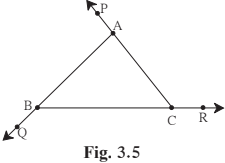
Prove that the sum of exterior angles of a triangle, obtained by extending its sides in the same direction is 360°.
Answer
Given : ∠PAB, ∠QBC and ∠ACR
are exterior angles of D ABC
To prove : ∠PAB + ∠QBC + ∠ACR = 360°
Proof : Method I
Considering exterior ∠PAB of D ABC,
∠ABC and ∠ACB are its remote interior angles.
∠PAB = ∠ABC + ∠ACB ----(I)
Similarly, ∠ACR = ∠ABC + ∠BAC ----(II)..theorem of remote interior angles
and ∠CBQ = ∠BAC + ∠ACB ---- (III)
Adding (I), (II) and (III),
∠PAB + ∠ACR + ∠CBQ
= ∠ABC + ∠ACB + ∠ABC + ∠BAC + ∠BAC + ∠ACB
= 2∠ABC + 2∠ACB + 2∠BAC
= 2 (∠ABC + ∠ACB + ∠BAC)
= 2 × 180° . . . . . sum of interior angles of a triangle
= 360°

Image

View full question & answer
Question 73 Marks
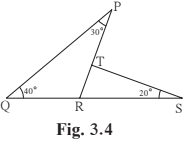
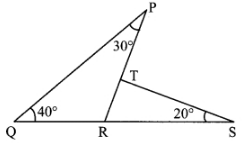
Observe figure 3.4 and find the measures of ∠PRS and ∠RTS.

Image

Answer
$\angle \mathrm{PRS}$ is an exterior angle of $\triangle \mathrm{PQR}$. So from the theorem of remote interior angles,
$\angle \mathrm{PRS}=\angle \mathrm{PQR}+\angle \mathrm{QPR}$
$=40^{\circ}+30^{\circ}$
$\therefore \angle \mathrm{PRS}=70^{\circ}$
$\therefore \angle \mathrm{TRS}=70^{\circ} \ldots[\mathrm{P}-\mathrm{T}-\mathrm{R}]$
In $\triangle \mathrm{RTS}$,
$\angle \mathrm{TRS}+\angle \mathrm{RTS}+\angle \mathrm{TSR}=180^{\circ} \ldots\left[\right.$ Sum of the measures of the angles of a triangle is $\left.180^{\circ}\right]$
$\therefore 70^{\circ}+\angle \mathrm{RTS}+20^{\circ}=180^{\circ}$
$\therefore \angle \mathrm{RTS}+90^{\circ}=180^{\circ}$
$\therefore \angle \mathrm{RTS}=180^{\circ}$
$\therefore \angle \mathrm{RTS}=90^{\circ}$
View full question & answer
Question 83 Marks
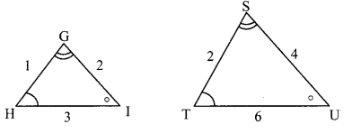
Draw a sketch of a pair of similar triangles. Label them. Show their corresponding angles by the same signs. Show the lengths of corresponding sides by numbers in proportion.
Answer

Image
∆GHI ~ ∆STU
View full question & answer
Question 93 Marks
In ∆XYZ, XY = 4 cm, YZ = 6 cm, XZ = 5 cm. If ∆XYZ ~ ∆PQR and PQ = 8 cm, then find the lengths of remaining sides of ∆PQR.
Answer
∆XYZ ~ ∆PQR [Given]
$\begin{array}{ll}\therefore & \frac{ XY }{ PQ }=\frac{ YZ }{ QR }=\frac{ XZ }{ PR } \text { [Corresponding sides of similar triangles] } \\ \therefore \quad \frac{4}{8}=\frac{6}{ QR }=\frac{5}{ PR } \quad \text { (i) } \\ & \text { Now, } \frac{4}{8}=\frac{6}{ QR } \\ \therefore & QR =\frac{6 \times 8}{4} \\ \therefore & QR =12 cm \\ \text { ii. } & \text { Also, } \frac{4}{8}=\frac{5}{ PR } \quad[\text { From (i)] } \\ \therefore & PR =\frac{5 \times 8}{4}\end{array}$
∴ PR = 10 cm
∴ QR = 12 cm, PR = 10cm
View full question & answer
Question 103 Marks
If ∆XYZ ~ ∆LMN, write the corresponding angles of the two triangles and also write the ratios of corresponding sides.
Answer
∆XYZ ~ ∆LMN [Given]
∴ ∠X ≅ ∠L
∠Y ≅ ∠M >
∠Z ≅ ∠N [Corresponding angles of similar triangles]
$\frac{ XY }{ LM }=\frac{ YZ }{ MN }=\frac{ XZ }{ LN }$ [Corresponding sides of similar triangles]
View full question & answer
Question 113 Marks
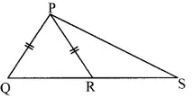
In the adjoining figure, if seg PR ≅ seg PQ, show that seg PS > seg PQ.

Image

Answer
Proof.
In ∆PQR,
seg PR ≅ seg PQ [Given]
∴ ∠PQR ≅ ∠PRQ ….(i) [Isosceles triangle theorem]
∠PRQ is the exterior angle of ∆PRS.
∴ ∠PRQ > ∠PSR ….(ii) [Property of exterior angle]
∴ ∠PQR > ∠PSR [From (i) and (ii)]
i.e. ∠Q > ∠S ….(iii)
In APQS,
∠Q > ∠S [From (iii)]
∴ PS > PQ [Side opposite to greater angle is greater]
∴ seg PS > seg PQ
View full question & answer
Question 123 Marks
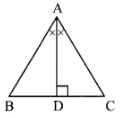
Prove that, if the bisector of ∠BAC of ∆ABC is perpendicular to side BC, then AABC is an isosceles triangle.

Image

Answer
Given: Seg AD is the bisector of ∠BAC.
seg AD ⊥ seg BC
To prove: AABC is an isosceles triangle.
Proof.
In ∆ABD and ∆ACD,
∠BAD ≅ ∠CAD [seg AD is the bisector of ∠BAC]
seg AD ≅ seg AD [Common side]
∠ADB ≅ ∠ADC [Each angle is of measure 90°]
∴ ∆ABD ≅ ∆ACD [ASA test]
∴ seg AB ≅ seg AC [c. s. c. t.]
∴ ∆ABC is an isosceles triangle.
View full question & answer
Question 133 Marks
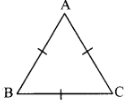
Prove that an equilateral triangle is equiangular.

Image

Answer
Given: ∆ABC is an equilateral triangle.
To prove: ∆ABC is equiangular
i.e. ∠A ≅ ∠B ≅ ∠C …(i) [Sides of an equilateral triangle]
In ∆ABC,
seg AB ≅ seg BC [From (i)]
∴ ∠C = ∠A (ii) [Isosceles triangle theorem]
In ∆ABC,
seg BC ≅ seg AC [From (i)]
∴ ∠A ≅ ∠B (iii) [Isosceles triangle theorem]
∴ ∠A ≅ ∠B ≅ ∠C [From (ii) and (iii)]
∴ ∆ABC is equiangular.
View full question & answer
Question 143 Marks
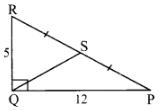
In $\triangle PQR , \angle Q =90^{\circ}, PQ =12, QR =5$ and QS is a median. Find $I ( QS )$.

Image
Answer
i. $PQ =12, QR =5$ [Given]
In APQR, $\angle Q =90^{\circ}$ [Given]
$\therefore PR ^2= QR ^2+ PQ ^2$ [Pythagoras theorem]
$=25+144$
$\therefore P R^2=169$
$\therefore P R=13$ units [Taking square root of both sides]ii. In right angled APQR, seg QS is the median on hypotenuse PR.
$\therefore Q S=\frac{1}{2} P R$ [In a right angled triangle, the length of the median on the hypotenuse is half the length of the hypotenuse]
$=\frac{1}{2} \times 13$
$\therefore l(Q S)=6.5$ units
View full question & answer
Question 153 Marks
Observe the given figure and find the measures of ∠PRS and ∠RTS.

Image

Answer
∠PRS is an exterior angle of ∆PQR.
So from the theorem of remote interior angles,
∠PRS = ∠PQR + ∠QPR
= 40° + 30°
∴ ∠PRS = 70°
∴ ∠TRS=70° …[P – T – R]
In ∆RTS,
∠TRS + ∠RTS + ∠TSR = 180° …[Sum of the measures of the angles of a triangle is 180°]
∴ 70° + ∠RTS + 20° = 180°
∴ ∠RTS + 90° = 180°
∴ ∠RTS = 180°
∴ ∠RTS = 90°
View full question & answer
Question 163 Marks
In the adjoining figure, line AB || line CD and line PQ is the transversal. Ray PT and ray QT are bisectors of ∠BPQ and ∠PQD respectively. Prove that m ∠PTQ = 90°.

Given: line AB || line CD and line PQ is the transversal.
ray PT and ray QT are the bisectors of ∠BPQ and ∠PQD respectively.
To prove: m∠PTQ = 90°
Answer
Proof:
$\left.\angle TPB =\angle TPQ =\frac{1}{2} \angle BPQ \ldots \text {..(i) [Ray } PT \text { bisects } \angle BPQ \right]$
$\angle TQD =\angle TQP =\frac{1}{2} \angle PQD \ldots \text {...(ii) }[\text { Ray } QT \text { bisects } \angle PQD ]$
line AB || line CD and line PQ is their transversal. [Given]
∴∠BPQ + ∠PQD = 180° [Interior angles]
$\therefore \frac{1}{2}(\angle BPQ )+\frac{1}{2}(\angle PQD )=\frac{1}{2} \times 180^{\circ}\left[\right.$ Multiplying both sides by $\left.\frac{1}{2}\right]$
∠TPQ + ∠TQP = 90°
In ∆PTQ,
∠TPQ + ∠TQP + ∠PTQ = 180° [Sum of the measures of the angles of a triangle is 180°]
∴ 90° + ∠PTQ = 180° [From (iii)]
∴ ∠PTQ = 180° – 90°
= 90°
∴ m∠PTQ = 90°
View full question & answer
Question 173 Marks
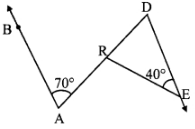
In the adjoining figure, line AB || line DE. Find the measures of ∠DRE and ∠ARE using given measures of some angles.

Image

Answer
i. ∠B AD = 70°, ∠DER = 40° [Given]
line AB || line DE and seg AD is their transversal.
∴ ∠EDA = ∠BAD [Alternate Angles]
∴ ∠EDA = 70° ….(i)
In ∆DRE,
∠EDR + ∠DER + ∠DRE = 180° [Sum of the measures of the angles of a triangle is 180°]
∴ 70°+ 40° +∠DRE = 180° [From (i) and D – R – A]
∴ ∠DRE = 180° -70° -40°
∴ ∠DRE = 70°

ii. ∠DRE + ∠ARE = 180° [Angles in a linear pair]
∴ 70° + ∠ARE = 180°
∴ ∠ARE = 180°-70°
∴ ∠ARE =110°
∴ ∠DRE = 70°, ∠ARE = 110°

View full question & answer
Question 183 Marks
The measures of angles of a triangle are x°, (x – 20)°, (x – 40)°. Find the measure of each angle.
Answer
The measures of the angles of a triangle are x°, (x – 20)°, (x – 40)°. [Given]
∴ x°+ (x – 20)° + (x – 40)° = 180° [Sum of the measures of the angles of a triangle is 180°]
∴ 3x – 60 = 180
∴ 3x = 180 + 60
∴ 3x = 240
∴ x = 240
$\therefore x=\frac{240}{3}$
∴ x = 80°
∴ The measures of the remaining angles are
x – 20° = 80° – 20° = 60°,
x – 40° = 80° – 40° = 40°
∴ The measures of the angles of the triangle are 80°, 60° and 40°.
View full question & answer