Question 15 Marks
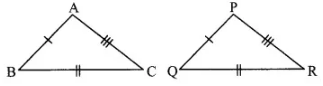
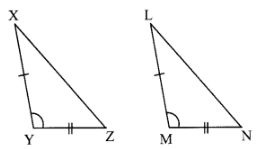
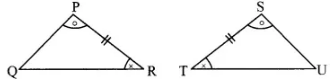
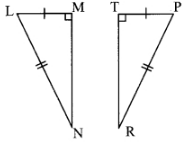
Check the congruence of triangles.
Answer
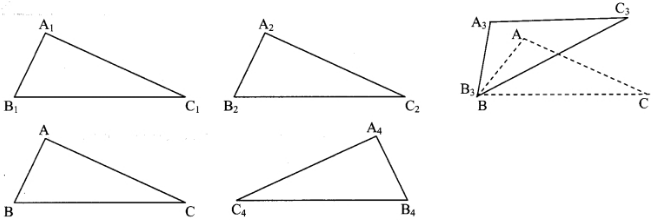
View full question & answer→Draw $\triangle A B C$ of any measure on a card-sheet and cut it out.
Place it on a card-sheet. Make a copy of it by drawing its border.
Name it as $\Delta A_1 B_1 C_1$.
Now slide the $\triangle A B C$ which is the cut out of a triangle to some distance and make one more copy of it.
Name it $\Delta A _2 B_2 C _2$.
Then rotate the cut out of triangle ABC a little, as shown in the figure, and make another copy of it.
Name the copy as $\triangle A_3 B_3 C_3$.
Then flip the triangle $A B C$, place it on another card-sheet and make a new copy of it.
Name this copy as $\triangle A_4 B_4 C_4$.
Have you noticed that each of $\triangle A_1 B_1 C_1, \triangle A_2 B_2 C_2, \triangle A_3 B_3 C_3$ and $\triangle A_4 B_4 C_4$ is congruent with $\triangle A B C$ ?
Because each of them fits exactly with $\triangle A B C$. Let us verify for $\triangle A_3 B_3 C_3$.
If we place $\angle A$ upon $\angle A 3, \angle B$ upon $\angle B 3$ and $\angle C$ upon $\angle C 3$, then only they will fit each other and we can say that $\triangle A B C=\triangle A_3 B_3 C_3$.
We also have $A B=A_3 B_3, B C=B_3 C_3, C A=C_3 A_3$.
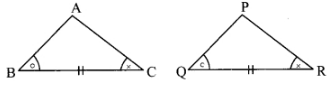
Note that, while examining the congruence of two triangles, we have to write their angles and sides in a specific order, that is with a specific one-to-one correspondence. If $\triangle A B C \cong \triangle P Q R$, then we get the following six equations:
$\angle A=\angle P, \angle B=\angle Q \angle C=\angle R$
and $A B=P Q B C=Q R, C A=R P$.
This means, with a one-to-one correspondence between the angles and the sides of two triangles, we get hree pairs of congruent angles and three pairs of congruent sides.
Place it on a card-sheet. Make a copy of it by drawing its border.
Name it as $\Delta A_1 B_1 C_1$.
Now slide the $\triangle A B C$ which is the cut out of a triangle to some distance and make one more copy of it.
Name it $\Delta A _2 B_2 C _2$.
Then rotate the cut out of triangle ABC a little, as shown in the figure, and make another copy of it.
Name the copy as $\triangle A_3 B_3 C_3$.
Then flip the triangle $A B C$, place it on another card-sheet and make a new copy of it.
Name this copy as $\triangle A_4 B_4 C_4$.
Have you noticed that each of $\triangle A_1 B_1 C_1, \triangle A_2 B_2 C_2, \triangle A_3 B_3 C_3$ and $\triangle A_4 B_4 C_4$ is congruent with $\triangle A B C$ ?
Because each of them fits exactly with $\triangle A B C$. Let us verify for $\triangle A_3 B_3 C_3$.
If we place $\angle A$ upon $\angle A 3, \angle B$ upon $\angle B 3$ and $\angle C$ upon $\angle C 3$, then only they will fit each other and we can say that $\triangle A B C=\triangle A_3 B_3 C_3$.
We also have $A B=A_3 B_3, B C=B_3 C_3, C A=C_3 A_3$.
Note that, while examining the congruence of two triangles, we have to write their angles and sides in a specific order, that is with a specific one-to-one correspondence. If $\triangle A B C \cong \triangle P Q R$, then we get the following six equations:
$\angle A=\angle P, \angle B=\angle Q \angle C=\angle R$
and $A B=P Q B C=Q R, C A=R P$.
This means, with a one-to-one correspondence between the angles and the sides of two triangles, we get hree pairs of congruent angles and three pairs of congruent sides.