Questions

Answer the following question.

Take a timed test

16 questions · self-marked practice — reveal the answer and mark yourself.

Question 15 Marks
With the help of a neat labelled diagram explain the laboratory preparation of Carbon dioxide gas.
Answer
Apparatus : Retort stand, round bottom flask, thistle funnel, gas delivery tube, gas jars.
Chemicals : Calcium carbonate (Pieces of Shahabad tiles/marble pieces/limestone), dilute hydrochloric acid.Procedure:
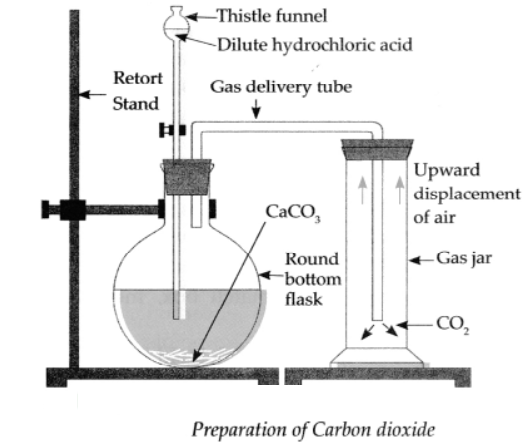
  • Assemble the apparatus as shown in the figure. While assembling, place $CaCO_3$ in the round bottom flask.
  • Add dilute HCl in the flask through thistle funnel. See to it that the end of the funnel dips in the acid.
  • $CO_2$ is formed as a result of the reaction between $CaCO_3$ and HCl. Collect this gas in four to five gas jars. The chemical equation of the above reaction is as follows. $CaCO_3 + 2HCl → CaCl_2 + H_2O + CO_2↑$
  •  
Image
View full question & answer
Question 25 Marks

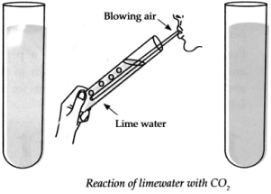
Apparatus : Test tube, straw, lime water, etc.
Procedure: Take freshly prepared lime water in a test tube. Blow air in it for some time through the straw and observe the lime water. Note the observation.

Image

What did you see?
What might be the reason behind the change?
Answer
When we blow air through the straw in freshly prepared lime water, it turns milky.
$\underset{\text { Lime }}{ CaO }+\underset{\text { Water }}{ H _2 O } \longrightarrow \underset{\text { Lime water }}{ Ca ( OH )_2}$
Freshly prepared lime water is obtained by dissolving lime $( CaO )$ in water $\left( H _2 O \right)$.
When we blow air through the straw in lime water, carbon dioxide $\left( CO _2\right)$ present in the air reacts with lime water to form white precipitate (insoluble substance) of Calcium Carbonate $\left( CaCO _3\right)$ due to which lime water turns milky.
$Ca\left(OH_2\right)+CO_2 \longrightarrow H_2 O+CaCO_3$
Lime water Carbon dioxide water Calcium Carbonate (White)
View full question & answer
Question 35 Marks

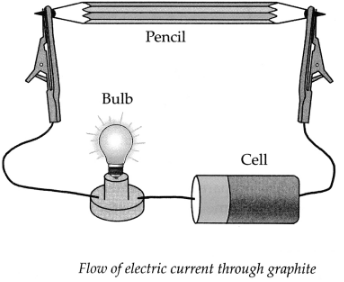
Apparatus : Pencil, electrical wires, battery/ cell, small bulb, water, kerosene, test tube, lead pencils, etc.
Procedure : Remove the lead from a pencil and arrange the apparatus as shown in the above diagram. Note your observations for the following.
Image
(a) What is the colour of lead in the pencil? .
(b) Try to break lead with your hand.
(c) Start the electric current in the circuit and observe. What did you find?
(d) Take some water in a test tube. Take some kerosene in another test tube. Put lead dust in both the test tube. What did you observe?
Answer
The colour of the lead in the pencil is black as it is made from graphite which is an allotrophic form of carbon.The lead breaks easily as it is made up of graphite which is brittle in nature.
When we start the electric current in the circuit, the bulb in the circuit glows, indicating that the lead in the pencil is a good conductor of electricity.
(i) Lead dust does not dissolve in water nor in kerosene.
(ii) It remains insoluble in both the test tubes.
View full question & answer
Question 45 Marks

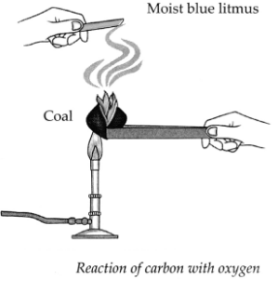
Apparatus : Coal, match box, moist litmus paper, etc.
Procedure : Ignite the coal. Hold the moist blue litmus paper over the gas released on igniting the coal. Note the observation
.
Image
(a) With which gas in the air does the coal react on igniting?
(b) What is the substance formed?
(c) What change takes place in the litmus paper?
(d) Write down the chemical reaction taking place in the above procedure.
Answer
A.Coal reacts with oxygen gas present in the air, on igniting.B.The substance formed is carbon dioxide.
C.The moist blue litmus paper turns red.
(i) Carbon combines with oxygen to form Carbon dioxide gas.
$\begin{aligned} & C + O _2 \longrightarrow CO _2 \uparrow \\ & \text { Carbon } \quad \text { Oxygen } \quad \text { Carbon dioxide } \\ & \end{aligned}$
(ii) This C02 combines with water present on moist blue litmus paper to form Carbonic acid which turns blue litmus to red.
$\begin{aligned} & CO _2+ H _2 O \longrightarrow H _2 CO _3 \\ & \text { Carbon Water Carbonic acid } \\ & \text { dioxide } \\ & \end{aligned}$
View full question & answer
Question 55 Marks
What is a compound? How are compounds formed?
Answer
  • A compound is a substance formed when two or more elements are chemically bonded with each other in definite proportion by weight.
  • When atoms or two or more different elements chemically react with each other in a definite proportion by weight, a compound is formed.
  • The properties of a compound are altogether different from its constituent elements.
  • Example: Pure water is a compound made up of two elements Hydrogen and Oxygen. Hydrogen (H) atoms and oxygen ( O ) atoms have chemically reacted with each other in definite proportion to form a compoundwater $\left( H _2 O \right)$. The proportion of hydrogen and oxygen in water by volume is $2: 1$ and by weight is $1: 8$ respectively.
  • The properties of water are altogether different from the properties of its constituent elements, hydrogen and oxygen.
View full question & answer
Question 65 Marks
Is the density of $CO_2$ more or less than that of air?
Answer
  1. Density is defined as mass per unit volume of a substance, expressed as kilograms per cubic meter.
  2. At standard temperature and pressure, the density of air is $1.29 kg/m^3.$ While that of carbon dioxide $(CO_2)$ is $1.79 kg/m^3.$ Hence, density of $CO_2$ is more than that of air.
View full question & answer
Question 75 Marks
What inference will you draw about the solubility of carbon?
Answer
Carbon is insoluble in water, kerosene and cooking oil.
View full question & answer
Question 85 Marks
In which of the solvents – water, kerosene and cooking oil does the coal powder dissolve?
Answer
Solvents such as water, kerosene and cooking oil do not dissolve coal powder in them.
View full question & answer
Question 95 Marks
Does an electric charge form on atoms when a covalent bond is formed between them? Why is a single bond between two carbon atoms strong and stable?
Answer
  • No, electric charge is not formed on atoms when a covalent bond is formed between them. This is because covalent bond is formed by sharing of electrons.
  • Therefore, there is no change in number of electrons and protons in these atoms and they remain electrically neutral.
  • Covalent bonds occur when electrons are shared between two atoms. A single covalent bond is formed when only one pair of electrons is shared between atoms.
  • In this sharing, the atomic orbitals directly overlap between the nuclei of two atoms forming the strongest type of covalent bond called as sigma bond.
  • Hence, a single covalent bond between two carbon atoms is strong and stable.
View full question & answer
Question 105 Marks
What is an element? What are the different types of elements.
Answer
  • A substance which cannot be decomposed into simple substances by any physical or simple chemical method is called as an Element.
  • An element is composed of atoms of only one kind.
  • The different types of elements are:
    (a) Metals – Examples: Gold, Silver, etc.
    (b) Non-metals – Examples: Carbon, Sulphur, etc.
    (c) Metalloids – Examples: Silicon, Antimony, etc.
View full question & answer
Question 115 Marks
What type of element is carbon? Give some information about it.
Answer
  • Carbon is a non-metallic element. It is available ‘ abundantly in the nature and occurs in free as well as combined state.
  • Carbon in free state is found as diamond and graphite and in combined state it is present to the extent of approximately 0.27% in the form of carbonate, coal, petroleum.
  • In atmosphere, the proportion of carbon in the form of carbon dioxide is approximately 0.03%.
View full question & answer
Question 125 Marks
Whatremains behind on complete combustion of any organic compound?
Answer
A black colour substance ‘Carbon’ remains behind on complete combustion of any organic compound.
View full question & answer
Question 135 Marks
How will you verify the properties of carbon dioxide?
Answer
  • When a burning candle is placed in a gas jar of carbon dioxide, it extinguishes indicating that carbon dioxide is a non-combustible gas and does not support combustion.
  • When carbon dioxide gas is passed through lime water, it turns lime water milky due to the formation of insoluble calcium carbonate.
  • Moist blue litmus turns red in a gas jar of carbon dioxide indicating, it is acidic in nature.
  • Carbon dioxide is fairly soluble in water, it dissolves in water forming carbonic acid.
View full question & answer
Question 145 Marks
Practical uses of $CO_2$.
Answer
  • $CO _2$ is used to make aerated drinks.
  • $CO _2$ obtained by chemical reaction or kept under pressure is used in fire extinguishers. Liquified $CO _2$ is used to remove caffeine from coffee.
  • Liquid $CO _2$ is used as solvent in modem eco-friendly dry cleaning.
  • Solid carbon dioxide is used in cold storage and to keep milk and milk products and frozen substances cool during transport. It is also used for getting special effects of a mist in dramas and movies.
View full question & answer
Question 155 Marks
Petrol, diesel, coal are fossil fuels.
Answer
(i) A fossil fuel is a fuel formed by natural processes, such as anaerobic decomposition of buried dead organisms. Fossil fuels contain high percentage of carbon. The word carbon is derived from the Latin word ‘Carbo’ meaning coal.

(ii) Coal is formed from the remains of trees and other vegetation. Approximately 350 million years ago, these remains were trapped on the bottom of swamps, accumulating layer after layer and creating a dense material called peat. As this peat was buried under more and more ground, the high temperature and pressure transformed it into coal.

(iii) Petrol and diesel are obtained from mineral oil. Mineral oil also called as crude oil or petroleum oil is formed from the remains of plants and animals that lived in the seas millions of years ago. This plant and animal matter has been drawn down and subjected to extremes of temperature and pressure over millions of years ago.

(iv) Mineral oil is commonly formed in rocks under the sea bed. The word petroleum is derived from Latin word ‘Rock oil’. Petrol and Diesel are obtained from mineral oil by the process called as fractional distillation.
Thus petrol, diesel and coal are fossil fuels.

View full question & answer
Question 165 Marks
Diamond, graphite and fullerenes are crystalline forms of carbon.
Answer
  • Carbon exhibits a property of allotropy in which an element exists in more than one form in nature.
  • The chemical properties of these different forms are the same but their physical properties are different.
  • Carbon exists in crystalline as well as non-crystalline (amorphous form).
  • Crystalline form has a regular and definite arrangement of atoms. They have high melting points and boiling points.
  • A crystalline form has a definite geometrical shape, sharp edges and plane surfaces.
  • Carbon has three crystalline allotropes such as diamond, graphite and fullerene.
  • In the structure of diamond, every carbon atom is bonded to four neighbouring atoms by covalent bonds.
  • Therefore, diamond has a tetragonal three dimensional structure which makes it very hard.
  • Brilliant and pure diamond is the hardest natural substance.
  • In the structure of graphite, every carbon atom in graphite is bonded to three other carbon atoms in such a way that a hexagonal layered structure is formed.
  • A graphite crystal is made of many sheets or layers of carbon atoms.
  • These layers slip over each other on applying pressure. One layer of graphite is called graphene.
  • Fullerene is rarely found in nature. It is found in soot and in interstellar space.
  • The first example of fullerene is Buckminster fullerene $(C_{60})$.
  • This allotrope of carbon is named fullerene after the architect.
  • Richard Buckminster Fuller because the structure of $C_{60}$ resembles the structure of the geodesic dome he designed.
  • (xi) Molecules of fullerenes are found in the form of buckyballs and buckytubes.
  • (xii) There are 30 to 900 carbon atoms in one molecule of a fullerene. , $C_{60}, C_{70}, C_{76}, C_{82}$ and $C_{86}$​​​​​​​ are other examples of fullerene. Their molecules occur in small numbers in soot.
View full question & answer