Questions

complete the Graph/Table.

Take a timed test

9 questions · self-marked practice — reveal the answer and mark yourself.

Question 13 Marks
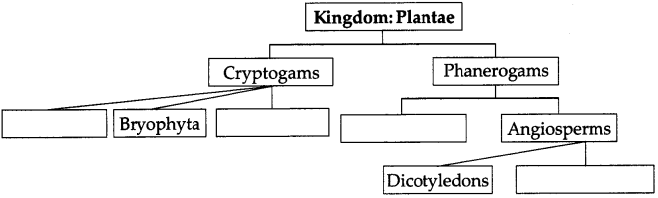
The flowers of Angiosperms plants bear are their …………….. organs Flowers develop into …………….. and seeds are formed within …………….. . Thus, these seeds are ……………..; hence, they are called angiosperms (angios: cover, sperms: seeds). The plants whose seeds can be divided into two equal halves or dicotyledons are called …………….. plants and those whose seeds cannot be divided into equal parts are called …………….. plants.
Answer
The flowers of Angiosperms plants bear are their reproductive orgAnswer: Flowers develop into fruits and seeds are formed within fruits. Thus, these seeds are covered; hence, they are called angiosperms (angios: cover, sperms: seeds). The plants whose seeds can be divided into two equal halves or dicotyledons are called dicotyledonous plants and those whose seeds cannot be divided into equal parts are called monocotyledonous plants.
View full question & answer
Question 23 Marks
Gymnosperms are mostly …………….., perennial and woody. Their stems are without …………….. The leaves form a …………….. These plants bear male and female flowers on different …………….. of the same plant …………….. of these plants do not have natural coverings, i.e. these plants do not form …………….. and are therefore called gymnosperms. (gymnos: naked, sperms: seeds). Examples Cycas, Picea (Christmas tree), Thuja (Morpankhi), Pinus (Deodar), etc.
Answer

Phanerogams plants which have special structures for reproduction and produce seeds. In these plants, after the process of reproduction, seeds are formed which contain the embryo and stored food. During germination of the seed, the stored food is used for the initial growth of the embryo. Depending upon whether seeds are enclosed in a fruit or not, phanerogams are classified into gymnosperms and angiosperms.

View full question & answer
Question 33 Marks
Phanerogams plants which have special structures for …………….. and produce …………….. In these plants, after the process of reproduction, seeds are formed which contain the …………….. and stored food. During germination of the seed, the stored food is used for the initial growth of the embryo. Depending upon whether seeds are enclosed in …………….. a or not, phanerogams are classified into …………….. and ……………. .
Answer
Phanerogams plants which have special structures for reproduction and produce seeds. In these plants, after the process of reproduction, seeds are formed which contain the embryo and stored food. During germination of the seed, the stored food is used for the initial growth of the embryo. Depending upon whether seeds are enclosed in a fruit or not, phanerogams are classified into gymnosperms and angiosperms.
View full question & answer
Question 43 Marks
Plants from Pteridophyta group have well developed roots, stem and leaves and separate …………….. for conduction of food and water. But,
they do not bear …………….. and ……………… They reproduce with the help of …………….. formed along the back or posterior surface of their leaves. Examples are ferns like Nephrolepis, Marsilea, Pteris, Adiantum, Equisetum, Selaginella, Lycopodium, etc. These plants reproduce …………….. by spore-formation and sexually by …………….. formation. They have a well-developed conducting system.
Answer
Plants from Pteridophyta group have well developed roots, stem and leaves and separate tissues for conduction of food and water. But, they do not bear flowers and fruits. They reproduce with the help of spores formed along the back or posterior surface of their leaves. Examples are ferns like Nephrolepis, Marsilea, Pteris, Adiantum, Equisetum, Selaginella, Lycopodium, etc. These plants reproduce asexually by spore-formation and sexually by zygote formation. They have a well-developed conducting system.
View full question & answer
Question 53 Marks
…………….. group of plants is called the amphibians’ of the plant kingdom because they grow in moist soil but need …………….. for reproduction. These plants are thalloid, multicellular and autotrophic. They reproduce by …………….. formation. The structure of the plant body of bryophytes is flat, ribbon?like long, without true …………….., stem and leaves. Instead, they have stem-like or leaf?like parts and root-like ……………. . They do not have specific …………….. for conduction of food and water. Examples are Moss (Funaria), Marchantia, Anthoceros, Riccia, etc.
Answer

Bryophyta group of plants is called the ‘amphibians’ of the plant kingdom because they grow in moist soil but need water for reproduction. These plants are thalloid, multicellular and autotrophic. They reproduce by spore formation. The structure of the plant body of bryophytes is flat, ribbon-like long, without true roots, stem and leaves. Instead, they have stem-like or leaf-like parts and root-like rhizoids. They do not have specific tissues for conduction of food and water. Examples are Moss (Funaria), Marchantia, Anthoceros, Riccia, etc.
View full question & answer
Question 63 Marks
Thallophyta plants grow mainly in …………….. . This group of plants, which do not have specific parts like root-stem-leaves-flowers but are autotrophic due to the presence of …………….., is called algae. Algae show great diversity. They may be unicellular or …………….., and microscopic or large. Examples of algae are Spirogyra, Ulothrix, Ulva, Sargassum, etc. Some of these are found in fresh water while some are found in saline water. These plants usually have a …………….. and fibre-like body. Various types of …………….. like yeasts and moulds which do not have …………….. are also included in this group.
Answer
Thallophyta plants grow mainly in water. This group of plants, which do not have specific parts like root-stem-leaves-flowers but are autotrophic due to the presence of chlorophyll, is called algae. Algae show great diversity. They may be unicellular or multicellular, and microscopic or large. Examples of algae are Spirogyra, Ulothrix, Ulva, Sargassum, etc. Some of these are found in fresh water while some are found in saline water. These plants usually have a soft and fibre-like body. Various types of fungi like yeasts and moulds which do not have chlorophyll are also included in this group.
View full question & answer
Question 93 Marks
(1) Spirogyra : Thallophyta : : Riccia :
(2) Moss : Bryophyta : : Selaginella :
(3) Nephrolepis : Pteridophyta :: Ulothrix :
(4) Pteridophyta : Roots :: Bryophyta :
(5) Gymnosperms : naked seeds : : Angiosperms :
(6) Dicotyledon : Reticulate venation : : Monocotyledon:
(7) Bamboo stem: Hollow:: Onion Stem:
(8) Monocotylendon : Tap root:: Dicotyledon :
Answer
(1) Bryophyta
(2) Pteridophyta
(3) Thallophyta
(4) Rhizoids
(5) Covered seeds
(6) Parallel venation
(7) Disc like
(8) Fibrous roots
View full question & answer