Questions

Question Answer (2 Marks)

Take a timed test

59 questions · self-marked practice — reveal the answer and mark yourself.

Question 12 Marks
Why do camels have large flat feet?

A camel.

A large flat foot of camel.
Answer
Camels have large flat feet so that there is a greater area in contact with the sand which produces less pressure on the sand and the camels can move easily on the sand.
View full question & answer
Question 22 Marks
A stone and the earth attract each other with an equal and opposite force. Why then we see only the stone falling towards the earth but not the earth rising towards the stone?
Answer
The mass of a stone is very small, due to which the gravitational force produces a large acceleration in it. Due to large acceleration of stone, we see stone falling towards the earth. The mass of earth is, however, very, very large. Due to the very large mass of the earth, the same gravitational force produces very, very small acceleration in the earth, that it cannot be observed. And hence we do not see the earth rising up towards the stone.
View full question & answer
Question 32 Marks
Explain why, buildings and dams have wide foundations.
Answer
The foundations of buildings and dams are laid on a large area of ground so that the weight of the building or dam produces less pressure on the ground and they may not sink into the ground.
View full question & answer
Question 42 Marks
Define thrust. What is its unit?
Answer
The force acting on a body perpendicular to its surface is called thrust.
The SI unit of thrust is Newton (N).
View full question & answer
Question 52 Marks
When does an object float or sink when placed on the surface of a liquid?
Answer
If the buoyant force exerted by the liquid is less than the weight of the object, the object will sink in the liquid. If the buoyant force exerted by the liquid is equal to or greater than the weight of the object, the object will float in the liquid.
View full question & answer
Question 62 Marks
The density of gold is $19\ g/cm^3$. Find the volume of $95\ g$ of gold.
Answer
$\text{Dencity of gold}=\frac{\text{mass of gold}}{\text{volume of gold}}$
$\text{Volume of gold}=\frac{\text{mass of gold}}{\text{dencity of gold}}$
$=\frac{95}{19}=5\text{cm}^3$
View full question & answer
Question 72 Marks
What force acting on an area of $0.5\ m^2$ will produce a pressure of $500\ Pa$?
Answer
$\text{Pressure}=\frac{\text{Force}}{\text{Area}}$
$\text{Force}=\text{Area}\times\text{pressure}$
$=0.5\times500$
$=250\text{N}$
View full question & answer
Question 82 Marks
Can a body have mass but no weight? Give reasons for your answer.
Answer
Yes, weight of a body is not constant, it varies with the value of acceleration due to gravity, g.
Weight of a body is zero, when it is taken to the centre of the earth or in the interplanetary space, where g = 0.
View full question & answer
Question 92 Marks
Explain why, big boulders can be moved easily by flood.
Answer
Big boulders weigh much less while in water and as such are easily moved by the flood.
View full question & answer
Question 102 Marks
If a fresh egg is put into a beaker filled with water, it sinks. On dissolving a lot of salt in the water, the egg begins to rise and then floats. Why?
Answer
When a lot of salt is dissolved in water, then the density of salt solution becomes much more than pure water. Due to its much higher density, the salt solution exerts a greater upward buoyant force on the egg making it rise and then float.
View full question & answer
Question 112 Marks
What happens to the buoyant force as more and more volume of a solid object is immersed in a liquid? When does the buoyant force become maximum?
Answer
As more and more volume of the solid object is immersed in the liquid, the upward ‘buoyant force’ also keeps on increasing. When the object is completely immersed in the liquid, the buoyant force acting on the solid becomes maximum and remains constant thereafter.
View full question & answer
Question 122 Marks
When a boat is partially immersed in water, it displaces $600\ kg$ of water. How much is the buoyant force acting on the boat in newtons? $(g = 10ms^{-2})$
Answer
Mass of water displaced =$600\ kg$
Weight of water displaced, $W = m \times g$
$= 600 \times 10 = 6000N$
Since, the weight of water displaced by the boat is 6000N, therefore the buoyant force acting on the boat will also be $6000\ N.$
View full question & answer
Question 132 Marks
What is the actual shape of the orbit of a planet around the sun? What assumption was made by Newton regarding the shape of an orbit of a planet around the sun for deriving his inverse square rule from Kepler’s third law of planetary motion?
Answer
The actual shape of the orbit of a planet around the sun is elliptical. The assumption made by the Newton regarding the shape of an orbit of a planet around the sun was that the orbit of a planet around the sun is ‘circular’.
View full question & answer
Question 142 Marks
A pressure of $10\ Pa$ acts on an area of $3.0\  m^2$​​​​​​​. What is the force acting on the area? What force will be exerted by the application of same pressure if the area is made one-third?
Answer
If the area is made one third i.e. $3m^2$, then the force would be:
$\text{Pressure}=\frac{\text{Force}}{\text{Area}}$
$\text{Force}=\text{Area}\times\text{pressure}$
$=3\times10$
$=30\text{N}$
If the area is made one third i.e. $1m^2​​​​​​​$​​​​​​​, then the force would be:
$\text{Pressure}=\frac{\text{Force}}{\text{Area}}$
$\text{Force}=\text{Area}\times\text{pressure}$
$=1\times10$
$=10\text{N}$
View full question & answer
Question 152 Marks
State Archimedes’ principle.
Answer
Archimedes' Principle: When an object is wholly (or partially) immersed in a liquid, it experiences a buoyant force (or upthrust) which is equal to the weight of liquid displaced by the object.
Buoyant force on an object = weight of liquid displaced by that object.
View full question & answer
Question 162 Marks
A body floats in kerosene of density $0.8 \times 10^3 kg/m^3$​​​​​​​ up to a certain mark. If the same body is placed in water of density $1.0 \times 10^3kg/m^3$​​​​​​​^, will it sink more or less? Give reason for your answer.
Answer
The body will sink less in water. This is because the density of water is more than that of kerosene due to which water will exert a greater upward buoyant force on the body.
View full question & answer
Question 172 Marks
A boy gets into a floating boat.
  1. What happens to the boat?
  2. What happens to the weight of water displaced?
  3. What happens to the buoyant force on the boat?
Answer
  1. The boat sinks a little more in water, that is, the boat floats lower in water.
  2. The weight of water displaced (by the submerged part of the boat) increases.
  3. The buoyant force acting on the boat increases.
View full question & answer
Question 182 Marks
A beaker full of water is suspended from a spring balance. Will the reading of the balance change:
  1. If a cork is placed in water?
  2. If a piece of heavy metal is placed in it?
Give reasons for your answer.
Answer
  1. The reading of spring balance will not change if a cork is placed in water because cork, being lighter than water, floats in water.
  2. The reading of spring balance will change if a piece of heavy metal is placed in water because heavy metal being denser than water, sinks in water.
View full question & answer
Question 192 Marks
If two equal weights of unequal volumes are balanced in air, what will happen when they are completely dipped in water? Why?
Answer
The two equal weights of unequal volumes which are balanced in air, will get imbalanced when they are completely dipped in water because due to their unequal volumes, they will displace unequal volumes of water and hence suffer unequal loss in weight.
View full question & answer
Question 202 Marks
Explain why, a piece of glass sinks in water but it floats in mercury.
Answer
A piece of glass sinks in water but it floats in mercury because density of glass is more than that of water but less than that of mercury.
View full question & answer
Question 212 Marks
Giving reasons state the reading on a spring balance when it is attached to a floating block of wood which weighs 50g in air.
Answer
The reading on spring balance will be zero. This is because the weight of floating block of wood is fully supported by the liquid in which it is floating and hence it does not exert any force on the spring balance.
View full question & answer
Question 222 Marks
State two applications of universal law of gravitation.
Answer
  1. Universal law of gravitation is used to determine the masses of the sun, the earth and the moon accurately.
  2. Universal law of gravitation helps in discovering new stars and planets.
View full question & answer
Question 232 Marks
What is the mass of $5m^3$ of cement of density $3000 kg/m^3$​​​​​​​^?
Answer
Volume $= 5m^3$​​​​​​​
Density $= 3000kg/m^3$​​​​​​​
Density of cement $=\frac{\text{mass of cement}}{\text{volume of cement}}$
mass of cement = Density of cement $\times $ volume of cement
$= 3000 \times 5 = 15000kg$
View full question & answer
Question 242 Marks
Define buoyant force. Name two factors on which buoyant force depends.
Answer
Buoyant force: The upward force acting on an object immersed in a liquid is called buoyant force.
Factors affecting buoyant force:
  1. Volume of object immersed in the liquid.
  2. Density of the liquid.
View full question & answer
Question 252 Marks
Use your ideas about pressure to explain why it is easier to walk on soft sand if you have flat shoes rather than shoes with sharp heels.

Answer
Flat shoes have greater area in contact with the soft sand as compared to heels. Due to this, there is less pressure on soft sand because of which they do not sink much in the sand and it is easy to walk on it.
View full question & answer
Question 262 Marks
Explain what is meant by the equation:
$\text{g}=\text{G}\times\frac{\text{M}}{\text{R}^2}$
where the symbols have their usual meanings.
Answer
This is the acceleration produced by the earth. It is also called acceleration due to gravity.
$\text{g}=\text{G}\times\frac{\text{M}}{\text{R}^2}$
Where, G = gravitational constant.
M = mass of the earth.
R = radius of the earth.
View full question & answer
Question 272 Marks
Calculate the pressure when a force of $200\ N$ is exerted on an area of: (i) $10\ m^2$ (ii) $5\ m^2.$
Answer
  1. Pressure on an area of $10\ m^2$
$\text{Force} = 200\text{N}$

$\text{Pressure}=\frac{200}{10}=20\text{Pa}$
  1. Pressure on an area of $5\ m^2$
$\text{Force} = 200\text{N}$

$\text{Pressure}=\frac{200}{5}=40\text{Pa}$
View full question & answer
Question 282 Marks
What is meant by the term ‘buoyancy’?
Answer
The tendency of a liquid to exert an upward force on an object placed in it, is called buoyancy.
View full question & answer
Question 292 Marks
Define density. What is the SI unit of density?
Answer
Density: The density of a substance is defined as mass of the substance per unit volume.Density of substance $=\frac{\text{Mass of substance}}{\text{Volume of substance}}$
SI unit of density is $kg/m^3.$
View full question & answer
Question 302 Marks
How much is the weight of an object on the moon as compared to its weight on the earth? Give reason for your answer.
Answer
The weight of an object on the moon is about one-sixth of its weight on the earth. This is because the value of acceleration due to gravity on the moon is about one-sixth of that on the earth.
View full question & answer
Question 312 Marks
State the principle of flotation.
Answer
According to the principle of floatation: An object will float in a liquid if the weight of object is equal to the weight of liquid displaced by it.
Weight of object = Weight of liquid displaced by it.
View full question & answer
Question 322 Marks
What do you understand by the term ‘acceleration due to gravity of earth'?
Answer
The uniform acceleration produced in a freely falling body due to the gravitational force of the earth is called acceleration due to gravity of earth.
View full question & answer
Question 332 Marks
The values of g at six distances A, B, C, D, E and F from the surface of the earth are found to be $3.08m/s^2, 9.2.3m/s^2, 0.57m/s^2, 7.34m/s^2, 0.30m/s^2$ and $1.49m/s^2$​​​​​​​, respectively.
  1. Arrange these values of g according to the increasing distances from the surface of the earth (keeping the value of g nearest to the surface of the earth first).
  2. If the value of distance F be $10000\ km$ from the surface of the earth, state whether this distance is deep inside the earth or high up in the sky. Give reason for your answer.
Answer
  1. $9.23m/s^2, 7.34m/s^2, 3.08m/s^2, 1.49m/s^2, 0.57m/s^2, 0.30m/s^2.$
  2. This distance F of $10000\ km$ is high up in the sky. The distance of $10000\ km$ cannot be deep inside the earth because the radius of earth is only about $6400\ km$ and the value of g at the centre of earth becomes zero.
View full question & answer
Question 342 Marks
What is the density of a substance of mass $100\ g$ and volume $10\ cm^3$?
Answer
Mass of the substance $= 100\ g$
Volume of the substance $ = 10\ cm^3$
Density of substance $=\frac{\text{mass of substance}}{\text{volume of substance}}$
$\text{Density}=\frac{100}{10}=10\text{g}/\text{cm}^3$
View full question & answer
Question 352 Marks
Define relative density. What is the SI unit of relative density?
Answer
Relative density: Relative density of a substance is the ratio of its density to that of water.Relative density of substance $=\frac{\text{Density of substance}}{\text{Density of water}}$
Relative density has no units as it is a ratio of two similar quantities.
View full question & answer
Question 362 Marks
Explain why, wooden (or concrete) sleepers are kept below the railway line.
Answer
Concrete or wooden sleepers are kept below the railway line so that the weight of passing train is spread over a large area of ground and the track may not sink into the ground.
View full question & answer
Question 372 Marks
A $\frac{1}{2}\text{kg}$ sheet of tin sinks in water but if the same sheet is converted into a box or boat, it floats. Why?
Answer
The sheet of tin sinks in water because the density of tin is higher than that of water. When the same sheet of tin is converted into a box or a boat, then due to the trapping of lot of ‘light’ air in the box or boat, the average density of the box or boat made of tin sheet becomes lower than that of water and hence it floats in water.
View full question & answer
Question 382 Marks
What do you mean by the term ‘free fall’?
Answer
The falling of a body from a height towards the earth under the gravitational force of the earth (with no other forces acting on it) is called free fall.
View full question & answer
Question 392 Marks
Explain why, school bags are provided with wide straps to carry them.
Answer
School bags have wide straps so that their weight may spread over a large area of shoulder producing less pressure on the shoulder.
View full question & answer
Question 402 Marks
Why do we feel light on our feet when standing in a swimming pool with water up to our armpits?
Answer
As more and more volume of our body is immersed in water, the apparent weight of the body goes on decreasing and the body seems to become lighter. This is due to the increase in upward buoyant force acting on the body.
View full question & answer
Question 412 Marks
Two different bodies are completely immersed in water and undergo the same loss in weight. Is it necessary that their weights in air should also be the same? Explain.
Answer
No, it is not necessary that their weights in air should also be the same. This is because the two bodies have undergone the same loss in weight on completely immersing in water due to their equal volumes and not because of their equal weights, so they may have different weights in air.
View full question & answer
Question 422 Marks
Calculate the force of gravitation between two objects of masses $50\ kg$ and $120\ kg$ respectively kept at a distance of $10\ m$ from one another.
(Gravitational constant, $G = 6.7 \times 10^{-11}Nm^2 kg^{-2}$​​​​​​​)
Answer
$\text{F}=\text{G}\times\frac{\text{m}\times\text{M}}{\text{d}^2}$
$\text{m}= 50\text{kg}$
$\text{M} = 120\text{kg}$
$\text{Distance}, \text{d} = 10\text{m}$
$\text{G} = 6.7 × 10^{-11}\text{Nm}^2/\text{kg}^2$
$\text{F}=6.67\times10^{-11}\times\frac{50\times120}{10^2}$
$\text{F}=6.67\times60\times10^{-11}$
$\text{F}=4.02\times10^{-9}\text{N}$
View full question & answer
Question 432 Marks
The density of turpentine is $840\ kg / m ^3$. What will be its relative density? (Density of water $\left.=1000\ kg / m ^3\right)$
Answer
Density of turpentine $=840\ kg / m 3$
Density of water $=1000\ kg / m$
Relative Density of substance $=\frac{840}{1000}=0.84$
View full question & answer
Question 442 Marks
Explain why, snow shoes stop you from sinking into soft snow.
Answer
Snow shoes stop us from sinking into soft snow because due to large area of snow shoes, our weight is spread over a large area of the snow producing small pressure.
View full question & answer
Question 452 Marks
Explain why, the tip of a sewing needle is sharp.


The tip of a sewing needle is sharp.
Answer
The tip of the sewing needle is sharp so that due to its sharp tip, the needle may put the force on a very small area of the cloth, producing a large pressure sufficient to pierce the cloth being stitched.
View full question & answer
Question 462 Marks
A force of $20\ N$ acts upon a body whose weight is $9.8\ N$ . What is the mass of the body and how much is its acceleration? $\left( g =9.8 ms^{-2}\right)$.
Answer
Weight $=9.8 N$
$W=m \times g$
$9.8=m \times 9.8$
$m =1 kg$
Force, $F =$ mass $\times$ acceleration
$20 N=1 kg \times a$
Acceleration,
$a=20\ m / s^2$
View full question & answer
Question 472 Marks
An object of weight 200N is floating in a liquid. What is the magnitude of buoyant force acting on it?
Answer
Since the object floats in the liquid, so the magnitude of the buoyant force exerted by the liquid is equal to the weight of the object.
Hence, buoyant force = 200N
View full question & answer
Question 482 Marks
Steel sinks in water but a steel boat floats. Why?
Answer
A piece of steel sinks in water because steel is denser than water. However, a steel ship is a hollow object made of steel and contains a lot of air in it. Due to presence of a lot of air in it, the average density of the ship becomes less than the density of water. Hence a ship floats in water.
View full question & answer
Question 492 Marks
What happens to the gravitational force between two objects when the distance between them is (i) doubled (ii) halved?
Answer
  1. If we double the distance between two bodies, the gravitational force becomes one-fourth.
  2. If we halve the distance between two bodies, then the gravitational force becomes four times.
View full question & answer
Question 502 Marks
What is the cause of buoyant force?
Answer
The cause of buoyant force is the greater upward pressure exerted by water underneath the object.
View full question & answer
Question 512 Marks
What is the force of gravity on a body of mass $150\ kg$ lying on the surface of the earth?
(Mass of earth $=6 \times 10^{24} kg$; Radius of earth $=6.4 \times 10^6 m ; G =6.7 \times 10^{-11} Nm ^2 / kg ^2$ )
Answer
Force due to gravity, $\text{F}=\text{G}\times\frac{\text{m}\times\text{M}}{\text{d}^2}$
$\text{F}=6.7\times10^{-11}\times\frac{6\times10^{24}\times150}{(6.4\times10^6)^2}$
$\text{F}=1472\text{N}$
View full question & answer
Question 522 Marks
Why does a sharp knife cut objects more effectively than a blunt knife?
Answer
A sharp knife cuts objects easily because due to its very thin edge, the force of our hand falls on a very small area of the object producing large pressure.
View full question & answer
Question 532 Marks
Explain why, a nail has a pointed tip.
Answer
A nail has a pointed tip, so that when it is hammered, the force of hammer is transferred to a very small area of wood creating a large pressure which pushes the nail into the wood.
View full question & answer
Question 542 Marks
Write down an equation that defines density.
Answer
Density of substance $=\frac{\text{mass of substance}}{\text{volume of substance}}$
View full question & answer
Question 552 Marks
Give reason for the following:
The force of gravitation between two cricket balls is extremely small but that between a cricket ball and the earth is extremely large.
Answer
The force of gravitation between two bodies is directly proportional to the product of their masses.
$\text{F}\propto\text{m}\times\text{M}$
Since the mass of cricket balls is very small as compared to that of the earth, so the force of gravitation between two cricket balls is extremely small while that between a ball and the earth is extremely large.
View full question & answer
Question 562 Marks
A coin and a piece of paper are dropped simultaneously from the same height. Which of the two will touch the ground first? What will happen if the coin and the piece of paper are dropped in vacuum? Give reasons for your answer.
Answer
The coin reaches the ground first as compared to the piece of paper because it experiences lesser resistance from air than that felt by paper.
If the coin and the piece of paper are dropped in vacuum, both of them will touch the ground at the same time.
View full question & answer
Question 572 Marks
An object weighs 500 grams in air. This object is then fully immersed in water. State whether it will weigh less in water or more in water. Give reason for your answer.
Answer
The object will weigh less in water because an upward force (buoyant force) equal to the weight of water displaced acts on the object when immersed in water which reduces its weight apparently.
View full question & answer
Question 582 Marks
A floating boat displaces water weighing 6000 newtons.
  1. What is the buoyant force on the boat?
  2. What is the weight of the boat?
Answer
Weight of water displaced by boat = 6000N.
  1. Buoyant force = 6000N, as the weight of water displaced is equal to buoyant force.
  2. Weight of a floating object = Weight of water displaced by it = 6000N.
View full question & answer
Question 592 Marks
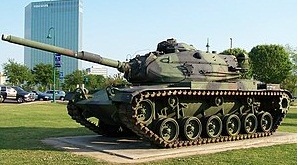
Explain why, a wide steel belt is provided over the wheels of an army tank.


A wide steel belt is provided over the wheels of an army tank.
Answer
A wide steel belt is provided over the wheels of an army tank so that they exert less pressure on the ground and do not sink into it.
View full question & answer