Questions

Question Answer (1 Marks)

Take a timed test

42 questions · self-marked practice — reveal the answer and mark yourself.

Question 11 Mark
A satellite goes round the earth in a circular orbit with constant speed. Is the motion uniform or accelerated?

This photograph shows a man-made 'communication satellite' going round the earth in a circular orbit (or circular path). We can see the dish antennae and solar panels (made of solar cells) clearly in this photograph.

This photograph shows a watch. The tip of seconds 'hand of this watch moves rapidly on the dial of the watch. The tips of minutes' hand and hours' also move on the dial but they move slowly.
Answer
It is accelerated motion as the velocity is changing continuously.
View full question & answer
Question 21 Mark
Write the formula for acceleration. Give the meaning of each symbol which occurs in it.
Answer
$\text{Acceleration}=\frac{\text{Final velocity}-\text{Initial velocity}}{\text{Time taken}}$$\text{a}=\frac{\text{v}-\text{u}}{\text{t}}$
View full question & answer
Question 31 Mark
Change the speed of 6m/s into km/h.
Answer
$6\text{m}/\text{s}$$=6\times\Big(\frac{3600}{1000}\Big)\text{km}/\text{hr}=21.6\text{km}/\text{hr}$
View full question & answer
Question 51 Mark
What type of motion is represented by the tip of the ‘seconds’ hand’ of a watch? Is it uniform or accelerated?
Answer
The tip of the ‘seconds’ hand’ of a watch represents uniform circular motion. It is an accelerated motion.
View full question & answer
Question 61 Mark
Name the physical quantity which gives us an idea of how slow or fast a body is moving.
Answer
Speed gives an idea of how slow or fast a body is moving.
View full question & answer
Question 81 Mark
A body goes round the sun with constant speed in a circular orbit. Is the motion uniform or accelerated?
Answer
The motion is accelerated.
View full question & answer
Question 121 Mark
Convert a speed of 54km/h into m/s.
Answer
We have to convert 5km/h into m/s.
$54\text{km/hr}=\frac{(54)(1000)}{3600}\text{m/s}$
$=15\text{m/s}$
View full question & answer
Question 131 Mark
The displacement of a moving object in a given interval of time is zero. Would the distance travelled by the object also be zero? Give reason for your answer.
Answer
No, because if a body takes a round trip such that its final position is same as the starting position, then the displacement of the body is zero but the distance travelled is non-zero.
View full question & answer
Question 141 Mark
What can you say about the motion of a body if its speed-time graph is a straight line parallel to the time axis?
Answer
The Speed of the body is constant or uniform.
View full question & answer
Question 151 Mark
State whether speed is a scalar or a vector quantity. Give reason for your choice.
Answer
Speed is a scalar quantity as it has magnitude only, it has no specified direction.
View full question & answer
Question 171 Mark
What is the other name of negative acceleration?
Answer
Negative acceleration is also called retardation.
View full question & answer
Question 181 Mark
Give two examples of bodies having non-uniform motion.
Answer
  1. Motion of a bus on a road.
  2. Motion of a racing horse.
View full question & answer
Question 191 Mark
Name the physical quantity obtained by dividing ‘Distance travelled’ by ‘Time taken’ to travel that distance.
Answer
Speed is defined as the distance travelled per unit time.
View full question & answer
Question 201 Mark
What does the slope of a distance-time graph indicate?
Answer
The slope of a distance-time graph indicates speed.
View full question & answer
Question 211 Mark
What name is given to the speed in a specified direction?
Answer
Speed of a body in a specified direction is called velocity.
View full question & answer
Question 221 Mark
Name the quantity which is measured by the area occupied under the velocity-time graph.
Answer
Distance travelled by the moving body.
View full question & answer
Question 231 Mark
Under which condition is the magnitude of average velocity equal to average speed?
Answer
When the object moves in a single straight line, the magnitude of average velocity equal to average speed.
View full question & answer
Question 251 Mark
What does the slope of a speed-time graph indicate?
Answer
The slope of a speed-time graph indicates acceleration.
View full question & answer
Question 261 Mark
What conclusion can you draw about the acceleration of a body from the speed-time graph shown below?
Answer
It represents non-uniform acceleration.
View full question & answer
Question 271 Mark
What conclusion can you draw about the speed of a body from the following distance-time graph?
Answer
The body has uniform speed.
View full question & answer
Question 281 Mark
Which of the two can be: zero under certain conditions: average speed of a moving body or average velocity of a moving body?
Answer
Average velocity of a moving body can be zero.
View full question & answer
Question 291 Mark
What can you say about the motion of a body whose distance-time graph is a straight line parallel to the time axis?
Answer
The body is not moving. It is stationary.
View full question & answer
Question 301 Mark
State whether the following statement is true or false:
Earth moves round the sun with uniform velocity.
Answer
No, earth moves round the sun with uniform speed, but its velocity changes continuously.
View full question & answer
Question 341 Mark
What do the following measure in a car?
  1. Speedometer.
  2. Odometer.
Answer
  1. The speedometer of a car measures instantaneous speed of the car.
  2. Odometer is a device used to record the distance travelled by the car.
View full question & answer
Question 351 Mark
In addition to speed, what else should we know to predict the position of a moving body?
Answer
In addition to speed, we should know the direction in which the body is moving.
View full question & answer
Question 361 Mark
Give one example of a motion where an object does not change its speed but its direction of motion changes continuously.
Answer
Motion of moon around the earth.
View full question & answer
Question 371 Mark
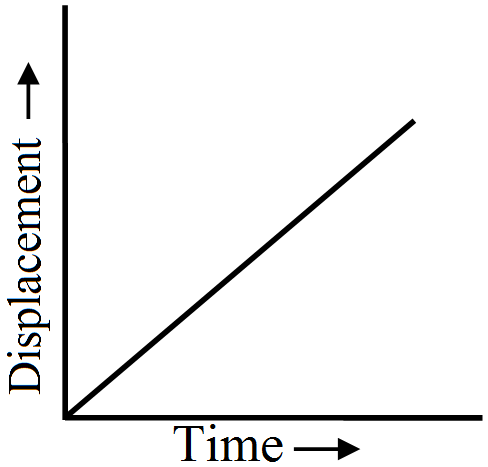
What conclusion can you draw about the velocity of a body from the displacement-time graph shown below:
Answer
It represents uniform velocity.
View full question & answer
Question 391 Mark
Name the type of motion in which a body has a constant speed but not constant velocity.
Answer
Uniform circular motion.
View full question & answer
Question 401 Mark
A car is moving along a straight road at a steady speed. It travels 150m in 5 seconds:
How long does it take to travel 240m?
Answer
Distance = 240m
$\text{Time}=\frac{\text{Distance}}{\text{V}_\text{av}}=\frac{240}{30}=8\text{s}$
View full question & answer
Question 411 Mark
What is the acceleration of a body moving with uniform velocity?
Answer
When a body is moving with uniform velocity, its acceleration is zero.
View full question & answer
Question 421 Mark
Under what conditions can a body travel a certain distance and yet its resultant displacement be zero?
Answer
When the body comes back to its starting point, it has zero resultant displacement but covers a certain non-zero distance.
View full question & answer