Questions

Question Answer (3 Marks)

Take a timed test

22 questions · self-marked practice — reveal the answer and mark yourself.

Question 13 Marks
A motorcyclist drives from place $A$ to $B$ with a uniform speed of $30\  km^{-1}$ and returns from place B to A with a uniform speed of $20\  km h ^{-1}$. Find his average speed.
Answer
Speed from $A$ to $B=30 km / h$.
Let the distance from A and B be D .
Time taken to travel from A to $B , T _1=\frac{\text { Distance travelled }}{\text { Speed }}$
$T_1=\frac{D}{30}$
Speed taken B to $A=20 km / h$
Time taken to travel from B to $A , T _2=\frac{\text { Distance travelled }}{\text { Speed }}=\frac{ D }{20}$
Total time taken, $T = T _1+ T _2$
$=\frac{D}{30}+\frac{D}{20}=\frac{D}{12}$
Total distance from $A$ to $B$ and from $B$ to $A=2 D$
$\text { Average speed }=\frac{\text { Total distance travelled }}{\text { Total time taken }}=\frac{2 D}{\frac{D}{12}}=24 km / h$
View full question & answer
Question 23 Marks
What is meant by the term ‘acceleration’ State the SI unit of acceleration.
Answer
Acceleration of a body is defined as the rate of change of its velocity with respect to time. It is a vector quantity. The S.I. unit of acceleration is $(m/s^2).$
View full question & answer
Question 33 Marks
A body travels a distance of 3km towards East, then 4km towards North and finally 9km towards East.
  1. What is the total distance travelled?
  2. What is the resultant displacement?
Answer
  1. Total distance travelled = 3 + 4 + 9 = 16km
  2. The body travels a total distance of 12km in east direction i.e. towards x-axis. And it travels a distance of 4km in North direction, i.e. towards y-axis.
Hence, resultant displacement is:

$=\sqrt{12^2+4^2}$

$=\sqrt{144+16}=\sqrt{160}=12.6\text{km}$
View full question & answer
Question 43 Marks
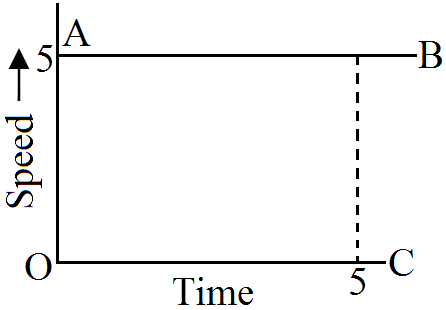
A body is moving uniformly in a straight line with a velocity of 5m/s. Find graphically the distance covered by it in 5 seconds.
Answer
We have to calculate the distance travelled by the moving body whose speed time graph is given to us.
Distance travelled = Area of rectangle OABC
So, distance travelled,
= (OA) × (OC)= (5) × (5)m
= 25m
View full question & answer
Question 53 Marks
If a sprinter runs a distance of 100 metres in 9.83 seconds, calculate his average speed in km/h.
Answer
Total distance travelled = 100m
Total time taken = 9.83 sec
Average speed $= \frac{\text{Total distance travelled}}{\text{ Total time taken}}$
$=\frac{100}{9.83} =10.172\text{m/s}$
Averge speed in km/h: $10.172\times\Big(\frac{3600}{1000}\Big)=36.62\text{km/h}$
View full question & answer
Question 63 Marks
Write the formula to calculate the speed of a body moving along a circular path. Give the meaning of each symbol which occurs in it.
Answer
The speed of a body moving along a circular path is given by the formula: $\text{v}=\frac{2\pi\text{r}}{\text{t}}$
where, v = speed
$\pi=3.14$ ( it is a constant)
r = radius of circular path
t = time taken for one round of circular path.
View full question & answer
Question 73 Marks
What is the difference between speed and velocity?
Answer
  1. Speed is a scalar quantity, whereas velocity is a vector quantity.
  2. Speed of a body is the distance travelled by it per unit time, whereas the velocity of a body is the distance travelled by it per unit time in a given direction.
  3. Speed is always positive, while velocity can be both positive and negative, depending upon the direction.
View full question & answer
Question 83 Marks
Derive the formula: $\text{s}=\text{ut}+\frac{1}{2}\text{at}^2,$ where the symbols have usual meanings.
Answer
Suppose a body has an initial velocity 'u' and a uniform acceleration' a' for time 't' so that its final velocity becomes 'v'. Let the distance travelled by the body in this time be 's'. The distance travelled by a moving body in time 't' can be found out by considering its average velocity. Since the initial velocity of the body is 'u' and its final velocity is 'v', the average velocity is given by.
View full question & answer
Question 93 Marks
A train travelling at $20\ ms^{-1}$ accelerates at $0.5\ ms^{-2}$​​​​​​​ for $30s$. How far will it travel in this time?
Answer
Initial velocity, $u = 20m/s$
Time, $t = 30s$
Acceleration,
$a = 0.5m/s^2$
Distance travelled is:
$\text{s}=\text{ut}+\frac{1}{2}\text{at}^2$
$\text{s}=20\times30+\frac{1}{2}\times0.5\times30\times30$
$\text{s}=600+225=825\text{m}$
View full question & answer
Question 103 Marks
A cyclist is travelling at $15\ ms^{-1}$. She applies brakes so that she does not collide with a wall $18m$ away. What deceleration must she have?
Answer
Initial velocity, $u = 15\ m/s$
Final velocity, $v = 0\ m/s$
Distance, $s = 18\ m$
Acceleration,$a = ?$
using relation, $\text{v}^2-\text{u}^2=2\text{as}$
$0^2-(15)^2=2\text{a}\times18$
$-225=36\text{a}$
$\text{a}=\frac{-225}{36}=-6.25\text{m/s}^2$
So, deceleration is $6.25m/s^2.$
View full question & answer
Question 113 Marks
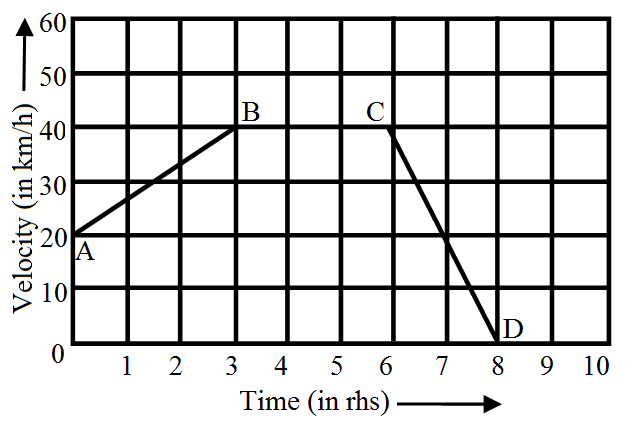
Given alongside is the velocity-tine graph for a moving body:


Find:
  1. Velocity of the body at point C.
  2. Acceleration acting on the body between A and B.
  3. Acceleration acting on the body between B and C.
Answer
  1. BC represents uniform velocity. So velocity of the body at point C is 40km.
  2. Acceleration = Slope of line AB
$=\frac{(40-20)}{3-0}\text{km/hr}^2$

$=6.66\text{km/hr}^2$
  1. BC represents uniform velocity, so, acceleration acting on the body is zero.
View full question & answer
Question 123 Marks
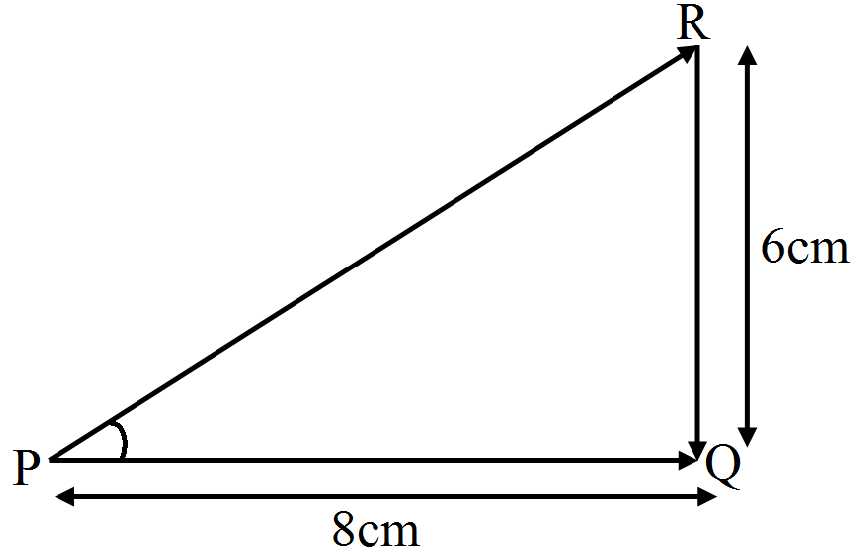
An ant travels a distance of 8cm from P to Q and then moves a distance of 6cm at right angles to PQ. Find its resultant displacement.
Answer
We have to find the resultant displacement from the given diagram:
we have: PQ = 8cm and QR = 6cm Resultant displacement: $\text{PR}=\sqrt{\text{PQ}^2+\text{QR}^2}$ $=\sqrt{64+36}$ $=\sqrt{100}$ $=10\text{cm}$ The direction of this displacement is from P to R. f If $\theta$ is the angle made by PR with PQ then, $\tan\theta=\frac{\text{RQ}}{\text{PQ}}$ $\Rightarrow\tan\theta^{-1}0.5625$ $\Rightarrow\theta=29.36^\circ$ This is the angle made by the resultant with PQ.
View full question & answer
Question 133 Marks
Derive the formula: v = u + at, where the symbols have usual meanings.
Answer
Consider a body having initial velocity 'u'. Suppose it is subjected to a uniform acceleration 'a' so that after time 't' its final velocity becomes 'v'. Now, from the definition of acceleration we know that:
Acceleration $=\frac{\text{Change in velocity}}{\text{Time taken}}$
Or Acceleration $=\frac{\text{Final velocity-Initial velocity}}{\text{time taken}}$
So, $\text{a}=\frac{\text{v-u}}{\text{t}}$
$\text{at}=\text{v-u}$
and, $\text{v}=\text{u+at}$
Where,
v = final velocity of the body
u = intial velocity of the body
a = acceleration
and t = time taken
View full question & answer
Question 143 Marks
Describe the motion of a body which is accelerating at a constant rate of $10ms^{-2}$​​​​​​​. If the body starts from rest, how much distance will it cover in $2\ s$?
Answer
The velocity of this body is increasing at a rate of ’$10$ metres per second’ every second.
Initial velocity, $u = 0m/s$
Time, $t = 2\ s$
Acceleration, $a = 10m/s^2$
Using, $\text{s}=\text{ut}+\frac{1}{2}\text{at}^2$
$=0\times2+\frac{1}{2}\times10\times2\times2$
$=0+20=20\text{m}$
View full question & answer
Question 153 Marks
Find the initial velocity of a car which is stopped in $10$ seconds by applying brakes. The retardation due to brakes is $2.5 m / s ^2$.
Answer
Initial velocity, $u =$ ?
Final velocity, $v =0 m / s$ (car is stopped)
Retardation, $a=-2.5 m / s ^2$
Time, $t =10 s$
$v=u+a t$
$0=u+(-2.5) \times 10$
$u=25 m / s$
View full question & answer
Question 163 Marks
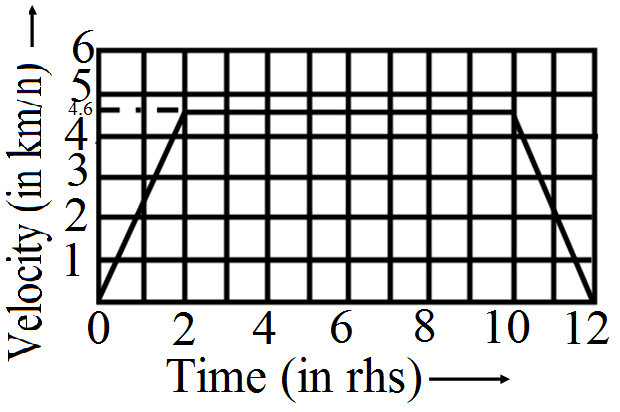
The speed-time graph of an ascending passenger lift is given alongside.
What is the acceleration of the lift:

  1. During the first two seconds?
  2. Detween second and tenth second?
  3. During the last two seconds?
Answer
We have to find the acceleration from the given graph.
Acceleration = slope of line AB
$=\frac{(4.6-0)}{(2-0)}\text{m/s}^2$
$=2.3\text{m/s}^2$
Between second and tenth second, it represents uniform speed, so, acceleration acting on the lift is zero.
During the last two seconds, it represents retardation of the lift, so its acceleration is $(-2.3m/s^2).$
View full question & answer
Question 173 Marks
A cheetah starts from rest, and accelerates at $2m/s^2$ for $10$ seconds. Calculate:
The final velocity.
Answer
Intial velocity, $u=0 m / s$
Final velocity, $v =$ ?
Acceleration, $a=2 m / s ^2$
Time, $t =10 s$
Using, $v=u+a t$
$v=0+2 \times 10=20 m / s$
View full question & answer
Question 183 Marks
Define the term ‘uniform acceleration’. Give one example of a uniformly accelerated motion.
Answer
A body has uniform acceleration if it travels in a straight line and its velocity increases by equal amounts in equal intervals of time.
For example: A freely falling body has uniform acceleration.
View full question & answer
Question 193 Marks
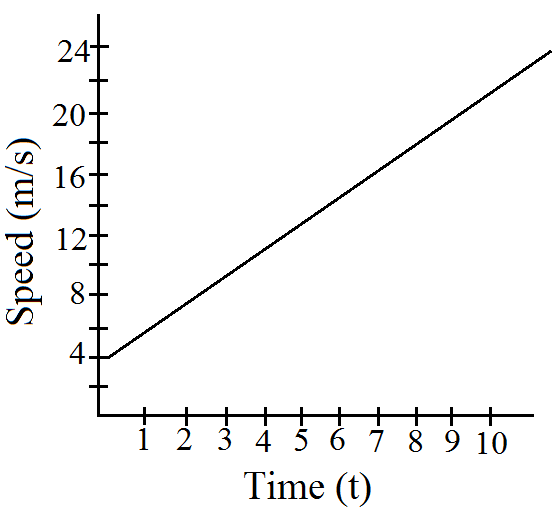
A car is moving on a straight road with uniform acceleration. The speed of the car varies with time as follows:
Time (s) 0 2 4 6 8 10
Speed (m/s) 4 8 12 16 20 24
Draw the speed-time graph by choosing a convenient scale. From this graph:
  1. Calculate the acceleration of the car.
  2. Calculate the distance travelled by the car in 10 seconds.
Answer
​​​​We have a velocity-time graph of a moving particle.
  1. We have to find the acceleration from the given graph.
Acceleration = slope of line

$=\frac{(12-4)}{4-0}\text{m/s}^2=2\text{m/s}^2$
  1. Distance travelled by the car is given by the area enclosed by the curve.
$\text{s}=\frac{(\text{Sum of parallel sides})(\text{Height})}{2}$

$=\frac{(4+24)(10)}{2}\text{m}$

$=140\text{m}$
View full question & answer
Question 203 Marks
A bus was moving with a speed of 54km/h. On applying brakes it stopped in 8 seconds. Calculate the acceleration.
Answer
Initial velocity, u = 54km/h = 15m/s
Final velocity, v = 0m/s
Time, t = 8s
Acceleration, a = ?
$\text{a}=\frac{\text{v-u}}{\text{t}}$
$=\frac{0-15}{8}=\frac{-15}{8}\text{m/s}^2=-1.875\text{m/s}^2$
View full question & answer
Question 213 Marks
A cheetah starts from rest, and accelerates at $2 m / s ^2$ for $10$ seconds. Calculate:
The distance travelled.
Answer
Intial velocity, $u =0 m / s$
Final velocity, $v =$ ?
Acceleration, $a=2 m / s ^2$
Time, $t =10 s$
Distance travelled is:
$s=u ut+\frac{1}{2} at^2$
$s=0 \times 10+\frac{1}{2} \times 2 \times 10 \times 10$
$s=0+100=100 m$
View full question & answer
Question 223 Marks
A car acquires a velocity of 72km per hour in 10 seconds starting from rest. Find:
  1. The acceleration.
  2. The average velocity.
  3. The distance travelled in this time.
Answer
Initial velocity, u = 0m/s
Final velocity, v = 72km/h = 20m/s
Time, t = 10s
  1. Acceleration $=\frac{\text{Final velocity-Initial velocity}}{\text{time taken}}$
So, $\text{a}=\frac{\text{v-u}}{\text{t}}$

$=\frac{20-0}{10}=\frac{20}{10}\text{m/s}^2=2\text{m/s}^2$
  1. Average velocity $=\frac{\text{ Initial velocity+Final velocity}}{2}$
Average velocity $=\frac{0+20}{2}=\frac{20}{2}\text{m/s}=10\text{m/s}$
  1. Distance travelled = Average velocity × Time
= 10m/s × 10s = 100m
View full question & answer