Questions

Answer the following question.

Take a timed test

9 questions · self-marked practice — reveal the answer and mark yourself.

Question 13 Marks
A $10\ cm$ long stick is kept horizontally in front of the concave mirror having focal length of $10\ cm$ in such a way that the end of the stick closest to the pole is at a distance of $20\ cm$. What will be the length of the image?
Answer
The stick is kept parallel to the Principal axis. Distance between $A$ and $P$ is $20\ cm$.Say $u_1 = 20\ cm.$
Hence, the other end of the stick is at distance, $u_2 = (u_1 + 10) = 30 cm$ from pole of the mirror.
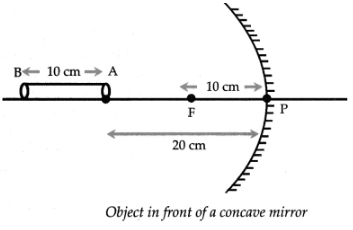
Image

$\begin{aligned} & \frac{1}{f}=\frac{1}{v_1}+\frac{1}{u_1} \\ & \frac{1}{v_1^{\prime}}=\frac{1}{f}-\frac{1}{u_1} \\ & =\frac{1}{-10}-\frac{1}{-20} \\ & =\frac{1}{20}-\frac{1}{10} \\ & =-\frac{1}{20} \\ & \therefore \quad v_1=-20 cm \\ & \text { Also, for other end of the stick, } \\ & \frac{1}{v_2}=\frac{1}{f}-\frac{1}{u_2} \\ & =\frac{1}{-10}-\frac{1}{-30} \\ & =\frac{1}{30}-\frac{1}{10} \\ & =-\frac{1}{15} \\ & \therefore \quad v_2=-15 cm \\ & \end{aligned}$
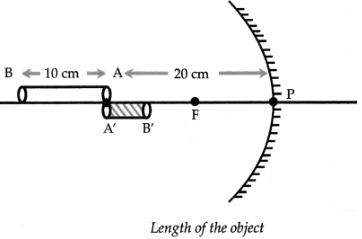
Image

The length of the image formed ?s given by, $u = u_2 – u_1 = 15 – (-20) = 5\ cm.$
The length of the image is $5\ cm.$
View full question & answer
Question 23 Marks
Rajashree wants to get an inverted image of height 5 cm of an object kept at a distance of 30 cm from a concave mirror. The focal length of the mirror is 10 cm. At what distance from the mirror should she place the screen? What will be the type of the image, and what is the height of the object?
Answer
Focal length = $f = -10 cm,$
Object distance = $u = -30 cm$
Height of the image = $h_2 = 7 cm$
To find: Height of the object = $h_1 = ?$
Image distance = u =?Formulae: $\frac{1}{v}+\frac{1}{h_2^u}=\frac{1}{f_v}$ $ M =\frac{h_2}{h_1}=-\frac{u}{u} $
Solution : $\frac{1}{v}+\frac{1}{u}=\frac{1}{f}$
$
\begin{aligned}
\frac{1}{v} & =\frac{1}{f}-\frac{1}{u} \\
\frac{1}{v} & =\frac{1}{-10}-\frac{1}{-30} \\
\frac{1}{v} & =\frac{-3+1}{30} \\
\frac{1}{v} & =\frac{-2}{30} \\
\frac{1}{v} & =\frac{1}{-15} cm \\
\therefore \quad v & =-15 cm
\end{aligned}
$
Rajashree has to place the screen 15 cm to the left of the mirror.
Magnification formula
$\begin{aligned} & M =\frac{h_2}{h_1}=-\frac{v}{u} \\ & h_1=\frac{-u h_2}{v} \\ & h_1=\frac{-(-30) \times(-5)}{-15} \\ & h_1=(-2) \times(-5) \\ & h_1=10 cm \end{aligned}$
View full question & answer
Question 33 Marks
An object 2 cm high is placed at a distance of 16cm from a concave mirror which produces a real image 3 cm high. Find the image distance.
Answer
Formula : $M =\frac{h_2}{h_1}=-\frac{v}{u} .$. (As image is real.)
Solution: $\frac{h_2}{h_1}=-\frac{v}{u}$
$
\begin{aligned}
& \frac{-3}{2}=\frac{-v}{-16} \\
\therefore \quad & v=\frac{-16 \times 3}{2} \\
\therefore \quad & v=-24 cm
\end{aligned}
$
View full question & answer
Question 43 Marks
An object 4cm in height is placed at a distance of 36 cm from a concave mirror. The image is formed 18 cm in the front of the mirror. Find the height of the image.
Answer
Formula: $M =\frac{h_2}{h_1}=-\frac{v}{u} .$. (As image is real.)
Solution: $\frac{h_2}{h_1}=-\frac{v}{u}$
$
\begin{array}{ll}
\therefore & h_2=-\frac{h_1 v}{u} \\
\therefore & h_2=-\left(\frac{4 \times-18}{-36}\right) \\
\therefore & h_2=-2 cm
\end{array}
$
View full question & answer
Question 53 Marks
An object placed 20 cm in front of a convex mirror is found to have an image 15cm behind the mirror. Find the focal length of the mirror.
Answer
Formula: $\frac{1}{v}+\frac{1}{u}=\frac{1}{f}$
Solution: $\frac{1}{v}+\frac{1}{u}=\frac{1}{f}$
$
\begin{aligned}
& \therefore \quad \frac{1}{15}+\frac{1}{(-20)}=\frac{1}{f} \\
& \therefore \quad \frac{1}{15}-\frac{1}{20}=\frac{1}{f} \\
& \therefore \quad \frac{4-3}{60}=\frac{1}{f} \\
& \therefore \quad \frac{1}{60}=\frac{1}{f} \\
& \therefore \quad f=60 cm
\end{aligned}
$
View full question & answer
Question 63 Marks
An image is formed 5 cm behind a convex mirror of focal length 10 cm. At what distance is the object placed from the mirror?
Answer
Formula: $\frac{1}{v}+\frac{1}{u}=\frac{1}{f}$
Solution: $\frac{1}{v}+\frac{1}{u}=\frac{1}{f}$
$
\begin{array}{ll}
\therefore & \frac{1}{u}=\frac{1}{f}-\frac{1}{v} \\
\therefore & \frac{1}{u}=\frac{1}{10}-\frac{1}{5} \\
\therefore & \frac{1}{u}=\frac{1-2}{10} \\
\therefore & \frac{1}{u}=\frac{-1}{10} \\
\therefore & u=-10 cm
\end{array}
$
View full question & answer
Question 73 Marks
A coin is kept in front of two plane mirrors inclined to each other. If 3 images of the coin are seen then what is the angle A between the mirrors?
Answer
Formula: $n=\frac{360^{\circ}}{ A }-1$
Solution: $n=\frac{360^{\circ}}{ A }-1$
$
\begin{aligned}
n+1 & =\frac{360^{\circ}}{ A } \\
A & =\frac{360^{\circ}}{n+1} \\
& =\frac{360^{\circ}}{3+1} \\
& =\frac{360^{\circ}}{4} \\
A & =90^{\circ}
\end{aligned}
$
View full question & answer
Question 83 Marks
A bird is sitting in front of two plane mirrors inclined at an angle of 600 to each other. How many images does the bird see in the mirror?
Answer
Formula: $\quad n=\frac{360^{\circ}}{ A }-1$
Solution:
$
\begin{aligned}
& n=\frac{360^{\circ}}{ A }-1 \\
& =\frac{360^{\circ}}{60^{\circ}}-1 \\
& =6-1 \\
& n=5
\end{aligned}
$
View full question & answer
Question 93 Marks
4. Which type of mirrors are used in the following?
Periscope, floodlights, shaving mirror, kaleidoscope, street lights, headlamps of a car.
Answer
ObjectsType of Mirror
PeriscopePlane mirror
FloodlightsConcave mirror
Shaving mirrorConcave mirror
KaleidoscopePlane mirror
Street lightsConvex mirror
Head lamps of carConcave mirror
View full question & answer