Questions

Question Answer (3 Marks)

Take a timed test

20 questions · self-marked practice — reveal the answer and mark yourself.

Question 13 Marks
What is the range of frequencies associated with (a) infrasound (b) audible sound, and (c) ultrasound?
Answer
  1. Infrasounds include sounds of frequencies below 20Hz.
  2. Audible sounds include sounds of frequencies between 20Hz and 20,000Hz.
  3. Ultrasounds include sounds of frequencies above 20,000Hz.
View full question & answer
Question 23 Marks
Why do we hear more clearly in a room with curtains then a room withour curtains?
Answer
We hear more clearly in a room with curtains than in a room without curtains because curtains are bad reflectors of sound. They absorb most of the sound falling on them, and hence do not produce echoes. On the other hand, in rooms without curtains, there is a greater reflection of sound due to which some echoes are produced.
These echoes cause a hindrance to hearing.
View full question & answer
Question 33 Marks
Give reason for the following:
In most of the cases, we cannot see the vibrations of a sound producing object with our eyes.
Answer
In most of the cases, a sound producing object vibrates so fast that we cannot see its vibrations with our eyes. The time interval between two successive vibration is lower than the persistence of vision. Hence we see the object in static state and not in vibration mode.
View full question & answer
Question 43 Marks
Name four ways in which sound can be produced.
Answer
Sound can be produced by the following methods:
  1. By vibrating strings (as in a sitar).
  2. By vibrating air (as in a flute).
  3. By vibrating membranes (as in a drum).
  4. By vibrating plates (as in cymbals).
View full question & answer
Question 53 Marks
When we put our ear to a railway line, we can hear the sound of an approaching train even when the train is far off but its sound cannot be heard through the air. Why?
Answer
When we put our ear to a railway line, we can hear the sound of an approaching train even when the train is far off but its sound cannot be heard through the air. This is due to the fact that sound travels much more fast through the railway line made of steel than through air.
View full question & answer
Question 63 Marks
Define the terms ‘frequency’, ‘wavelength’ and ‘velocity’ of a sound wave. What is the relation between them?
Answer
Frequency: The number of vibrations per second is called frequency.
Wavelength: The minimum distance in which a sound wave repeats itself is called its wavelength.
Velocity: The distance travelled by a wave in one second is called velocity of wave.
Relation: Relation between velocity, frequency and wavelength of a wave:
Velocity of wave = frequency × wavelength
$\text{v}=\text{f}\times\lambda$
View full question & answer
Question 73 Marks
A device called oscillator is used to send waves along a stretched string. The string is 20cm long, and four complete waves fit along its length when the oscillator vibrates 30 times per second. For the waves on the string:
  1. What is their wavelength?
  2. What is their frequency?
  3. What is their speed?
Answer
  1. Given that there are four complete waves. So,
$\text{Wavelength}=\frac{\text{Total length of string}}{\text{Number of waves}}$

Therefore,

$\text{Wavelength}=\frac{20}{4}\text{cm}$

$=5\text{cm}$

$=0.05\text{m}$
  1. We have to calculate frequency. We know,
Frequency = (Vibration per second) × (Number of complete waves formed)

Therefore frequency,

Frequency = (30) × (4)Hz

= 120Hz
  1. Now we have to calculate the velocity of the wave.
Given: Frequency f = 120Hz

Wavelength $\lambda=0.05\text{m}$

We know the relation between velocity, frequency, and wavelength

$\text{v}=\text{f}\times\lambda$

Where,

ν is the velocity,

f the frequency,

$\lambda$ the wavelength.

Therefore,

ν = (120) × (0.05)m/s

= 6m/s

Therefore, velocity of the wave is 6m/s.
View full question & answer
Question 83 Marks
Explain how, flaws (or defects) in a metal block can be detected by using ultrasound.
Answer
Ultrasound waves are made to pass through one face of the metal block and ultrasound detectors are placed on the opposite face of the block to detect the transmitted ultrasound waves.
  1. If the ultrasound waves pass uninterrupted through all parts of the metal block, then the block is flawless.
  2. However, if the ultrasound waves are not able to pass through a part of the metal block and get reflected back, then there is a flaw in the metal block.
View full question & answer
Question 93 Marks
An electric bell is suspended by thin wires in a glass vessel and set ringing. Describe and explain what happens if the air is gradually pumped out of the glass vessel.
Answer
If the air is gradually pumped out of the glass vessel, no sound of the electric bell can be heard because vacuum is created in the vessel and there are no air molecules to carry sound vibrations.
View full question & answer
Question 103 Marks
Explain how, bats use ultrasound to catch the prey.
Answer
Bats emit high frequency ultrasonic squeaks while flying and listen to the echoes produced by the reflection of their squeaks from their prey. From the time taken by the echo to be heard, bats can judge the distance of the prey in their path and catch it.
View full question & answer
Question 113 Marks
Why cannot a sound heard on the moon? How do astronauts talk to one another on the surface of moon?
Answer
Sound cannot be heard on the surface of moon because there is no air on the moon to carry the sound waves.
Astronauts talk to one another on the surface of moon through wireless sets using radio waves. This is because radio waves can travel even through vacuum though sound waves cannot travel through vacuum.
View full question & answer
Question 123 Marks
Define the following terms: (a) Echolocation (b) Echocardiography, and (c) Ultrasonography.
Answer
  1. Echolocation: Echolocation is the method used by some animals to locate the objects by hearing the echoes of their ultrasonic squeaks.
  2. Echocardiography: Echocardiography is the use of ultrasound waves to investigate the action of the heart.
  3. Ultra sonography: Ultra sonography is the technique of obtaining pictures of internal organs of the body by using echoes of ultrasound pulses.
View full question & answer
Question 133 Marks
Explain the terms 'crests' and 'troughs' of a wave? What type mof waves consist of crests and troughs?
Answer
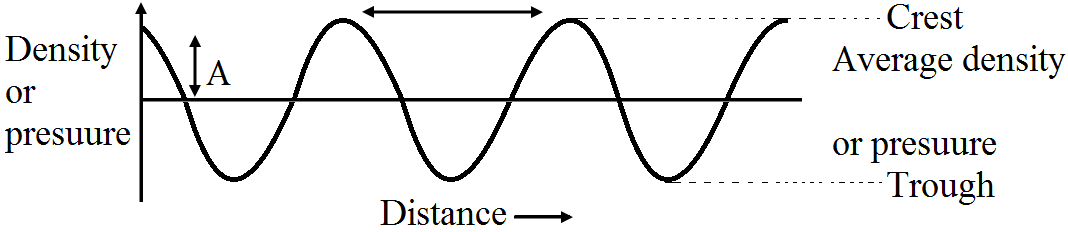
Crest: The 'elevation' or 'hump' in a transverse wave is called crest. It is that part of the transverse wave which is above the line of zero disturbance of the medium.
Trough: The 'depression' or 'hollow' in a transverse wave is called trough. It is that part of the transverse wave which is below the line of zero disturbance of medium.
A transverse wave consists of crests and troughs.
View full question & answer
Question 143 Marks
The longitudinal waves travel in a coiled spring at a rate of 4m/s. The distance between two consecutive compressions is 20cm. Find:
  1. Wavelength of the wave.
  2. Frequency of the wave.
Answer
  1. The distance between two consecutive compressions or rare factions is equal to its wavelength.
Hence, from the diagram of wave we can say that wavelength is 0.2m.
  1. Now we have to calculate the frequency of the wave.
Given: Velocity ν = 4m/s

Wavelength $\lambda= 0.2\text{m}$

We know the relation between velocity, frequency, and wavelength $\text{f}=\frac{\text{v}}{\lambda},$

Where v is the velocity of sound, f the frequency, and $\lambda$ the wavelength.

So,

$\text{f}=\frac{4}{0.2}\text{Hz}$

$=20\text{Hz}$

Therefore, frequency of the wave is 20Hz.
View full question & answer
Question 153 Marks
What is ultrasound? What is the difference between ordinary sound and ultrasound?
Answer
Ultrasounds: Ultrasounds are the sounds having very high frequency which cannot be heard by human beings.
Ordinary sound Ultrasound
These include sounds of frequencies in the range of 20Hz to 20,000hz. These include sounds of frequencies above 20,000Hz.
These sounds are audiible to human ears. These sounds are inaudible to human ears.
View full question & answer
Question 163 Marks
How is it that bats are able to fly at night without colliding with other objects?
Answer
Bats are able to fly at night without colliding with other objects because they emit high frequency ultrasonic squeaks while flying and listen to the echoes produced by the reflection of their squeaks from the objects or obstacles in their path. From the time taken by the echo to be heard, bats can judge the distance of the object in their path and avoid it by changing the direction.
View full question & answer
Question 173 Marks
Explain the term ‘amplitude’ of a wave. Draw the diagram of a wave and mark its amplitude on it.
Answer
The maximum displacement of the particles of the medium from their original undisturbed positions, when a wave passes through the medium, is called amplitude (A) of the wave.
View full question & answer
Question 183 Marks
Which object is vibrating when the following sounds are produced?
  1. The sound of a sitar.
  2. The sound of table.
  3. The sound of a tuning fork.
  4. The buzzing of a bee or mosquito.
  5. The sound of a flute.
Answer
Sound is produced by the following objects:
  1. Vibrating stretched strings of sitar.
  2. Vibrating stretched membranes of tabla.
  3. Vibrating prongs of a tuning fork.
  4. Vibrating wings of mosquito.
  5. Vibrating air columns in flute.
View full question & answer
Question 193 Marks
A body vibrating with a time-period of $\frac{1}{256}\text{s}$ produces a sound wave which travels in air with a velocity of 350m/s. Calculate the wavelength.
Answer
Time period, $\text{T}=\frac{1}{256}\text{s}$
Velocity, $\text{V} = 350\text{m/s}$
$\text{Frequency}=\frac{1}{\text{time period}}=256\text{Hz}$
$\lambda=\frac{\text{Velocity of wave}}{\text{Frequency}}$
Hence,
$=\frac{350}{256}=1.36\text{m}$
View full question & answer
Question 203 Marks
Write any three applications (or use) of ultrasound.
Answer
Applications of ultrasound are:
  1. Ultrasound is used in industry for detecting flaws in metal blocks without damaging them.
  2. In hospitals, ultrasounds are used to investigate the internal organs of the human body such as liver, kidneys, uterus, etc.
  3. Ultrasounds are also used to monitor the growth of fetus inside the mother’s uterus.
View full question & answer