Questions

Answer the following question.

Take a timed test

25 questions · 9 auto-graded MCQ + 16 self-marked written.

Question 13 Marks
Ravi applied a force of 10 N and moved a book 30 cm in the direction of the force. How much was the work done by Ravi? (Ans: 3 J)
Answer
Given:
Force (F) = 10 N
θ = 0°, (Since force and displacement are in same direction)
Displacement (s) = 30 cm = 30/100 m
To Find:
Work (W) = ?
Formula:
W = Fs cos θ
Solution:
W = Fs cos θ
Solution:
The work done by Ravi is 3J
https://api.studentbro.in/NCERTSOLUTION//wp-content/uploads/2021/01/Maharashtra-Board-Class-9-Scienc..." alt="Maharashtra Board Class 9 Science Solutions Chapter 2 Work and Energy 7" width="250" height="" loading="lazy" />
Numericals For Practice
View full question & answer
Question 23 Marks
The velocity of a car increase from 54 km/hr to 72 km/hr. How much is the work done if the mass of the car is 1500 kg? (Ans. : 131250 J)
Answer
https://api.studentbro.in/NCERTSOLUTION//wp-content/uploads/2021/01/Maharashtra-Board-Class-9-Scienc..." sizes="(max-width: 330px) 100vw, 330px" srcset="330w, 201w" alt="Maharashtra Board Class 9 Science Solutions Chapter 2 Work and Energy 23" width="300" height="" loading="lazy" />
https://api.studentbro.in/NCERTSOLUTION//wp-content/uploads/2021/01/Maharashtra-Board-Class-9-Scienc..." sizes="(max-width: 391px) 100vw, 391px" srcset="391w,300w" alt="Maharashtra Board Class 9 Science Solutions Chapter 2 Work and Energy 24" width="350" height="" loading="lazy" />
Work done to increase the velocity = 131250 J
View full question & answer
Question 33 Marks
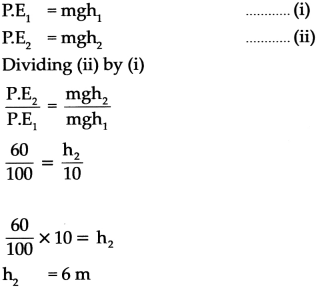
If the energy of a ball falling from a height of $10$ metres is reduced by $40$ %, how high will it rebound? (Ans : $6\ m$)
Answer
Given: Initial height $\left( h _1\right)=10 m$
Let Initial $\left(P . E_1\right)=100$
Final $\left(P . E_2\right)=100-40$
$=60 To$ Find:
Final height $\left( h _2\right)=$ ?
Formula:
P.E. = mgh
Solution:

Maharashtra Board Class 9 Science Solutions Chapter 2 Work and Energy 6

The ball will rebound by $6\ m$.
View full question & answer
Question 43 Marks
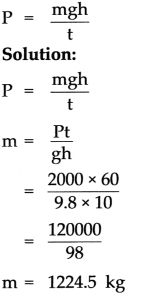
An electric pump has $2$ kW power. How much water will the pump lift every minute to a height of $10\ m$?
(Ans : $1224.5\ kg$)
Answer
Given:
Power $( P )=2 kW=2000 W$
Height $( h )=10 m$
Time $( t )=1 min=60 s$
Acceleration due to gravity $( g )=9.8 m / s ^2$
To Find:
Mass of water $( m )=$ ?
Formula:
Maharashtra Board Class 9 Science Solutions Chapter 2 Work and Energy 5
Water lifted by the pump is $1224.5\ kg$
View full question & answer
Question 53 Marks
1. Take two aluminium channels of different lengths.
2. Place the lower ends of the channels on the floor and hold their upper ends at the same height.
3. Now take two balls of the same size and weight and release them from the top end of the channels. They will roll down and cover the same distance.

Questions
1. At the moment of releasing the balls, which energy do the balls have?
2. As the balls roll down which energy is converted into which other form of energy?
3. Why do the balls cover the same distance on rolling down?
4. What is the form of the eventual total energy of the balls?
5. Which law related to energy does the above activity demonstrate? Explain.

Answer
1. At the moment of releasing the ball they possess Potential energy as they are at a height above the ground.
2. As the balls roll down, the Potential energy is converted into Kinetic energy since they are now in motion.
3. Since they have been released from the same height, they will cover the same distance.
4. The eventual form of the total energy of the balls is “Mechanical Energy” i.e, a combination of Potential energy and Kinetic energy
5. The above activity demonstrates the “Law of Conservation of Energy”
View full question & answer
MCQ 63 Marks
The work done on an object does not depend on ….
  • A
    displacement
  • B
    applied force
  • initial velocity of the object
  • D
    the angle between force and displacement.
Answer
Correct option: C.
initial velocity of the object
View full question & answer
MCQ 73 Marks
If we increase the velocity of a car moving on a flat surface to four times its original speed, its potential energy ….
  • A
    will be twice its original energy
  • will not change
  • C
    will be 4 times its original energy
  • D
    will be 16 times its original energy.
Answer
Correct option: B.
will not change
will not change
View full question & answer
MCQ 83 Marks
The total energy of an object falling freely towards the ground …
  • A
    decreases
  • B
    remains unchanged
  • increases
  • D
    increases in the beginning and then decreases
Answer
Correct option: C.
increases
increases
View full question & answer
MCQ 93 Marks
The potential energy of your body is least when you are …..
  • A
    sitting on a chair
  • B
    sitting on the ground
  • sleeping on the ground
  • D
    standing on the ground
Answer
Correct option: C.
sleeping on the ground
View full question & answer
MCQ 103 Marks
While dragging or lifting an object, negative work is done by
  • A
    the applied force
  • B
    gravitational force
  • C
    frictional force
  • (B) snd (C) both
Answer
Correct option: D.
(B) snd (C) both
(B) snd (C) both
View full question & answer
MCQ 113 Marks
Power is a measure of the …….
  • the rapidity with which work is done
  • B
    amount of energy required to perform the work
  • C
    The slowness with which work is performed
  • D
    length of time
Answer
Correct option: A.
the rapidity with which work is done
(A). the rapidity with which work is done
View full question & answer
MCQ 123 Marks
Which of the forces involved in dragging a heavy object on a smooth, horizontal surface, have the same magnitude?
  • A
    the horizontal applied force
  • B
    gravitational force
  • reaction force in vertical direction
  • D
    force of friction
Answer
Correct option: C.
reaction force in vertical direction
View full question & answer
MCQ 133 Marks
Joule is the unit of …
  • A
    force
  • B
    work
  • C
    energy
  • (B) and (C) both
Answer
Correct option: D.
(B) and (C) both
(B) and (C) both
View full question & answer
MCQ 143 Marks
For work to be performed, energy must be ….
  • A
    transferred from one place to another
  • B
    concentrated
  • C
    transformed from one type to another
  • (A) and (C) both
Answer
Correct option: D.
(A) and (C) both
(A) and (C) both
View full question & answer
Question 153 Marks
Why is the work done on an object moving with uniform circular motion zero?
Answer
  • In uniform circular motion, the force acting on an object is along the radius of the circle.
  • Its displacement is along the tangent to the circle. Thus, they are perpendicular to each other.
    Hence θ = 90° and cos 90 = θ
    ∴ W = Fs cos θ = 0
View full question & answer
Question 163 Marks
If an object has 0 momenta, does it have kinetic energy? Explain your answer.
Answer
  • No, it does not have kinetic energy if it does not have momentum.
  • Momentum is the product of mass and velocity. If it is zero, it implies that v = 0 (since mass can never be zero).
  • Now K.E = ~ mv2, So if v = 0 then K.E also will be zero.
  • Thus, if an object has no momentum then it cannot possess kinetic energy.
View full question & answer
Question 173 Marks
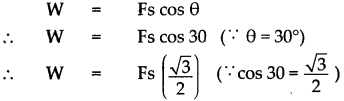
Determine the amount of work done when an object is displaced at an angle of 300 with respect to the direction of the applied force.
Answer
When an object is displaced by displacement ‘s’ and by applying force ‘F’ at an ’angle’ 30°. work done can be given as
Maharashtra Board Class 9 Science Solutions Chapter 2 Work and Energy 25
View full question & answer
Question 183 Marks
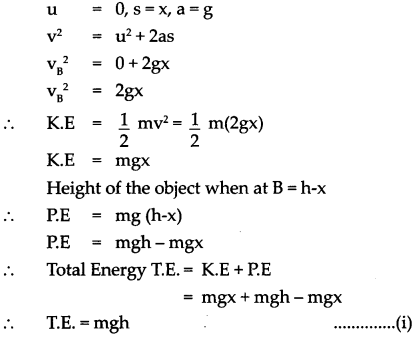
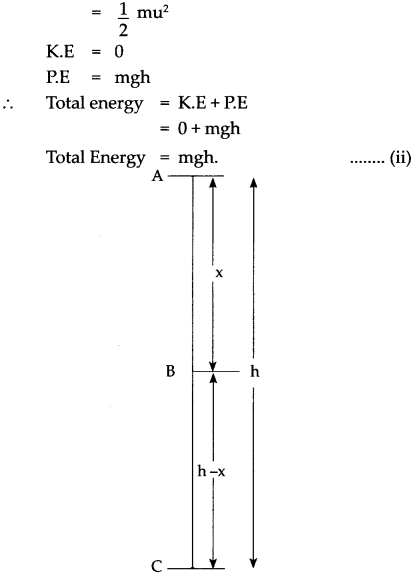
Prove that the kinetic energy of a freely falling object on reaching the ground is nothing but the transformation of its initial potential energy.
Answer
Let us look at the kinetic and potential energies of an object of mass $( m )$, falling freely from height $( h )$, when the object is at different heights.As shown in the figure, the point $A$ is at a height ( $h$ ) from the ground. Let the point $B$ be at a distance $V$ , vertically below $A$ . Let the point C be on the ground directly below $A$ and $B$ . Let us calculate the energies of the object at $A, B$ and $C$.
(1) Let the velocity of the object be $v_B$ when it reaches point $B$, having fallen through a distance $x$.

Maharashtra Board Class 9 Science Solutions Chapter 2 Work and Energy 2

(2) When the object is stationary at $A$, its initial velocity is $u = 0$
$\therefore K.E = 1/2\ mass \times velocity\ 2$

Maharashtra Board Class 9 Science Solutions Chapter 2 Work and Energy 3

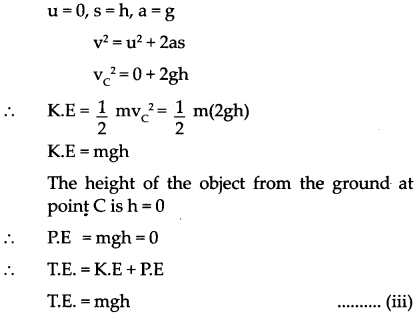
(3) Let the velocity of the object be vc when it reaches the ground, near point $C$.

Maharashtra Board Class 9 Science Solutions Chapter 2 Work and Energy 4

From equations (i) and (iii) we see that the total potential energy of the object at its initial position is the same as the kinetic energy at the ground.
View full question & answer
Question 193 Marks
Derive the formula for the kinetic energy of an object of mass m, moving with velocity v.
Answer
Suppose a stationary object of mass ‘m’ moves because of an applied force. Let ‘u’ be its initial velocity (here u = 0). Let the applied force be ‘F’. This generates an acceleration a in the object, and after time T, the velocity of the object becomes equal to ‘v’. The displacement during this time is s. The work done on the object is
W = F x s ……………….. (1)
Using Newton’s 2nd law of motion,
F = ma ……………….. (2)
Using Newton’s 2nd equation of motion
$s=u t+\frac{1}{2} a t^{2}$
However, as initial velocity is zero, u = 0
https://myfiles.space/user_files/99359_2eb721bd6f767931/99359_custom_files/img1685780115.png" alt="Image" width="300" height="" />
View full question & answer
Question 203 Marks
Explain the difference between potential energy and kinetic energy.
Answer
Kinetic Energy Potential Energy
(i) Kinetic energy is the energy possessed by the body due to its motion. (i) Potential energy is the energy possessed by the body because of its shape or position.
(ii) K.E = $1/2 mv^2$ (ii) P.E = mgh
(iii) e.g., flowing water, such as when falling from a waterfall. (iii) e.g., water at the top of a waterfall, before the drop.
View full question & answer
Question 213 Marks
(a) Can your father climb stairs as fast as you can?
(b) Will you fill the overhead water tank with the help of a bucket or an electrical motor?
(c) Suppose Raj ashree, Yash and Ranjeet have to reach the top of a small hill. Raj ashree went by car. Yash went cycling while Ranjeet went walking. If all of them choose the same path, who will reach first and who will reach last? (Think before you answer.
Answer
(a) No, father takes more time to climb stairs.
(b) Overhead water tank can be filled with the help of one electric motor rather than filling it with bucket.
(c) Raj ashree will reach first, followed by Yash and Ranjeet will reach last because car moves faster than a cycle and a person walking.
View full question & answer
Question 223 Marks
From the following activities find out whether work is positive, negative or zero. Give reasons for your answers.
(a) A boy is swimming in a pond.
(b) A coolie is standing with a load on his head.
(c) Stopping a moving car by applying brakes.
(d) Catching the ball which you friend has thrown towards you.
Answer
(a) A boy is swimming in a pond: The work done is positive because the direction of applied force and displacement are the same.
(b) A coolie is standing with a load on his head: The work done is zero because the applied force does not cause any displacement.
(c) Stopping a moving car by applying brakes: The work done is negative because the fore applied by the brakes acts in a direction opposite to the direction of motion of car.
(d) Catching the ball which you friend has thrown towards you : Negative work because the force required to stop the ball, acts opposite to the displacement of the ball.
View full question & answer
Question 233 Marks
Study the activity and answer the following questions.https://pg-data.sgp1.digitaloceanspaces.com/chapter_wise/15898/Q9.png" alt="Image" width="250" height="" />
(a) Figure A – Why does the cup get pulled?
(b) Figure B – What is the relation between the displacement of the cup and the force applied through the ruler?
(c) In Figure C-Why doesn’t the cup get displaced?
(d) What is the type of work done in figures A, B and C?
(e) In the three actions above, what is the relationship between the applied force and the displacement?
Answer
(a) The cup gets pulled as the force of the nut and the displacement of the cup is in the same direction.
(b) The displacement of the cup and the force applied through the ruler is in the opposite direction.
(c) Tire cup does not get displaced as two equal forces are working in opposite directions.
(d) The work done in figure A is positive, figure B is negative and in figure C is zero.
(e) In figure A the applied force and the displacement is in the same direction, in figure B the applied force and the displacement is in the opposite direction and in figure C the applied force and displacement is perpendicular to each other.
View full question & answer
Question 243 Marks
(A) An arrow is released from a stretched bow.
(B) Water kept at a high flows through a pipe into the tap below.
(C) A compressed spring is released.
(a) Which words describe the state of the object in the above examples?
(b) Where did the energy required to cause the motion of the objects come from?
(c) If the obj ects were not brought in those states, would they have moved?
Answer
(a) Words such as stretched bow, water kept at a height and compressed spring describe the state of the objects.
(b) The energy required for the objects came from its specific state or motion in the form of potential energy.
(c) No, if the objects were not brought in those states, they would have not moved.
View full question & answer
Question 253 Marks
Discuss the directions of force and of displacement in each of the following cases.
(i) Pushing a stalled vehicle.
(ii) Catching the ball which your friend has thrown towards you.
(iii) Tying a stone to one end of a string and swinging it round and round by the other end of the string.
(iv) Walking up and down a staircase; climbing a tree.
(v) Stopping a moving car by applying brakes.
Answer
(i) Force and displacement are in the same direction.
(ii) Force and displacement are in the opposite direction.
(iii) Force and displacement are perpendicular to each other.
(iv) Force and displacement are in the opposite direction.
(v) Force and displacement are in the opposite direction.
View full question & answer