Questions

4 Mark Question

Take a timed test

6 questions · self-marked practice — reveal the answer and mark yourself.

Question 14 Marks
Construct $\triangle \mathrm{DEF}$ such that $\mathrm{DE}=4.2 \mathrm{~cm}, \angle \mathrm{D}=60^{\circ}, \angle \mathrm{E}=70^{\circ}$ and draw circumcircle of it. Draw rough figure. Write the given measures.
View full question & answer
Question 24 Marks
Radius of a circle is 20 cm. Distance of a chord from the centre of the circle is 12 cm. Find the length of the chord.
View full question & answer
Question 34 Marks
Prove the Theorem : The segment joining the centre of a circle and the midpoint of its chord is perpendicular to the chord.
View full question & answer
Question 44 Marks
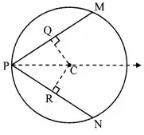
Seg PM and seg PN are congruent chords of a circle with centre C. Show that the ray PC is the bisector of ∠NPM.
Given: Point C is the centre of the circle.
chord PM ≅ chord PN
To prove: Ray PC is the bisector of ∠NPM.
Construction: Draw seg CR ⊥ chord PN, P-R-N
seg CQ ⊥ chord PM, P-Q-M
Answer
Proof:

Image
chord PM chord PN [Given]
seg CR ⊥ chord PN
seg CQ ⊥ chord PM [Construction]
∴ segCR ≅ segCQ ….(i) [Congruent chords are equidistant from the centre]
In ∆PRC and ∆PQC,
∠PRC ≅ ∠PQC [Each is of 90°]
segCR ≅ segCQ [From (i)]
seg PC ≅ seg PC [Common side]
∴ ∆PRC ≅ ∆PQC [Hypotenuse side test]
∴ ∠RPC ≅ ∠QPC [c. a. c. t.]
∴ ∠NPC ≅ ∠MPC [N- R-P, M-Q-P]
∴ Ray PC is the bisector of ∠NPM.

View full question & answer
Question 54 Marks
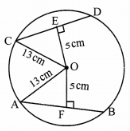
In a circle with radius 13 cm , two equal chords are at a distance of 5 cm from the centre. Find the lengths of chords.
Given: In a circle with cente $O$,
OA and OC are the radii and AB and CD are its congruent chords,
$O A=O C=13 cm$
$O E=O F=5 cm$
seg $O E \perp$ chord CD, C-E-D
seg OF $\perp$ chord AB. A-F-B
To find: length of the chords
Answer

Image

$\text { i. In } \triangle A F O, \angle A F O=90^{\circ}$
$\therefore A O^2=A F^2+F O^2 \text { [Pythagoras theorem] }$
$\therefore 13^2=A F^2+5^2$
$\therefore 169=A F^2+25$
$\therefore A F^2=169-25$
$\therefore A F^2=144$
$\therefore A F=\sqrt{144} \text { [Taking square root on both sides] }$
$\therefore A F=12 cm \text {....(i) }$
ii. Now $A F=\frac{1}{2} A B$ [Perpendicular drawn from the centre of the circle to the chord bisects the chord.]
$\therefore 12=\frac{1}{2}(A B)[\text { From (i)] }$
$\therefore A B=12 \times 2=24 cm$
$\therefore C D=A B=24 cm \text { [chord } A B \cong \text { chord } C D]$
$\therefore$ The lengths of the two chords are $24 cm$ each.
View full question & answer
Question 64 Marks
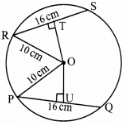
Radius of circle is $10\ cm$ . There are two chords of length $16\ cm$ each. What will be the distance of these chords from the centre of the circle?
Given: In a circle with centre O ,
OR and OP are radii and RS and PQ are its congruent chords.
$P Q=R S=16 cm$
$O R=O P=10 cm$
seg $OU \perp$ chord PQ, P-U-Q
seg $OT \perp$ chord RS, R-T-S
To find: Distance of chords from centre of the circle.
Answer

Image

i. $P U=\frac{1}{2}(P Q)$ PPerpendicular drawn from the centre of the circle to the chord bisects the chord.]
$\therefore P U=\frac{1}{2} \times 16=8 cm \ldots(i) \text { ii. In } \triangle OUP, \angle OUP=90^{\circ}$
$\therefore OP^2=OU^2+PU^2 \text { [Pythagoras theorem] }$
$\therefore 10^2=OU^2+8^2[\text { From (i)] }$
$\therefore 100=OU^2+64$
$\therefore O U^2=100-64=36$
$\therefore OU=\sqrt{ } 36[\text { Taking square root on both sides }]$
$\therefore OU=6 cm$
iii. Now, OT = OU [Congruent chords of a circle are equidistant from the centre.]
$\therefore OT=OU=6 cm$
$\therefore$ The distance of the chords from the centre of the circle is $6\ cm$ .
View full question & answer