Questions

4 Mark Question

Take a timed test

14 questions · self-marked practice — reveal the answer and mark yourself.

Question 14 Marks
If a diameter of a circle bisects each of the two chords of a circle then prove that the chords are parallel.
Answer
Given: AB and CD are two chords of a circle with centre O. Diameter POQ bisects them at points L and M. To prove: AB || CD Proof: AB and CD are two chords of a circle with centre O. Diameter POQ bisects them at L and M. Then $\text{OL}\perp\text{AB}$ Also, $\text{OM}\perp\text{CD}$$\therefore\ \angle\text{ALM}=\angle\text{LMD}=90^\circ$
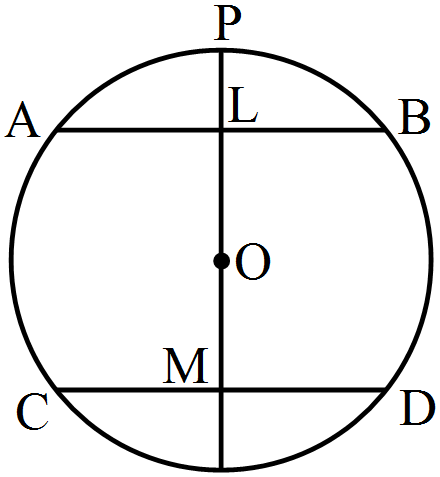
Since alternate angles are equal, we have: AB || CD
View full question & answer
Question 24 Marks
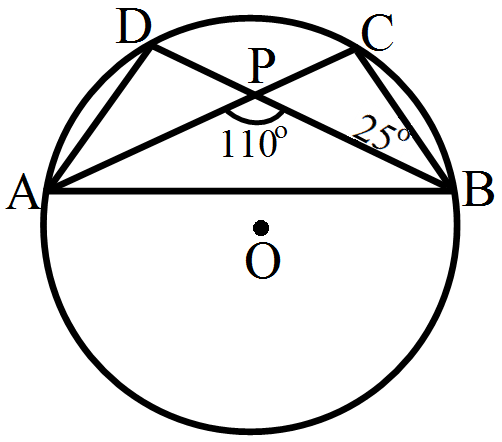
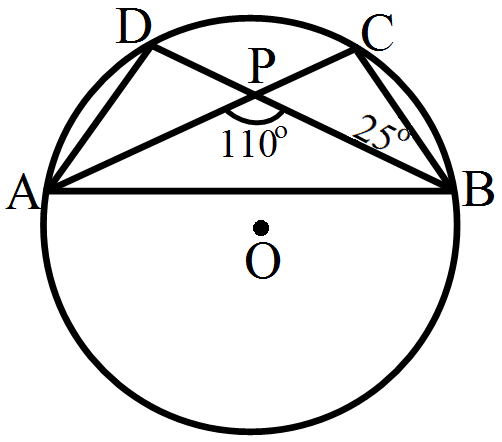
In the given figure, O is the centre of the circle. if $\angle\text{PBC}=25^\circ$ and $\angle\text{APB}=110^\circ,$find the value of $\angle\text{ADB}.$
Answer
From the given diagram, we have: $\angle\text{ACB}=\angle\text{PCB}$
$\angle\text{BPC}=(180^\circ-110^\circ)=70^\circ$ [Linear pair]
Considering $\triangle\text{PCB},$ we have:$\angle\text{PCB}+\angle\text{BPC}+\angle\text{PBC}=180^\circ$ [Angle sum property]
$\Rightarrow\ \angle\text{PCB}+70^\circ+25^\circ=180^\circ$
$\Rightarrow\ \angle\text{PCB}=(180^\circ-95^\circ)=85^\circ$
$\Rightarrow\ \angle\text{ACB}=\angle\text{PCB}=85^\circ$
We know that the angles in the same segment of a circle are equal.$\therefore\ \angle\text{ADB}=\angle\text{ACB}=85^\circ$
View full question & answer
Question 34 Marks
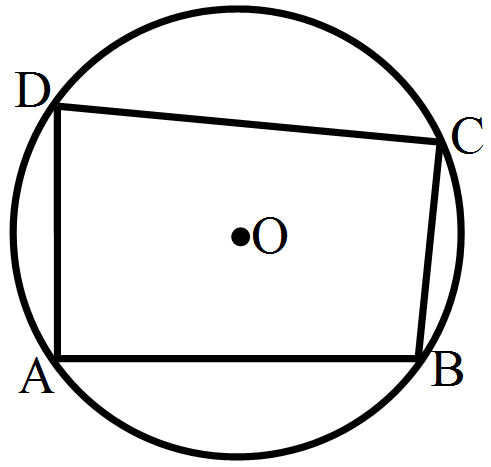
Prove that the perpendicular bisectors of the sides of a cyclic quadrilateral are concurrent.
Answer
Let ABCD be a cyclic quadrilateral and let O be the centre of the circle passing through A, B, C, D. Then each of AB, BC, CD, and DA being a chord of the circle, its right bisector must pass through O.$\therefore$ the right bisectors of AB, BC, CD and DA pass through and are concurrent.
View full question & answer
Question 44 Marks
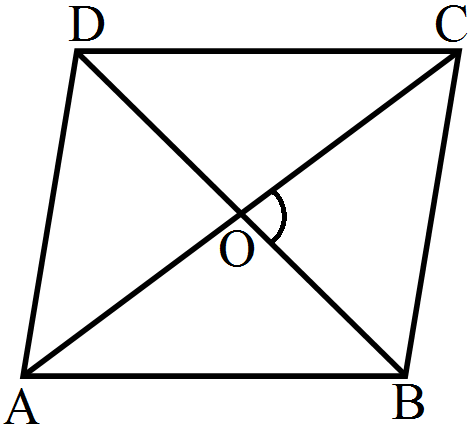
Prove that the circles described with the four sides of a rhombus, as diameters, pass through the point of intersection of its diagonals.
Answer
ABCD is a rhombus. Let the diagonal AC and BD of the rhombus ABCD intersect at O. But, we know that the diagonals of a rhombus bisect each other at right angles. So, $\angle\text{BOC}=90^\circ$$\therefore\ \angle\text{BOC}$ lies in a circle.
Thus the circle drawn with BC as diameter will pass through O. Similarly, all the circles described with AB, AD, and CD as diameter will pass through O.
View full question & answer
Question 54 Marks
In a cyclic quadrilateral ABCD, if $(\angle\text{B}-\angle\text{D})=60^\circ,$ show that the smaller of the two is 60°
Answer
ABCD is a cyclic quadrilateral$\angle\text{B}-\angle\text{D}=60^\circ\dots(\text{i})$
And$\angle\text{B}+\angle\text{D}=180^\circ\dots(\text{ii})$
Adding (i) and (ii) we get,$2\angle\text{B}=240^\circ$
$\therefore\ \angle\text{B}=\frac{240}{2}=120^\circ$
Substituting the value of $\angle\text{B}=120^\circ$ in (i) we get$120^\circ-\angle\text{D}=60^\circ$
$\Rightarrow\ \angle\text{D}=120^\circ-60^\circ=60^\circ$
The smaller of the two angles i.e. $\angle\text{D}=60^\circ.$
View full question & answer
Question 64 Marks
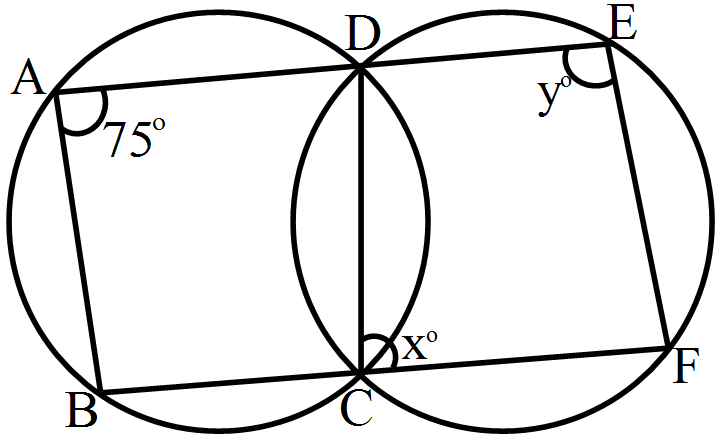
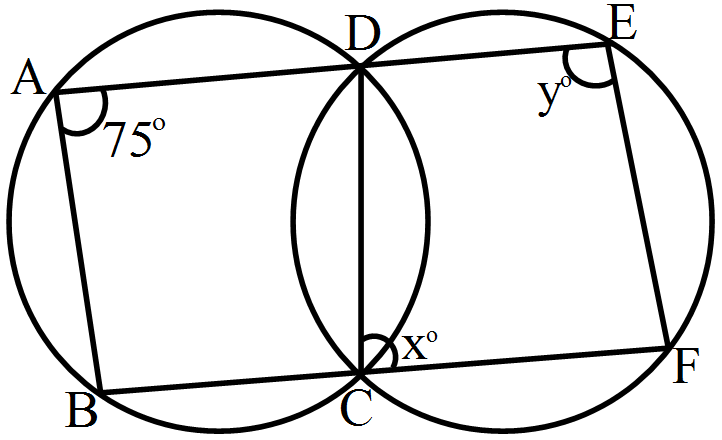
In the given figure, $\angle\text{BAD}=75^\circ,\angle\text{DCF}=\text{x}^\circ$ and $\angle\text{DEF}=\text{y}^\circ.$ Find the values of x and y.
Answer
We know that if one side of a cyclic quadrilateral is produced, then the exterior angle is equal to the interior opposite angle$\text{i.e.},\angle\text{BAD}=\angle\text{DCF}=75^\circ$
$\Rightarrow\ \angle\text{DCF}=\text{x}=75^\circ$
Again, the sum of opposite angles in a cyclic quadrilateral is 180°. Thus, $\angle\text{DCF}=\angle\text{DEF}=180^\circ$$\Rightarrow\ 75^\circ+\text{y}=180^\circ$
$\Rightarrow\ \text{y}=(180^\circ-75^\circ)=105^\circ$
Hence, $\text{x}=75^\circ$ and $\text{y}=105^\circ.$
View full question & answer
Question 74 Marks
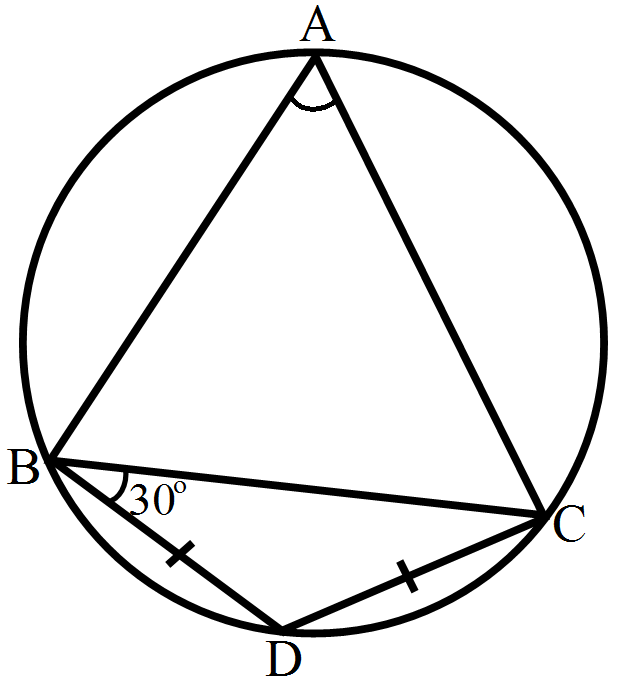
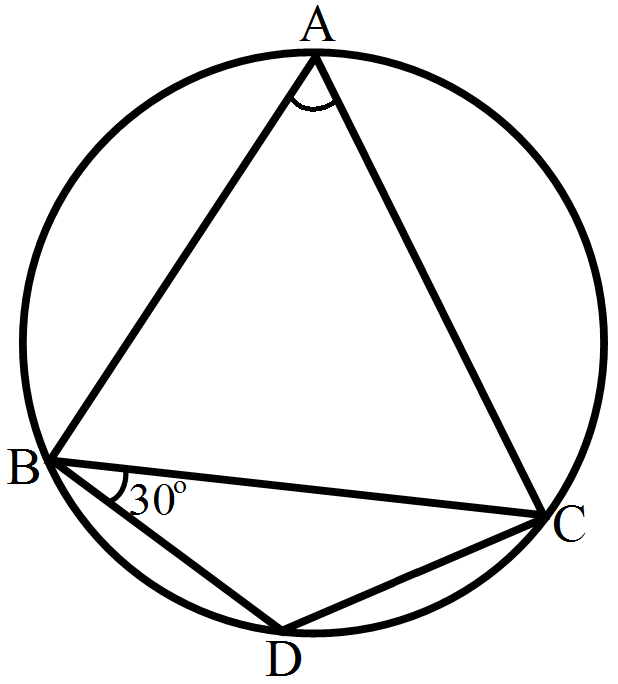
In the given figure, BD = DC and $\angle\text{CBD}=30^\circ,$ find $\angle\text{BAC}.$
Answer
BD = DC$\Rightarrow\ \angle\text{BCD}=\angle\text{CBD}=30^\circ$
In $\triangle\text{BCD},$ we have:$\angle\text{BCD}+\angle\text{CBD}+\angle\text{CDB}=180^\circ$ [Angle sum property of a triangle]
$\Rightarrow\ 30^\circ+30^\circ+\angle\text{CDB}=180^\circ$
$\Rightarrow\ \angle\text{CDB}=(180^\circ-60^\circ)=120^\circ$
The opposite angles of a cyclic quadrilateral are supplementary. Thus, $\angle\text{CDB}+\angle\text{BAC}=180^\circ$$\Rightarrow\ 120^\circ+\angle\text{BAC}=180^\circ$
$\Rightarrow\ \angle\text{BAC}=(180^\circ-120^\circ)=60^\circ$
$\therefore\ \angle\text{BAC}=60^\circ$
View full question & answer
Question 84 Marks
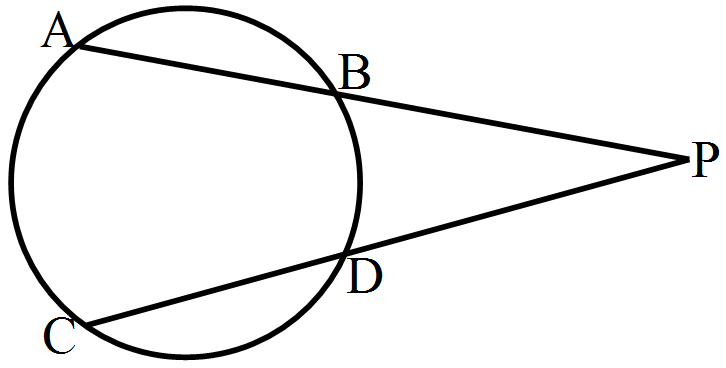
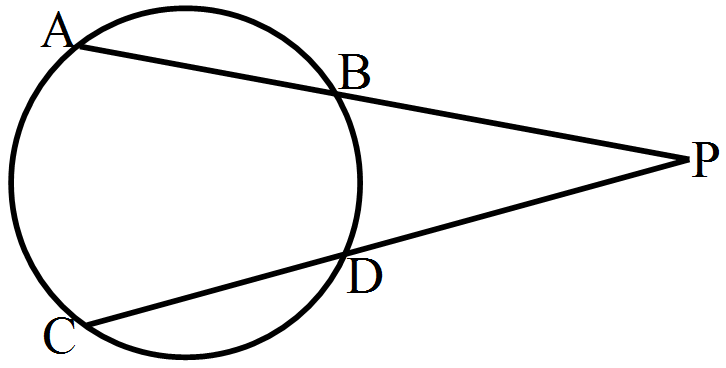
Two chords AB and CD of a circle intersect each other at P outside the circle. If AB = 6cm, BP = 2cm and PD = 25cm, find CD.
Answer
AB and CD are two chords of a circle which intersect each other at P outside the circle. AB = 6cm, BP = 2cm and PD = 2.5cm$\therefore$ AP × BP = CP × DP
⇒ 8 × 2 = (CD + 2.5) × 2.5 $[\because$ CP = CD + DP$]$ Let CD = xcm Thus, 8 × 2 = (CD + 2.5) × 2.5 ⇒ 16 = 2.5x + 6.25 ⇒ 2.5x = (16 - 6.25) = 9.75$\Rightarrow\ \text{x}=\frac{9.75}{2.5}=3.9$
Hence, CD = 3.9cm
View full question & answer
Question 94 Marks
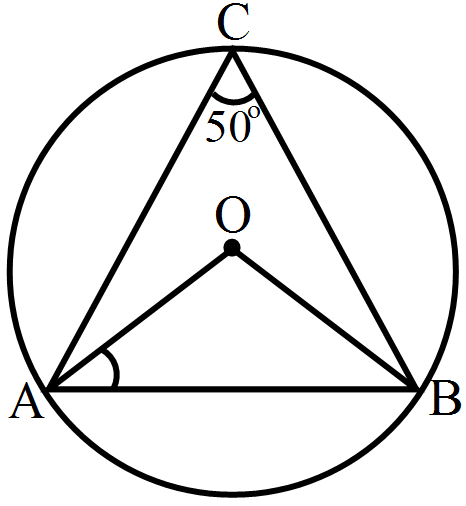
In the given figure, O is the centre of the circle. If $\angle\text{ACB}=50^\circ,$ find $\angle\text{OAB}.$
Answer
We know that the angle subtended by an arc of a circle at the centre is double the angle subtended by the arc at any point on the circumference.$\angle\text{AOB}=2\angle\text{ACB}$
$=2\times50^\circ$ [Given]
$\angle\text{AOB}=100^\circ\dots(\text{i})$
Let us consider the triangle $\triangle\text{OAB}.$$\text{OA}=\text{OB}$ (Radii of a circle)
Thus, $\angle\text{OAB}=\angle\text{OBA}$ In $\triangle\text{OAB},$ we have:$\angle\text{AOB}+\angle\text{OAB}+\angle\text{OBA}=180^\circ$
$\Rightarrow\ 100^\circ+\angle\text{OAB}+\angle\text{OBA}=180^\circ$
$\Rightarrow\ 100^\circ+2\angle\text{OAB}=180^\circ$
$\Rightarrow\ 2\angle\text{OAB}=180^\circ-100^\circ=80^\circ$
$\Rightarrow\ \angle\text{OAB}=40^\circ$
Hence, $\angle\text{OAB}=40^\circ$
View full question & answer
Question 104 Marks
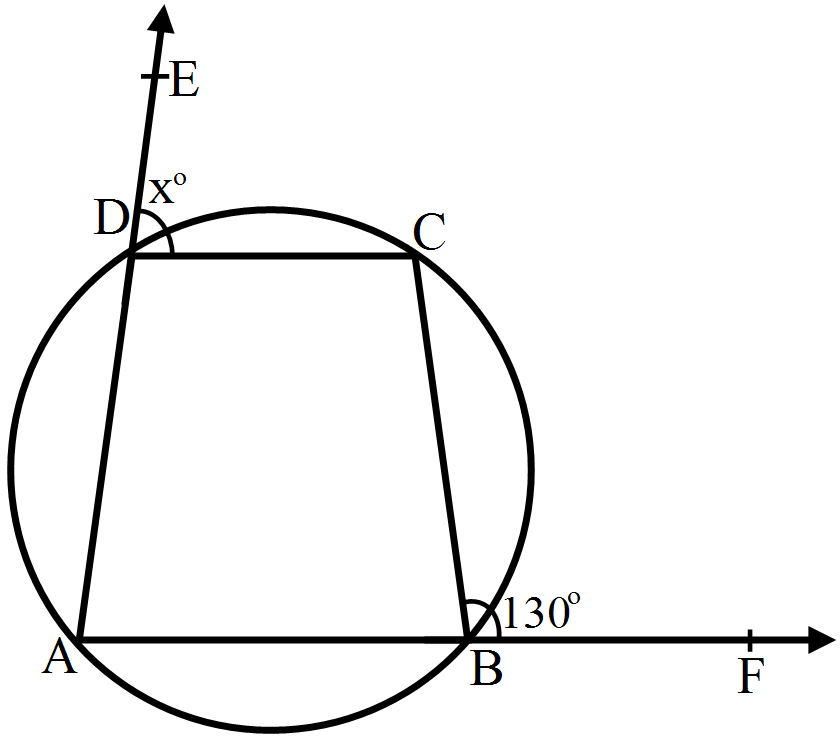
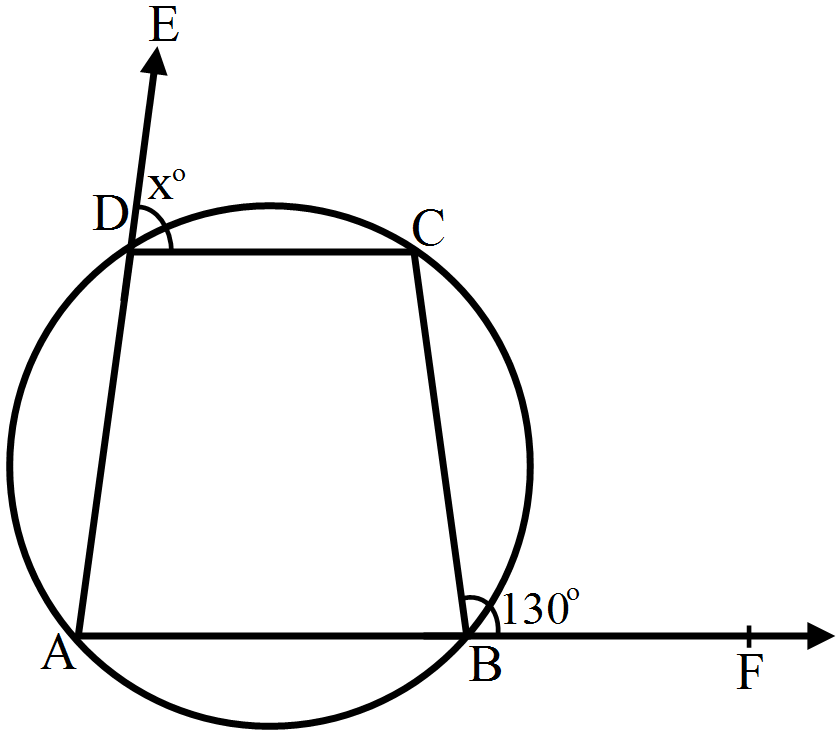
In the given figure, sides AD and AB of cyclic quadrilateral ABCD are produced to E and Frespectively. If $\angle\text{CBF}=130^\circ$ and $\angle\text{CDE}=\text{x}^\circ,$ find the value of x.
Answer
ABCD is a cyclic quadrilateral. We know that in a cyclic quadrilateral, the exterior angle = interior opposite angle.$\therefore\ \angle\text{CBF}=\angle\text{CDA}=(180^\circ-\text{x})$
$\Rightarrow\ 130^\circ=180^\circ-\text{x}$
$\Rightarrow\ \text{x}=180^\circ-130^\circ=50^\circ$
$\Rightarrow\ \text{x}=50^\circ$
View full question & answer
Question 114 Marks
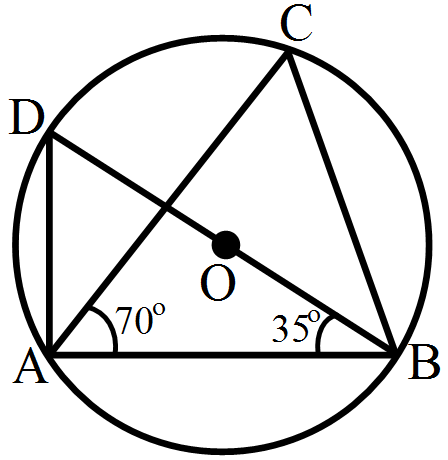
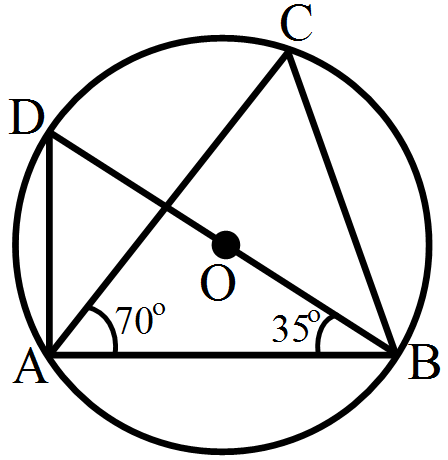
In the given figure, O is the centre of the circle. If $\angle\text{ABD}=35^\circ$ and $\angle\text{BAC}=70^\circ,$find $\angle\text{ACB}.$
Answer
It is clear that BD is the diameter of the circle. Also, we know that the angle in a semicircle is a right angle. i.e., $\angle\text{BAD}=90^\circ$ Now, considering the $\triangle\text{BAD},$ we have:$\angle\text{ADB}+\angle\text{BAD}+\angle\text{ABD}=180^\circ$ [Angle sum property of a triangle]
$\Rightarrow\ \angle\text{ADB}+90^\circ+35^\circ=180^\circ$
$\Rightarrow\ \angle\text{ADB}=(180^\circ-125^\circ)=55^\circ$
Angles in the same segment of a circle are equal. Hence, $\angle\text{ACB}=\angle\text{ADB}=55^\circ$
View full question & answer
Question 124 Marks
Prove that two different circles cannot intersect each other at more than two points.
Answer
Given: Two distinct circles To prove: Two distinct circles cannot intersect each other in more than two points. Proof: Suppose that two distinct circles intersect each other in more than two points.$\therefore$ These points are non-collinear points.
Three non-collinear points determine one and only one circle.$\therefore$ There should be only one circle.
This contradicts the given, which shows that our assumption is wrong. Hence, two distinct circles cannot intersect each other in more than two points.
View full question & answer
Question 134 Marks
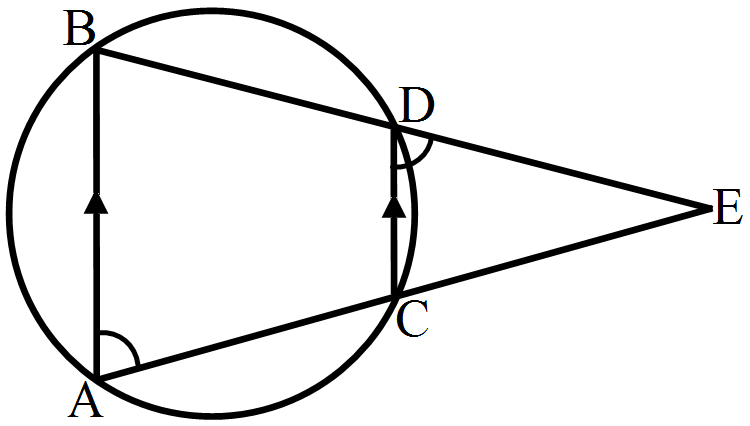
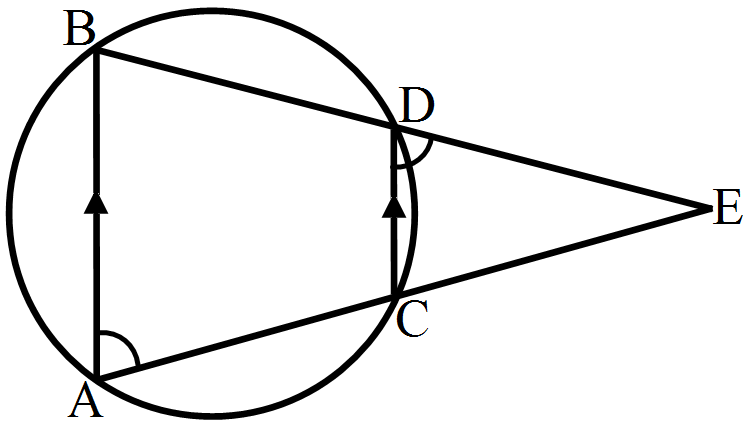
In the given figure, AB and CD are two parallel chords of a circle. If BDE and ACE are straight lines, intersecting at E, prove that $\triangle\text{AEB}$ is isosceles.
Answer
AB and CD are two parallel chords of a circle. BDE and ACE are two straight lines that intersect at E. If one side of a cyclic quadrilateral is produced, then the exterior angle is equal to the interior opposite angle.$\therefore$ Exteriore $\angle\text{EDC}=\angle\text{A}\dots(\text{i})$
Exteriore $\angle\text{DCE}=\angle\text{B}\dots(\text{ii})$​​​​​​​ Also, AB parallel to CD. Then, $\angle\text{EDC}=\angle\text{B}$ [Corresponding angles]$\angle\text{DCE}=\angle\text{A}$ [Corresponding angles]
$\therefore\ \angle\text{A}=\angle\text{B}$ [From (i) and (ii)]
Hence, $\triangle\text{AEB}$ is isosceles.
View full question & answer
Question 144 Marks
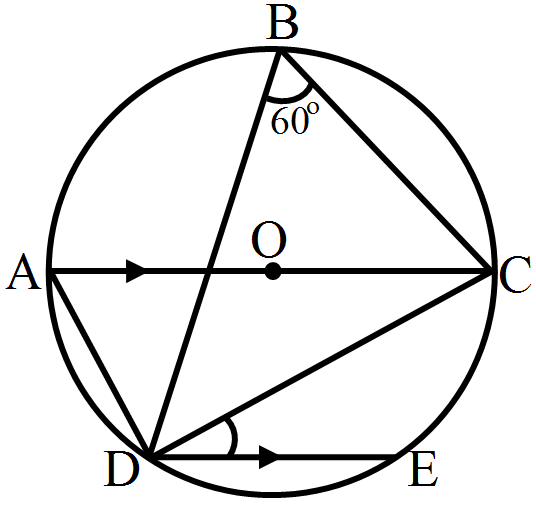
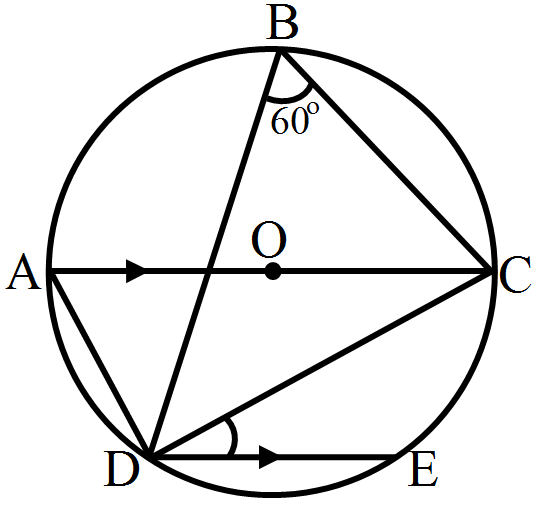
In the adjoining figure, DE is a chord parallel to diameter AC of the circle with centre O. If $\angle\text{CBD}=60^\circ,$calculate $\angle\text{CDE}.$
Answer
Angles in the same segment of a circle are equal.$\text{i.e},\angle\text{CAD}=\angle\text{CBD}=60^\circ$
We know that an angle in a semicircle is a right angle.$\text{i.e},\angle\text{ACD}=90^\circ$
In $\triangle\text{ADC},$ we have:$\angle\text{ACD}+\angle\text{ADC}+\angle\text{CAD}=180^\circ$ [Angle sum property of a triangle]
$\Rightarrow\ \angle\text{ACD}+90^\circ+60^\circ=180^\circ$
$\Rightarrow\ \angle\text{ACD}=180^\circ-(90^\circ+60^\circ)$
$=(180^\circ-150^\circ)=30^\circ$
$\Rightarrow\ \angle\text{CDE}=\angle\text{ACD}=30^\circ$ [Alternate angles as AC parallel to DE]
Hence, $\angle\text{CDE}=30^\circ$
View full question & answer