Questions

MCQ(1M)

Take a timed test

13 questions · auto-graded multiple-choice test.

MCQ 11 Mark
In figure, if lines $l$ and $m$ are parallel, then $x =$
  • A
    $20^\circ$
  • $45^\circ$
  • C
    $65^\circ$
  • D
    $85^\circ$
Answer
Correct option: B.
$45^\circ$

From figure,
$\angle\text{ABD}=\angle\text{CDF} [$Correspondence angles$]$
$\Rightarrow\ \angle\text{CDF}=65^\circ$
Now,
$\angle\text{FDE}=180^\circ-\angle\text{CDF}=180^\circ-65^\circ$
$\Rightarrow\ \angle\text{FDE}=115^\circ$
In $\triangle\text{EDF},$
$\angle\text{FDE}+\angle\text{DEF}+\angle\text{EFD}=180^\circ$
$\Rightarrow\ 115^\circ+\text{x}+20^\circ=180^\circ [$Sum of all interior angles of a $\triangle$ as $180^\circ ]$
$\Rightarrow\ \text{x}=180^\circ-20^\circ-115^\circ=45^\circ$
View full question & answer
MCQ 21 Mark
In figure, if $ l_1 || l_2,$ what isb the value of $y$ ?
  • A
    $100$
  • B
    $120$
  • $135$
  • D
    $150$
Answer
Correct option: C.
$135$
Let angle supplement of $3 x^{\circ}$ be $Z^{\circ}$
$\Rightarrow z^{\circ}=180^{\circ}-3 x^{\circ}$
$\Rightarrow \angle AHF+\angle FHB=180^{\circ}$
$\Rightarrow z^{\circ}+3 x^{\circ}=180^{\circ}$
$\Rightarrow z^{\circ}=180^{\circ}-3 x^{\circ}$
Now,
$x^{\circ}+y^{\circ}=180^{\circ}$
Also, $x^{\circ}=z^{\circ} \ [$Correspondence angles$]$
$\Rightarrow x^{\circ}=180^{\circ}-3 x^{\circ}$
$\Rightarrow 4 x^{\circ}=180^{\circ}$
$\Rightarrow x^{\circ}=45^{\circ}$
$x^{\circ}+y^{\circ}=180^{\circ}$
$\Rightarrow y^{\circ}=180^{\circ}-x^{\circ}=180^{\circ}-45^{\circ}=135^{\circ}$
View full question & answer
MCQ 31 Mark
If two interior angles on the same side of a transversal intersecting two parallel lines are in the ratio $2 : 3,$ then the measure of the larger angle is:
  • A
    $54^\circ$
  • B
    $120^\circ$
  • $108^\circ$
  • D
    $136^\circ$
Answer
Correct option: C.
$108^\circ$

Let $AB$ and $CD$ are two parallel lines and $PQ$ is transverce to it.
According to question,
$\frac{\angle\text{BRS}}{\angle\text{DSR}}=\frac{2}{3}$
$\Rightarrow\ \angle\text{BRS}=\frac{2}{3}\angle\text{DSR}\dots(1)$
Now,
$\angle\text{CSR}=\angle\text{BRS} \ [$Alternate angles$]$
$\Rightarrow\ \angle\text{CSR}+\angle\text{DSR}=180^\circ$
$\Rightarrow\ \angle\text{BRS}+\angle\text{DSR}=180^\circ$
$\Rightarrow\ \frac{2}{3}\angle\text{DSR}+\angle\text{DSR}=180^\circ$
$\Rightarrow\ \angle\text{DSR}=\frac{180\times3}{5}=108^\circ$
$\Rightarrow\ \angle\text{BRS}=\frac{2}{3}\times108^\circ=72^\circ$
Thus,
$\angle\text{DSR}=108^\circ$ and $\angle\text{BRS}=72^\circ$
$\Rightarrow$ Larger angle is $\angle\text{DSR}.$
View full question & answer
MCQ 41 Mark
In figure, $\text{AOB}$ is a straight line. If $\angle\text{AOC}+\angle\text{BOD}=85^\circ,$ then $\angle\text{COD}=$
  • A
    $85 ^{\circ}$
  • B
    $90 ^{\circ}$
  • $95 ^{\circ}$
  • D
    $100 ^{\circ}$
Answer
Correct option: C.
$95 ^{\circ}$


From figure, we can see

$\angle\text{AOC}+\angle\text{COD}+\angle\text{BOD}=180^\circ$

But,

$\angle\text{AOC}+\angle\text{BOD}=85^\circ$ [Given]

$\Rightarrow\ 85^\circ+\angle\text{COD}=180^\circ$

$\Rightarrow\ \angle\text{COD}=95^\circ$
View full question & answer
MCQ 51 Mark
In figure, if $l_1 || l_2$ and $l_3 || l_4$, what is $y$ in terms of $x$?
  • A
    $90+\text{x}$
  • B
    $90+2\text{x}$
  • $90-\frac{\text{x}}{2}$
  • D
    $90-2\text{x}$
Answer
Correct option: C.
$90-\frac{\text{x}}{2}$
From figure,
$\angle\text{EPR}=\angle\text{PQS} \ [$Correspondence angles are equal$]$
$\Rightarrow\ \angle\text{PQS}=\text{x}^\circ$
Also $, \angle\text{PQS}=\angle\text{RSD} \ [$Correspondence angles are equal$]$
$\Rightarrow\ \angle\text{RSD}=\text{x}^\circ$
Now $, \angle\text{RSD}+\text{y}^\circ+\text{y}^\circ=180^\circ$
$\Rightarrow\ \text{x}^\circ+2\text{y}^\circ=180^\circ$
$\Rightarrow\ \text{y}^\circ=\frac{180^\circ-\text{x}^\circ}{2}$
$\Rightarrow\ \text{y}^\circ=90^\circ-\frac{\text{x}^\circ}{2}$
View full question & answer
MCQ 61 Mark
Two complementary angles are such that two times the measure of one is equal to three times the measure of the other. The measure of the smaller angle is:
  • A
    $45^\circ$
  • B
    $30^\circ$
  • $36^\circ$
  • D
    None of these
Answer
Correct option: C.
$36^\circ$
Let one angle be $\theta$
Then, its complementary $=90-\theta$
According to question,
$2\theta=3(90-\theta)$
$=5\theta=270$
$\theta=54^\circ$
Then, $90-\theta^\circ=36^\circ$
Hence, the smaller angle is $36^\circ .$
View full question & answer
MCQ 71 Mark
In figure, if $l_1|| l_2$, what is $x + y$ in terms of $w$ and $z$?
  • $180 - w + z$
  • B
    $180 + w - z$
  • C
    $180 - w - z$
  • D
    $180 + w + z$
Answer
Correct option: A.
$180 - w + z$
Let angle supplement of $w^{\circ}$ be $a^{\circ}$.
$\Rightarrow a^{\circ}=180^{\circ}-w^{\circ}$
Now $, a^{\circ}=x^\circ \ [$Alternate opposite angles$]$
$\Rightarrow x^{\circ}=180-w^{\circ} . . .(1)$
Now $, y^{\circ}=z^{\circ} . .. (2) \ [$Alternate angles$]$
Adding $(1)$ and $(2),$ we get
$x^{\circ}+y^{\circ}=180^{\circ}-w^{\circ}+z^{\circ}$
View full question & answer
MCQ 81 Mark
One angle is equal to three times its supplement. The measure of the angle is:
  • A
    $130^\circ$
  • $135^\circ$
  • C
    $90^\circ$
  • D
    $120^\circ$
Answer
Correct option: B.
$135^\circ$
Let the required angle be ${\theta}.$
Then, measure of its supplement $180^\circ-\theta$
According to question, we have
$\theta=3(180-\theta)$
$\Rightarrow\ \theta=540^\circ-3\theta$
$\Rightarrow\ 4\theta=540^\circ $
$\Rightarrow\ \theta=135^\circ$
View full question & answer
MCQ 91 Mark
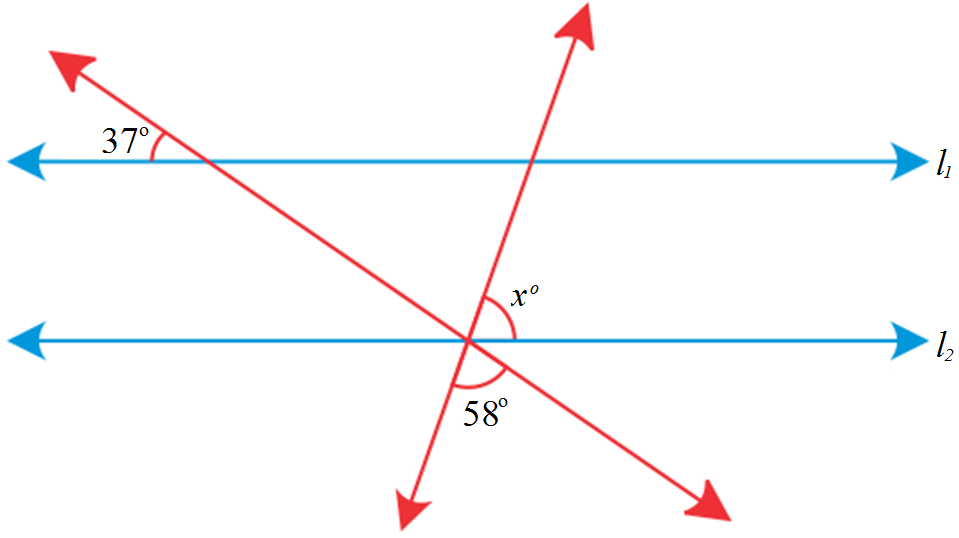
In figure, if $l_1 || l_{2,}$ what is the value of $x$?

  • A
    $90^\circ$
  • $85^\circ$
  • C
    $75^\circ$
  • D
    $70^\circ$
Answer
Correct option: B.
$85^\circ$
From figure,
$\angle\text{ERC}=\angle\text{RPA}\ [$Corresponding angles are equal$]$
$\Rightarrow \angle\text{ERC}=37^\circ=\angle\text{RPA}$
Also $, \angle\text{RPA}=\angle\text{BPF} \ [$Opposite angles$]$
$\Rightarrow \angle\text{RPA}=37^\circ=\angle\text{BPF}$
Now $, \angle\text{QPB}+\angle\text{BPF}+\angle\text{FPG}=180^\circ$
$\Rightarrow\ \text{x}^\circ+37^\circ+58^\circ=180^\circ$
$\Rightarrow\ \text{x}^\circ=85^\circ$
View full question & answer
MCQ 101 Mark
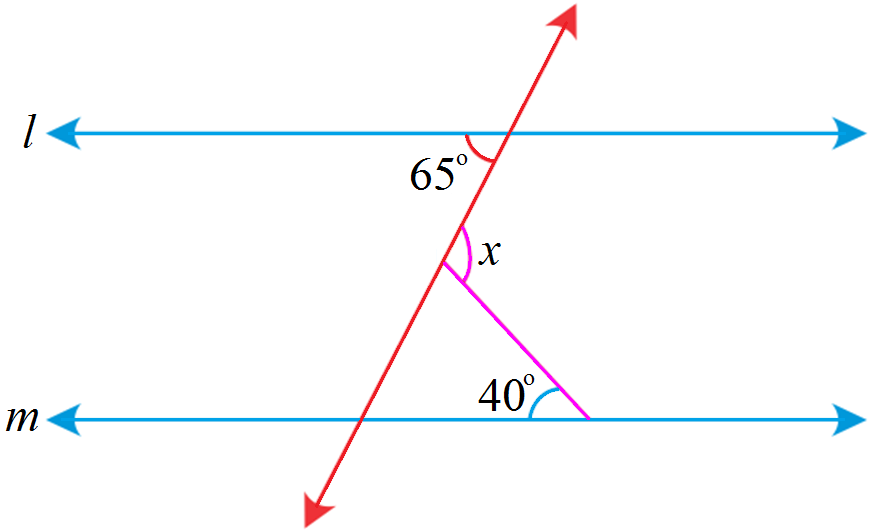
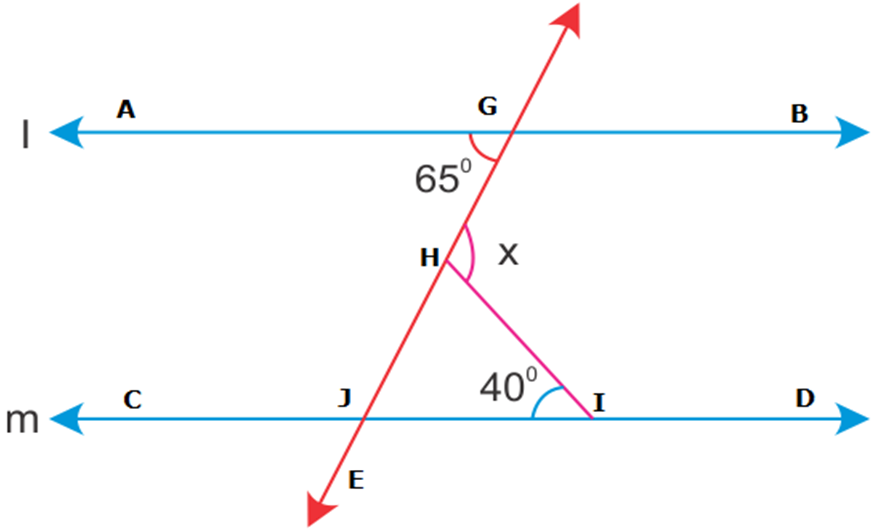
In figure, if $l \| m,$ then $x =$
  • $105^\circ$
  • B
    $65^\circ$
  • C
    $40^\circ$
  • D
    $25^\circ$
Answer
Correct option: A.
$105^\circ$

From figure,
$\angle\text{AGE}=\angle\text{FGB}\ [$Opposite angles$]$
$\Rightarrow\ \angle\text{FGB}=65^\circ$
Also,
$\angle\text{FGB}=\angle\text{HJI}\ [$Corresponding angle$]$
$\Rightarrow\ \angle\text{HJI}=65^\circ$
Now, in $\angle\text{HJI},$
$\angle\text{HJI}+\angle\text{JIH}+\angle\text{IHJ}=180^\circ$
$\Rightarrow\ 65^\circ+40^\circ+\angle\text{IHJ}=180^\circ$
$\Rightarrow\ \angle\text{IHJ}=180^\circ-65^\circ-40^\circ=75^\circ$
Now,
$\text{x}=180^\circ-\angle\text{IHJ}=180^\circ-75^\circ$
$=105^\circ$
View full question & answer
MCQ 111 Mark
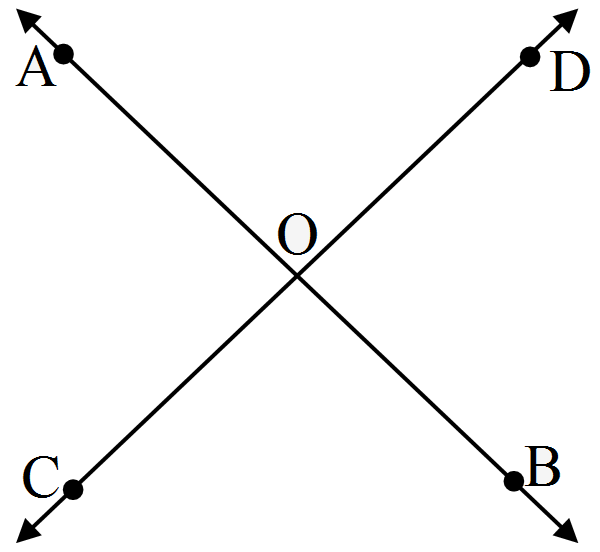
Two lines $AB $ and $CD $ intersect at $O$. If $\angle\text{AOC}+\angle\text{COB}+\angle\text{BOD}=270^\circ,$ then $\angle\text{AOC}=$
  • A
    $70^\circ$
  • B
    $80^\circ$
  • $90^\circ$
  • D
    $180^\circ$
Answer
Correct option: C.
$90^\circ$

$\angle\text{AOC}+\angle\text{COB}+\angle\text{BOD}=270^\circ \ [$Given$]$
From figure,
$\angle\text{AOC}+\angle\text{COB}+\angle\text{BOD}+\angle\text{DOA}=360^\circ$
$\Rightarrow\ 270^\circ+\angle\text{DOA}=360^\circ$
$\Rightarrow\ \angle\text{DOA}=360^\circ-270^\circ=90^\circ$
Now,
$\angle\text{DOA}+\angle\text{AOC}=180^\circ$
$\Rightarrow\ \angle\text{AOC}=180^\circ-90^\circ=90^\circ$
View full question & answer
MCQ 121 Mark
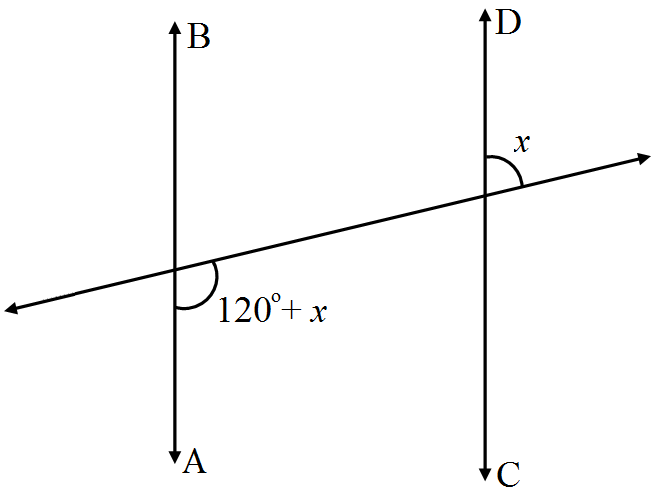
In figure, if $AB \| CD,$ then the value of $x$ is:
  • A
    $20^\circ$
  • $30^\circ$
  • C
    $45^\circ$
  • D
    $60^\circ$
Answer
Correct option: B.
$30^\circ$

From figure,
$\angle\text{DPQ}+\angle\text{x}^\circ=180^\circ\dots(1) \ [$linear pair$]$
Also,
$\angle\text{DPQ}=\angle\text{AQP} \ [$Interior opposite angles$]$
$\Rightarrow\ \angle\text{DPQ}=120^\circ+\text{x}$
From $(1),$
$120^\circ+\text{x}+\text{x}=180^\circ$
$\Rightarrow\ 2\text{x}=60^\circ$
$\Rightarrow\text{x}=30^\circ$
View full question & answer
MCQ 131 Mark
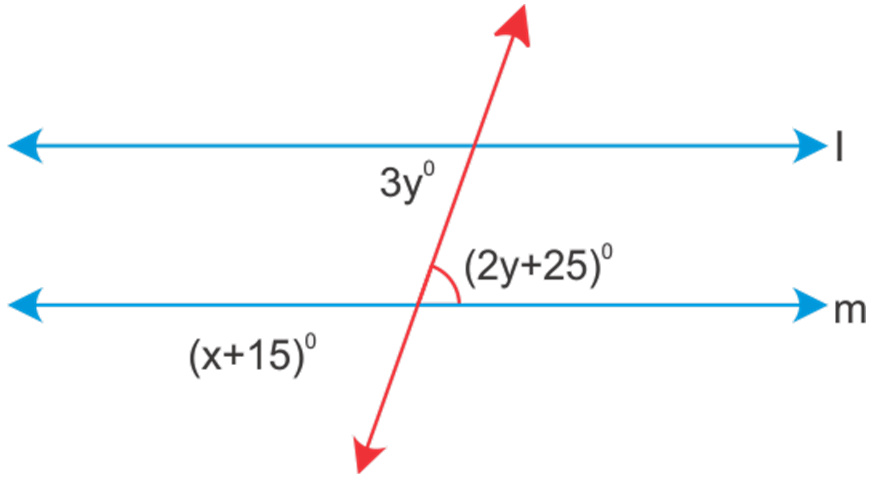
In figure, if $l \| m,$ what is the value of $x$?
  • $60$
  • B
    $50$
  • C
    $45$
  • D
    $30$
Answer
Correct option: A.
$60$

$3y^\circ = 2y^\circ + 25^\circ\ [$Alternate angles$]$
$\Rightarrow y^\circ = 25^\circ$
Now,
$x^\circ + 15^\circ = 2y^\circ + 25^\circ\ [$Opposite angles$]$
$\Rightarrow x = 2y^\circ + 25^\circ - 15^\circ$
$\Rightarrow x = 2y^\circ + 10^\circ$
$\Rightarrow x = 2 \times 25^\circ + 10^\circ$
$\Rightarrow x = 60^\circ$
View full question & answer
MCQ(1M) - Maths STD 9 Questions - Vidyadip