Questions

5 Mark Question

🎯

Test yourself on this topic

9 questions · timed · auto-graded

Question 15 Marks
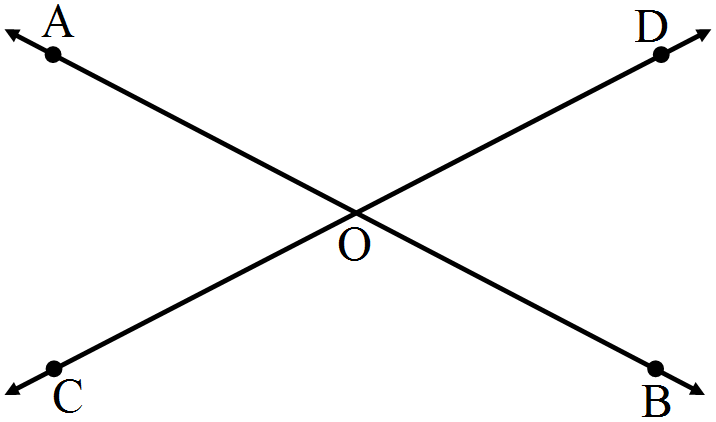
If two straight lines intersect in such a way that one of the angles formed measures 90°, show that each of the remaining angles measures 90°.
Answer
We know that if two lines intersect, then the vertically-opposite angles are equal. $\angle\text{AOC}=90^\circ.$ Then, $\angle\text{AOC}=\angle\text{BOD}=90^\circ.$
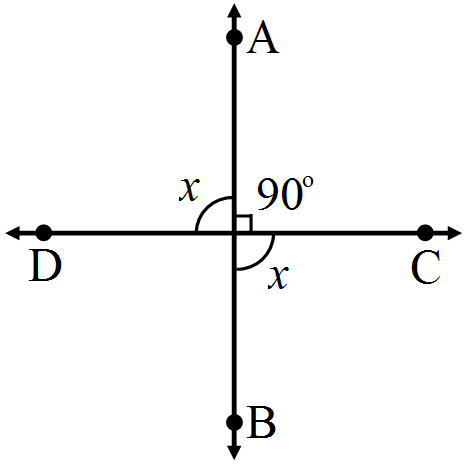
And let $\angle\text{BOC}=\angle\text{AOD}=\text{x}$ Also, we know that the sum of all angles around a point is 360º$\therefore\angle\text{AOC}+\angle\text{BOD}+\angle\text{AOD}+\angle\text{BOC}=360^\circ$
$\Rightarrow90^\circ+90^\circ+\text{x}+\text{x}=360^\circ$
$\Rightarrow2\text{x}=180^\circ$
$\Rightarrow\text{x}=90^\circ$
Hence, $\angle\text{BOC}=\angle\text{AOD}=90^\circ$$\therefore\angle\text{AOC}=\angle\text{BOD}=\angle\text{BOC}=\angle\text{AOD}=90^\circ$
Hence, the measure of each of the remaining angles is 90º.
View full question & answer
Question 25 Marks
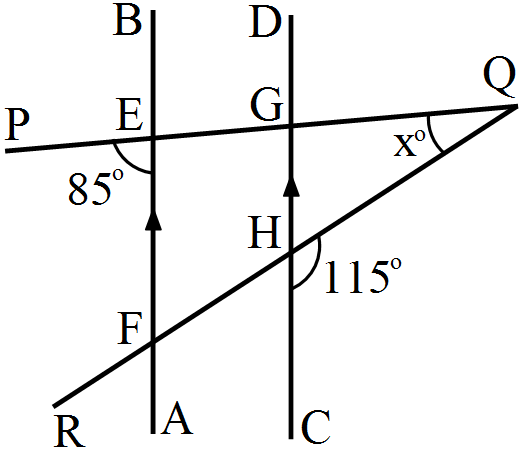
In the given figure, AB || CD. Find the value of x.
Answer
Since AB || CD and PQ a transversal. So, $\angle\text{PEF}=\angle\text{EGH}$ [Corresponding angles]$\Rightarrow\angle\text{EGH}=85^\circ$
$\angle\text{EGH}$ and $\angle\text{QGH}$ form a linear pair.
So, $\angle\text{EGH}+\angle\text{QGH}=180^\circ$$\Rightarrow\angle\text{QGH}=180^\circ-85^\circ=95^\circ$
Similarly, $\angle\text{GHQ}+115^\circ=180^\circ$$\Rightarrow\angle\text{GHQ}=180^\circ-115^\circ=65^\circ$
In $\triangle\text{GHQ},$ we have,$\Rightarrow\angle\text{GQH}+\angle\text{GHQ}+\angle\text{QGH}=180^\circ$
$\text{x}^\circ+65^\circ+95^\circ=180^\circ$
$\Rightarrow\text{x}=180-65-95=180-160$
$\therefore\text{x}=20$
View full question & answer
Question 35 Marks
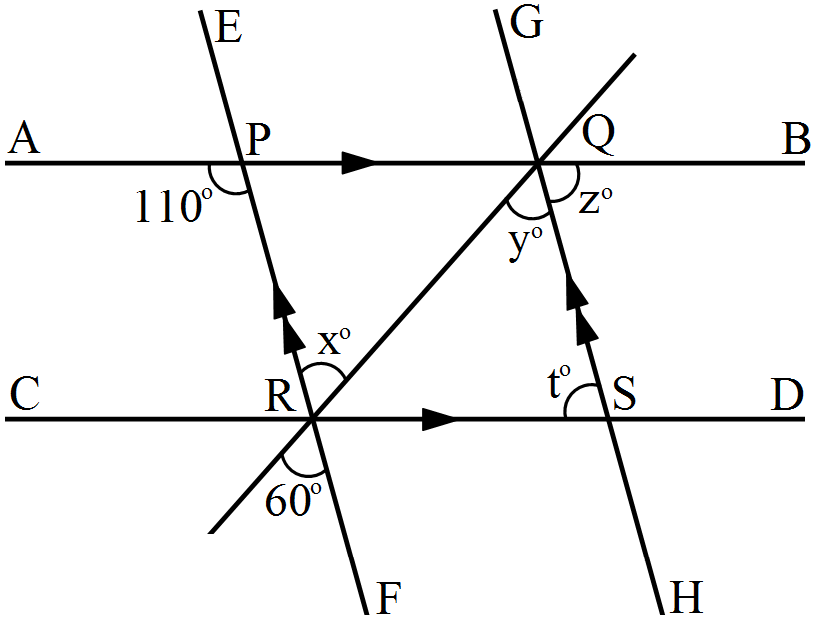
In the given figure, $AB\ ||\ CD$ and $EF\ ||\ GH$. Find the value of $x, y, z$ and $t$.

Answer
$\angle\text{PRQ}=\text{x}^\circ=60^\circ$ [vertically opposite angles]Since $EF\ ||\ GH$, and $RQ$ is a transversal.
So, $\angle\text{x}=\angle\text{y}$ [Alternate angles]
$\Rightarrow\text{y}=60$
AB || CD and PR is a transversal.
So, $\angle\text{PRD}=\angle\text{APR}$ [Alternate angles]
$\Rightarrow\angle\text{PRQ}+\angle\text{QRD}=\angle\text{APR}$ $[\text{since }\angle\text{PRD}=\angle\text{PRQ}+\angle\text{QRD]}$
$\Rightarrow\text{x}+\angle\text{QRD}=110^\circ$
$\Rightarrow\angle\text{QRD}=110^\circ-60^\circ=50^\circ$
In $\triangle\text{QRS},$ we have,
$\angle\text{QRD}+\text{t}^\circ+\text{y}^\circ=180^\circ$
$\Rightarrow50+\text{t}+60=180$
$\Rightarrow\text{t}=180-110=70$
Since, $AB\ ||\ CD$ and $GH$ is a transversal
So, $z^{\circ}=t^{\circ}=70^{\circ}$ [Alternate angles]
$\therefore x=60, y=60, z=70$ and $t=70$
View full question & answer
Question 45 Marks
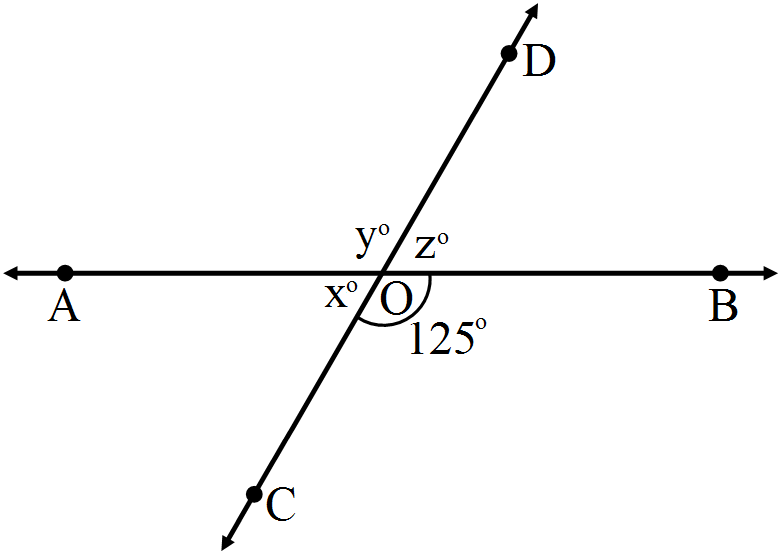
In the given figure, the two lines AB and CD intersect at a point O such that $\angle\text{BOC}=125^\circ.$ Find the values of x, y and z.
Answer
Here, $\angle\text{AOC}$ and $\angle\text{BOC}$ from a liner pair.$\therefore\angle\text{AOC}+\angle\text{BOC}=180^\circ$
$\Rightarrow\text{x}^\circ+125^\circ=180^\circ$
$\Rightarrow\text{x}^\circ=180^\circ-125^\circ=55^\circ$
Now,$\angle\text{AOD}=\angle\text{BOC}=125^\circ$ (Vertically opposite angles)
$\therefore\text{y}^\circ=125^\circ$
$\angle\text{BOD}=\angle\text{AOC}=55^\circ$ (Vertically opposite angles)
$\therefore\text{y}^\circ=55^\circ$
Thus, the respective values of x, y and z are 55, 125 and 55.
View full question & answer
Question 55 Marks
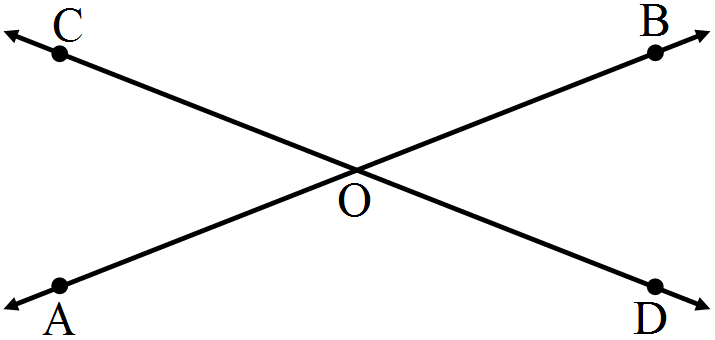
Two lines AB and CD intersect at a point O, such that $\angle\text{BOC}+\angle\text{AOD}=280^\circ,$ as shown in the figure. Find all the four angles.
Answer
We know that if two lines intersect, then the vertically-opposite angles are equal. Let $\angle\text{BOC}=\angle\text{AOD}=\text{x}^\circ$ Then,$\text{x}+\text{x}=280$
$\Rightarrow2\text{x}=280$
$\Rightarrow\text{x}=140^\circ$
$\therefore\angle\text{BOC}=\angle\text{AOD}=140^\circ$
Also, let $\angle\text{AOC}=\angle\text{BOD}=\text{y}^\circ$ We know that the sum of all angles around a point is 360º.$\therefore\angle\text{AOC}+\angle\text{BOC}+\angle\text{BOD}+\angle\text{AOD}=360^\circ$
$\Rightarrow\text{y}+140+\text{y}+140=360^\circ$
$\Rightarrow2\text{y}=80^\circ$
$\text{y}=40^\circ$
Hence, $\angle\text{AOC}=\angle\text{BOD}=40^\circ$$\therefore\angle\text{BOC}=\angle\text{AOD}=140^\circ$ and $\angle\text{AOC}=\angle\text{BOD}=40^\circ$
View full question & answer
Question 65 Marks
Two lines AB and CD intersect each other at a point O such that $\angle\text{AOC}:\angle\text{AOD}=5:7.$ Find all the angles.
Answer
Let $\angle\text{AOC}=5\text{k}$ and $\angle\text{AOD}=7\text{k,}$ where k is some constant. Here, $\angle\text{AOC}$ and $\angle\text{AOD}$ form a linear pair.$\therefore\angle\text{AOC}+\angle\text{AOD}=180^\circ$
$\Rightarrow5\text{k}+7\text{k}=180^\circ$
$\Rightarrow12\text{k}=180^\circ$
$\Rightarrow\text{k}=15^\circ$
$\therefore\angle\text{AOC}=5\text{k}=5\times15^\circ=75^\circ$
$\angle\text{AOD}=7\text{k}=7\times15^\circ=105^\circ$
Now, $\angle\text{BOD}=\angle\text{AOC}=75^\circ$ (Vertically opposite angles)$\angle\text{BOC}=\angle\text{AOD}=105^\circ$ (Vertically opposite angles)
View full question & answer
Question 75 Marks
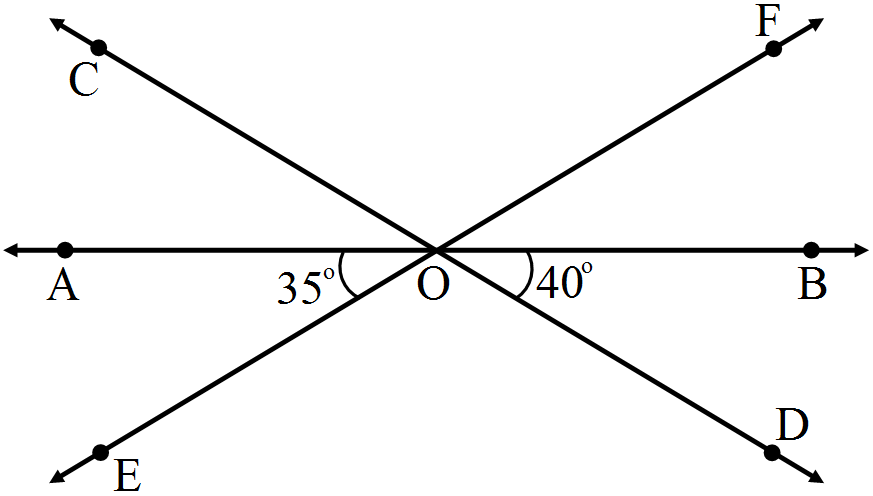
In the given figure, three lines AB, CD and EF intersect at a point O such that $\angle\text{AOE}=35^\circ$ and $\angle\text{BOD}=40^\circ.$ Find the measure of $\angle\text{AOC},\angle\text{BOF},\angle\text{COF}$ and $\angle\text{DOE}.$
Answer
In the given figure,$\angle\text{AOC}=\angle\text{BOD}=40^\circ$ (Vertically opposite angles)
$\angle\text{BOF}=\angle\text{AOE}=35^\circ$ (Vertically opposite angles)
Now, $\angle\text{EOC}$ and $\angle\text{COF}$ form a linear pair.$\therefore\angle\text{EOC}+\angle\text{COF}=180^\circ$
$\Rightarrow(\angle\text{AOE}+\angle\text{AOC})+\angle\text{COF}=180^\circ$
$\Rightarrow35^\circ+406\circ+\angle\text{COF}=180^\circ$
$\Rightarrow75^\circ+\angle\text{COF}=180^\circ$
$\Rightarrow\angle\text{COF}=180^\circ-75^\circ=105^\circ$
Also, $\angle\text{DOE}=\angle\text{COF}=105^\circ$ (Vertically opposite angles)
View full question & answer
Question 85 Marks
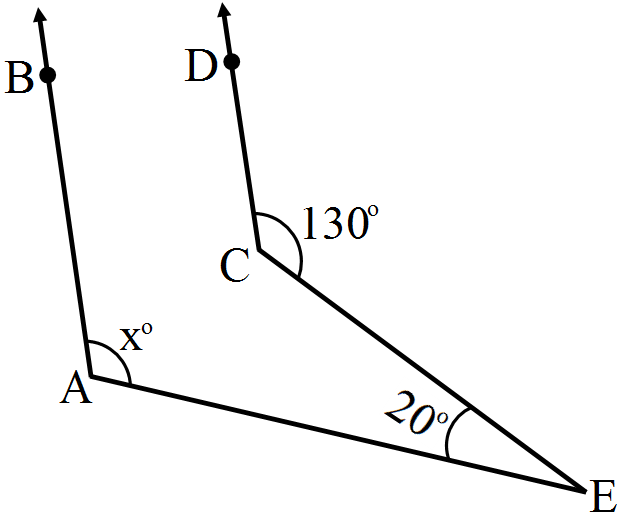
In the given figure, AB || CD. Find the value of x.
Answer
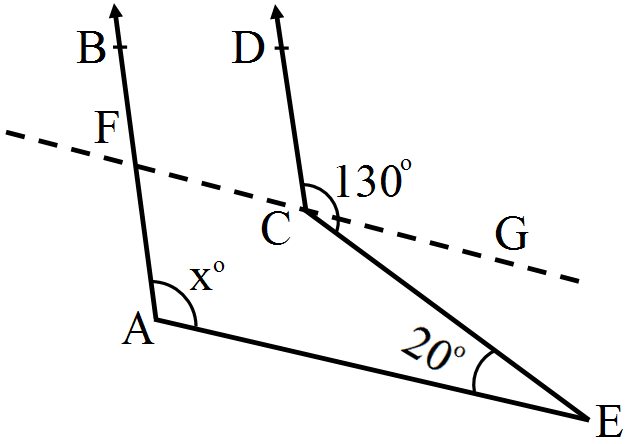
Through C draw FG || AE Now, since CG || BE and CE is a transversal. So, $\angle\text{GCE}=\angle\text{CEA}=20^\circ$ [Alternate angles]$\therefore\angle\text{DCG}=130^\circ-\angle\text{GCE}$
$=130^\circ-20^\circ=110^\circ$
Also, we have AB || CD and FG is a transversal. So, $\angle\text{BFC}=\angle\text{DCG}=110^\circ$ [Corresponding angles] As, FG || AE, AF is a transversal.$\angle\text{BFG}=\angle\text{FAE}$ [Corresponding angles]
$\therefore\text{x}^\circ=\angle\text{FAE}=110^\circ.$
Hence, x = 110.
View full question & answer
Question 95 Marks
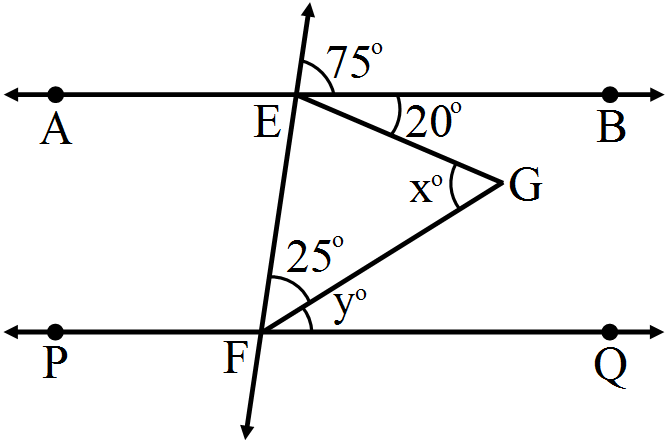
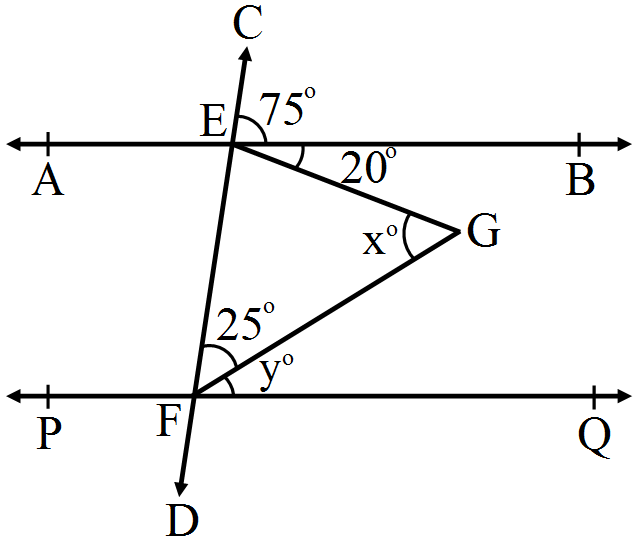
In the figure, $AB\ ||\ PQ.$ Find the value of $x$ and $y$.

Answer

Since $AB\ ||\ PQ$ and $EF$ is a transversal.
So, $\angle\text{CEB}=\angle\text{EFQ}$ [Corresponding angles]
$\Rightarrow\angle\text{EFQ}=75^\circ$
$\Rightarrow\angle\text{EFG}+\angle\text{GFQ}=75^\circ$
$25^\circ+\text{y}^\circ=75^\circ$
$\Rightarrow\text{y}=75-25=50$
Also, $\angle\text{BEF}+\angle\text{EFQ}=180^\circ$ [sum of consecutive interior angles is $180^\circ$]
$\angle\text{BEF}=180^\circ-\angle\text{EFQ}$
$=180^\circ-75^\circ$
$\angle\text{BEF}=105^\circ$
$\therefore\angle\text{FEG}+\angle\text{GEB}=\angle\text{BEF}=105^\circ$
$\Rightarrow\angle\text{FEG}=105^\circ-\angle\text{GEB}=105^\circ-20^\circ=85^\circ$
In $\triangle\text{EFG}$ we have,$\text{x}^\circ+25^\circ+\angle\text{FEG}=180^\circ$
$\Rightarrow\text{x}^\circ+25^\circ+85^\circ=180^\circ$
$\Rightarrow\text{x}^\circ+110^\circ=180^\circ$
$\Rightarrow\text{x}^\circ=180^\circ-110^\circ$
$\Rightarrow\text{x}^\circ=70^\circ$
Hence, $x = 70.$
View full question & answer
5 Mark Question - Maths STD 9 Questions - Vidyadip