Question 12 Marks
Express the following rational numbers as decimals:$\frac{327}{500}$
AnswerGiven rational number is $\frac{327}{500}$ Now we have to express this rational number into decimal form. So We will use long division method as below.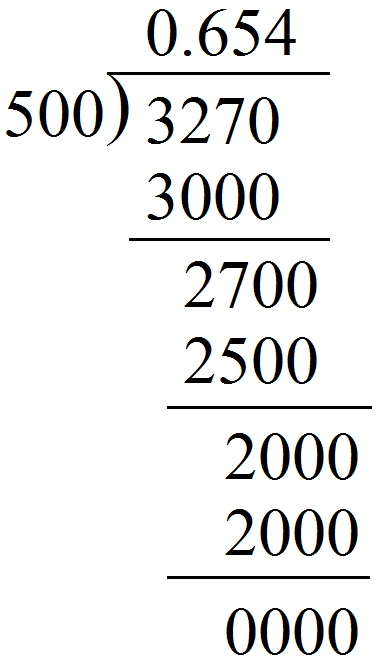
Hence, $\frac{327}{500}=0.654$ View full question & answer→Question 22 Marks
Identify the following as rational or irrational numbers. Give the decimal representation of rational numbers:$\sqrt{1.44}$
AnswerWe have,$\sqrt{1.44}$
$=\sqrt{\Big(\frac{144}{100}\Big)}$
$=\frac{12}{10}$
$=1.2$
Every terminating decimal is a rational number, so 1.2 is a rational number. Its decimal representation is 1.2.
View full question & answer→Question 32 Marks
Identify the following as rational or irrational numbers. Give the decimal representation of rational numbers:$\sqrt{4}$
AnswerWe have,$\sqrt{4}$ can be written in the form of
$\frac{\text{p}}{\text{q}}.$ So, it is a rational number. Its decimal representation is 2.0
View full question & answer→Question 42 Marks
Express the following rational numbers as decimals:$\frac{33}{26}$
AnswerBy long division, we have 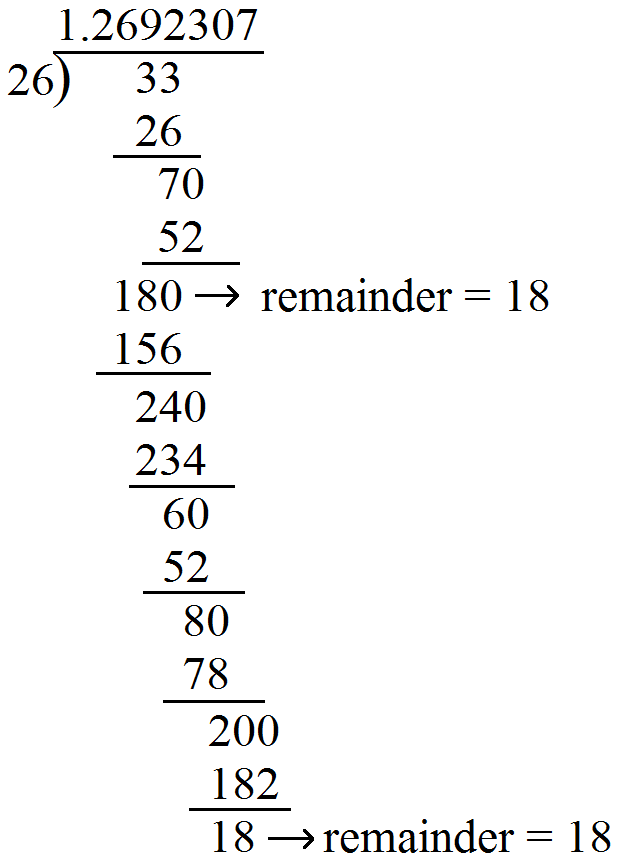 $\therefore\frac{33}{26}=1.2692307698307\ ...=1.\overline{2692307}$
 View full question & answer→Question 52 Marks
Express the following rational numbers as decimals:$\frac{2}{3}$
AnswerGiven rational number is $\frac{2}{3}$ Now we have to express this rational number into decimal form. So We will use long division method as below.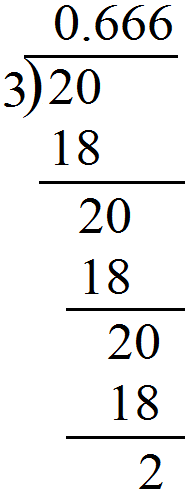
Therefore $\frac{2}{3}=0.6666$ $\Rightarrow\frac{2}{3}=0.\bar{6}$ Hence, $\frac{2}{3}=0.\bar{6}$ View full question & answer→Question 62 Marks
In the following equations, find which variables x, y and z etc. represent rational or irrational numbers:
$x^2=5$
AnswerWe have, $x^2 = 5$ Taking square root on both the sides, we get$\text{x}=\sqrt{5}$
$\sqrt{5}$ is not a perfect square root, so it is an irrational number.
View full question & answer→Question 72 Marks
In the following equations, find which variables x, y and z etc. represent rational or irrational numbers:$\text{u}^2=\frac{17}{4}$
AnswerWe have,$\text{u}^2=\frac{17}{4}$
Taking square root on both sides, we get,$\text{u}=\sqrt{\Big(\frac{17}{4}\Big)}$
$\text{u}=\Big(\frac{\sqrt{17}}{4}\Big)$
Quotient of an irrational and a rational number is irrational, so u is an Irrational number.
View full question & answer→Question 82 Marks
In the following equations, find which variables $x, y$ and $z$ etc. represent rational or irrational numbers:
$z^2=0.04$
Answer$z^2=0.04$ We have, Taking square root on the both sides, we get $z=0.2 \frac{2}{10}$ can be expressed in the form of $\frac{ a }{ b }$, so it is a rational number.
View full question & answer→Question 92 Marks
Identify the following as rational or irrational numbers. Give the decimal representation of rational numbers:$\sqrt{\Big(\frac{9}{27}\Big)}$
AnswerWe have,$\sqrt{\Big(\frac{9}{27}\Big)}$
$=\frac{3}{\sqrt{27}}$
$=\frac{1}{\sqrt{3}}$
Quotient of a rational and an irrational number is irrational numbers so $\frac{1}{\sqrt{3}}$ is an irrational number.$\sqrt{\Big(\frac{9}{27}\Big)}$ is an irrational number.
View full question & answer→Question 102 Marks
Express the following rational numbers as decimals:$\frac{15}{4}$
AnswerGiven rational number is $\frac{15}{4}$ Now we have to express this rational number into decimal form. So We will use long division method as below.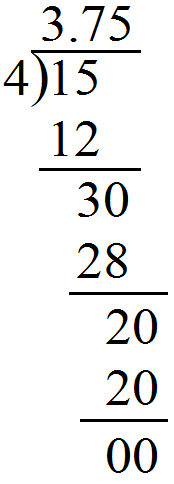
Hence, $\frac{15}{4}=3.75$ View full question & answer→Question 112 Marks
Is zero is rational number? Can you write it in the form $\frac{\text{p}}{\text{q}},$ where p and q are integers and $\text{q}\neq0?$
AnswerYes, zero is a rational number. It can be written in the form of $\frac{\text{p}}{\text{q}}$ where $\text{q}\neq0$ as such as $\frac{0}{3},\frac{0}{5},\frac{0}{11}, \ \text{etc }...$
View full question & answer→Question 122 Marks
Express the following rational numbers as decimals:$-\frac{4}{9}$
AnswerGiven rational number is $-\frac{4}{9}$ Now we have to express this rational number into decimal form. So We will use long division method as below.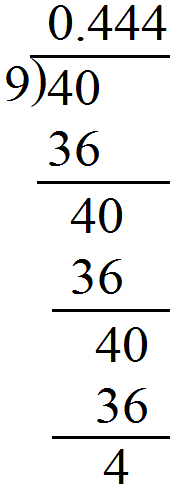
Therefore $\frac{4}{9}=0.444$ $\Rightarrow-\frac{4}{9}=0.\bar{4}$ Hence, $-\frac{4}{9}=-0.\bar{4}$ View full question & answer→Question 132 Marks
Express the following rational numbers as decimals:$\frac{42}{100}$
AnswerGiven rational number is $\frac{42}{100}$
Now we have to express this rational number into decimal form. We will use long division method as below.
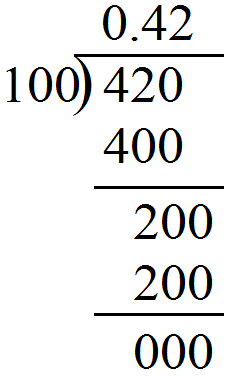
Hence, $\frac{42}{100}=0.42$ View full question & answer→Question 142 Marks
Express the following rational numbers as decimals:$-\frac{22}{13}$
AnswerGiven rational number is $-\frac{22}{13}$ Now we have to express this rational number into decimal form. So We will use long division method as below.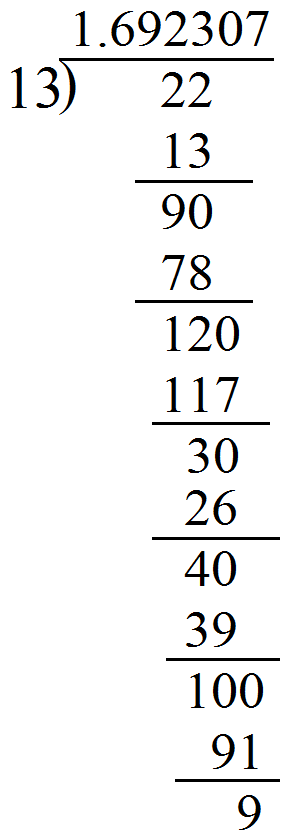
Therefore $\frac{2}{13}=1.692307$ $\Rightarrow\frac{22}{33}=\overline{1.692307}$ Hence, $\frac{-22}{13}-0.\overline{1.692307}$ View full question & answer→Question 152 Marks
Look at several examples of rational numbers in the form $\frac{\text{p}}{\text{q}}(\text{q}\neq0),$ where p and q are integers with no common factors other than 1 and having terminating decimal representations. Can you guess what property q must satisfy?
AnswerA rational number $\frac{\text{p}}{\text{q}}$ is a terminating decimal only, when prime factors of q are 2 and 5 only. Therefore, $\frac{\text{p}}{\text{q}}$ is a terminating decimal only, when prime factorization if q must have only powers of 2 or 5 or bith.
View full question & answer→Question 162 Marks
Identify the following as rational or irrational numbers. Give the decimal representation of rational numbers:$\sqrt{100}$
AnswerWe have,$\sqrt{100}$
= 10 can be expressed in the form of $\frac{\text{a}}{\text{b}},$ So $\sqrt{100}$ is a rational number Its decimal representation is 10.0.
View full question & answer→Question 172 Marks
In the following equations, find which variables x, y and z etc. represent rational or irrational numbers:$\text{v}^2=3$
AnswerWe have,$\text{v}^2=3$
Taking square root on both sides, we get,$\text{v}=\sqrt{3}$
$\sqrt{3}$ is not a perfect square root, so v is irrational number.
View full question & answer→Question 182 Marks
Identify the following as rational or irrational numbers. Give the decimal representation of rational numbers:$-\sqrt{64}$
AnswerWe have,$-\sqrt{64}$
$=-8$
$=-\Big(\frac{8}{1}\Big)$
$=-\Big(\frac{8}{1}\Big)$ can be expressed in the form of $\frac{\text{a}}{\text{b}},$
so $-\sqrt{64}$ is a rational number. Its decimal representation is -8.0.
View full question & answer→Question 192 Marks
Express the following rational numbers as decimals:$\frac{-2}{15}$
AnswerGiven rational number is $\frac{-2}{15}$ Now we have to express this rational number into decimal form. So We will use long division method as below.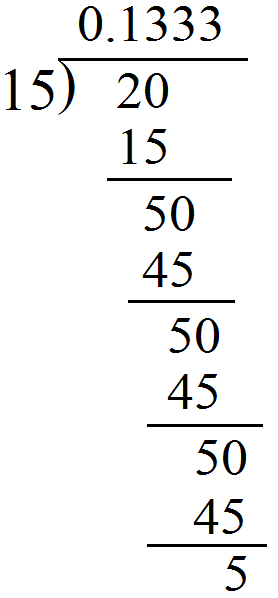
Therefore $\frac{2}{15}=0.13333$ $\Rightarrow\frac{2}{15}=0.\overline{13}$ Hence, $\frac{-2}{15}-0.\overline{13}$ View full question & answer→Question 202 Marks
Express the following rational numbers as decimals:$\frac{437}{999}$
AnswerGiven rational number is $\frac{437}{999}$ Now we have to express this rational number into decimal form. So We will use long division method as below.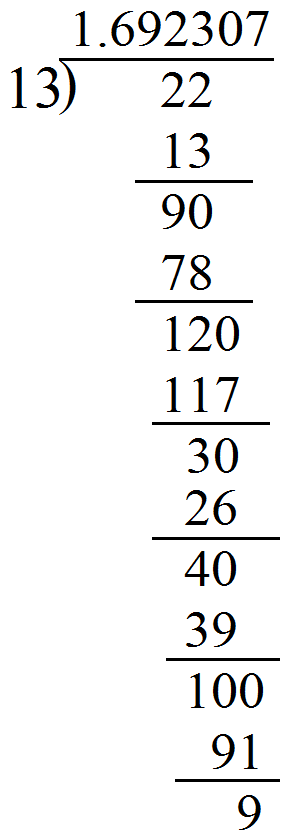
Therefore $\frac{2}{13}=1.692307$ $\Rightarrow\frac{22}{33}=\overline{1.692307}$ Hence, $\frac{-22}{13}-0.\overline{1692307}$ View full question & answer→Question 212 Marks
Identify the following as rational or irrational numbers. Give the decimal representation of rational numbers:$3\sqrt{18}$
AnswerWe have,$3\sqrt{18}$
$=3\times\sqrt{2}\times3\times3$
$=9\times\sqrt{2}$
Since, the product of a ratios and an irrational is an irrational number.$=9\times\sqrt{2}$ is an irrational.
$=3\times\sqrt{18}$ is an irrational number.
View full question & answer→