Questions

4 Mark Question

Take a timed test

9 questions · self-marked practice — reveal the answer and mark yourself.

Question 14 Marks
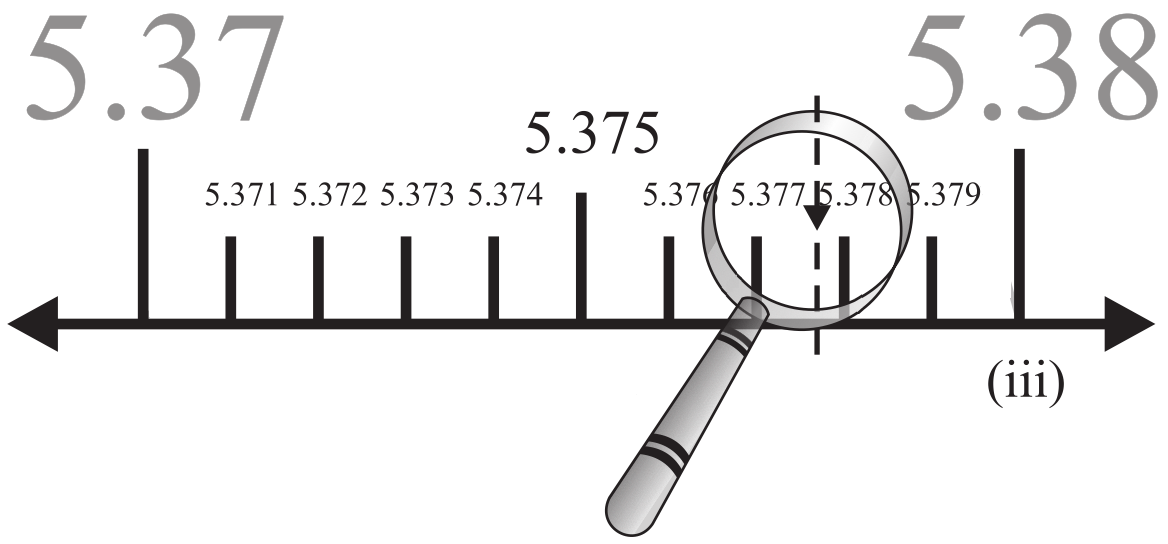
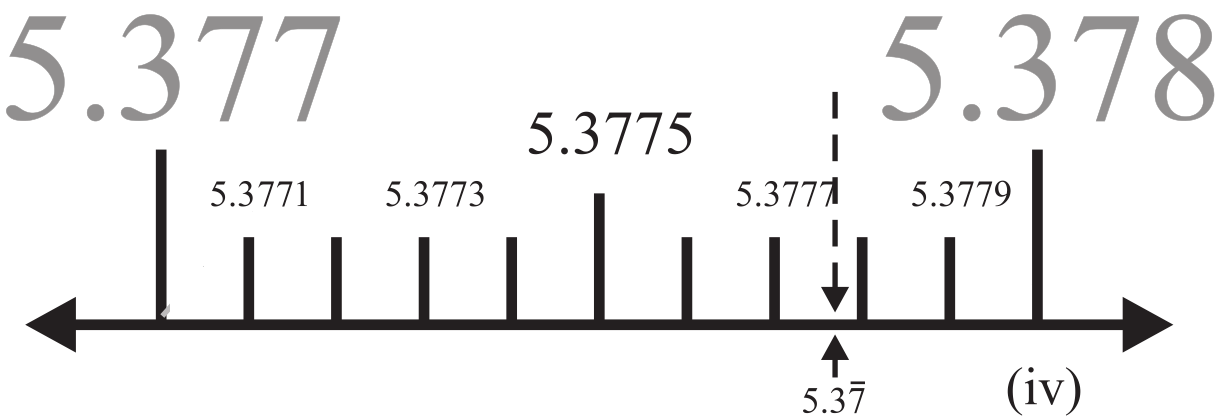
Visualise the representation of $5.3\bar{7}$ on the number line upto 5 decimal places, that is upto 5.37777.
Answer
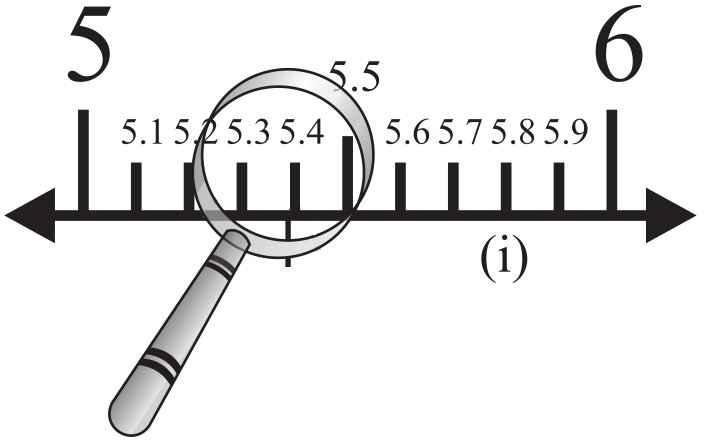
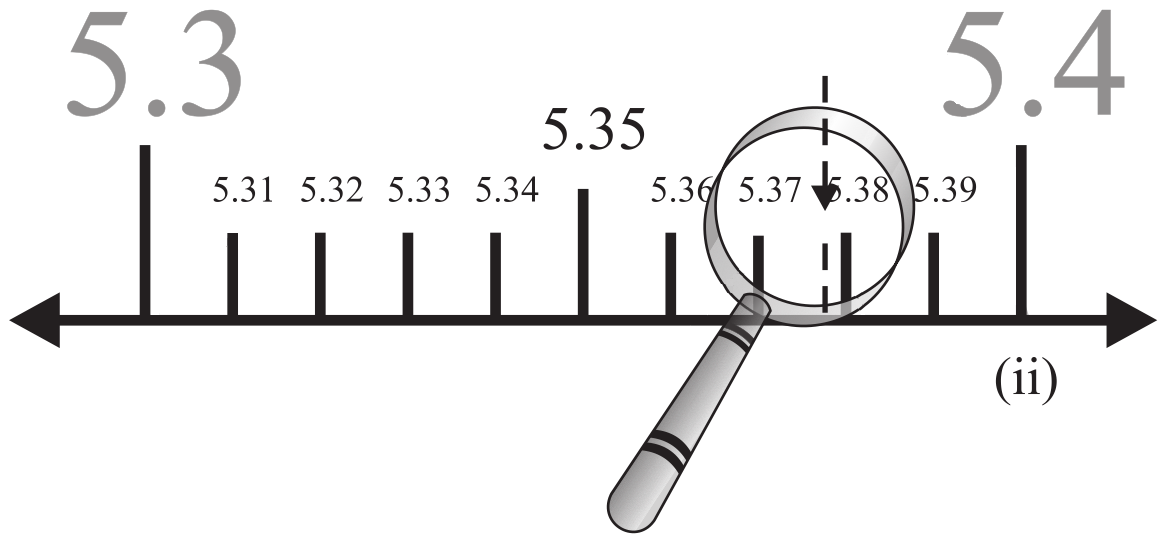
Once again we proceed by successive magnification, and successively decrease the lengths of the portions of the number line in which $5.3\bar{7}$ is located. First, we see that $5.3\bar{7}$ is located between 5 and 6. In the next step, we locate $5.3\bar{7}$ between 5.3 and 5.4. To get a more accurate visualization of the representation, we divide this portion of the number line into 10 equal parts and use a magnifying glass to visualize that $5.3\bar{7}$ lies between 5.37 and 5.38. To visualize $5.3\bar{7}$ more accurately, we again divide the portion between 5.37 and 5.38 into ten equal parts and use a magnifying glass to visualize that $5.3\bar{7}$ lies between 5.377 and 5.378. Now to visualize $5.3\bar{7}$ still more accurately, we divide the portion between 5.377 and 5.378 into 10 equal parts, and visualize the representation of $5.3\bar{7}$ as in fig.,(iv). Notice that $5.3\bar{7}$ is located closer to 5.3778 than to 5.3777 (iv).
View full question & answer
Question 24 Marks
Represent $\sqrt{3.4},\sqrt{9.4},\sqrt{10.5}$ on the real number line.
Answer

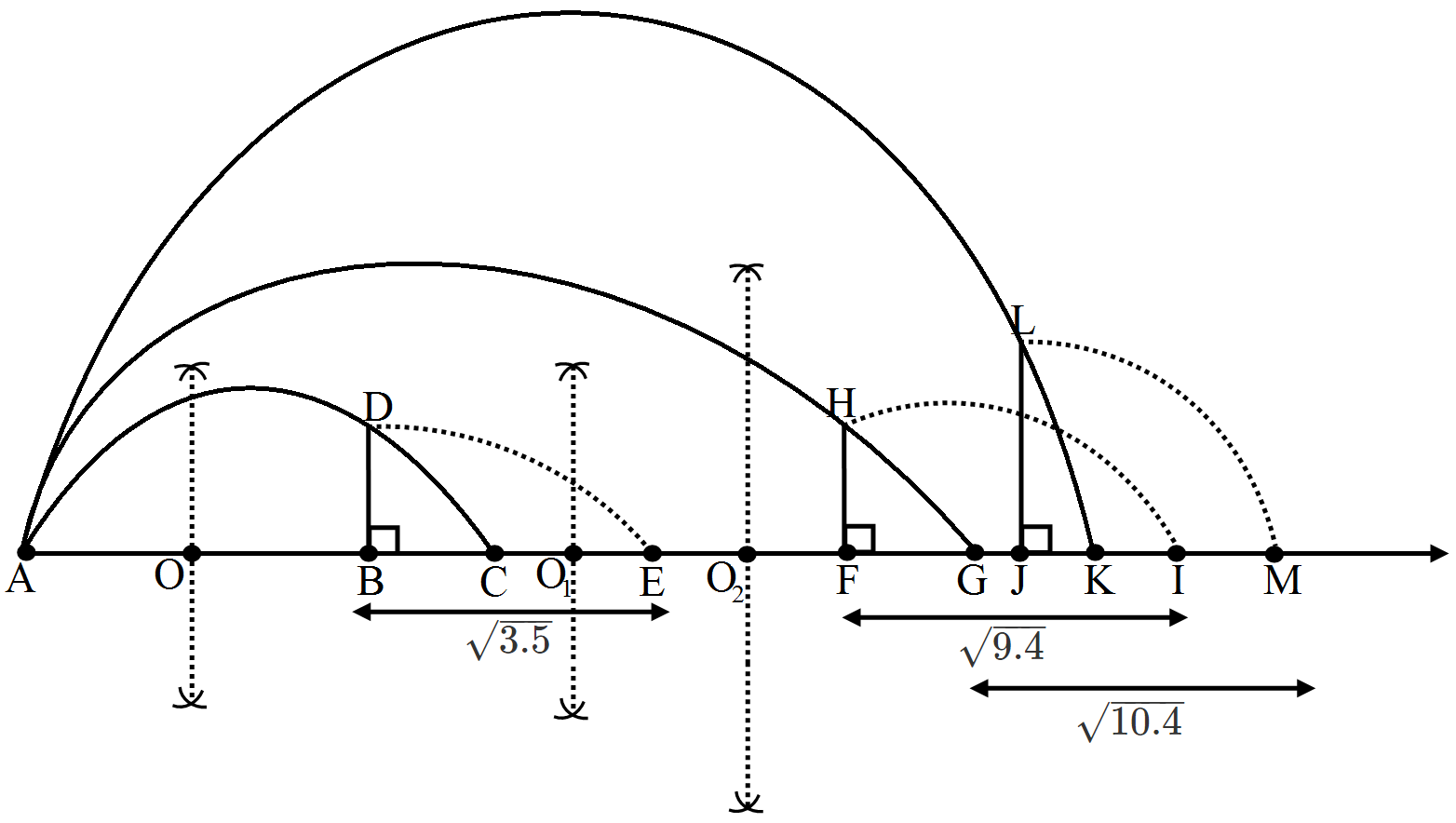
In order to represent $\sqrt{3.5}$ on number line, we follow the following steps:
1. Draw a line and mark a point $A$ on it.
2. Mark a point $B$ on the line drawn in step 1 such that $A B=3.5 cm$.
3. Mark a point c on AB produced such that $BC =1$ unit.
4. Find mid-point of $A C$. Let the mid-point be $O$.
5. Taking $O$ as the centre and $O C=O A$ as radius draw a semi-circle; also draw a line passing through $B$ perpendicular to $O B$. Suppose it cuts the semi-circle at $D$.
6. Taking $B$ as the centre and $B D$ as radius draw an arc cutting $O C$ produced at $E$. Point $E$ so obtained represent $\sqrt{3.5}$.

In order to represent $\sqrt{9.4}$ on number line, we follow the following steps:
1. Mark a point F on the line drawn such that $AF =9.4 cm$
2. Mark a point G on AF produced such that $FG =1$ unit.
3. Find mid-point of $A G$. Let the mid-point be $O_1$.
4. Taking $O _1$ as the centre and $O _1 A= O _1 G$ as radius draw a semi-circle. Also, draw a line passing through F perpendicular to $O _1 F$. Suppose it cuts the semi-circle at H
5. Taking F as the centre and FH as radius draw an arc cutting $O _1 G$ produced at I. Point I so obtained represents $\sqrt{9.4}$.

In order to represent $\sqrt{10.5}$ on number line, we follow the following steps:
1. Mark a point $J$ on the line such that $A J=10.5 cm$.
2. Mark a point $K$ on $A J$ produced such that $J K=1$ unit.
3. Find mid-point of $A K$. Let the mid-point be $O _2$.
4. Taking $O _2$ as the centre and $O _2 A= O _2 K$ as radius draw a semi-circle. Also, draw a line passing through J perpendicular to $O _2 J$. Suppose it cuts the semi-circle at L .
5. Taking J as the centre and J as radius draw an arc cutting $O _2 K$ produced at M . Point M so obtained represents $\sqrt{10.5}$
View full question & answer
Question 34 Marks
Represent $\sqrt{6},\sqrt{7},\sqrt{8}$ on the number line.
Answer

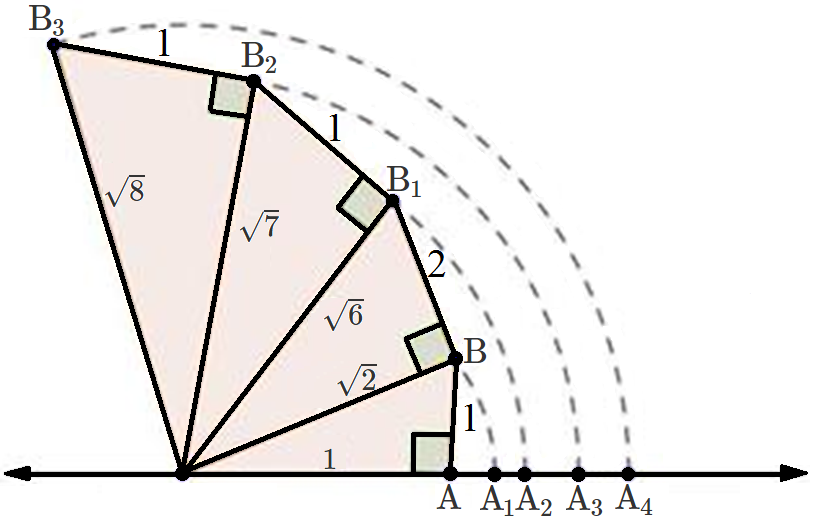
Draw a number line and mark a point O, representing zero, on it. Suppose point A represents 1 as shown. Then, $O A$
$=1$.
Draw a right triangle $O A B$ such that $A B=O A=1$.
By pythagoras theorem, we have
$(OB)^2=(OA)^2+(AB)^2$
$\Rightarrow OB{ }^2=1^2+1^2=OB 2=1+1=2$
$\Rightarrow OB=\sqrt{2}$
Now, draw a circle with centre O and radius OB . We find that the arcle cuts the number line at A .
Clearly, $A _1= OB =$ Radius of the cirde $=\sqrt{2}$
Thus, $A _1$ represents $\sqrt{2}$ on the number line.
Now, draw a right triangle $OBB _1$, such that $BB _1=2$.
Again by pythagoras theorem, we have,
$OB_1^2=OB^2+BB_1^2$
$\Rightarrow OB_1^2=(\sqrt{2})^2+(2)^2$
$\Rightarrow OB_1^2=6$
$\Rightarrow OB_1=\sqrt{6}$
Now, draw a circle with centre O and radius $OB _1$. We find that the circle cuts the number line at $A _2$.
Clearly, $OA _2= OB _2=$ Radius of circle $=\sqrt{6}$
Thus, $A_2$ represents $\sqrt{6}$ on the number line.
Now, draw a right angle triangle $OB _1 B_2$ such that $B _1 B_2=1$.
By pythagoras theorem, we have,
$OB_2^2=OB_1^2+B_1 B_2^2$
$\Rightarrow OB_2^2=(\sqrt{6})^2+(1)^2$
$\Rightarrow OB_2^2=6+1=7$
$\Rightarrow OB_2=\sqrt{7}$
Now, draw a circle with centre O and radius $OB _2$. We find that the circle cuts the number line at $A _3$.
Clearly, $OA _3= OB _2=$ Radius of circle $=\sqrt{7}$
Thus, $A_3$ represents $\sqrt{7}$ on the number line.
Now, again draw a right triangle $OB _2 B_3$ such that $B _2 B_3=1$.
By pythagoras theorem, we have,
$OB_3^2=OB_2^2+B_2 B_3^2$
$\Rightarrow OB_3^2=(\sqrt{7})^2+(1)^2$
$\Rightarrow OB_3^2=7+1=8$
$\Rightarrow OB_3=\sqrt{8}$
Now, draw a circle with centre O and radius $OB _3$. We find that the circle cuts the number line at $A _4$.
Clearly, $OA _4= OB _3=$ Radius of circle $=\sqrt{8}$
View full question & answer
Question 44 Marks
Find a rational number and also an irrational number lying between the numbers 0.3030030003... and 0.3010010001...
Answer
Let,
a = 0.3010010001 and,
b = 0.3030030003...
We observe that in the third decimal place a has digit 1 and b has digit 3, therefore a < b in the third decimal place a has digit 1. So, if we consider rational and irrational numbers.
x = 0.302
y = 0.302002000200002.....
We find that a < x < b and, a < y < b.
Hence, x and y are required rational and irrational numbers respectively.
View full question & answer
Question 54 Marks
Visualise $2.665$ on the number line, using successive magnification.
Answer
The following steps for successive magnification to visualise 2.665 are:
  1. We observe that 2.665 is located somewhere between 2 and 3 on the number line. So, let us look at the portion of the number line between 2 and 3.
  1. We divide this portion onto 10 equal parts and mark each point of division. The first mark to the right of 2 will represent 2.1, the next 2.2 and soon. Again we observe that 2.665 lies between 2.6 and 2.7
  1. We mark these points $A _1$ and $A _2$ respectively. The first mark on the right side of $A _{\text {, will represt rent } 2.61 \text {, the }}$ number 2.62 , and soon. We observe 2.665 lies between 2.66 and 2.67 .
  1. Let us mark 2.66 as $B_1$ and 2.67 as $B_2$. Again divide the $B_1 B_2$ into ten equal parts. The first mark on the right side of $B_1$ will represent 2.661 , then next 2.662 , and so on.

Clearly, fifth point will represent $2.665.$
View full question & answer
Question 64 Marks
Find six rational numbers between 3 and 4.
Answer
Given that to find out six rational numbers between 3 and 4 We have,$3\times\frac{7}{7}=\frac{21}{7}$ and
$4\times\frac{6}{6}=\frac{28}{7}$
We know 21 < 22 < 23 < 24 < 25 < 26 < 27 < 28$\frac{21}{7}<\frac{22}{7}<\frac{23}{7}<\frac{24}{7}<\frac{25}{7}<\frac{26}{7}<\frac{27}{7}<\frac{28}{7}$
$3<\frac{22}{7}<\frac{23}{7}<\frac{24}{7}<\frac{25}{7}<\frac{26}{7}<\frac{27}{7}<4$
Therefore, 6 rational numbers between 3 and 4 are$\frac{22}{7},\frac{23}{7},\frac{24}{7},\frac{25}{7},\frac{26}{7},\frac{27}{7}$
Similarly to find 5 rational numbers between 3 and 4, multiply 3 and 4 respectively with $\frac{6}{6}$ and in order to find 8 rational numbers between 3 and 4 multiply 3 and 4 respectively with $\frac{8}{8}$ and so on.
View full question & answer
Question 74 Marks
Find five rational numbers between 1 and 2.
Answer
As we have to find 5 rational numbers, we multiply the numbers by $\frac{6}{6}$$1=1\times\frac{6}{6}=\frac{6}{6}$
and $2=2\times\frac{6}{6}=\frac{12}{6}$ Thus, 5 Rational numbers between 1 & 2 $\Big(\text{i.e}\ \frac{6}{6}\ \&\ \frac{12}{6}\Big)$ are $\frac{7}{6},\frac{8}{6},\frac{9}{6},\frac{10}{6},\frac{11}{6}$
View full question & answer
Question 84 Marks
Find three different irrational numbers between the rational numbers $\frac{5}{7}$ and $\frac{9}{11}.$
Answer
$\frac{5}{7}=0.\overline{714285}$$\frac{9}{11}=0.\overline{81}$
3 irrational numbers are-
0.73073007300073000073... 0.75075007500075000075... 0.790790079000790000...
Concept Insight: There is infinite number of rational and irrational numbers between any two rational numbers. Convert the number into its decimal form to find irrationals between them.
Alternatively following result can be used to answer:
Irrational number between two numbers x and y
$=\sqrt{\text{xy}},$ if x and y both are irrational numbers
$=\sqrt{\text{xy}},$ if x is rational number and y is irrational number
$=\sqrt{\text{xy}},$ if x × y is not a perfect square and x, y both are rational numbers
View full question & answer
Question 94 Marks
Prove that $\sqrt{3}+\sqrt{5}$ is an irrational number.
Answer
If possible, let $\sqrt{3}+\sqrt{5}$ be a rational number equal to x. Then,$\text{x}=\sqrt{3}+\sqrt{5}$
$\text{x}^2=\Big(\sqrt{3}+\sqrt{5}\Big)^2$
$\text{x}^2=8+2\sqrt{15}$
$\frac{\text{x}^2-8}{2}=\sqrt{15}$
Now, $\sqrt{\frac{\text{x}^2-8}{2}}$ is rational$\sqrt{15}$ is rational
Thus, we arrive at a contradiction. Hence, $\sqrt{3}+\sqrt{5}$ is an irrational number.
View full question & answer