MCQ 11 Mark
$\text{ABCD}$ is a parallelogram and $E$ is the mid $-$ point of $BC. DE$ and $AB$ when produced meet at $F$. Then $,AF =$
- A
$\frac{3}{2}\text{AB}$
- ✓
$2\text{AB}$
- C
$3\text{AB}$
- D
$\frac{5}{4}\text{AB}$
AnswerCorrect option: B. $2\text{AB}$
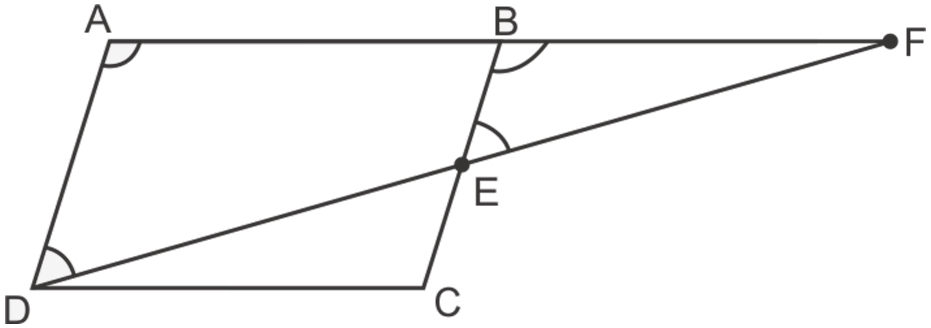
$BE \| AD$
$\Rightarrow BE \| AD$
Now, consider $\triangle\text{FAD}$
$BE \| AD$
Also $\frac{\text{BE}}{\text{AD}}=\frac{1}{2}$
In $\triangle\text{FBE}$ and $\triangle\text{FAD},$
$\angle\text{FAD}=\angle\text{FBE} \ ($Corresponding angles$)$
$\angle\text{ADF}=\angle\text{BEF}\ ($Corresponding angles$)$
$\angle\text{F} =\angle\text{F} \ ($Common$)$
Hence, $\triangle\text{FBE}\sim\triangle\text{FAD}$
$\Rightarrow\frac{\text{BF}}{\text{AF}}=\frac{\text{BE}}{\text{AD}}=\frac{1}{2}$
$\Rightarrow1-\frac{\text{BF}}{\text{AF}}=1-\frac{1}{2}$
$\Rightarrow\frac{\text{AF}-\text{BF}}{\text{AF}}=\frac{1}{2}$
$\Rightarrow\frac{\text{AB}}{\text{AF}}=\frac{1}{2}$
$\Rightarrow\text{AF}=\text{2AB}$ View full question & answer→MCQ 21 Mark
In a parallelogram $\text{ABCD},$ if $\angle\text{DAB}=75^\circ$ and $\angle\text{DBC}=60^\circ,$ then $\angle\text{BDC}=$
- A
$75^\circ$
- B
$60^\circ$
- ✓
$45^\circ$
- D
$55^\circ$
AnswerCorrect option: C. $45^\circ$
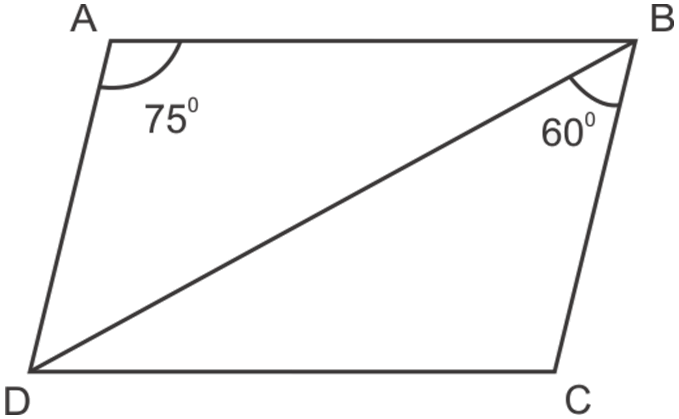
In parallelogram $\text{ABCD},$
$\angle\text{A}+\angle\text{D}=180^\circ$
$\Rightarrow\angle\text{D}=180^\circ-75^\circ=105^\circ$
$\angle\text{ADB}=\angle\text{DBC} \ ($Alternate angles$)$
$\Rightarrow\angle\text{ADB}=60^\circ$
$\angle\text{BDC}=\angle\text{ADC}-\angle\text{ADB}$
$=105^\circ-60^\circ=45^\circ$ View full question & answer→MCQ 31 Mark
The figure formed by joining the mid $-$ points of the adjacent sides of a quadrilateral is a:
Answer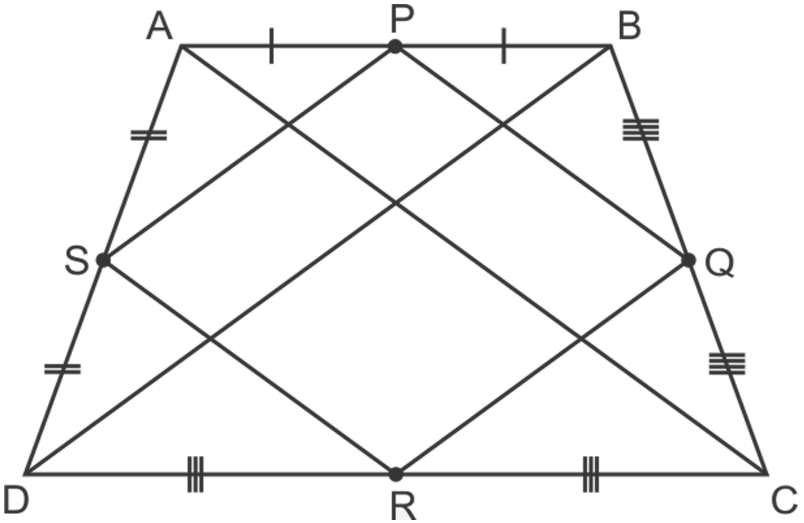
$P, Q, R S$ are the mid $-$ points of $AB, BC, CD, AD$ respectively.
Consider $\triangle\text{ADB},$
If in a triangle, the mid $-$ points of two sides are joint by a line then the line is parallel to the third side.
$\Rightarrow\text{PS}\|\text{DB}$ in $\triangle\text{ADB}$
Similarly in $\triangle\text{CDB},$
$RQ \| DB$
Hence $PS \| RQ ...(1)$
Similarly in $\triangle\text{ABC}$ and $\triangle\text{ADC}$
$SR \| AC, PQ \| AC$
$\Rightarrow SR \| PQ ...(2)$
From eq. $(1)$ and $(2), \text{PQRS}$ is a parallelogram. View full question & answer→MCQ 41 Mark
In a rhombus $\text{ABCD},$ if $\angle\text{ACB}=40^\circ,$ then $\angle\text{ADB}=$
- A
$70^\circ$
- B
$45^\circ$
- ✓
$50^\circ$
- D
$60^\circ$
AnswerCorrect option: C. $50^\circ$
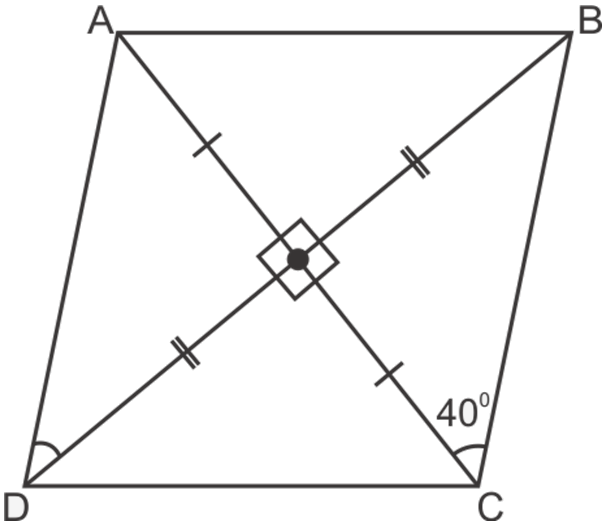
Consider $\triangle\text{AOD} \ \ \ \triangle\text{COB}$
$\angle\text{AOD}=\angle\text{COB}=90^\circ$
$AD = BC\ ($Sides of Rhombus$)$
$AO = CO\ ($Diagonals bisects each other$)$
So by $\text{RHS}$ property, $\triangle\text{AOD}\cong\triangle\text{COB}$
$\Rightarrow\angle\text{OAD}=\angle\text{OCB}=40^\circ$
$\angle\text{ADB}=\angle\text{ADO}$
$=180^\circ-90^\circ-40^\circ=50^\circ$ View full question & answer→MCQ 51 Mark
If an angle of a parallelogram is two $-$ third of its adjacent angle, the smallest angle of the parallelogram is:
- A
$108^\circ$
- B
$54^\circ$
- ✓
$72^\circ$
- D
$81^\circ$
AnswerCorrect option: C. $72^\circ$
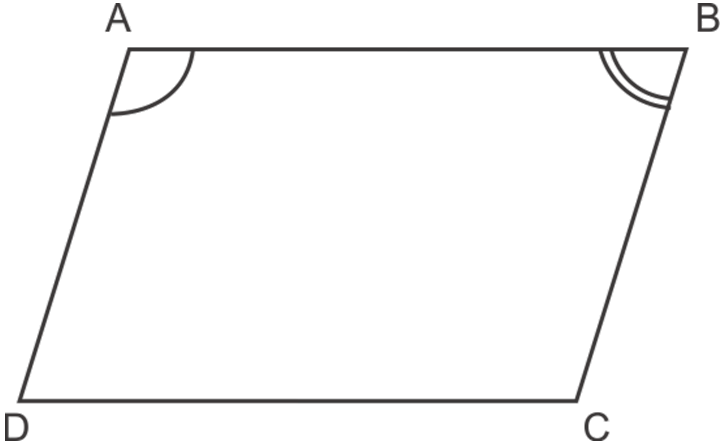
Let $\text{ABCD}$ be a parallelogram and $\angle\text{A}=\frac{2}{3}\angle\text{B}$
Also, $\angle\text{A}+\angle\text{B}=180^\circ \ ($Adjacent angles in a parallelogram are supplementry$)$
$\Rightarrow\frac{2}{3}\angle\text{B}+\angle\text{B}=180^\circ$
$\Rightarrow\angle\text{B}=108^\circ$ and $\angle\text{A}=72^\circ$
$\Rightarrow$ Smallest angle is $72^\circ .$ View full question & answer→MCQ 61 Mark
We get a rhombus by joining the mid $-$ points of the sides of a:
Answer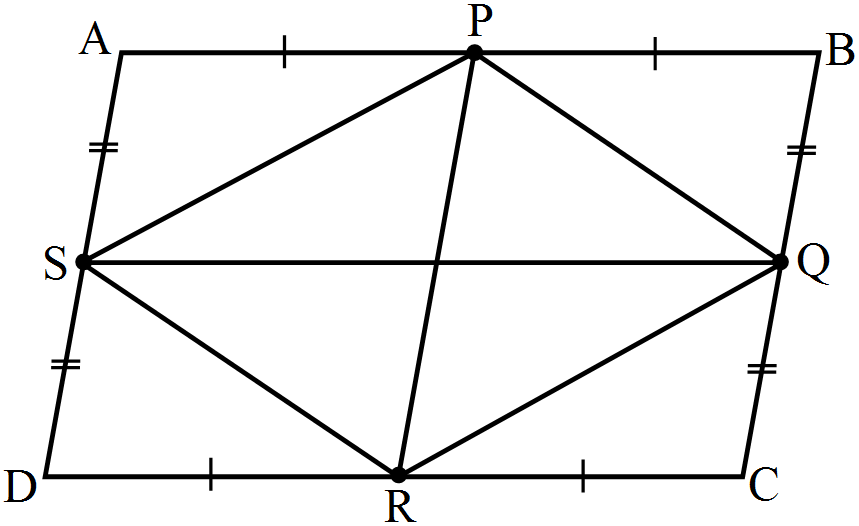
$\text{PR}\|\text{AD}$
$\Rightarrow\text{AB}\not\bot\text{AD}$
$\text{QS}\|\text{AB}$
$\Rightarrow\text{PR}\not\bot\text{QS}$
Since diagonals of $\text{PQRS}$ are not making $90^\circ$ between them,
$\text{PQRS}$ is not a Rhombus.
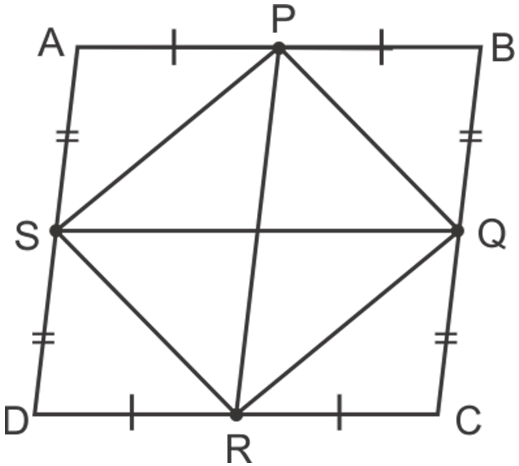
$P, Q, R$ and $S$ are the mid $-$ points,
$PR$ and $QS$ are diagonals of quadrilateral $\text{PQRS}.$
$PR \| AD, QS \| AB$
Because they are Formed by joning of mid $-$ points of sides of Rhombus $\text{ABCD}.$
$AD$ is not $\bot$ to $AB$
$\Rightarrow PR$ will not be $\bot$ to $QS$
i.e angle between diagonals $PR ,QS$ is not $90^\circ .$
So, $\text{PQRS}$ is not a Rhombus.
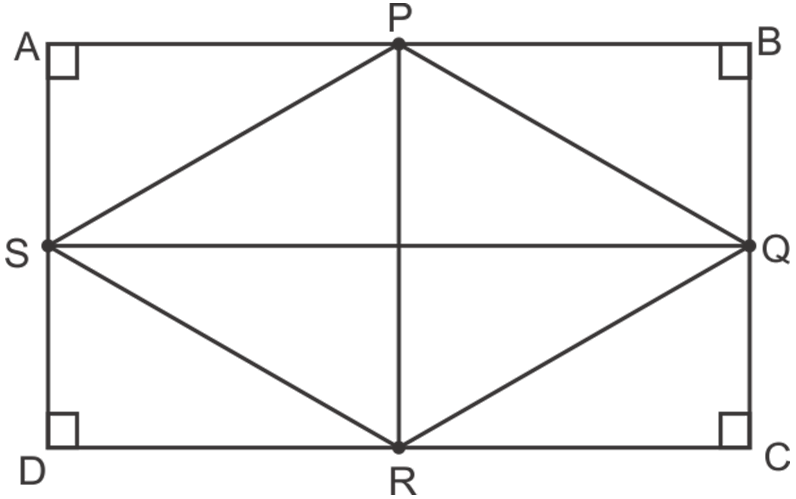
$PR$ and $QS$ are making $90^\circ$ with each $-$ other.
Because $PR \| AD, QS \| AB$ and $\text{AD}\perp\text{AB}$
So $PR$ and $QS$ are diagonals of $\text{PQRS}$ and are $\perp$ to each other.
Hence , $\text{PQRS}$ is a Rhombus.
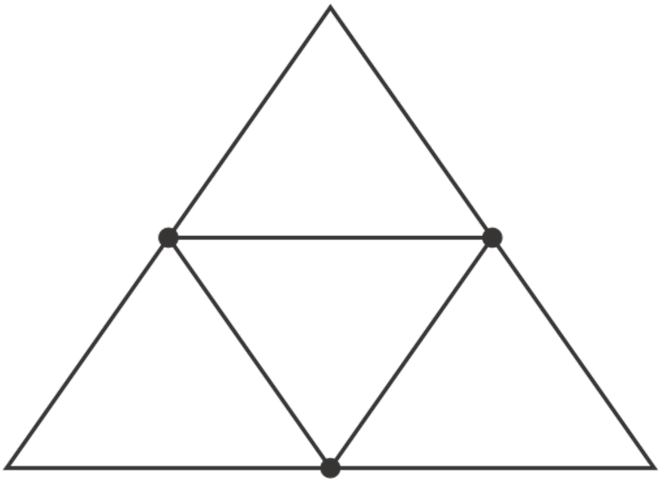
By joining the mid $-$ points of sides of a triangle, no quadrilateral is formed. View full question & answer→MCQ 71 Mark
The bisectors of any two adjacent angles of a parallelogram intersect at:
- A
$30^\circ$
- B
$45^\circ$
- C
$60^\circ$
- ✓
$90^\circ$
AnswerCorrect option: D. $90^\circ$
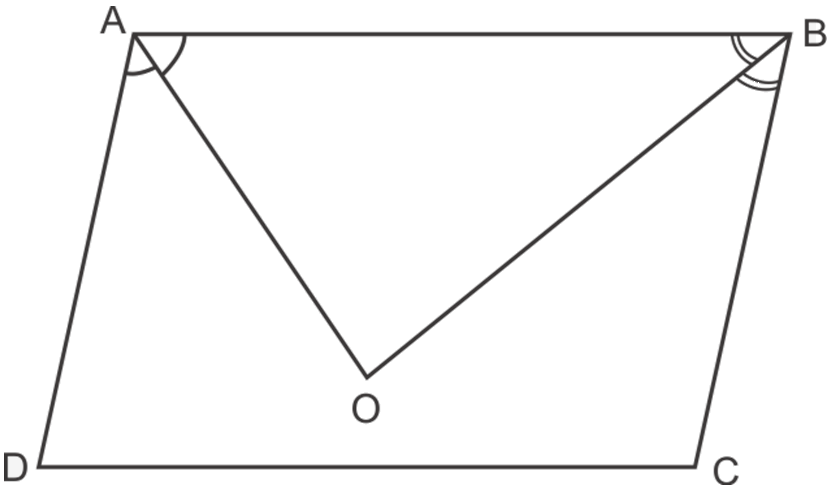
In a parallelogram, sum of adjacent angles $= 180^\circ$
$\Rightarrow \angle \text{A}+\angle\text{B}=180^\circ$
$\Rightarrow\frac{\angle\text{A}}{2}+\frac{\angle\text{B}}{2}=90^\circ\ ...(1)$
$\Rightarrow\angle\text{OAB}=\frac{\angle\text{A}}{2}$ and $\angle\text{OBA}=\frac{\angle\text{B}}{2}$
Thus, $\angle\text{OAB}+\angle\text{OBA}=90^\circ\ [$From eq $(1)]$
$\Rightarrow\angle\text{AOB}=180^\circ-(\angle\text{OAB}+\angle\text{OBA})=180^\circ-90^\circ$
$\Rightarrow\angle\text{AOB}=90^\circ$ View full question & answer→MCQ 81 Mark
The figure formed by joining the mid $-$ points of the adjacent sides of a rectangle is a:
Answer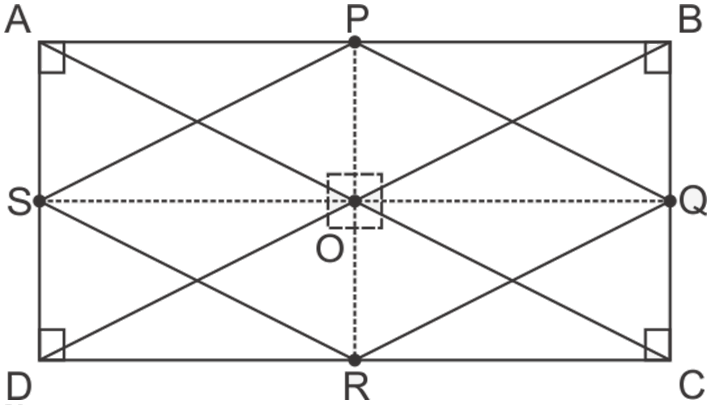
$PQ \| AC\ ($since in $\triangle\text{ABC}$ mid $-$ points of $AB , BC$ are meeting by $PQ)$
Similarly $, SR \| AC$
$\Rightarrow PQ \| SR$
Now in $\triangle\text{ABD}$ and $\triangle\text{CBD},$
$PS \| BD$ and $QR \| BD$
$\Rightarrow PS\| QR$
Hence, $\text{PQRS}$ is a parallelogram.
But $\text{PR }\bot \text{ QS}$
$\Rightarrow$ Diagonals cut at $90^\circ$
$\Rightarrow \text{PQRS}$ is a Rhomus. View full question & answer→MCQ 91 Mark
The consecutive sides of a quadrilateral have:
- A
- ✓
- C
- D
Infinitely many common points.
Answer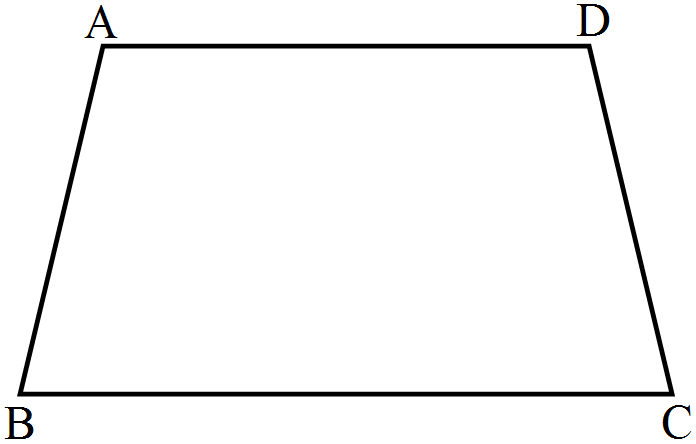
Consecutive sides of a Quadrilateral $\text{ABCD}$ are
$AB$ and $BC,$
$BC$ and $CD,$
$CD$ and $AD,$
$AD$ and $AB,$
Which have only one point in common
i.e the joint point of their ends. View full question & answer→MCQ 101 Mark
The figure formed by joining the mid $-$ points of the adjacent sides of a parallelogram is a:
Answer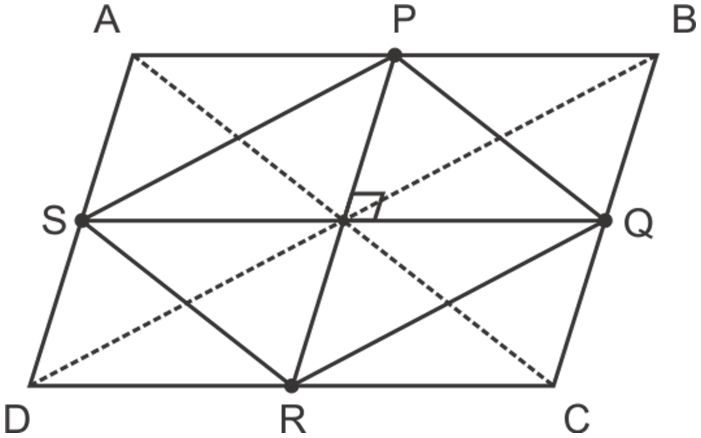
$PQ \| SR \| AC$
$QR \| PS \| BD$
Because line joining the mid $-$ points of two sides of triangle is $\|$ to third side
Now because $AC$ is not prependicular to $BD$ in parallelogram,
$\Rightarrow SR$ is not perpendicular to $QR$
Also $\triangle\text{ASP}\not\cong\triangle\text{DRS}$
$\Rightarrow \text{PS} \neq \text{SR}$
$\Rightarrow \text{PQRS}$ is just a parallelogram. View full question & answer→MCQ 111 Mark
Digonals necessarily bisect opposite angles in a:
AnswerDiagonals necessarily bisect opposite angles in a square.
View full question & answer→MCQ 121 Mark
$P$ is the mid $-$ point of side $BC$ of a parallelogram $\text{ABCD}$ such that $\angle\text{BAP}=\angle\text{DAP}.$ If $AD = 10\ cm,$ then $CD =$
- ✓
$5\ cm.$
- B
$6\ cm.$
- C
$8\ cm.$
- D
$10\ cm.$
AnswerCorrect option: A. $5\ cm.$
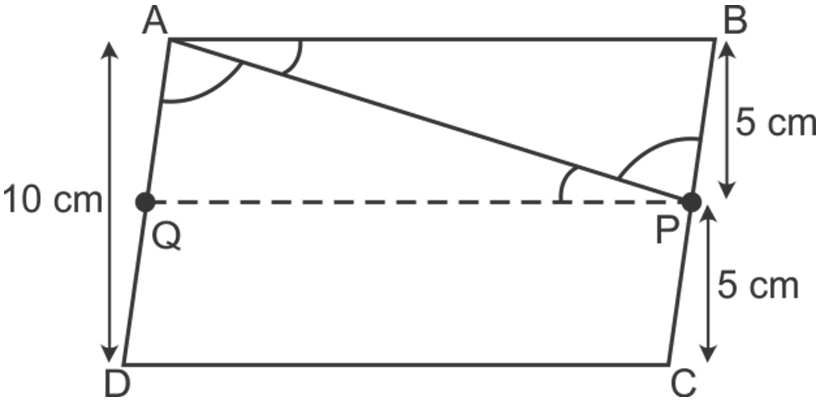
Let a line parallel to $AB$ is drawn from $P$ to meet $AD$ at $Q$.
$PQ \| AB \| DC$
$Q$ is also mid $-$ point of $AD$.
Now, consider parallelogram $\text{ABPQ}$.
$\angle\text{PAQ}=\angle\text{APB} \ ($Alternate angles$)$
Also $\angle\text{PAQ}=\angle\text{BAP} ($Given$)$
$\Rightarrow\angle\text{APB}=\angle\text{BAP}$
So $\triangle\text{ABP}$ is isoseceles triangle.
$\Rightarrow\text{BP}=\text{AB}$
i.e. $\text{AB}=\frac{10}{2}=5\text{ cm}$ View full question & answer→MCQ 131 Mark
If one angle of a parallelogram is $24^\circ$ less than twice the smallest angle, then the measure of the largest angle of the largest angle of the parallelogram is:
- A
$176^\circ$
- B
$68^\circ$
- ✓
$112^\circ$
- D
$102^\circ$
AnswerCorrect option: C. $112^\circ$
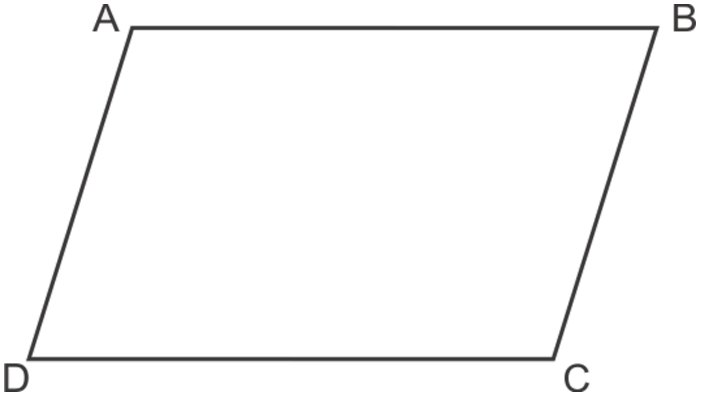
Let the smallest angle $=\angle\text{ADC}=\text{x}^\circ$
Other angle $\angle\text{BCD}$
$\Rightarrow\angle\text{BCD}=2\text{x}^\circ-24^\circ$
Also, $\angle\text{ACD}+\angle\text{BCD}=180^\circ$ (Sum of adjacent angles in $\|^{gram} = 180^\circ)$
$\Rightarrow\text{x}^\circ+2\text{x}^\circ-24^\circ=180^\circ$
$\Rightarrow3\text{x}^\circ=204^\circ$
$\Rightarrow\text{x}=68^\circ$
$\Rightarrow$ Largest angle $=\angle\text{BCD}=2\times68^\circ-24^\circ=112^\circ$ View full question & answer→MCQ 141 Mark
In $E$ is the mid $-$ point of median $AD$ such that $BE$ produced meets $AC$ at $F$. If $AC = 10.5\ cm$, then $AF =$
- A
$3\ cm.$
- ✓
$3.5\ cm.$
- C
$2.5\ cm.$
- D
$5\ cm.$
AnswerCorrect option: B. $3.5\ cm.$
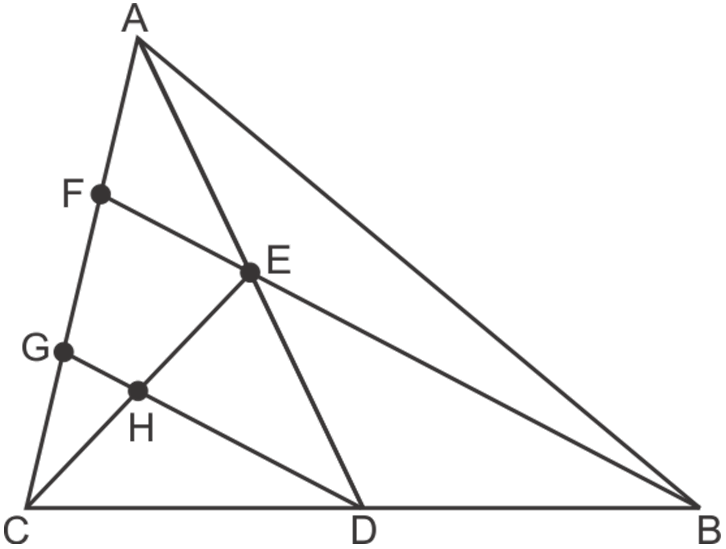
$A$ line $DG$ is drawn parallel to $EF$ to meet $AC$.
$FE\| DG $ and $FE\| GH$
Now, consider $\triangle\text{ADG}.$
$E$ is the mid $-$ point of $AD$ and $EF$ is line from $E \|$ to Base $DG$.
So by property, it will meet $AG$ at its midpoint
i.e. $F$ is midpoint of $AG.$
$\Rightarrow AF = FG ...(1)$
Now, consider $\triangle\text{FBC}\ \ \ \triangle\text{GDC}$
$FE \| GH$ and $FE \| GD$
$D$ is mid $-$ point of $BC$.
$\Rightarrow\frac{\text{DC}}{\text{BC}}=\frac{1}{2}\dots(2)$
Because $\triangle\text{FBC}\sim\triangle\text{GDC},$
$\Rightarrow\frac{\text{GC}}{\text{FC}}=\frac{1}{2}$
$\Rightarrow FC = 2GC$
or $FG = GC ...(3)$
From equation $(1)$ and $(3)$
$AF = FG = GC$
$\Rightarrow\text{AF}=\frac{\text{AC}}{3}=\frac{10.5}{3}=3.5\text{cm}$ View full question & answer→MCQ 151 Mark
The diagonals $AC$ and $BD$ of a rectangle $\text{ABCD}$ intersect each other at $P$. If $\angle\text{ABD}=50^\circ,$ then $\angle\text{DPC}=$
- A
$70^\circ$
- B
$90^\circ$
- ✓
$80^\circ$
- D
$100^\circ$
AnswerCorrect option: C. $80^\circ$
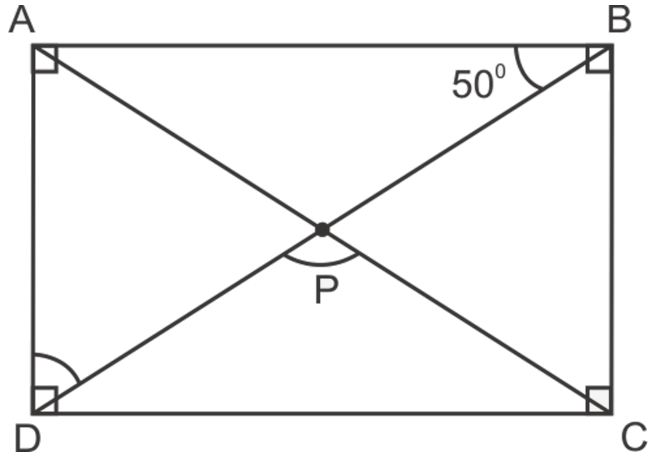
In $\triangle\text{ABD},$
$\angle\text{BDA}+\angle\text{ABD}+\angle\text{DAB}=180^\circ$
$\angle\text{ABD}=50^\circ$ and $\angle\text{DAB}=90^\circ$
$\Rightarrow\angle\text{BDA}=180^\circ-90^\circ-50^\circ=40^\circ$
Consider $\triangle\text{ABD}\ \ \ \triangle\text{BAC}$
$\text{AD}=\text{BC},\ \angle\text{DAB}=\angle\text{ABC}=90^\circ,\text{BD}=\text{AC}$
Hence, by $\text{RHS}$ property $\triangle\text{ABD}\cong\triangle\text{BAC}$
$\Rightarrow\angle\text{ABD}=\angle\text{BAC}=50^\circ$
Now, consider $\triangle\text{ABP}$
$\angle\text{PAB}+\angle\text{PBA}+\angle\text{APB}=180^\circ$
$\angle\text{PAB}=\angle\text{BAC}=50^\circ$
$\angle\text{PAB}=\angle\text{ABD}=50^\circ$
$\Rightarrow\angle\text{APB}=180^\circ-50^\circ-50^\circ=80^\circ$
Now, $\angle\text{APB}=\angle\text{DPC} ($Opposite angles$)$
$\Rightarrow\angle\text{DPC}=80^\circ$ View full question & answer→MCQ 161 Mark
Which of the following quadrilateral is not a rhombus?
AnswerCorrect option: D. One angle between the diagonals is $60^\circ$ .
For a rhombus, the angle between the diagonals is $90^\circ$ and not $60^\circ$ .
View full question & answer→MCQ 171 Mark
The figure formed by joining the mid $-$ points of the adjacent sides of a Square is a:
Answer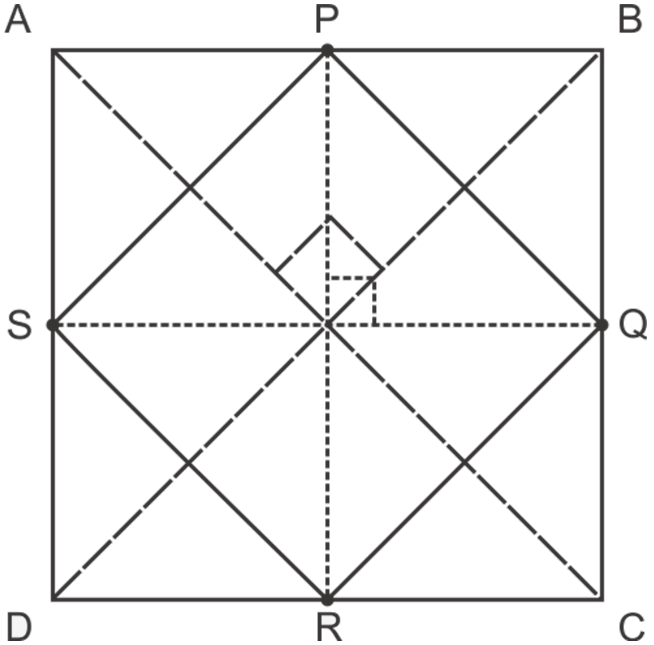
$PS \| QR, PQ \| SR ...(1)$
Because lines joining the mid $-$ points of any two sides of a triangle are parallel to the third side
$\text{AC } \bot \text{ BD} ,\text{BR } \bot \text{ QS}\ ($From Figure$)$
$SR \| AC$ and $QR \| BD$
$\text{AC } \bot \text{ BD}$
$\Rightarrow \text{SR }\bot \text{ QR}$
Hence $\angle\text{SRQ}=90^\circ\ ...(2)$
Also $\triangle\text{APS}\cong\triangle\text{DSR}$
$\Rightarrow\text{PS} = \text{SR}\dots(3)$
From equations $(1), (2), (3)$
$\text{PQRS}$ is a square. View full question & answer→MCQ 181 Mark
The figure formed by joining the mid $-$ points of the adjacent sides of a rhombus is a:
Answer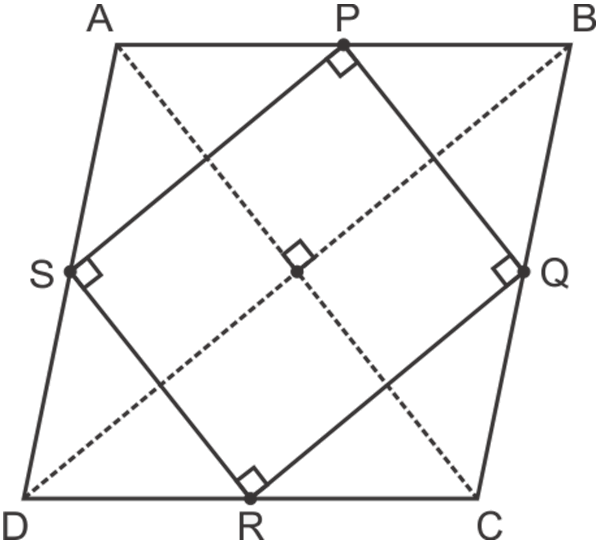
In $\triangle\text{ABD}$ and $\triangle\text{CBD}$
$PS \| BD $ and $QR \| BD$
A line joining mid $-$ points of two sides of triangle is parallel to third side
$\Rightarrow PS \| QR$
Similiarly $PQ \| SR$
Because $SR \| A$C and $QR \| BD,$
And angle between the diagonals of a Rhombus $AC$ and $BD =90^\circ, $
Angle between $SR$ and $QR = 90^\circ$
$\Rightarrow \text{PQRS}$ is a rectangle. View full question & answer→MCQ 191 Mark
In a quadrilateral $\text{ABCD}, \angle\text{A}+\angle\text{C}$ is $2$ times $\angle\text{B}+\angle\text{D}$ If $\angle\text{A}=140^\circ$ and $\angle\text{D}=60^\circ$ then $\angle\text{B}=$
- ✓
$60^\circ$
- B
$80^\circ$
- C
$120^\circ$
- D
AnswerCorrect option: A. $60^\circ$
$\angle\text{A}+\angle\text{B}+\angle\text{C}+\angle\text{D}=360^\circ\dots(1)$
Now, $\angle\text{A}+\angle\text{C}=2(\angle\text{B}+\angle\text{D}) \ ($given$) ...(2)$
Also, $\angle\text{A}=140^\circ,\ \angle\text{D}=60^\circ$
Putting value of $(\angle\text{A}+\angle\text{C})$ from eq. $(2)$ in eq. $(1)$
$2(\angle\text{B}+\angle\text{D})+\angle\text{B}+\angle\text{D}=360^\circ$
$3(\angle\text{B}+\angle\text{D})=360^\circ$
$\Rightarrow\angle\text{B}+\angle\text{D}=120^\circ$
$\Rightarrow\angle\text{B}+60^\circ=120^\circ$
$\Rightarrow\angle\text{B}=60^\circ$
View full question & answer→MCQ 201 Mark
The bisectors of the angle of a parallelogram enclose a:
Answer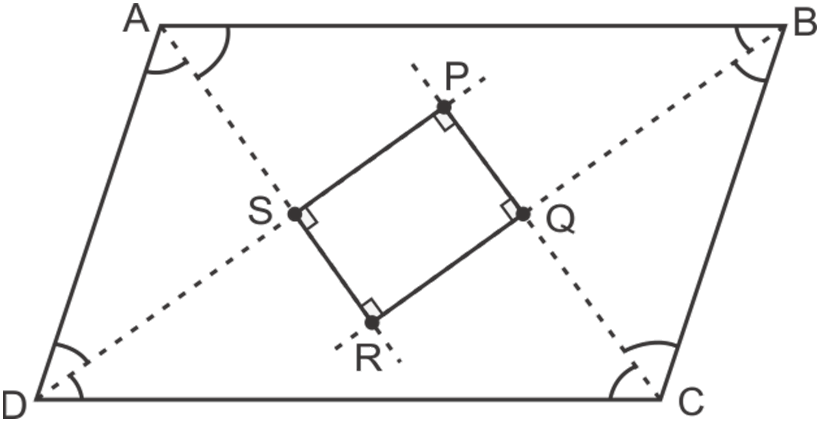
$AR, BR, CP, DP$ are the bisectors of angles of parallelogram.
Because two bisectors of adjacent angles make $90^\circ$ between them
So $\text{PQRS}$ is a Rectangle
Because $DP$ and $BR$ are acute angle bisectors so the distance between them $PQ < PS $
$($The distance between other two bisectors$)$
So $\text{PQ}\neq\text{PS} ($So $\text{PQRS}$ is not a square, but only a rectangle$)$ View full question & answer→MCQ 211 Mark
In $\triangle\text{ABC},\angle\text{A}=30^\circ,\angle\text{B}=40^\circ $ and $\angle\text{C}=110^\circ.$ The angles of the triangle formed by joining the mid $-$ points of the sides of this triangle are:
- A
$70^\circ , 70^\circ , 40^\circ$
- B
$60^\circ , 40^\circ , 80^\circ$
- ✓
$30^\circ , 40^\circ , 110^\circ$
- D
$60^\circ , 70^\circ , 50^\circ$
AnswerCorrect option: C. $30^\circ , 40^\circ , 110^\circ$
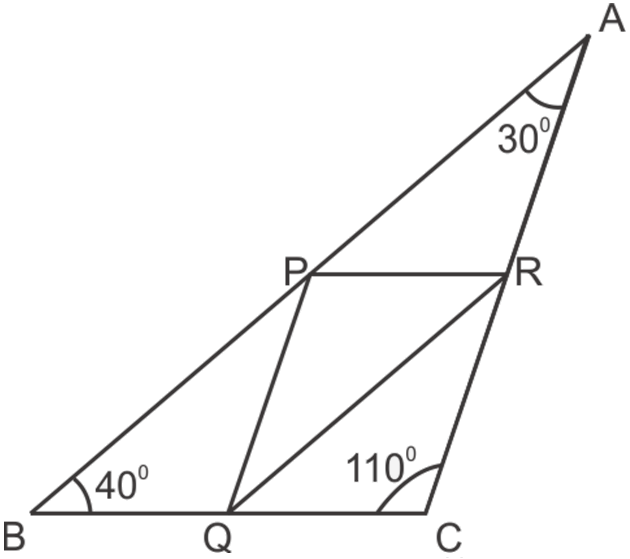
If in any triangle, all the mid $-$ points $($of each sides$)$ are joined to form a triangle,
then that triangle is similian to a parent triangle.
i.e.$\triangle\text{QPR}\sim\triangle\text{ABC}$
So angles of $\triangle\text{PQR}$ will be same as angles of $\triangle\text{ABC}.$
Thus, angles are $30^\circ , 40^\circ , 110^\circ$ View full question & answer→MCQ 221 Mark
$\text{ABCD}$ is a parallelogram and $E$ and $F$ are the centroids of triangles $\text{ABD}$ and $\text{BCD}$ respectively, then $EF =$
Answer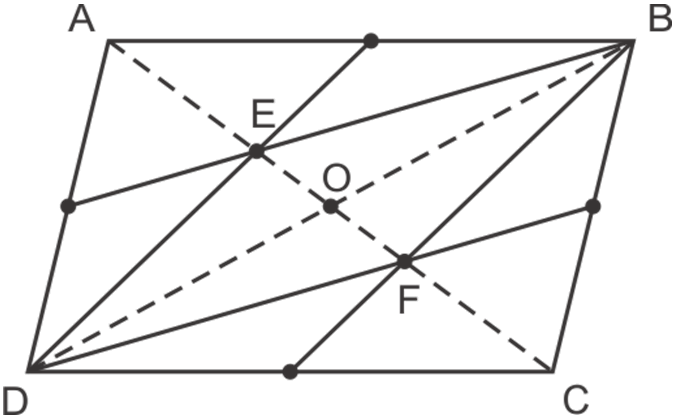
Centroid is the point where all medians of a meet.
In $\triangle\text{ABD}, E$ is the centroid,
And in $\triangle\text{BCD}, F$ is the centroid.
By the property of centroid, centroid divides a median in $2 : 1$
So from figure,
$\frac{\text{AE}}{\text{EO}}=\frac{2}{1}\Rightarrow\text{EO}=\frac{\text{AE}}{2}\ ...(1)$
Also $\frac{\text{CF}}{\text{FO}}=\frac{2}{1}\Rightarrow\text{FO}=\frac{\text{CF}}{2}\ ...(2)$
Because $AC$ is a digonal of a parallelogram, $O$ is its midpoint.
$\Rightarrow OA = OC$
$\Rightarrow AE = CF$
Adding equations $(1) (2),$
$\text{EO + FO} =\frac{\text{AE}+\text{CF}}{2}=\frac{\not2\text{AE}}{\not2}$
$\Rightarrow\text{EF}=\frac{\not2\text{AE}}{\not2}$
$\Rightarrow\text{EF}=\text{AE}$ View full question & answer→MCQ 231 Mark
The opposite sides of a quadrilateral have:
- ✓
- B
- C
- D
Infiniely many common points.
Answer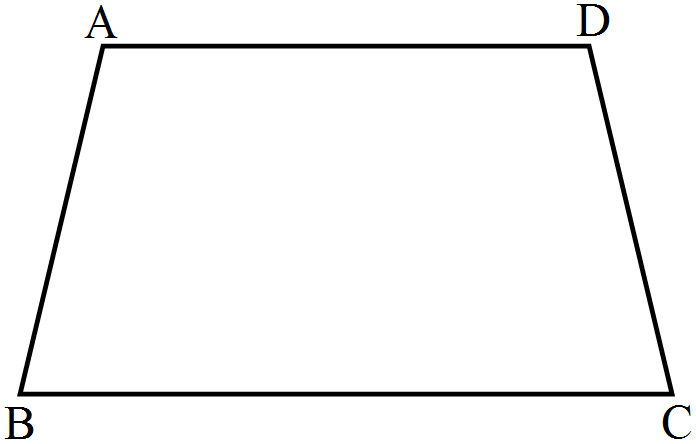
$\text{ABCD}$ is a Quadrilateral.
The opposite sides $AB$ and $DC, AD$ and $BC$ have no common point. View full question & answer→MCQ 241 Mark
If the diagonals of a rhombus of a rhombus are $18\ cm$ and $24\ cm$ respectively, then its side is equal to:
- A
$16\ cm.$
- ✓
$15\ cm.$
- C
$20\ cm.$
- D
$17\ cm.$
AnswerCorrect option: B. $15\ cm.$
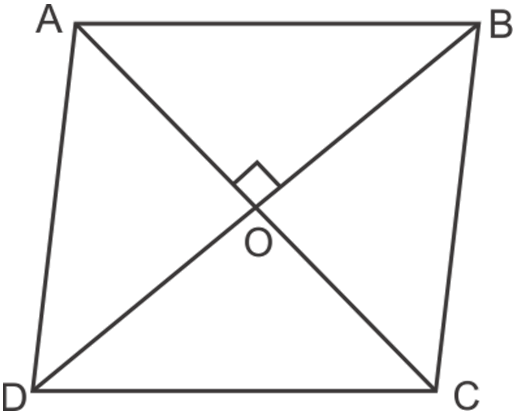
Let $BD = 24\ cm $ and $AC = 18\ cm \ ($Given$)$
Now, $\frac{\text{AC}}{2}=\frac{18}{2}=9\text{ cm}$ and $\text{BO}=\frac{\text{BD}}{2}=\frac{24}{2}=12\text{ cm}$
Now, $\text{AB}=\sqrt{(\text{AO})^2+(\text{BO})^2}\ ($Diagonals make $90^\circ$ between them$)$
$=\sqrt{9^2+12^2}$
$=\sqrt{81+144}$
$=\sqrt{225}$
$\text{AB}=15\text{ cm}$ View full question & answer→MCQ 251 Mark
Diagonals of a quadrilateral $\text{ABCD}$ bisect each other. If $\angle\text{A}=45^\circ,$ then $\angle\text{B}=$
- A
$115^\circ$
- B
$120^\circ$
- C
$125^\circ$
- ✓
$135^\circ$
AnswerCorrect option: D. $135^\circ$
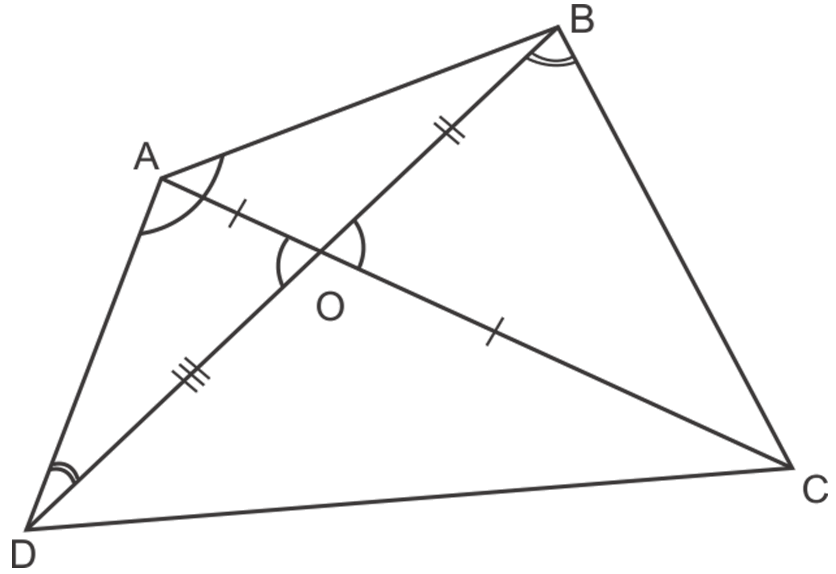
Consider $\triangle\text{AOD}\ \ \ \triangle\text{COB},$
$AO = CO ($Diagonals bisects each other$)$
$OD = OB ($Diagonals bisects each other$)$
$\angle\text{AOD}=\angle\text{COB} ($Opposite angles$)$
So by $\text{SAS}$ property, $\triangle\text{AOD}\cong\triangle\text{COB},$
$\Rightarrow\angle\text{ADO}=\angle\text{CBO}\dots(1)$
$\angle\text{ABD}=180^\circ-\angle\text{A}-\angle\text{ADO}$
$($in $\triangle\text{ADB})$
$=180^\circ-45^\circ-\angle\text{ADO}$
$\angle\text{ABD}=135^\circ-\angle\text{ADO}\dots(2)$
$\angle\text{B}=\angle\text{ABD}+\angle\text{CBO}$
Putting values From eq $(1)$ and $(2)$
$\angle\text{B}=135^\circ-\angle\text{ADO}+\angle\text{ADO}$
$\angle\text{B}=135^\circ$ View full question & answer→MCQ 261 Mark
$\text{ABCD}$ is a parallelogram, $M$ is the mid $-$ point of $BD$ and $BM$ bisects $\angle\text{B}.$ Then, $\angle\text{AMB}=$
- A
$45^\circ$
- B
$60^\circ$
- ✓
$90^\circ$
- D
$75^\circ$
AnswerCorrect option: C. $90^\circ$
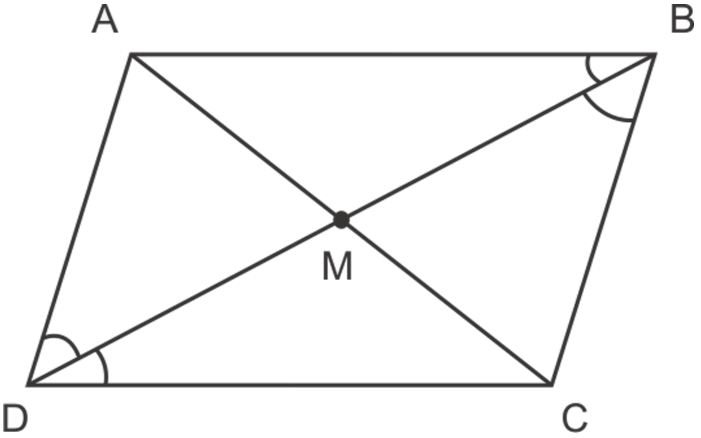
$\angle\text{ABM}=\angle\text{CBM}\ ...(1)$
$(BM$ bisects $\angle\text{B})$
$\angle\text{ABM}=\angle\text{MDC}\ ...(2) ($Alternate angles$)$
$\angle\text{CBM}=\angle\text{ADM}\ ...(3) ($Alternate angles$)$
From equations $(1), (2) (3)$
$\angle\text{MDC}=\angle\text{ADM}...(4)$
Now, consider $\triangle\text{ABM}$
$\triangle\text{CBD}$
$\angle\text{CBD}=\angle\text{ABD} [$ from eq $(1)]$
$DB = DB ($Common$)$
$\angle\text{ADB}=\angle\text{CDB} [$from eq $(4)]$
Hence, by $\text{ASA}$ property,
$\triangle\text{ADB}\cong\triangle\text{CBD}$
$\Rightarrow AB = CB, AD = CD$
Hence, it becomes a Rhombus.
So now diagonals of a Rhombus bisect each other at $90^\circ .$
$\Rightarrow\angle\text{AMB}=90^\circ$ View full question & answer→MCQ 271 Mark
If the degree measures of the angles of quadrilateral are $4x, 7x, 9x$ and $10,$ what is the sum of the measures of the smallest angle and largest angle?
- A
$140^\circ$
- B
$150^\circ$
- ✓
$168^\circ$
- D
$180^\circ$
AnswerCorrect option: C. $168^\circ$
Sum of all angles of a Quadrilateral $= 360^\circ$
$4x + 7x + 9x + 10x = 360^\circ$
$30x = 360^\circ$
$x = 12^\circ$
So, sum of smallest and largest angle,
i.e. $4x + 10x = 14x $
$= 14 \times 12 = 168^\circ$
View full question & answer→MCQ 281 Mark
$\text{ABCD}$ is a trpezium in which $AB \| DC. M$ and $N$ are then mid $-$ points of $AD$ and $BC$ respectively. If $AB = 12\ cm, MN = 14\ cm$, then $CD =$
- A
$10\ cm.$
- B
$12\ cm.$
- C
$14\ cm.$
- ✓
$16\ cm.$
AnswerCorrect option: D. $16\ cm.$
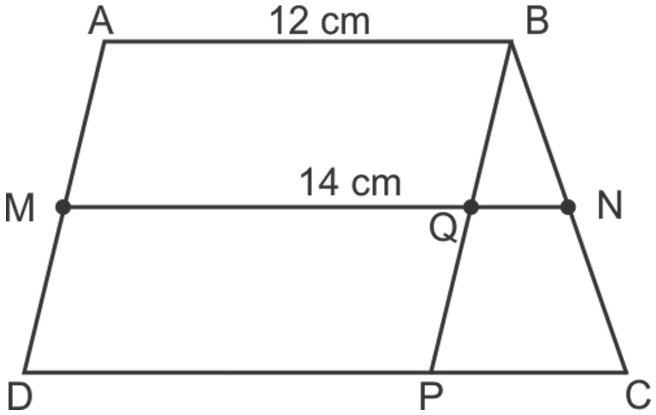
Let a line $BP$ is drawn $\|$ to $AD$ to meet $DC$ at $P$.
$\text{ABPD}$ is a parallelogram.
$AB \| PD, AD \| BP$
So $AB = DP$
Let $BP$ cuts $MN$ at $Q$.
$MQ$ is also $\|$ to $AB \| PD$
So $AB = MQ = PD = 12\ cm ...(1)$
$QN = MN - MQ = 14 - 12 = 2\ cm$
Consider $\triangle\text{BPC}.$
$Q$ and $N$ are the mid $-$ points of $BP , BC,$ and the line joining them $QN \| PC$.
Then by property, $\frac{\text{QN}}{\text{PC}}=\frac{1}{2}$
$\Rightarrow PC = 2QN = 2 \times 2 = 4\ cm$
Now b$, DC = DP + PC$
$DP = 12\ cm [$From $(1)]$
$\Rightarrow DC = 12 + 4 = 16\ cm$ View full question & answer→MCQ 291 Mark
$\text{ABCD}$ is a parallelogram in which diagonal $AC$ bisects $\angle\text{BAD}.$ if $\angle\text{BAC}=35^\circ,$ then $\angle\text{ABC}=$
- A
$70^\circ$
- ✓
$110^\circ$
- C
$90^\circ$
- D
$120^\circ$
AnswerCorrect option: B. $110^\circ$
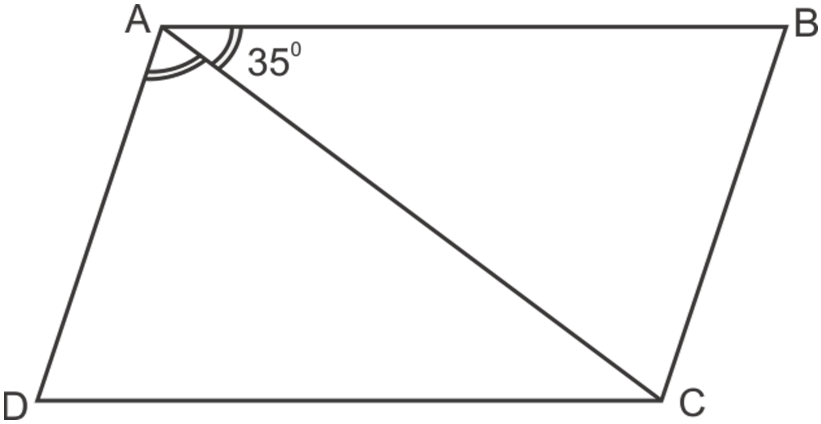
$AC$ bisects $\angle\text{DAB}.$
$\Rightarrow\angle\text{DAC}=\angle\text{BAC}=35^\circ$
$\Rightarrow\angle\text{BAD}=2\times35^\circ=70^\circ$
$\angle\text{A}+\angle\text{B}=180^\circ \ ($Sum of any two adjacent angles in parallelogram $=180^\circ )$
$\Rightarrow\angle\text{B}=\angle\text{ABC}=180^\circ-\angle\text{BAD}$
$=180^\circ-70^\circ=110^\circ$ View full question & answer→MCQ 301 Mark
$\text{PQRS}$ is a quadrilateral. $PR$ and $QS$ intersect each other at $O$. in which of the following cases, $\text{PQRS}$ is a parallelogram?
- ✓
$\angle\text{P}=100^\circ,\angle\text{Q}=80^\circ,\angle\text{R}=100^\circ$
- B
$\angle\text{P}=85^\circ,\angle\text{Q}=85^\circ,\angle\text{R}=95^\circ$
- C
$\text{PQ}=7\text{ cm},\text{QR}=7\text{ cm},\text{RS}=8\text{ cm},\text{SP}=8\text{ cm}$
- D
$\text{OP}=6.5\text{ cm},\text{OQ}=6.5\text{ cm},\text{OR}=5.2\text{ cm},\text{OS}=5.2\text{ cm}$
AnswerCorrect option: A. $\angle\text{P}=100^\circ,\angle\text{Q}=80^\circ,\angle\text{R}=100^\circ$
In a parallelogram, opposite corner angles are equal and sum of adjacent angles $= 108^\circ$
Hence, in quadrrilateral $\text{PQRS},$
$\Rightarrow\angle\text{P}=\angle\text{R}$ and $\angle\text{Q}=\angle\text{S}$
Also, $\angle\text{P}+\angle\text{Q}=\angle\text{Q}+\text{R}=180^\circ$
Hence, if $\angle\text{P}=100^\circ$ and $\angle\text{Q}=80^\circ,$ then
$\angle\text{P}+\angle\text{Q}=100^\circ+80^\circ=180^\circ$
Also, if $\angle\text{Q}+=80^\circ$ and $\angle\text{R}=100^\circ$ then
$\angle\text{Q}+\angle\text{R}=80^\circ+100^\circ=180^\circ$
View full question & answer→MCQ 311 Mark
The diagonals of a parallelogram $\text{ABCD}$ intersect at $O$. if $\angle\text{BOC}=90^\circ$ and $\angle\text{BDC}=50^\circ,$ then $\angle\text{AOB}=$
- ✓
$40^\circ$
- B
$50^\circ$
- C
$10^\circ$
- D
$90^\circ$
AnswerCorrect option: A. $40^\circ$
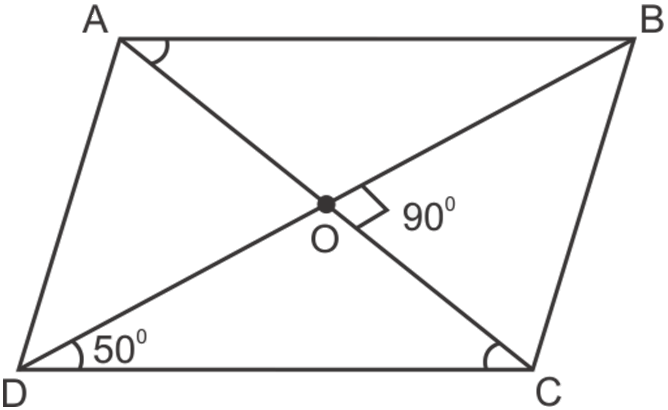
In a parallelogram $\text{ABCD},$
$\angle\text{OAB}=\angle\text{OCB}$
In $\triangle\text{OCB}$
$\angle\text{OCD}+\angle\text{COD}+\angle\text{ODC}=180^\circ$
$\angle\text{COD}=90^\circ$
$\angle\text{ODC}=50^\circ \ ($given$)$
$\angle\text{OCD}=180^\circ-90^\circ-50^\circ=40^\circ$
$\Rightarrow\angle\text{OAB}=\angle\text{OCD}=40^\circ$ View full question & answer→MCQ 321 Mark
The two digonals are equal in a:
AnswerThe two diagonals are equal in a rectangle $($property$).$
View full question & answer→