Questions

4 Mark Question

Take a timed test

17 questions · self-marked practice — reveal the answer and mark yourself.

Question 14 Marks
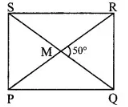
Diagonals of a rectangle PQRS are intersecting in point M. If ∠QMR = 50°, then find the measure of ∠MPS.
Answer
Image
□PQRS is a rectangle.
$\therefore P M=\frac{1}{2} P R \ldots(i)$
$MS =\frac{1}{2} QS$. ..(ii) [Diagonals of a rectangle bisect each other]
Also, PR = QS …..(iii) [Diagonals of a rectangle are congruent]
∴ PM = MS ….(iv) [From (i), (ii) and (iii)]
In ∆PMS,
PM = MS [From (iv)]
∴ ∠MSP = ∠MPS = x° …..(v) [Isosceles triangle theorem]
∠PMS = ∠QMR = 50° ……(vi) [Vertically opposite angles]
In ∆MPS,
∠PMS + ∠MPS + ∠MSP = 180° [Sum of the measures of the angles of a triangle is 180°]
∴ 50° +x + x = 180° [From (v) and (vi)]
∴ 50° + 2x= 180
∴ 2x= 180-50
∴ 2x= 130
$\therefore x=\frac{130}{2}=65^{\circ}$
$\therefore \angle M P S=65^{\circ}[\text { From }(v)]$
View full question & answer
Question 24 Marks
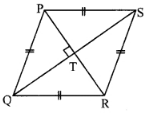
Diagonals $PR$ and $QS$ of a rhombus $\text PQRS$ are $20\ cm$ and $48\ cm$ respectively. Find the length of side $PQ$.
Answer

Image

$\square P Q R S$ is a rhombus. [Given]
$PR =20 cm$ and $QS =48 cm$ [Given]
$\therefore PT =\frac{1}{2} PR$ [Diagonals of a rhombus bisect each other]
$=\frac{1}{2} \times 20=10\ cm$
Also, QT $=\frac{1}{2}$ QS [Diagonals of a rhombus bisect each other] $=\frac{1}{2} \times 48=24 cm$
ii. In $\triangle PQT , \angle PTQ =90^{\circ}$ [Diagonals of a rhombus are perpendicular to each other]
$\therefore PQ ^2= PT ^2+ QT ^2$ [Pythagoras- theorem]
$=10^2+24^2$
$=100+576$
$\therefore PQ ^2=676$
$\therefore P Q=\sqrt{676}$ [Taking square root of both sides]
$=26\ cm$
$\therefore$ The length of side $PQ$ is $26\ cm$ .
View full question & answer
Question 34 Marks
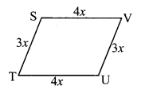
Ratio of two adjacent sides of a parallelogram is 3 : 4, and its perimeter is 112 cm. Find the length of its each side.
Answer

Image
Let □STUV be the parallelogram.
Ratio of two adjacent sides of a parallelogram is 3 : 4.
Let the common multiple be x.
ST = 3x cm and TU = 4x cm
∴ ST = UV = 3x cm
TU = SV = 4x cm …..(i) [Opposite sides of a parallelogram]
Perimeter of □STUV = 112 [Given]
∴ ST + TU + UV + SV = 112
∴ 3x + 4x + 3x + 4x = 112 [From (i)]
∴ 14x = 112
$\therefore x=\frac{112}{14}$
∴ x = 8
∴ ST = UV = 3x = 3 x 8 = 24 cm
∴ TU = SV = 4x = 4 x 8 = 32 cm [From (i)]
∴ The lengths of the sides of the parallelogram are 24 cm, 32 cm, 24 cm and 32 cm.
View full question & answer
Question 44 Marks
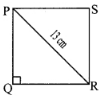
If diagonal of a square is $13\ cm$, then find its side.
Answer

Image

Let $□PQRS$ be the square of side $x\ cm$.
$\therefore PQ = QR = x cm$ …..(i) [Sides of a square]
$\therefore In \triangle PQR, \angle Q = 90^\circ$ [Angle of a square]
$\therefore PR^2 = PQ^2 + QR​​​​​​​^2$​​​​​​​ [Pythagoras theorem]
$\therefore 13 = x + x$ [From (i)]
$\therefore 169 = 2x^2$​​​​​​​
$\begin{aligned} \therefore \quad x^2 & =\frac{169}{2} \\ \therefore \quad x & =\sqrt{\frac{169}{2}} \quad \text { [Taking square root of both sides] } \\ \therefore \quad x & =\frac{13}{\sqrt{2}} \\ & =\frac{13}{\sqrt{2}} \times \frac{\sqrt{2}}{\sqrt{2}} \quad \text { [Multiplying the numerator and denominator by } \sqrt{2} \text { ] } \\ & =\frac{13 \sqrt{2}}{2}=6.5 \sqrt{2} cm \end{aligned}$
The length of the side of the square is $6.5√2\ cm.$​​​​​​​
 
View full question & answer
Question 54 Marks
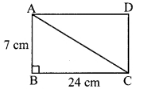
Adjacent sides of a rectangle are $7\ cm$ and $24\ cm$. Find the length of its diagonal.
Answer

Image

Let $\square A B C D$ be the rectangle.
$AB=7 cm, BC=24 cm$
In $\triangle A B C, \angle B=90^{\circ}$ [Angle of a rectangle]
$A C^2=A B^2+B C^2$ [Pythagoras theorem]
$=7^2+24^2$
$=49+576$
$=625$
AC $=\sqrt{ } 625$ [Taking square root of both sides]
$=25 cm$
$\therefore$ The length of the diagonal of the rectangle is $25\ cm .$
View full question & answer
Question 64 Marks
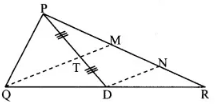
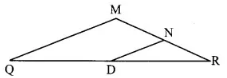
In the adjoining figure, seg $PD$ is a median of $\triangle P Q R$. Point $T$ is the midpoint of seg PD. Produced QT intersects PR at M. Show that $\frac{P M}{P R}=\frac{1}{3}$. [Hint: Draw DN $\| QM$ ]

Image

Answer
Given: seg PD is a median of ∆PQR. Point T is the midpoint of seg PD.
To Prove: $\frac{P M}{P R}=\frac{1}{3}$
Construction: Draw seg DN ||seg QM such that P-M-N and M-N-R.
Proof:
In ∆PDN,
Point T is the midpoint of seg PD and seg TM || seg DN [Given]
∴ Point M is the midpoint of seg PN. [Construction and Q-T-M]
∴ PM = MN [Converse of midpoint theorem]
In ∆QMR,
Point D is the midpoint of seg QR and seg DN || seg QM [Construction]

Image
∴ Point N is the midpoint of seg MR. [Converse of midpoint theorem]
∴ RN = MN …..(ii)
∴ PM = MN = RN …..(iii) [From (i) and (ii)]
Now, PR = PM + MN + RN [ P-M-R-Q-T-M]
∴ PR = PM + PM + PM [From (iii) ]
∴ PR = 3PM
$\frac{P M}{P R}=\frac{1}{3}$

View full question & answer
Question 74 Marks
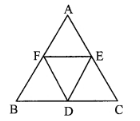
In the adjoining figure, ∆ABC is an equilateral triangle. Points F, D and E are midpoints of side AB, side BC, side AC respectively. Show that ∆FED is an equilateral triangle.

Image
Given: ∆ABC is an equilateral triangle.
Points F, D and E are midpoints of side AB, side BC, side AC respectively.
To prove: ∆FED is an equilateral triangle.

Answer
Proof:
∆ABC is an equilateral triangle. [Given]
∴ AB = BC = AC ….(i) [Sides of an equilateral triangle]
Points F, D and E are midpoints of side AB and BC respectively.
$
\therefore FD =\frac{1}{2} AC \ldots \text {...(ii) [Midpoint theorem] }
$
Points $D$ and $E$ are the midpoints of sides $B C$ and $A C$ respectively.
$
\therefore DE =\frac{1}{2} AB \text {....(iii) [Midpoint theorem] }
$
Points $F$ and $E$ are the midpoints of sides $A B$ and $A C$ respectively.
$
\therefore F E=\frac{1}{2} BC
$
$\therefore FD = DE = FE [$ [From (i), (ii), (iii) and (iv) ]
$\therefore \triangle FED$ is an equilateral triangle.
View full question & answer
Question 84 Marks
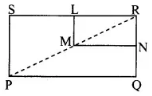
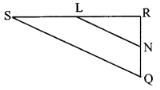
In the adjoining figure, □PQRS and □MNRL are rectangles. If point M is the midpoint of side PR, then prove that,
i. SL = LR
ii. $LN =\frac{1}{2} S Q$.

Image
Given: □PQRS and □MNRL are rectangles. M is the midpoint of side PR.

Answer
Proof:
i. □PQRS and □MNRL are rectangles. [Given]
∴ ∠S = ∠L = 90° [Angles of rectangles]
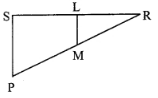
∠S and ∠L form a pair of corresponding angles on sides SP and LM when SR is their transversal.

Image

∴eg ML || seg PS …(i) [Corresponding angles test]
In ∆PRS,
Point M is the midpoint of PR and seg ML || seg PS. [Given] [From (i)]
∴ Point L is the midpoint of seg SR. ……(ii) [Converse of midpoint theorem]
∴ SL = LR

ii. Similarly for ∆PRQ, we can prove that,

Image
Point N is the midpoint of seg QR. ….(iii)
In ∆RSQ,
Points L and N are the midpoints of seg SR and seg QR respectively. [From (ii) and (iii)]
$\therefore LN =\frac{1}{2} SQ$ [Midpoint theorem]

View full question & answer
Question 94 Marks
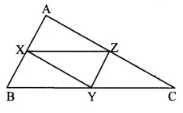
In the adjoining figure, points X, Y, Z are the midpoints of of ∆ABC respectively, cm. Find the lengths of side AB, side BC and side AC AB = 5 cm, AC = 9 cm and BC = 11c.m. Find the lengths of XY, YZ, XZ.

Image

Answer
i. $A C=9 cm$ [Given]
Points $X$ and $Y$ are the midpoints of sides $A B$ and $B C$ respectively. [Given] $\therefore X Y=\frac{1}{2} A C$ [Midpoint tfyeprem] $=\frac{1}{2} \times 9=4.5 cm$
ii. $A B=5 cm$ [Given]
Points $Y$ and $Z$ are the midpoints of sides $B C$ and $A C$ respectively. [Given] $\therefore Y Z=\frac{1}{2} A B$ [Midpoint theorem] $=\frac{1}{2} \times 5=2.5 cm$
iii. $BC =11 cm$ [Given]
Points $X$ and $Z$ are the midpoints of sides $A B$ and $A C$ respectively. [Given] $\therefore XZ =\frac{1}{2} BC$ [Midpoint theorem] $=\frac{1}{2} \times 11=5.5 cm$
$I ( XY )=4.5 cm , I (Y Z)=2.5 cm , I ( XZ )=5.5 cm$
View full question & answer
Question 104 Marks
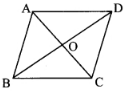
Diagonals of a rhombus are $20\ cm$ and $21\ cm$ respectively, then find the side of rhombus and its Perimeter.
Answer

Image

i. Let $□ABCD$ be the rhombus.
$AC = 20\ cm, BD = 21\ cm$
$AQ  =\frac{1}{2} AC \quad$
$\text { [Diagonals of a rhombus bisect }$
$\text { each other] }$
$ =\frac{1}{2} \times 20=10 cm \quad \text { (i) }$
Also, $BO =\frac{1}{2} BD \quad$ [Diagonals of a rhombus bisect each other]
$=\frac{1}{2} \times 21=\frac{21}{2} cm$
ii. In $\triangle AOB, \angle AOB = 90^\circ$ [Diagonals of a rhombus are prependicular to each other]
$\therefore AB^2 = AO^2 + BO^2$​​​​​​​ [Pythagoras theorem]
$=(10)^2+\left(\frac{21}{2}\right)^2 \quad \text { [From (i) and (ii)] }$
$ =100+\frac{441}{4}$
$ =\frac{400+441}{4}$
$\therefore \quad AB ^2  =\frac{841}{4}$
$\therefore \quad AB  =\sqrt{\frac{841}{4}} \quad[\text { Taking square root of both sides] }$
$ =\frac{29}{2}=14.5 cm$
iii. Perimeter of $□ABCD$
$= 4 x AB = 4 x 14.5 = 58\ cm$
$\therefore$ The side and perimeter of the rhombus are $14.5\ cm$ and $58\ cm$ respectively.
View full question & answer
Question 114 Marks
Diagonals of a square IJKL intersects at point M. Find the measures of ∠IMJ, ∠JIK and ∠LJK.
Answer

Image
□IJKL is a square. [Given]
∴ seg IK ⊥ seg JL [Diagonals of a square are perpendicular to each other]
∠ IMJ=90°
∠ JIL 90° ……. (i) [Angle of a square]
ii. $\angle J K=\frac{1}{2} \angle J L$ [Diagonals of a square bisect the opposite angles] $\angle JKK =\frac{1}{2}\left(90^{\circ}\right)$ [From (i)
$\therefore \angle JK =45^{\circ}$
$\angle JK =90^{\circ}$ (ii) [Angle of a square]
iii. $\angle L J K=\frac{1}{2} \angle I J K$ [Diagonals of a square bisect the opposite angles] $\angle LJK =\frac{1}{2}\left(90^{\circ}\right)$ [From (ii)]
$\therefore \angle L J K=45^{\circ}$
$\therefore \angle L J K=90^{\circ}, \angle J K K=45^{\circ}, \angle LJK =45^{\circ}$
View full question & answer
Question 124 Marks
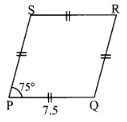
In a rhombus PQRS, if PQ = 7.5 cm, then find QR. If ∠QPS 75°, then find the measures of ∠PQR and ∠SRQ.
Answer

Image

i. PQ = 7.5 cm [Given]
□PQRS is a rhombus. [Given]
∴ QR = PQ [Sides of a rhombus are congruent]
∴ QR = 7.5 cm

ii. ∠QPS = 75° [Given]
∠QPS + ∠PQR = 180° [Adjacent angles of a rhombus are supplementary]
∴ 75° + ∠PQR = 180°
∴ ∠PQR = 180° – 75°
∴ ∠PQR =105°

iii. ∠SRQ = ∠QPS [Opposite angles of a rhombus]
∴ ∠SRQ = 75°
∴ QR = 7.5 cm, ∠PQR = 105°,
∠SRQ = 75°

View full question & answer
Question 134 Marks
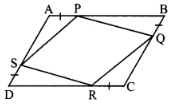
In the adjoining figure, if points P, Q, R, S are on the sides of parallelogram such that AP = BQ = CR = DS, then prove that □PQRS is a parallelogram.

Image
Given: □ABCD is a parallelogram.
AP = BQ = CR = DS
To prove: □PQRS is a parallelogram.

Answer
Proof:
□ABCD is a parallelogram. [Given]
∴ ∠B = ∠D ….(i) [Opposite angles of a parallelogram]
Also, AB = CD [Opposite sides of a parallelogram]
∴ AP + BP = DR + CR [A-P-B, D-R-C]
∴ AP + BP = DR + AP [AP = CR]
∴ BP = DR ….(ii)
In APBQ and ARDS,
seg BP ≅ seg DR [From (ii)]
∠PBQ ≅ ∠RDS [From (i)]
seg BQ ≅ seg DS [Given]
∴ ∆PBQ ≅ ∆RDS [SAS test]
∴ seg PQ ≅ seg RS …..(iii) [c.s.c.t]
Similarly, we can prove that
∆PAS ≅ ∆RCQ
∴ seg PS ≅ seg RQ ….(iv) [c.s.c.t]
From (iii) and (iv),
□PQRS is a parallelogram. [A quadrilateral is a parallelogram, if pairs of its opposite angles are congruent]
View full question & answer
Question 144 Marks
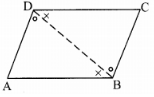
In the above theorem, to prove ∠DAB ≅ ∠BCD, is any change in the construction needed? If so, how will you write the proof making the change?

Image

Answer
Yes
Construction: Draw diagonal BD.
Proof:
side AB || side CD and diagonal BD is their transversal. [Given]
∴ ∠ABD ≅ ∠CDB ……..(i) [Alternate angles]
side BC || side AD and diagonal BD is their transversal. [Given]
∴ ∠ADB ≅ ∠CBD ……..(ii) [Alternate angles]
In ∆DAB and ∆BCD,
∠ABD ≅ ∠CDB [From (i)]
seg BD ≅ seg DB [Common side]
∴ ∠ADB ≅ ∠CBD [From (ii)]
∴ ∆DAB ≅ ∆BCD [ASA test]
∴ ∠DAB ≅ ∠BCD [c.a.c.t.]
Note: ∠DAB s ∠BCD can be proved using the same construction as in the above theorem.
∠BAC ≅ ∠DCA …..(i)
∠DAC ≅ ∠BCA ……(ii)
∴ ∠BAC + ∠DAC ≅ ∠DCA + ∠BCA [Adding (i) and (ii)]
∴ ∠DAB ≅ ∠BCD [Angle addition property]
View full question & answer
Question 154 Marks
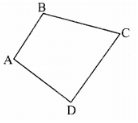
Write the following pairs considering □ABCD.
Image
Answer
Pairs of adjacent sides:
i. AB, AD
ii. AD, DC
iii. DC, BC
iv. BC, AB

Pairs of adjacent angles:
i. ∠A, ∠B
ii. ∠C, ∠D
iii. ∠B, ∠C
iv. ∠D, ∠A

Pairs of opposite sides:
i. AB, DC
ii. AD, BC

Pairs of opposite angles:
i. ∠A, ∠C
ii. ∠B, ∠D

View full question & answer
Question 164 Marks
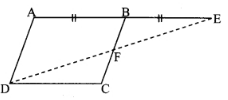
In the adjoining figure, □ABCD is a parallelogram. Point E is on the ray AB such that BE = AB, then prove that line ED bisects seg BC at point F.

Image
Given: □ABCD is a parallelogram.
BE = AB
To prove: Line ED bisects seg BC at point F i.e. FC = FB

Answer
Proof:
□ABCD is a parallelogram. [Given]
∴ seg AB ≅ seg DC …….(i) [Opposite angles of a parallelogram]
seg AB ≅ seg BE ……..(ii) [Given]
seg DC ≅ seg BE ……..(iii) [From (i) and (ii)]
side DC || side AB [Opposite sides of a parallelogram]
i.e. side DC || seg AE and seg DE is their transversal. [A-B-E]
∴ ∠CDE ≅ ∠AED
∴ ∠CDF ≅ ∠BEF …..(iv) [D-F-E, A-B-E]
In ∆DFC and ∆EFB,
seg DC = seg EB [From (iii)]
∠CDF ≅ ∠BEF [From (iv)]
∠DFC ≅ ∠EFB [Vertically opposite angles]
∴ ∆DFC ≅ ∆EFB [SAA test]
∴ FC ≅ FB [c.s.c.t]
∴ Line ED bisects seg BC at point F.
View full question & answer
Question 174 Marks
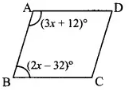
In a parallelogram ABCD, if ∠A = (3x + 12)°, ∠B = (2x – 32)°, then liptl the value of x and the measures of ∠C and ∠D.
Answer

Image
□ABCD is a parallelogram. [Given]
∴ ∠A + ∠B = 180° [Adjacent angles of a parallelogram are supplementary],
∴ (3x + 12)° + (2x-32)° = 180°
∴ 3x + 12 + 2x – 32 = 180
∴ 5x – 20 = 180
∴ 5x= 180 + 20
$\therefore 5 x=200$
$\therefore x=\frac{200}{5}$
$\therefore x=40$
ii. ∠A = (3x + 12)°
= [3(40) + 12]°
=(120 +12)°= 132°
∠B = (2x – 32)°
= [2(40) – 32]°
= (80 – 32)° = 48°
∴ ∠C = ∠A = 132°
∠D = ∠B = 48° [Opposite angles of a parallelogram]
∴ The value of x is 40, and the measures of ∠C and ∠D are 132° and 48° respectively.
View full question & answer